Lambrini Loumbourdi is a Senior Lecturer in Teaching English as a Foreign Language (TEFL) at the English Department of Justus Liebig University Giessen . She specializes in inclusion, teacher professionalization, and assessment in primary and secondary English education. Education: MA in TEFL/TESL (University of Birmingham, 2000), PhD (Goethe University Frankfurt, completed 2014) Key Roles: Supervising teacher practicums, conducting seminars on inclusion, and leading research on standardized testing impacts Her research focuses on inclusive educational practices for students with Special Educational Needs (SEN), the washback effect of standardized exams on pedagogy, and task-based language teaching . She has developed assessment frameworks through the PEAK1 project and collaborates with international academic networks (DGFF, EALTA). Recent publications analyze inclusive teacher mindsets, speaking assessment in primary schools, and standardized testing impacts. Her work bridges classroom practice with policy-level educational reforms. She is a member of the Deutsche Gesellschaft für Fremdsprachenforschung (DGFF) and EALTA, with extensive teaching experience across elementary, high-school, and vocational settings.
Professor Sandra Reitbrecht is a W2 Professor of German Linguistics / German as a Foreign Language at the University of Bamberg since September 2025, where she leads research and teaching in her specialized field. Previously, she served as a University Lecturer at the University College of Teacher Education Vienna (2017-2025) and held research positions including Project Manager for the Sparkling Science Project 'AaMoL' and Research Associate in the FWF project on scientific text competence at the University of Graz. Her research focuses on pronunciation didactics in German as a foreign/second language, academic language competence development, text competence, and writing didactics. She has made significant contributions to understanding how reflective modeling can enhance academic writing skills in secondary education contexts. Her work bridges theoretical linguistics with practical classroom applications, particularly through the development of model videos and material-based writing tasks. Professor Reitbrecht's publication record shows a clear trend toward increasingly interdisciplinary work that combines writing studies, language education, and technology integration. Her recent publications (2023-2025) demonstrate growing interest in AI applications for language instruction, multilingual approaches to language teaching, and the transfer of writing strategies across educational contexts. Member of the International Committee of the International Association for Germanic Studies (since 07/2025) Vice President of the Austrian Association for German as a Foreign/Second Language (2017-2023) Member of the organizing committee for the 18th International Conference of German Teachers in Lübeck 2025 Member of the jury for the European Language Label 2021 and 2025 Review activities for numerous academic journals including InfoDaF and International Journal of Multilingualism As an educator, Professor Reitbrecht has coordinated the Eye-Tracking Research Group and developed professional development courses for teachers across multiple countries. Her commitment to science communication is evident through her role as a Young Science Ambassador and her participation in public outreach activities including radio interviews and workshops at the Children's University of Vienna.
Michael Müller serves as a Senior Lecturer at the Institute of Geography and its Didactics, University of Education Freiburg since 2009, holding multiple leadership roles including elected Senate membership, chair of the Senate Sustainability Committee, and Director of the Sustainability Office. His work focuses on geography didactics for secondary education, integrating research with teaching and extensive administrative duties in curriculum development and institutional governance. His educational trajectory includes doctoral completion in 2017 on bilingual geography task design, preceded by Realschule teacher training at PH Freiburg (1991-1995) and professional experience as a school teacher (1997-2006). Key appointments include secondments to the Institute for Anglistik (1999-2009) where he developed the European Teaching Program. Research centers on geography education innovation , particularly bilingual teaching methodologies (Geography-English) and intercultural competence development . His signature contribution is a task-based model for fostering students' value orientations through reflective classroom activities, expanded into sustainable development education (2025) and ethical geography teaching (2022). This bridges language acquisition, subject knowledge, and cultural awareness in secondary contexts. His publication record shows sustained output since 2006, with monograph-level depth in 2018 and recent expansion into sustainability ethics. Approximately 70% address bilingual geography teaching, demonstrating consistent specialization while evolving toward broader educational frameworks like Sustainable Development Goal 4. As an advisor, Müller supervises student internships and research projects, emphasizing practical application through field excursions (Rhine River, Freiburg's Vauban district) and curriculum development. His administrative scope spans examination regulations, European program coordination, and sustainability strategy implementation across the university. Though no formal lab exists, his leadership of the Sustainability Office and international IGU-CGE collaborations creates research-oriented opportunities. His work maintains strong connections to classroom practice while contributing to global geography education discourse through conferences in London, Lancaster, and New York.
Professor Zeynep Kalkavan-Aydin is a distinguished academic at Pädagogische Hochschule Freiburg, where she serves as Professor for German as a Foreign and Second Language and Head of Bachelor's and Master's Degree Programs in this field. She is also Deputy Institute Director at the Institute for German Language and Literature and holds several significant leadership roles including Member of the Senate Committee for International Affairs and Directorium Member of the Language Center. Her international collaborations span across Jordan, Colombia, Bolivia, and Turkey, with particular emphasis on the DAAD|BMBF-funded 'International Graduate School German as a Foreign Language' partnership with German Jordanian University. Professor Kalkavan-Aydin's research centers on multilingualism in educational contexts, with specific focus on how students' entire linguistic repertoires can be leveraged as resources in German language teaching. Her work examines translanguaging practices, multilingual scaffolding strategies, literacy acquisition in multilingual settings, and teacher professionalization. She approaches multilingualism not as a challenge to be overcome but as a valuable asset that enhances cognitive processing and language development when strategically integrated into pedagogical practices. Her extensive publication record demonstrates consistent productivity with numerous high-impact publications in 2024-2025, particularly focusing on multilingual classroom interaction, professional development for language teachers, and language education for professional contexts. Her research employs rigorous video-based classroom analysis to document authentic teaching practices and their impact on student learning in multilingual environments. DAAD|BMBF funding for 'International Graduate School German as a Foreign Language' (2020-2026) Ministry of Science, Research and Arts Baden-Württemberg funding for 'Professional Teaching Perception in Vocational Teaching' Erasmus+ funding for 'Integration of Language and Subject Learning in Multilingual Settings' As a supervisor, Professor Kalkavan-Aydin leads the Joint PhD Program 'German as a Foreign Language' between PH Freiburg and German Jordanian University, currently mentoring six doctoral candidates. Her supervision style emphasizes empirical classroom research, with particular focus on video-based analysis of multilingual interaction patterns. She actively involves her students in international research collaborations and professional development networks, providing them with opportunities to present at major conferences and publish in high-impact journals. Professor Kalkavan-Aydin leads the Multilingual Classroom Interaction (MuCI) Research Group, which conducts video-based studies of language teaching practices across different educational contexts. Her team develops professional learning communities where teachers collaboratively analyze classroom videos to enhance their professional perception of multilingual interaction patterns. The group's work bridges theoretical research and practical application, creating resources for teacher training that are directly informed by empirical classroom observations.
Tanyasha Yearwood is a Professor in the Department of English Philology at the University of Göttingen's Faculty of Humanities. She holds an active teaching position with responsibilities spanning both the Department of English Philology and the Department of Romance Philology, teaching courses related to language teaching methodology, intercultural learning, and critical cultural awareness. Her primary research interests focus on Computer-Assisted Language Learning (CALL), Blended Learning approaches, and practical implementation of production-oriented learning and teaching methodologies. Yearwood's work particularly emphasizes the integration of technology in language classrooms, with special attention to creating learner-centered environments rather than technology-focused ones. She has extensively explored Activity Theory as a framework for understanding classroom dynamics in technology-enhanced language learning. Her publication record reveals a consistent trajectory in CALL research, with particular focus on how technology can be normalized in classroom settings to serve as complementary rather than central elements in language learning. Her work spans theoretical frameworks like Activity Theory to practical classroom implementations, especially in resource-constrained environments like single-computer classrooms. The evolution of her research shows increasing attention to cultural dimensions of language learning, particularly intercultural competence and critical cultural awareness. Yearwood maintains an active presence in international academic conferences, regularly presenting at major venues including EUROCALL, IATEFL, and specialized CALL conferences. Her teaching portfolio demonstrates comprehensive coverage of language teacher education across multiple semesters, with consistent offerings in research methods for language teaching and practical application of theoretical concepts.
Hannes Brischke serves as a Teacher for special tasks at the University of Fine Arts Saar (HBKsaar) within the Communication Design program since 2023, delivering specialized instruction across multiple semesters including Winter 2025/26 and Summer 2025 offerings. His academic foundation stems from completing communication design studies at HBKsaar, followed by establishing his Berlin-based design business in 2021 where he executes art and culture sector projects concurrently with his teaching role. Professional expertise centers on Graphic Design and Type Design with specialized focus in Editorial Design Systems , Corporate Identity development, and Visual Communication theory. His work explores visual language applications across domains including fashion, architecture, sports, and subcultural identity through practical frameworks like Design Tropes and Visual Poetics . Brischke maintains active student engagement through structured consultation hours and supervised project work including Sammeln (Collecting Techniques), emphasizing hands-on application of design principles rather than traditional research supervision. His industry-integrated teaching approach bridges academic instruction with contemporary professional practice in the art and culture sector.
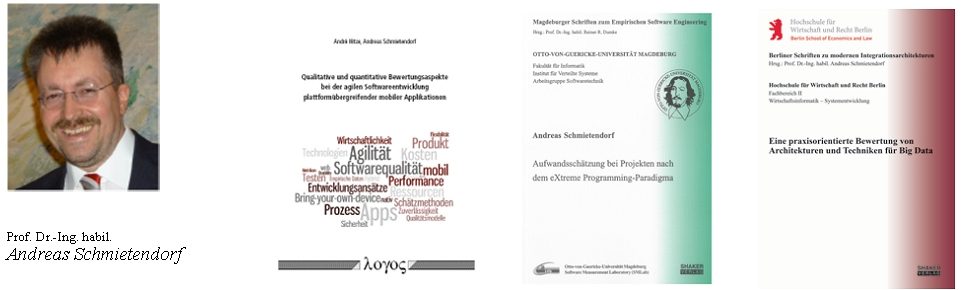
Prof. Dr. Andreas Schmietendorf is a Professor of Business Informatics – System Development at the Berlin School of Economics and Law (HWR Berlin) and holds a private lectureship in Software Engineering at the Otto von Guericke University Magdeburg. He leads the Business Informatics – System Development research group and is actively involved in the HWR doctoral college and Competence Center Digitization. His research focuses on the intersection of software engineering, business informatics, and artificial intelligence, with particular emphasis on: AI-driven changes in software engineering practices Trustworthy AI implementations in domain-specific contexts Web API security and management Digital transformation through low-code development approaches Requirements engineering for trustworthy digital services Prof. Schmietendorf's recent work has centered on the TAHAI (TrustAdHocAI) research project, which investigates trustworthy ad-hoc AI solutions across multiple domains including railway infrastructure, mediation research, and forestry. His research group regularly publishes on software engineering, AI applications, and digital transformation, with a strong focus on practical industry collaborations. The group has produced numerous workshops (ESAPI, KI4SE), conference proceedings, and practical implementations that bridge academic research and industry needs. He has successfully supervised multiple PhD students to completion and maintains an active doctoral supervision portfolio. His research group collaborates extensively with industry partners, particularly Deutsche Bahn, and regularly organizes events that foster academic-industry dialogue. Prof. Schmietendorf is also active in teaching, offering courses on Service Engineering at the University of Magdeburg and various business informatics topics at HWR Berlin. His teaching emphasizes practical applications of software engineering principles and the integration of emerging AI technologies through hands-on exercises and industry-relevant case studies.
Dr. Carolin Straßmann is a Lecturer for Special Tasks at the Institute of Computer Science, Ruhr West University of Applied Sciences. She holds a PhD from the University of Duisburg-Essen where she previously served as a Research Assistant at the Chair of Social Psychology: Media and Communication. Concurrently, she participates in an industry placement at celano GmbH via the state program ‘Career Paths FH Professorship’. Her research centers on optimizing human-technology interaction, with emphasis on: Social effects of virtual agents and social robots Long-term AI-based interactions Nonverbal behavior and appearance dynamics Persuasive and positive impacts of innovative technologies She received notable scientific recognition including: Best Poster Award, Media Psychology Conference (2019) Best Student Paper Award, International Communication Association (2018) At her Human Factors & Gender Studies lab, she utilizes AR/VR systems, social robots, and behavioral research tools. She teaches courses in Applied Statistics, Usability Engineering, and Media Psychology, while supervising student projects.
Dai Guohua serves as a Lecturer at Beijing Foreign Studies University, specializing in Chinese language pedagogy and modern cultural studies within the Chinese Studies framework. Her academic profile integrates practical teaching methodology with interdisciplinary cultural analysis. Her educational foundation includes a Master of Arts in Chinese Language and Chinese Literature. Research interests center on: Specified Chinese language instruction using task-based learning frameworks Modern Chinese literary movements Contemporary Chinese artistic expressions With extensive international teaching experience across Japan and Europe, she applies cross-cultural perspectives to language education. Fluent in Mandarin Chinese, English, and Japanese, she bridges linguistic and cultural contexts in her methodology. Academic service includes advising for multiple degree programs: BA in Chinese as a Foreign Language MEd in Chinese as a Foreign Language BA in Modern Sinology BA in Modern China MA in Modern Sinology Her consultation hours are available by appointment from room KWZ 0.710, reflecting active engagement with students despite the absence of documented research awards or publications in the source material.
Shangwen Wang is an Assistant Professor in the School of Computer Science at National University of Defense Technology (NUDT) in Changsha, China. He earned his Bachelor's degree in June 2017, Master's degree in December 2019, and Ph.D. in December 2023, all from NUDT. During his graduate studies, he was supervised by Professor Xiaoguang Mao. From May 2022 to July 2023, he was a visiting student at Southern University of Science and Technology under Professor Yepang Liu. His educational background includes: Ph.D. in Software Engineering, NUDT (2020.3-2023.12), supervised by Prof. Xiaoguang Mao Visiting Scholar, SUSTech (2022.5-2023.7), supervised by Prof. Yepang Liu M.A. in Software Engineering, NUDT (2017.9-2019.12), supervised by Prof. Xiaoguang Mao B.A. in Software Engineering, NUDT (2013.9-2017.6) Wang's research focuses on program repair, program comprehension, mining software repositories, software maintenance and evolution, software testing, and AI for Software Engineering. His work bridges traditional software engineering techniques with modern AI approaches, particularly leveraging large language models for various software engineering tasks. He has made significant contributions to automated program repair, fault localization, vulnerability detection, and code generation. His research demonstrates a strong emphasis on empirical validation and practical applicability to real-world software development challenges. His recent publications show a clear trend toward integrating large language models with traditional software engineering tasks. The 15 most recent articles reveal a focus on applying LLMs to program repair, fault localization, vulnerability detection, and code generation, while maintaining strong empirical foundations. His work spans both theoretical advancements and practical tool development, with applications in software security, testing, and maintenance. His notable achievements include: CCF Outstanding Doctoral Dissertation (CCF优博) 2024 Outstanding Doctoral Graduates, NUDT, 2023 Multiple distinguished paper awards including ACM SIGSOFT Distinguished Paper Award (ISSTA'24) and IEEE TCSE Distinguished Paper Awards (ICSME'22, SANER'22) Prestigious scholarships from NUDT throughout his academic career As an active member of the software engineering community, Wang serves on numerous program committees for top conferences including ICSE, ASE, ESEC/FSE, and ISSTA. He has also contributed to teaching as a teaching assistant for courses such as Compiler, Python Programming, Discrete Mathematics, and C++ Programming. His research group appears to be actively mentoring students, as evidenced by his role as corresponding author on multiple student-led publications. Wang maintains an active research presence with collaborations across multiple institutions in China. His work demonstrates a clear trajectory from traditional program analysis techniques toward integrating cutting-edge AI approaches, particularly large language models, into software engineering practices.
Professor Henner Gimpel holds the Chair of Digital Management at the University of Hohenheim, where he serves as Vice Dean for Research and Knowledge Transfer at the Faculty of Business, Economics and Social Sciences. He leads the Digital Business Management program, directs the FIM Research Institute for Information Management, and serves as academic director of the Digital Leadership Academy. Additionally, he holds a leading position at Fraunhofer FIT's Business Informatics branch. Professor Gimpel's research focuses on the analysis and design of digitalization, particularly examining socio-technical information systems where people, information, and digital technologies interact. His work emphasizes human-centered and economically effective development of information systems, with special attention to individual acceptance and use of digital technologies across various roles including consumers, customers, patients, employees, and users. His key research areas include Digital Health and Wellbeing, Hybrid and Artificial Intelligence, Smart Sustainability and Digital Ethics, and IT adoption and usage. His research methodology combines theoretically grounded empirical studies with design-oriented and model-theoretical approaches, bridging business administration (particularly business informatics, marketing, and organization) with behavioral economics, psychology, and computer science. Professor Gimpel has international research experience from stays at IBM T.J. Watson Research Center in New York and the Center for Interuniversity Research and Analysis on Organizations in Montréal. Current Research Projects: Influence of ICT on Collective Intelligence of Human Groups (DFG) ABBA: AI for Business | Business for AI (BMBF) PALLADiUM: Palliative Care as a Digital Working World (bidt) Hospital 4.0: Lean digital-supported logistics in hospitals (BMBF) ForDigitHealth: Research network for healthy digital technology use (StMWK) PräDiTec: Prevention for safe and healthy work with digital technologies (BMBF) DeLLFi: Integrating digitalization in teaching, learning and research Professor Gimpel actively supports numerous companies across various industries in developing innovative solutions for digital transformation challenges, with clients including Allianz, BMW, Carl Zeiss, Deutsche Bank, IBM, Microsoft, Siemens, and multiple university hospitals. Prior to his academic career, he gained five years of practical experience as a management consultant at McKinsey & Company.
Prof. Dr. Wolfgang Kratsch serves as Research Professor for Applied AI at Augsburg University of Applied Sciences, Director of the FIM Research Institute for Information Management, and holds a leading position in Fraunhofer FIT's Business Information Systems division. He co-founded and manages the Center for Process Intelligence, driving industry-academia collaboration in digital transformation. His educational background includes B.Sc. and M.Sc. in Business Informatics from the University of Augsburg (2017), followed by a summa cum laude doctorate in data-driven management of process networks from the University of Bayreuth (2020). University of Augsburg: B.Sc./M.Sc. Business Informatics (2017) University of Bayreuth: PhD in Data-Driven Process Network Management (2020) Dr. Kratsch's research centers on data-driven process management , focusing on data extraction, quality assurance, and AI-driven context-sensitive process optimization. His methodology emphasizes design science research yielding prototype implementations for immediate practical use. Key domains include process mining, robotic process automation, and generative AI integration in business workflows, with strong industry applicability. Core Methodology: Design Science Research Technical Focus: Event Log Generation, Object-Centric Process Mining Application Areas: Manufacturing, Healthcare, Transportation His publication trajectory (2021–2025) reveals accelerating integration of generative AI with process mining , particularly in unstructured data extraction (text/video) and automated process improvement. Recent works emphasize practical industry solutions in manufacturing error analysis, airport operations, and medical monitoring, demonstrating consistent collaboration with industrial partners like Munich Airport. No scientific awards were explicitly mentioned in the source material. Dr. Kratsch actively contributes to academia through teaching at Augsburg and Bayreuth Universities, industry project leadership, and startup mentorship. His spin-off credium GmbH (founded 2020) built a 15-person AI/data science team, reflecting his entrepreneurial approach to translating research into market solutions. Current projects prioritize practical AI deployment in serial production and process intelligence systems. Teaching: Lectures/seminars at Augsburg & Bayreuth Universities Startup Experience: credium GmbH (Data Science/AI focus) Industry Projects: Manufacturing optimization, airport operations He leads the FIM Research Institute and Center for Process Intelligence, directing multidisciplinary teams in developing process mining prototypes. His labs focus on bridging academic research with industrial deployment, particularly in video-based process monitoring and generative AI for business process design.