Hannes Bleuler is a Professor at École Polytechnique Fédérale de Lausanne (EPFL), affiliated with the School of Engineering and the Laboratory of Robotics Systems (LSRO). His primary email contact is hannes.bleuler@epfl.ch, confirming his active status as a current EPFL member. His research spans multiple disciplines including Robotics, Haptic Interfaces, Mobile Robotics, Field Robotics, Microengineering, and Electrochemistry. Professor Bleuler's work demonstrates strong interdisciplinary connections between mechanical engineering, electrical systems, and human-computer interaction, with particular emphasis on practical applications in medical, industrial, and virtual environments. Analysis of his publication trends shows consistent research activity over two decades, with 206 scholarly works including 32 doctoral theses (suggesting significant student supervision), 45 research articles, and 76 conference papers. His recent work (2020-2023) focuses on advanced haptic feedback systems, energy efficiency in mobile robotics, and novel actuation methods for miniature robotic systems, reflecting ongoing innovation in his field. Professor Bleuler has collaborated extensively with researchers including Rolf Wüthrich, Roger Gassert, Mohamed Bouri, and Francesco Mondada, indicating strong institutional connections within EPFL's robotics community. His research has been published in prestigious venues including Electrochimica Acta, Journal of Micromechanics and Microengineering, and Emerging Trends in Mobile Robotics, demonstrating both theoretical rigor and practical application of his work.
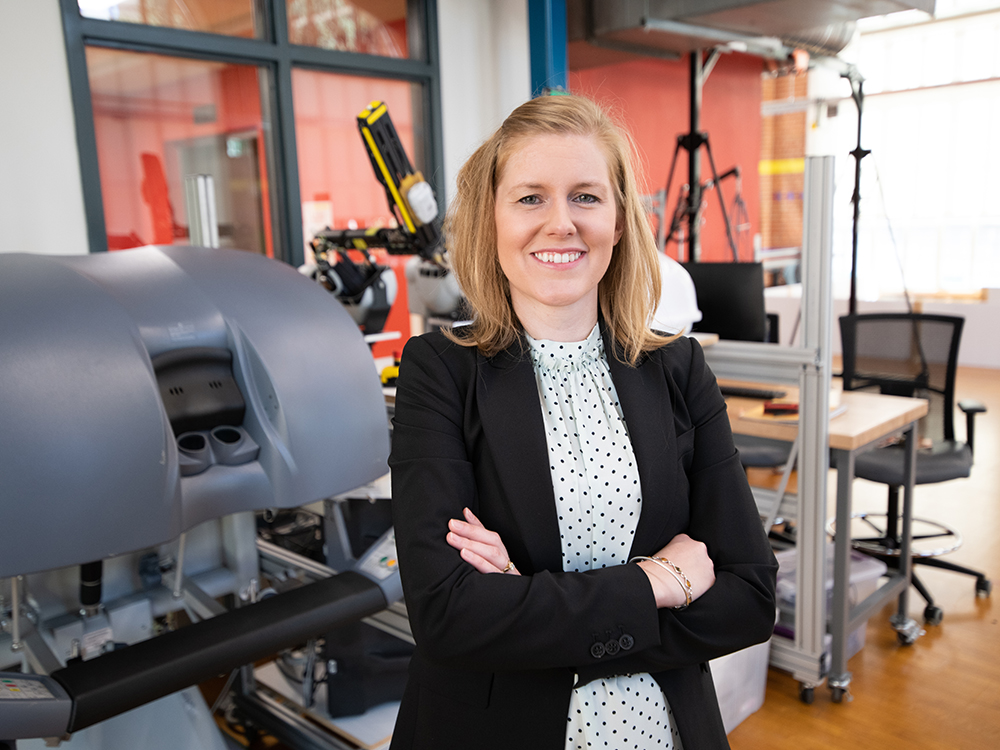
Ann Majewicz Fey is an Associate Professor at the University of Texas at Austin's Department of Mechanical Engineering, holding the Robert and Francis Stark Centennial Fellowship in Engineering. She directs the Human-Enabled Robotic Technology (HER) Laboratory and holds courtesy appointments at Dell Medical School's Department of Surgery and Perioperative Care, as well as UT Southwestern Medical Center's Department of Surgery. She is also a Core Faculty member of Texas Robotics. Dr. Fey earned her B.S. degrees in Mechanical and Electrical Engineering from the University of St. Thomas, an M.S.E. in Mechanical Engineering from Johns Hopkins University, and a Ph.D. in Mechanical Engineering from Stanford University. Prior to UT Austin, she was an Assistant Professor at the University of Texas at Dallas. Her research focuses on human-robotic systems, particularly in surgical and interventional care. Key areas include haptic feedback systems, robotic surgical tools, and stress detection during medical procedures. She pioneers technologies like bio-inspired continuum robots for fetal medicine and novel gripping systems for soft tissues. Her work also emphasizes surgical training through haptic simulators and project-based mechatronic education. Notable achievements include the NSF CAREER Award (2019) and CRII Award (2014). She serves as an associate editor for IEEE Robotics and Automation Letters and has contributed to advancing skill assessment and teleoperation in robotic surgery. Dr. Fey’s research bridges clinical needs with engineering innovation, aiming to enhance both patient outcomes and provider efficiency. Her lab actively develops prototypes for minimally invasive surgery, training tools, and adaptive robotic systems.
Mandayam A. Srinivasan is a Senior Research Scientist in the Department of Mechanical Engineering at MIT and Principal Investigator at the Research Laboratory of Electronics (RLE). He holds a Ph.D. in Mechanical Engineering from Yale University (1984). His research focuses on haptics, including human-machine interaction, tactile perception, and biomechanics, with applications in medical simulation, robotics, and assistive technologies. He leads teams developing tactile displays using MEMS, medical procedure simulators, and shared virtual environments. Dr. Srinivasan’s work bridges engineering and bioscience, pioneering the field of 'computer haptics' and developing tactile sensors like GelSight. His research has implications for prosthetics, rehabilitation, and autonomous robotics. He has contributed to medical diagnostics (e.g., malaria detection via deep learning) and accessibility technologies for visually impaired individuals. His lab, the Laboratory for Human and Machine Haptics (The TouchLab), advances haptic interfaces for virtual reality and surgical training. Key projects include tactile blood pressure imaging, C. elegans biomechanics studies, and haptic feedback systems for blind navigation (BlindAid). His publications span haptics, robotics, and biomedical engineering, emphasizing interdisciplinary collaboration across mechanical engineering, neuroscience, and computer science.
Yunzhu Li is an Assistant Professor of Computer Science at Columbia University, leading the Robotic Perception, Interaction, and Learning Lab (RoboPIL). Previously, she held positions at UIUC and Stanford, and completed her PhD at MIT under advisors Antonio Torralba and Russ Tedrake, with a bachelor's from Peking University. Her research focuses on robotic manipulation, embodied intelligence, and multi-modal perception, emphasizing physics-inspired models and foundation models for generalizable robot learning. RoboPIL develops structured world models for deformable objects, integrates multi-modal sensing (vision, touch, audio), and explores long-horizon embodied interactions. Key research directions include structured world models for manipulable objects, embodied intelligence through foundation models, and multi-modal perception fusion. Recent talks highlight advancements in robot learning, including workshops at ICRA, NUS, and RSS. Her lab actively engages students in PhD, Master's, and undergraduate programs, emphasizing technical strength and self-motivation. Scientific awards include the Best Paper Award at ICRA 2024 Workshop and Sony Faculty Innovation Award. Her work has been featured in venues like Science, Nature Electronics, and IEEE journals. Professional service includes organizing workshops on structured world models and embodied agents, and serving on program committees for CVPR, ICLR, and RSS.
Roles & Affiliations Dr. Yunjie Yang is a Senior Lecturer (equivalent to Associate Professor) at the School of Engineering , University of Edinburgh. He is affiliated with the Edinburgh Futures Institute (EFI), Edinburgh Generative AI Laboratory (GAIL), and Edinburgh Centre for Robotics. He previously held the Chancellor’s Fellow in Data Driven Innovation (2018–2023) and Bayes Innovation Fellow (2023–2024). Education PhD in Engineering Electronics (2018), University of Edinburgh MSc in Control Science & Engineering (2013), Tsinghua University BEng in Measurement & Control Engineering (2010), Anhui University Research Interests His research focuses on AI-driven sensing and imaging, machine learning, digital twins, and soft robotics. Specific areas include: Electrical impedance tomography (EIT) for medical imaging Soft robotic perception and tactile sensing Medical devices and wearable technologies Data-driven inverse problems and reconstruction algorithms Awards & Fellowships 2024 IEEE J. Barry Oakes Advancement Award ERC Starting Grant Fellowships: Young Academy of Europe (FYAE), International Society for Industrial Process Tomography (FISIPT), and Higher Education Academy (FHEA) 2015 IEEE I&M Society Graduate Fellowship Award Advising & Grants Dr. Yang supervises PhD students in robotics, sensing, and medical imaging (e.g., Huazhi Dong). He leads projects such as the SELECT project on soft robot perception and Real-time Bedside Medical Imaging. His research is funded by grants from the ERC, Medical Research Council, and the European Commission. Research Group He heads the SMART Group , focusing on Sensing, Machine Learning, and Robotics. The group develops technologies like modular soft wearable gloves and digital twin frameworks for multiphase flow imaging.
Dr. Ali Mohammadi is a Senior Lecturer in the Department of Electronic & Electrical Engineering within the Faculty of Engineering & Design at the University of Bath. He leads innovative research in Micro-electromechanical Systems (MEMS) and serves as an Associate Editor for IEEE Sensors. His work is supported by multiple EPSRC-funded research projects with strong industry collaboration, totaling over £1.5 million across five projects. Dr. Mohammadi is embedded within several key research units: Electronics Materials, Circuits & Systems Research Unit (EMaCS), The Foundry: Centre for Digital, Manufacturing & Design, Centre for Bioengineering & Biomedical Technologies (CBio), and the Bath Institute for the Augmented Human. Dr. Mohammadi's academic background includes postdoctoral research at the Department of Engineering Science, University of Oxford (2016-2017) and the Department of Electrical and Computer Systems Engineering, Monash University, Australia (2014-2016). This foundation has enabled his interdisciplinary approach to micro/nano-electromechanical systems and electronic circuit design. His research program addresses fundamental challenges in micro/nano-electromechanical transducers and electronic interface circuits, with specific innovations in on-chip atomic force microscopy, implantable energy harvesters, and high precision coupled resonator sensors. These contributions span multiple UN Sustainable Development Goals, particularly advancing clean energy technologies and healthcare solutions. Dr. Mohammadi's work uniquely bridges electrical engineering, mechanical systems, and materials science to develop next-generation sensing and energy harvesting technologies with real-world applications. Analysis of his 48 research outputs reveals a clear trajectory from fundamental MEMS device development toward integrated sensor systems with practical applications. His most recent publications (2023-2025) demonstrate increasing integration of machine learning with precision sensing technologies, particularly for manufacturing condition monitoring and biomedical applications. The research shows progression from individual components to complete systems, with growing emphasis on real-time data processing at the sensor edge and human-machine interfaces. Dr. Mohammadi's professional standing includes: Member of the Institute of Electrical and Electronics Engineers (IEEE) Associate Editor of IEEE Sensors Journal As a doctoral supervisor, Dr. Mohammadi actively mentors students in Microelectromechanical Systems and Electronic Integrated Circuits. His research portfolio includes two active EPSRC projects: 'Transforming the use of Ansys simulation software within engineering curricula' and 'SENSYCUT- Sensor Enabled Systems for Precision Cutting,' demonstrating strong industry-academic collaboration. These projects focus on practical engineering solutions for manufacturing optimization, condition monitoring, and human-computer interaction, with direct applications in industrial settings. Dr. Mohammadi's research ecosystem spans multiple interdisciplinary centers at Bath. Within EMaCS, he advances fundamental electronic materials and circuit design. Through The Foundry, he contributes to digital manufacturing innovation. His CBio affiliation enables medical applications of his sensor technologies, while the Bath Institute for the Augmented Human provides context for human-centered applications of his tactile display research. This multi-faceted institutional integration allows his work to progress from laboratory prototypes to real-world implementations across healthcare, manufacturing, and human augmentation domains.
Daniel Kuhner is a researcher in the Department of Computer Science at the University of Freiburg, affiliated with the Autonomous Intelligent Systems group under Prof. Dr. Wolfram Burgard. He holds a B.Sc. and M.Sc. in Computer Science from the same institution and has been a PhD student since 2013. Education: Bachelor of Science in Computer Science, University of Freiburg (2007–2010) Master of Science in Computer Science, University of Freiburg (2010–2013) His research centers on robotics and intelligent systems, with key interests in object manipulation, motion planning, human-robot interaction, and brain-computer interfaces. He is involved in the NeuroBots project under the BrainLinks-BrainTools initiative, focusing on assistive technologies for users with communication impairments. His teaching includes organizing proseminars and system design projects on brain signal decoding from 2014 to 2018. Daniel Kuhner's recent publications highlight trends in robot task planning using natural referring expressions, tactile-based object segmentation, and BCI-driven assistive robotics. His work bridges autonomous exploration, real-time interaction, and adaptive systems, emphasizing practical applications in assistive and service robotics. Scientific Awards: No scientific awards mentioned in the provided text. Daniel Kuhner has supervised multiple bachelor's theses, including those of Claas Bollen and Milan Benninger. He has been involved in organizing academic teaching activities and research projects. While no grants are explicitly listed, his participation in BrainLinks-BrainTools indicates involvement in funded interdisciplinary research. He is also associated with the development of autonomous exploration frameworks and assistive robotic systems. Labs and Teams: Autonomous Intelligent Systems Group, University of Freiburg NeuroBots Project, BrainLinks-BrainTools
Kalin Stefanov is an ARC DECRA Fellow and Research Fellow in the Department of Human Centred Computing at Monash University. He holds a PhD in Computer Science from KTH Royal Institute of Technology and an MSc in Artificial Intelligence from the University of Amsterdam. His research focuses on Affective Computing, exploring systems that recognize and simulate human affects, with applications in social robotics, neurodiverse communication, and multimodal interaction. He has led projects on sign language translation and large-scale deepfake detection datasets. Key collaborations include work at the University of Southern California’s Institute for Creative Technologies and National Institute of Informatics. He has received accolades such as the Discovery Early Career Researcher Award (2023) and Best Paper Awards (2019, 2024). His research also contributes to UN SDG 4 (Quality Education) through accessible technologies for neurodiverse groups and visually impaired learners. Projects include the 'Active Generation of fingerspelling in Australian Sign Language' and 'Research Towards automated Australian Sign Language translation,' funded by the Australian Research Council. Stefanov’s work spans AI ethics, multimodal data platforms (e.g., OpenSense), and systems for social signal processing in human-robot interaction.
Russ Tedrake is the Toyota Professor of Electrical Engineering and Computer Science, Aeronautics and Astronautics, and Mechanical Engineering at MIT. He directs the Center for Robotics at CSAIL and leads MIT's DARPA Robotics Challenge team. Additionally, he serves as Senior Vice President of Robotics Research at Toyota Research Institute (TRI). His work focuses on control solutions for complex dynamical systems, integrating mechanics, optimization, and machine learning for robotic manipulation. Education: B.S.E. in Computer Engineering, University of Michigan (1999) Ph.D. in Electrical Engineering and Computer Science, MIT (2004) Postdoctoral Associate, MIT Brain and Cognitive Sciences Department Research Interests: Tedrake’s research emphasizes elegant control strategies for underactuated and stochastic systems. Key areas include robust control design using non-smooth mechanics, merging systems theory with machine learning, and developing tools like the Drake software framework for simulation and analysis. His team explores topics such as contact-rich manipulation, trajectory optimization, and real-time motion planning. Notable Contributions: Tedrake’s group develops algorithms for dexterous robotics, including tactile sensing with GelSight sensors and high-speed manipulation strategies. The Drake toolbox is widely used for robotics simulation and control. Awards: 2024 MIT School of Engineering Distinguished Educator Award NSF CAREER Award Multiple teaching awards, including the 2021 Jamieson Teaching Award Labs & Projects: Leads the Robot Locomotion Group at CSAIL, which studies agile robotics. Active in TRI’s research on autonomous vehicles and industrial robotics.
Thomas Maier is a Professor and Head of the Research and Teaching Department of Technical Design at the University of Stuttgart, leading the Institute of Engineering Design and Technical Design. His academic focus lies in interface design, design methodology, and vehicle design, with a strong emphasis on human factors and ergonomics. He has contributed significantly to the development of adaptive human-machine interfaces and user-centered design approaches across automotive, medical, and industrial applications. His research explores the integration of advanced technologies like mid-air haptics, gesture control, and AI-driven evaluation methods into product design. Notable projects include optimizing surgical arm assistance systems, evaluating automated vehicle interiors, and developing ergonomic control devices for medical and agricultural machinery. Maier's work bridges engineering and design, emphasizing collaboration between disciplines to address real-world challenges. Publications span over 15 years, focusing on topics such as driver feedback systems, mixed-reality simulators, and hybrid project management in automotive innovation. He has pioneered methodologies for evaluating user experience in automated vehicles and surgical environments, contributing to international conferences and industry partnerships. His contributions have been published in journals like Current Directions in Biomedical Engineering and IEEE Engineering Management Review . Maier leads interdisciplinary teams in Stuttgart, fostering collaboration between engineering and design disciplines. His lab focuses on innovative solutions for sustainable vehicle design, ergonomic medical devices, and adaptive interfaces for aging populations. Current projects include the RUMBA consortium for automated vehicle user experience and the development of tactile feedback systems for elderly users.
Alap Kshirsagar is a postdoctoral researcher at the Intelligent Autonomous Systems lab within the Computer Science Department at TU Darmstadt, Germany. He joined the lab in July 2022 and is affiliated with the Adaptive Mind research cluster , which integrates Cognitive Science, Experimental Psychology, and Artificial Intelligence. Education: Ph.D. in Mechanical Engineering, Cornell University (2022) M.S. in Mechanical Engineering, Indian Institute of Technology (IIT) Madras (2017) B.S. in Mechanical Engineering, Indian Institute of Technology (IIT) Bombay (2014) Research Interests: Alap specializes in Human-Robot Interaction , Robotic Manipulation , and Tactile Perception . His work explores Dynamic Motor-Skill Learning , Vision-Based Tactile Sensors , and Safe Reinforcement Learning frameworks. He investigates how humans adapt to robotic collaborators and develops simulation tools like TacEx for tactile sensing research. Publication Trends: His recent work focuses on human-robot handover dynamics , visuotactile integration , and adaptive motor-skill learning . Key contributions include tactile sensor simulation frameworks (TacEx), computational models for fear-induced postural control , and variational expert systems for HRI. Collaborative projects span Isaac Sim , German Robotics Conference , and IEEE/RSJ IROS initiatives. Scientific Awards: 🏆 Best Workshop Paper, ICRA@40 (2024) 🏆 Best Late Breaking Report, IEEE RO-MAN (2019) Advising & Grants: Alap supervises Bachelor's and Master's theses on topics like non-verbal communication , self-supervised robotic pouring , and visuotactile pose estimation . He collaborates with institutions including Georgia Tech , DFKI , and IIT Bombay .
David Goedicke is a researcher in Human-Computer Interaction (HCI) with a focus on driving simulation, robotics, and immersive technologies. His work spans collaborations with institutions like Stanford University and the University of Duisburg-Essen, often involving mixed reality (VR/AR) and autonomous systems. Key research areas: Human-robot interaction, driving simulation, tactile interfaces, and ethical data practices. Publications appear in leading venues like CHI, HRI, AutomotiveUI, and CoRR, with recent projects examining cultural driving behaviors, drone-based movement instruction, and AR remote tutoring. His contributions include prototyping tools (e.g., Portobello, ReRun) and frameworks for analyzing multi-perspective interactions in virtual environments.
Volker Dürr is a Professor of Biological Cybernetics at Bielefeld University , Faculty of Biology, and a member of the Center for Cognitive Interaction Technology (CITEC) . His work focuses on sensory control of locomotion , active tactile sensing in insects , and biomimetic modeling of movement systems. Education : Habilitation in Zoology (University of Cologne, 2008; Bielefeld, 2005), PhD in Biology (Bielefeld, 1998), Diploma in Biology (Tübingen, 1994) Academic Career : Professor at Bielefeld (2009-present), Junior Research Group Leader (University of Cologne, 2007-2009), Research Assistant (Bielefeld, 1998-2006) His research investigates how insects use antennal mechanosensory systems and proprioception to control locomotion in complex environments. Key themes include goal-directed movements , sensorimotor integration , and biomimetic robotics . Publications emphasize tactile sensing (15/23 articles), neural control of movement (9/23), biomechanical modeling (7/23), and cross-species locomotion analysis (4/23). Recent work explores virtual reality paradigms for locomotion studies and spiking neural networks for proprioceptive modeling.
Dr. Robert Haschke serves as a Professor and Responsible Investigator in the Cognitive Systems and Social Interaction Group at Bielefeld University's Faculty of Engineering. He is affiliated with the Center for Cognitive Interaction Technology (CITEC) and serves on the Examination Board for the Intelligent Interactive Systems Master's program. His office is located at CITEC 2-035, and he can be reached at rhaschke@techfak.uni-bielefeld.de or +49 521 106-12122. Professor Haschke's research spans multiple domains of robotics and artificial intelligence, with particular emphasis on tactile sensing systems, robotic manipulation, and human-robot interaction. His work explores advanced methods for enabling robots to perceive their environment through touch, with applications in assistive robotics and industrial automation. He investigates how machines can learn from human interactions and adapt their behavior through reinforcement learning and sensor fusion techniques. His research bridges theoretical advances with practical implementations, focusing on transferring knowledge from simulation to real-world robotic systems. Analysis of Professor Haschke's recent publications reveals a strong trajectory toward more sophisticated tactile perception systems and their integration with language and vision for natural human-robot collaboration. His work consistently addresses the simulation-to-reality gap, developing methods for transferring control policies from virtual environments to physical robots. The research shows increasing integration of multimodal sensing (tactile, visual, linguistic) to enable more capable and adaptable robotic manipulation in unstructured environments. As an educator, Professor Haschke teaches advanced courses including Robot Manipulators (39-Inf-RM), Advanced Artificial Intelligence (39-M-Inf-AI-adv_a), Advanced Artificial Intelligence (focus) (39-M-Inf-AI-adv-foc), and Basics of Artificial Intelligence (39-M-Inf-AI-bas). His teaching reflects his research expertise, providing students with both theoretical foundations and practical skills in robotics and AI. Professor Haschke is an integral member of Bielefeld University's Cognitive Systems and Social Interaction Group within CITEC. His work contributes significantly to the university's Socio-Technical World research area, particularly in developing capabilities that enable agents (humans, robots, and AI systems) to act, communicate, and learn in complex environments. His research group focuses on creating robotic systems that can interact naturally with humans through advanced perception and adaptive control mechanisms.
Dr Ze Ji is Reader of Robotics and Autonomous Systems at Cardiff University’s School of Engineering, where he leads the Robotics and Autonomous Intelligent Machines (RAIM) group and directs the Robotics and Autonomous Systems Laboratory. He is Co-Investigator and theme leader for the ERDF-funded IROHMS research centre and holds a Royal Academy of Engineering Industrial Fellowship hosted by Spirent Communications Ltd. Education PhD in Engineering, Cardiff University (2007) – EU FP6 TAI-CHI project MSc, Cardiff University BEng, Cardiff University Research Interests Dr Ji’s research centres on Robot Perception And Learning (RoPAL) , spanning: Simultaneous localisation and mapping (SLAM) Deep reinforcement learning for navigation and manipulation Human-robot collaboration & digital-twin based fatigue management Vision, tactile sensing, and smart sensing systems Unmanned surface vehicles (USVs) and UAV coordination Physics-based differentiable simulation for elastoplastic material handling Publications Trend Since 2021 Dr Ji has authored >120 peer-reviewed papers. A dominant theme is mapless navigation via hierarchical and preference-based reinforcement learning for ground, aerial and surface robots. Parallel streams investigate human-centric manufacturing (digital twins for fatigue-aware assembly), vision-based tactile sensing, defect detection on steel, and orchard robotics (green-fruit segmentation), all underpinned by deep learning and rigorous real-world validation. Scientific Awards & Fellowships Royal Academy of Engineering Industrial Fellowship EU FP6 Best Exhibit Prize, Helsinki 2006 (TAI-CHI project) Fellow of the Higher Education Academy (FHEA) Grants & Centres Principal Investigator, EPSRC-funded differentiable physics project (2025) Co-Investigator, IROHMS (ERDF/WEFO) Industrial Fellowship with Spirent Communications Ltd Laboratory & Facilities Dr Ji manages the Robotics and Autonomous Systems Laboratory , housing two KUKA LBR iiwa robots, Robotnik Vogui+, three KUKA YouBots, TurtleBots, drones, advanced 3-D vision systems, and sensors. The lab has also produced two student-built USVs (unmanned surface vehicles) for maritime research.