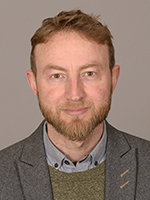
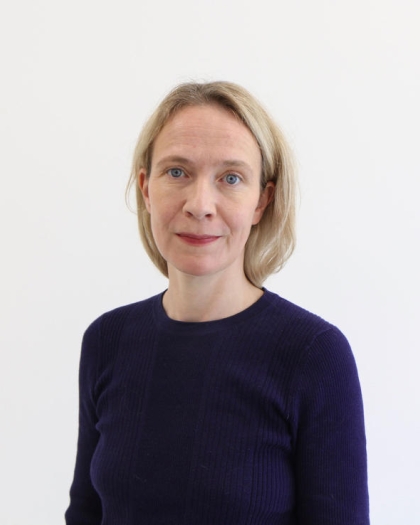
Arnstein Hjelde is a Professor at the Department of Languages, Literature and Culture at Østfold University College (HiØ) in Halden, Norway. His research focuses on multilingualism, heritage languages, Norwegian in America, grammar, and dialectology. He holds a Cand. philol. from Trondheim University and has held academic positions since the 1990s, including visiting scholar roles at the University of Wisconsin and research fellowships at NTNU. He has led research projects such as 'American Norwegian and Heritage Linguistics' and 'Multilingual Children in Kindergarten and School (FLEBBS)'. His work explores language change in Norwegian-American communities, dialect evolution, and language attrition. Notable contributions include studies on infinitive markers in American Norwegian and the linguistic repertoires of heritage speakers. He has served as R&D leader at HiØ and held board positions, reflecting his academic and administrative roles.
Karine Stjernholm is an Associate Professor at the Department of Languages, Literature and Culture, Østfold University College. She is a co-project leader for the proposed Center of Excellence in Language Education (EcoLL) collaborating with NTNU. Her research focuses on sociolinguistics, language and identity, multilingualism, and the Oslo dialect. She has led a project exploring language dynamics in Østfold, Norway, emphasizing industrial history's impact on social class distinctions reflected in language use. Stjernholm holds a Ph.D. analyzing how Oslo's linguistic landscape shifted from place-based dialects to lifestyle-indexed language use. Her work uses corpora like TAUS and NoTa, alongside the Oslo-testen survey, applying theories of globalization and urban sociology. Key contributions include comparative linguistic landscape studies and analyses of dialect convergence in Oslo. Her awards include the Alliance Kunnskap Oslo Prize (2013) for Oslo-focused research and a teaching award from the University of Oslo. She has held roles such as Department Leader at the Language Council of Norway and an Erasmus Grant fellowship at the Meertens Institute (Netherlands). Stjernholm teaches courses like NOR403 Language and Society and coordinates the Master's program in Norwegian Language Education. She actively participates in research networks like SONE (Norway’s Sociolinguistics Network) and SLICE (European Standard Language Ideology projects). Her recent work explores multilingualism in education, linguistic landscapes in regional towns, and the interplay between globalization and language variation. She contributes to public outreach through articles in media like Forskning.no and Smaalenenes avis .
Christina Berg Tveitan is an Assistant Professor at the University College of Southeast Norway (HiØ) , affiliated with the Department of Languages, Literature and Culture within the Faculty of Teacher Education and Languages . She joined the institution in September 2019 and holds a Master's degree in Norwegian Language Education / Literacy and linguistic diversity in school. Her research focuses on second language acquisition, children's language development, and multilingualism, with particular emphasis on early childhood education and teacher-student interactions. Recent work examines literature mediation practices in kindergartens and the role of storytelling in fostering literacy. Christina teaches courses such as Norwegian 1 for Teachers Years 1–7 and contributes to the Special Education master’s programme . She collaborates with the Decentralized competence development initiative, emphasizing localized educational strategies. Her publications (2017–2025) span topics including multilingual children's syntax acquisition, kindergarten teacher-student translation judgments, and the sociocultural dimensions of Norwegian dialects. Notable works include a 2025 study on kindergarten staff's roles as literature mediators and a 2024 analysis of computational thinking in early childhood settings. Christina actively engages in research partnerships, such as the Rekomp-partnerskap project exploring knowledge exchange dynamics between institutions. Her work bridges linguistic theory with practical pedagogical applications in multicultural educational contexts.
Zehad Sabri Mohamed Zehad serves as a Senior Lecturer in Middle East Studies at the University of Oslo since autumn 2015. His academic affiliation is with the Institute for Comparative Literature and Culture (IKOS) where he specializes in Arabic language instruction. Dr. Zehad holds a Master's degree in Classic Arabic linguistics from the University of Alexandria (2015), with thesis work focusing on semantics and syntax of Arabic poetry from pre-Islamic times to the Abbasid era, particularly critiquing Ibn Jenny's approach. He also completed a Diploma in Teaching Arabic to Non-Native Speakers (University of Alexandria 2010) with emphasis on curriculum development and student-centered learning methodologies. His research interests center on communicative approaches to teaching foreign languages where students are at the center of the teaching process. Key areas include curriculum development, examination and assessment techniques, task-based and content-based teaching methods, classroom activities design, and learning strategies for Arabic language acquisition. Dr. Zehad has accumulated extensive international teaching experience across multiple institutions including positions at the University of Texas, Oklahoma University, Michigan State University, and various programs in Morocco, Egypt, and language camps in Minnesota, USA. With native fluency in Arabic, advanced proficiency in English (C1), and intermediate French (B1), he brings multilingual expertise to his teaching practice. His background also includes theater acting (2005-2012) and work as a theater instructor, writer, and director at Alexandria University's TAFL Center (2010-2015).
Paul Sbertoli-Nielsen is a Doctoral Research Fellow in the Department of Linguistics and Nordic Studies at the University of Oslo, Faculty of Humanities. His research is centered on empirical, multimodal analysis of everyday communication across Norwegian, English, and Spanish, using frameworks from Conversation Analysis and Interactional Linguistics. He actively contributes to international research networks such as the Nordic Network for Intercultural Communication (NIC), Richard Ogden’s international CA group, and the Seminario Permanente de Análisis de la Conversación (SPAC). His academic training includes an MA in European Languages and a BA in Philosophy, both from the University of Oslo. His MA focused on corpus linguistics, relevance theory, multilingualism, and discourse analysis, with a thesis comparing Norwegian and Spanish politeness and conversational style. His philosophical background emphasizes epistemology and the philosophy of language. Sbertoli-Nielsen’s research investigates universal and language-specific features of talk-in-interaction, particularly response particles, turn-taking, and multimodal alignment. His recent publications explore bilabial-nasal response tokens in Norwegian and multimodal grammatical aspect in Spanish, highlighting how small linguistic details contribute to intersubjective understanding and affective affiliation. His work has implications for language teaching and intercultural communication. His most recent articles, published in Interactional Linguistics and Norsk lingvistisk tidsskrift , reflect a strong trend in fine-grained, multimodal analysis of spoken interaction, combining phonetic detail with sequential and interactional context. These studies span cross-linguistic comparisons and contribute to typological pragmatics and interactional grammar. He has not received any explicitly mentioned scientific awards or prizes. Paul has advised no students listed in the provided text. He has not been awarded any named grants, although his participation in multiple international research groups suggests collaborative research engagement. His work is supported by institutional affiliations and publication in peer-reviewed journals. He is a member of the Conversation Analysis and Interactional Linguistics research group at the University of Oslo, which serves as his primary academic lab and intellectual community. His regional and international collaborations extend this network across Europe and the Spanish-speaking world, forming a distributed but cohesive research team focused on cross-linguistic interactional patterns.
Miyuki Tsuruta Pedersen is a Senior Lecturer in Japanese Studies at the University of Oslo , affiliated with the Department of Culture Studies and Oriental Languages under the Faculty of Humanities. Her research and teaching focus on Japanese language education, with a specific emphasis on grammar instruction for foreign language learners. She has authored educational materials such as the textbook NIHONGO BUMPŌ (2014), which provides foundational grammar training for Japanese as a foreign language. Contact: m.t.pedersen@ikos.uio.no | +47 22856028
Anje Müller Gjesdal is an Associate Professor at the Department of Foreign Languages, University of Bergen. Her research focuses on French language studies, political discourse, semantics, and discourse analysis, with particular emphasis on climate change communication, migration narratives, and gender studies. She has contributed to projects like CLARINO and LINGCLIM. Her teaching includes French grammar and translation at undergraduate levels. Key publications include analyses of climate change terminology, migration narratives in textbooks, and translation challenges in feminist literature. She co-edits journals like ELLA and has presented at international conferences on multilingualism and intercultural competence. Her work bridges corpus linguistics with sociopolitical themes, emphasizing the role of language in shaping societal debates.
Dr. Takamine Kaori is an Associate Professor in the Department of Language and Culture within the Faculty of Humanities, Social Sciences and Education at UiT The Arctic University of Norway. Her academic career spans nearly two decades with consistent publication output since 2006, demonstrating expertise in both Japanese linguistics and language education pedagogy. Her research interests fall into two interconnected domains: Japanese linguistic structures and language education for international students in Norwegian higher education. In Japanese linguistics, she specializes in syntactic analysis of postpositions, resultative predicates, and spatial terms. In language education, her focus is on academic writing instruction, formative assessment techniques, and preparatory programs for international engineering students. Analysis of her recent publications (2022-2023) reveals a strong emphasis on practical pedagogical approaches for international students, particularly in engineering fields. Her work consistently addresses documented challenges in Norwegian higher education including underdeveloped writing skills, lack of critical thinking, and insufficient language proficiency among international students. She advocates for moving beyond traditional lecture formats toward interactive, student-centered methodologies that promote 21st century skills. Dr. Takamine collaborates extensively with colleagues including Eilertsen, Randi; Dybdahl, Tone Harr; and Holbø, Marianne on projects related to international student support and language education. Her work bridges theoretical linguistics with practical educational applications, creating meaningful connections between her expertise in Japanese language structure and her commitment to improving language instruction for diverse student populations.
Linda Ruth Wheeldon is a Professor of Experimental Linguistics at the Department of Foreign Languages and Translation, University of Agder, Norway. She leads the university's experimental linguistics research group and serves as PhD specialization leader for linguistics in the Faculty of Humanities and Education. Her academic journey includes positions at the University of Birmingham (Reader in Psycholinguistics, 2011; Associate Professor, 2000) and postdoctoral research at the Max Planck Institute for Psycholinguistics. PhD in Experimental Psycholinguistics (University of Cambridge, 1989) MSc in Psychology and Linguistics (University of Edinburgh, 1985) Research Focus : Her work bridges experimental psycholinguistics and theoretical linguistics, investigating language structure representation and its influence on comprehension/production. Current research examines how bilingualism and physical fitness mitigate age-related language decline. Methodologically, she employs reaction time studies, eye-tracking, and EEG/MEG neuroimaging to analyze sentence production, phonological representations, and morphological processing. Publications & Collaborations : With over 85 publications and 3,124 citations, her recent work explores bilingualism's impact on attention networks, fitness interventions for language comprehension, and neural mechanisms of syntactic binding. Collaborators include Sam Lucas (University of Birmingham) and Katrien Segaert (University of Birmingham). British Academy grant recipient Leverhulme Trust Fellow Laboratory : Leads the Experimental Linguistics Lab (ELL) at UiA, focusing on bilingual processing, aging, and cognitive-linguistic interactions.
Jerzy Norbert Nykiel serves as Associate Professor in the Department of Foreign Languages within the Faculty of Humanities at University of Bergen. His academic profile centers on rigorous historical linguistic research with particular emphasis on syntactic evolution in English across multiple historical periods. Professor Nykiel's research program systematically investigates grammaticalization pathways and syntactic change through corpus-driven methodologies. Key areas include: Development of progressive constructions and alternative aspectual markers Evolution of prepositional phrases into subordinators Negation patterns and idiomatic expression change Copula systems and adjunct structures in historical English His work bridges Germanic and Romance linguistics through comparative frameworks, as demonstrated in the 2025 edited volume examining progressive aspect across language families. Analysis of his recent publications (2020-2025) reveals consistent output focused on diachronic syntax, with increasing attention to quantitative corpus methods. The research demonstrates strong continuity in examining grammaticalization cycles while expanding into cross-linguistic comparisons, particularly between Germanic and Romance language systems. Professor Nykiel maintains active scholarly engagement through conference presentations and collaborative projects, including co-authored works with international researchers like Kristian A. Rusten and Reijirou Shibasaki. His role as co-editor of the 2025 John Benjamins anthology confirms leadership in the field of historical linguistics.
Kevin M. Cahill is a Professor of Philosophy at the Department of Philosophy and First Semester Studies, University of Bergen (UiB). He is an active researcher with a strong focus on Wittgenstein studies, skepticism, and philosophical anthropology, and is affiliated with the Wittgenstein Research Group and Wittgenstein Archives in Bergen (WAB). His main research interests include: Skepticism and its anthropological dimensions Philosophy of the Social Sciences Wittgenstein's philosophy and its applications The relationship between Analytic and Continental philosophy Cultural philosophy and philosophical anthropology Professor Cahill's scholarly output demonstrates a consistent trajectory from early work on the Tractatus and ethics toward more recent explorations of cultural philosophy and anthropological perspectives on skepticism. His publications span ethics, philosophy of language, philosophy of mathematics, and cultural theory, with a growing emphasis on applying Wittgensteinian insights to diverse philosophical domains. His notable recognition includes: Norwegian Research Council Fripro-Frihumsam Research Grant for 'Mathematics with a Human Face' project (2019-2023) Leadership of the NordForsk Nordic Network for Philosophical Anthropology (2010-2013) Professor Cahill actively supervises doctoral students and has been involved in significant research projects. His 'Mathematics with a Human Face' project received approximately 10 million kroner from the Norwegian Research Council and included positions for a PhD student and postdoctoral fellow. He teaches courses on Wittgenstein, Origins of Analytic Philosophy, Philosophy of the Social Sciences, Philosophy of Language, and Existentialism, emphasizing the practical application of philosophical concepts to contemporary issues.