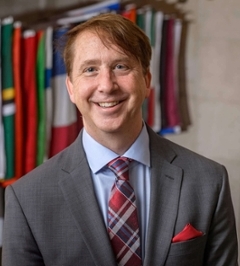
Stefan Engelberg is a Professor of German Linguistics at the University of Mannheim and Honorary Professor of Lexicography at the University of Tübingen. He serves as Head of the Lexicon Department and Head of the Program Area "Lexical Syntagmatics" at the Leibniz Institute for the German Language (IDS), with responsibilities in human resources management and research planning . His affiliations include membership in the Management Board and Extended Management Board of IDS, editorial roles in "Studies on the German Language" and "Colonial and Postcolonial Linguistics" book series, and leadership in projects like the International Association for Colonial and Postcolonial Linguistics .
Xavier Bach is a Lecturer in Language Sciences at Toulouse Jean Jaurès University, affiliated with the Cognition, Languages, Ergonomics (CLLE) research unit. His academic career spans prestigious institutions including Trinity College, University of Oxford, where he served as a Junior Research Fellow (2019-2023) and Lecturer in French Linguistics at Christ Church College (2021-2023), followed by an ATER position at Toulouse Jean Jaurès University (2023-2024) before securing his current permanent lectureship. His research focuses on core areas of linguistic theory with particular emphasis on Inflectional Morphology , Syntax , and Diachronic Linguistics . Key thematic strands include: Romance language typology and variation (especially Occitan, Oïl dialects, and Italian) Austronesian language documentation Cartographic representation of linguistic variation Language contact phenomena Gender-inclusive language innovations Analysis of his recent publications reveals a consistent trajectory in morphosyntactic research, with significant contributions to understanding inflectional systems in Romance languages, particularly Occitan. His work bridges historical linguistics and contemporary sociolinguistic developments, notably examining how language contact shapes grammatical change (as in negation systems) while simultaneously documenting modern linguistic innovations like non-binary language forms. This dual focus on historical depth and contemporary relevance characterizes his scholarly approach. Bach actively contributes to major collaborative research initiatives including the ParCoLab Parallel Corpus project for regional French languages. His teaching portfolio at Toulouse Jean Jaurès University covers foundational and advanced topics in morphology and phonology, reflecting his research expertise in linguistic structure and variation. As a core member of the CLLE research unit, Bach participates in interdisciplinary work spanning descriptive linguistics, language documentation, and cognitive approaches to language structure. His research integrates theoretical frameworks with empirical data from both historical texts and contemporary language use, contributing to broader understanding of linguistic diversity and change in Romance language contexts.
Dejan Stosic is a Professor in the Department of Language Sciences at the University of Toulouse Jean Jaurès, where he has been employed since 2003, first as Lecturer (2013-2022) and currently as University Professor (since 2022). He is a member of the CLLE Laboratory (Cognition, Languages, Language, Ergonomie), a joint research unit (UMR 5263) of the CNRS. His academic career spans multiple institutions, including previous positions at the University of Artois. Stosic's research focuses at the interface of semantics and syntax, with specializations in spatial semantics, prepositional semantics, expression of manner, nominal semantics, and lexical/grammatical polysemy. His work primarily examines French, with significant comparative components involving Serbian and English. Methodologically, he combines introspection with corpus analysis in his linguistic investigations. His most recent publications (2023-2024) demonstrate a continued focus on complex prepositions in French, polysemy patterns, spatial-temporal mappings, and the expression of manner across languages. These works reveal consistent research trajectories examining how spatial concepts structure temporal domains and how complex prepositional constructions evolve across European languages. Stosic is actively involved in multiple research projects including the ANR DIVITAL project (2021-2025) focused on increasing the digital vitality of regional French languages, and the SALTA project examining spatial asymmetries across languages. He regularly organizes academic events such as the PrETrELa event (2024) on written press and language study, and the MoCo Workshop on Motion & Cognition. His scholarly contributions include several significant books such as 'Complex Adpositions in European Languages' (2020), 'The Semantics of Dynamic Space in French' (2019), and 'Les prépositions complexes en français. Théories, descriptions, applications' (2023), establishing him as a leading expert in prepositional semantics and complex adpositions across European languages.
Asst. Prof. Cevdet ŞANLI is a distinguished scholar in Turkish Language and Literature at Yıldız Technical University's Faculty of Education . His career spans over 25 years, with prior roles at Sakarya University and Trakya University. His work bridges Old Turkish Poetry , Modern Turkish Dialects , and Elementary Education Curriculum Development . Doctorate: Trakya University (1992) Postgraduate: Trakya University (1990) Undergraduate: Atatürk University (1986) Research focuses on Turkish dialects (particularly Kosovo/Prizren variations), epigraphic studies in Ottoman Turkish, and language policy in education. He has authored over 68 publications, including Scopus-indexed works and AHCI articles. As Deputy Director of the Faculty Academic Council since 2016, he shapes institutional academic strategy. His educational contributions include designing courses like Postgraduate Thesis Work and Öğretmenlik Uygulaması for undergraduate Turkish language training.
Francesc Sidera Caballero is a Senior Professor in the Department of Psychology at the University of Girona (UdG), where they have worked since 2008-2009. They coordinate the Psychology Degree program and teach in both the Psychology and Teacher Training degrees. PhD in Psychology (2009) BSc in Psychology (2002) Their research focuses on the development of social understanding in children, particularly emotional expression, theory of mind, and language acquisition. Key areas include: Emotion comprehension in hearing-impaired children Role of syntax in cognitive development Bullying and cyberbullying dynamics in schools Executive functions and academic achievement Emotional intelligence in educational contexts Virtual reality applications in psychology education Scientific contributions include studies on: Language effects on pretend emotion understanding Training programs for false belief comprehension Assessment tools for autonomous learning Emotion recognition in developmental disorders
Maria Carmela Benvenuto is an Associate Professor at the Department of Modern Literature and Culture, Sapienza University of Rome, affiliated with the Faculty of Letters and Philosophy. Her career spans teaching and research in historical linguistics, focusing on Indo-European languages, particularly Ancient Greek and Iranian. She actively contributes to the doctoral program in Linguistics and collaborates with international research groups. Doctoral degrees in Historical Linguistics and Italian Language History (2004, Sapienza University) Researcher at Sapienza University since 2008 National Scientific Qualification for Associate Professor in Glottology and Linguistics (2013, 2018) Her research interests include linguistic typology, functional and cognitive linguistics, and the expression of possession in ancient languages. Recent studies focus on language contact in the Achaemenid world, multilingualism, and morphosyntactic changes in Old Persian and Greek. Her publications highlight trends in Achaemenid-period linguistic interference and syncretism of genitive/dative cases. Benvenuto participates in international conferences and is a member of several academic societies, including the Italian Glottology Society and the Societas Iranologica Europea. She leads research on graphic interferences in ancient languages and contributes to projects like TIGMA/TGAW.
Flavia Pompeo is an Associate Professor at the Department of Modern Letters and Cultures , Sapienza University of Rome. Her work focuses on morphosyntax , semantics , and historical sociolinguistics of ancient Indo-European and Balkan languages, with specialization in Old Greek and Old Persian corpora. She employs methodologies from Construction Grammar and cognitive linguistics , analyzing case functions, possessive expressions, and argument alternations. Her research integrates digital corpora for Old Persian studies and examines the Achaemenid cuneiform script and metalinguistic phenomena. Her recent publications (2024–2019) explore case systems , verbal semantics , epigraphic dating formulas , and multilingualism in ancient empires , reflecting her interdisciplinary approach combining traditional linguistics with digital tools. She has been Director of the Linguistics Degree Program (2020–2023, reappointed 2023–2026) and contributes to international research projects on ancient language contact and writing systems . Active in academic community-building, she organizes conferences and participates in scholarly societies.
Augusto Soares da Silva is a Full Professor at the Faculty of Philosophy and Social Sciences, Catholic University of Portugal. His research spans Linguistics , Cognitive Linguistics , and Sociolinguistics , with a focus on Portuguese language variation, pluricentricity, and metaphor analysis. PhD in Portuguese Linguistics (1997), Catholic University of Portugal Specializes in European Portuguese and Brazilian Portuguese comparative studies PI for projects like CONDIV and Global Portuguese His work integrates corpus linguistics , conceptual metaphor , and cultural cognition , analyzing political discourse, emotional conceptualization, and grammatical theories. He has supervised over 166 scientific productions and co-created the CONDIVport2 Corpus for political and societal texts. Dr. da Silva actively contributes to academic discourse through edited volumes, invited talks, and organizational roles. Recent activities include co-organizing the 2024 conference on Affective and Emotional Dimensions of Experience .
Prof. Dr. Maria Thurmair serves as Professor of German as a Foreign Language Philology at the University of Regensburg within the Faculty of Languages, Literature and Cultural Studies, Institute of German Studies. She has held this position since 1998 after previously teaching at the University of Rostock from 1996. Her academic leadership extends to roles as Women's Representative and Equal Opportunities Officer for Science and Art of the Faculty of Philosophy III. Her scholarly foundation includes: Magister Artium (1984) in German as a Foreign Language, Modern German Literature, and English Linguistics from Ludwig-Maximilians-Universität München PhD (Dr. phil., 1987) in German as a Foreign Language, German Linguistics, and English Linguistics from Ludwig-Maximilians-Universität München Prof. Thurmair's research bridges theoretical linguistics with practical language teaching methodology. Her expertise spans text linguistics, modal particles, comparative structures, word formation, and the spoken-written language continuum. She has made significant contributions to understanding how linguistic structures function across different text types and how this knowledge can inform language teaching practices, particularly for German as a foreign language. Her recent publications reveal evolving interests in language-culture-communication intersections across scientific discourse, artistic expression, and cross-cultural contexts. She has increasingly focused on practical applications of linguistic theory for language learners and educators, evident in her contributions to reference works like the Duden grammar. Prof. Thurmair's institutional leadership demonstrates her commitment to academic excellence beyond research and teaching responsibilities, contributing to gender equality and opportunities in academia.
Dr. Silvia Mihailesku serves as a Senior Lecturer at the Faculty of Modern Languages , Department for Language Teaching, at the St. Cyril and St. Methodius University of Veliko Tarnovo . Her work focuses on Romanian-Bulgarian linguistic parallels, Balkan language contact phenomena, and translation theory. Research Themes: Balkan linguistic convergence, Romanian-Bulgarian syntactic comparison, translation strategies, verbal aspect theory, and CEFR-based language education Projects: Participates in international academic networks for sustainable collaboration between institutions in Serbia, Poland, and Romania Publications: Specializes in contrastive syntax, modal systems, and lexicographical studies between Romance and Slavic languages Education: PhD holder in linguistic disciplines Article Trends show consistent focus on Romanian-Bulgarian language contact, with keywords spanning verbal aspect , presumptive mood , and quantitative expressions . Her sub-fields include syntactic transformation , lexical borrowing , and CEFR implementation .
Ivan Markov Zlatev is a Senior Lecturer at the Department of Russian Language within the Faculty of Modern Languages at St. Cyril and St. Methodius University of Veliko Turnovo in Bulgaria. He holds a PhD and has established himself as a specialist in Russian linguistics with a focus on morphology, lexicology, and comparative studies between Russian and Bulgarian languages. Dr. Zlatev's research primarily centers on interjections and onomatopoeia, with extensive comparative analysis of emotional expressions across Russian and Bulgarian. His scholarly work demonstrates a systematic approach to understanding semantic components in interjections, examining how concepts like surprise, fear, and emotional valence are expressed linguistically in both languages. He has also investigated the relationship between interjections and other parts of speech, exploring word formation and semantic motivation. His publication record spans over two decades (2002-2024), showing consistent scholarly productivity with works appearing in academic journals like 'Bulgarian Russistics' and proceedings from international symposia. His research output includes book-length publications such as the two-part 'Russian Orthography: Rules and Exercises' and the 2023 monograph on 'Interjections in Russian and Bulgarian Languages.' Dr. Zlatev participated in the significant research project 'Database for two-way parallel Russian-Bulgarian electronic corpus' (2013-2015), which created a bilingual database connecting parallel corpora of original and translated texts. This project provided valuable tools for translation equivalence research, linguistic asymmetry studies, and contrastive description between the languages. He maintains active participation in academic service through the Department of Russian Language's Annual Linguistic Readings at Veliko Tarnovo University and has contributed to major departmental milestones, including the 60th anniversary of the Russian Language Department as evidenced by his 2024 publication.
Jens Erik Mogensen is an Associate Professor at the University of Copenhagen's Department of English, Germanic and Romance Studies within the Faculty of Humanities. He currently serves as the leader of German Studies at UCPH and has held significant administrative positions including Associate Dean for Education at the Faculty of Humanities (2011-2021) and Head of the Department of English, Germanic and Romance Studies (2001-2011). He is also a board member of Oslo Metropolitan University since 2019. His educational background includes: PhD in German Linguistics and Philology, University of Copenhagen, 1995 MA, University of Copenhagen, 1990 Leadership courses in Denmark and the UK Mogensen's research spans multiple dimensions of linguistic inquiry with particular focus on German language across historical periods. His primary research interests include German grammar from 750 AD to present, historical and modern lexicography (both monolingual and bilingual), language change mechanisms, and the intricate relationship between languages and cultural history. More recently, he has developed a cross-disciplinary research interest in European occultism and popular culture, particularly in the 20th century. His teaching portfolio covers grammar, phonetics and phonology, syntax, language history, translation studies, and lexicography, reflecting the breadth of his scholarly expertise. An analysis of his scholarly output reveals consistent contributions to German linguistics, with a strong emphasis on historical developments, grammatical structures, and lexicographic practices. His work demonstrates a clear trajectory from traditional linguistic analysis toward more interdisciplinary approaches that connect language studies with cultural phenomena, particularly evident in his recent work on occultism and popular culture. The publications show sustained engagement with both theoretical linguistic frameworks and practical applications in language education and policy. Mogensen's academic recognition includes: Rasmus Rask-prisen (1988) Ridder af Dannebrogordenen (Knight of the Order of the Dannebrog) (2020) Throughout his career, Mogensen has demonstrated significant leadership in academic administration and educational innovation. His involvement in numerous committees under The Ministry of Education, The Ministry of Research, and the Danish government since 1996 reflects his influence on national language and education policy. His work as Chairman of the cross-faculty committee on language strategy (2011-2021) and Chairman of the steering committee for educational research demonstrates his commitment to shaping educational practices. His research on public sector interpreting has led to innovative models for certification and education in this field.
Mirjam Schmuck serves as Associate Professor of German linguistics in the Department of English, Germanic and Romance Studies at the University of Copenhagen's Faculty of Humanities, a position she has held since August 2021. Her academic career includes prior appointments as Professor at TU Darmstadt (2020-2021) and interim professorships at Freie Universität Berlin and the University of Bochum (2017-2020), alongside earlier roles as Assistant Professor at the University of Mainz (2012-2019). Her educational background features a Master's degree in German (with French and Art history) completed between 1997-2003, followed by a doctorate in German linguistics awarded on February 7, 2011. Schmuck has maintained continuous research activity since 2005, initially as a Research Assistant at the University of Mainz. Professor Schmuck's research centers on Germanic linguistics with specialized expertise in comparative grammar, historical and synchronic analysis of German syntax, language variation/change, and socio-onomastics. Her work uniquely bridges theoretical linguistics with sociocultural dimensions through investigations of gender linguistics, name studies (particularly personal names and surnames), and language contact phenomena. This interdisciplinary approach reveals how naming practices reflect societal structures and identity formation across Germanic-speaking communities. Analysis of her recent publications (2023-2025) demonstrates a concentrated research trajectory in onomastics, especially deonymic processes and morphological aspects of Germanic names, while maintaining strong connections to grammatical theory. Her editorial leadership of special issues on European naming practices indicates growing scholarly influence in establishing cross-cultural frameworks for name research. The consistent focus on German grammar within sociolinguistic contexts reveals a methodological commitment to connecting micro-linguistic analysis with macro-social patterns. While specific doctoral advisees aren't named in available records, the Department of English, Germanic and Romance Studies maintains an official list of PhD students. Schmuck's research has been supported through significant editorial roles including co-editorship of Beiträge zur Namenforschung since 2016, alongside participation in major projects like the Digital Dictionary of Surnames in Germany (2012-2019) and the German Surname Atlas (2005-2010). Her conference organization record demonstrates active knowledge dissemination within international onomastic communities.
Baris Kabak is a Professor of English Linguistics at the Department of English and American Studies , Julius Maximilian University of Würzburg . He previously held a Junior Professorship at the University of Konstanz and served as Vice President for Internationalization from 2018–2021. Kabak founded the JMU Podcast in 2019 and has been a Senior Associate Member at St. Antony’s College, Oxford. Education : PhD in Linguistics (University of Delaware, 2003), MA in Linguistics (University of Delaware, 2000), BA in English Language Teaching (Boğaziçi University, 1998) Research Interests span phonology, phonetics, and prosodic typology, with a focus on Turkish and Korean linguistics. His work explores cross-linguistic influences in second language acquisition, stress-melody alignment in music, and sociophonetic variation in English varieties. He investigates phonological change, morphophonology-syntax interfaces, and bilingual speech perception. Workshop Organization : Co-organized events on phonological domains, stress systems, and suprasegmental processing. Scientific Awards include the Dean’s Honors List at Binghamton University and a Competitive Fellowship at the University of Delaware. His students have received accolades for dissertations on Turkish-German bilingualism and Turkish stress patterns. Advisory Role : Supervised PhD projects on non-native English, L3 phonology, Turkish verb agreement, Russian stress systems, and Korean suspended affixation. Current advisee: Matthias Krebs (L2 phonology of English).
John Sundquist is Professor of Germanic Linguistics in the School of Languages & Cultures at Purdue University . He teaches graduate and undergraduate courses in historical linguistics, morphosyntax, corpus linguistics, and German language and culture. Education Ph.D. in Germanic Linguistics — Indiana University M.A. in Germanic Linguistics — Indiana University B.A. in German and English — Valparaiso University Research Focus Professor Sundquist’s scholarship centers on historical Germanic linguistics , with particular emphasis on morphosyntactic variation and change in German, Swedish, Danish, and English. Employing corpus-linguistic and variationist methodologies, he investigates the diachrony of light-verb constructions , word-order shifts, and the evolution of negation (Jespersen’s Cycle). His work on Old Saxon metre and punctuation and the Hêliand manuscript contributes to philological understanding of early Germanic texts, while his pedagogical research explores STEAM-oriented, interdisciplinary approaches to teaching German language and culture. Publication Profile Across more than thirty refereed articles and book chapters published between 2002 and 2025, Sundquist’s research spans diachronic syntax , corpus linguistics , Scandinavian languages , Old Saxon philology , and language pedagogy . Recurrent themes include light-verb productivity, the Rich Agreement Hypothesis, negation cycles, and the intersection of syntax with metre and punctuation in medieval texts. Labs, Teams & Pedagogical Engagement Professor Sundquist actively mentors students in historical and corpus linguistics, integrating them into data-driven projects on Germanic language change. He collaborates on interdisciplinary STEAM initiatives that link German cultural studies with science, technology, engineering, arts, and mathematics education.