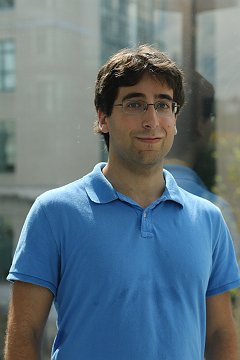
Chasalevris Athanasios is an Assistant Professor at the School of Mechanical Engineering, National Technical University of Athens (NTUA), specializing in Rotordynamics and Tribology. His research focuses on nonlinear dynamics of machines, active bearings, and turbomachinery design. He holds a Ph.D. in Rotordynamics from the University of Patras (2009) and a Diploma in Mechanical & Aeronautical Engineering (2004). Research Interests: Machine Dynamics, Turbomachinery, Active Bearings, Bifurcation Analysis, Crack Detection. Teaching: Dynamics of Rotating Machines, Kinematics and Dynamics of Mechanisms, Machine Elements I. Collaborations: KIT (Germany), RPI (USA), MTU Aero Engines (Germany), and Cleveland State University (USA). Awards include the Humboldt Foundation Fellowship (2010), GE's 'Beyond and Ahead' Award (2017), and recognition as a Top 2% Scientist (2023). He has authored over 40 publications and supervised numerous graduate students. Current roles include Academic Advisor at DOATAP and Associate Editor for journals like ASME Journal of Tribology.
Pavlos S. Georgilakis is a Professor at the School of Electrical and Computer Engineering, National Technical University of Athens (NTUA), specializing in modern techniques for power system analysis, optimization, and renewable energy integration. He holds a Diploma (1990) and PhD (2000) in Electrical Engineering from NTUA. His career includes roles as Lecturer (2009) and Associate Professor (2018–2023) at NTUA, and Assistant Professor at the Technical University of Crete (2004–2009). Research focuses on power transmission/distribution systems, transformer design, and applying AI/optimization for grid efficiency. He led 10 research projects, including Horizon 2020 initiatives SHAR-Q, WiseGRID, and NobelGrid. He authored 3 books and over 230 publications (SCOPUS citations: >5,500). Editor of IET Smart Grid, Energies, and Electricity journals; senior IEEE member. He supervised 4 doctoral, 9 master’s, and 76 diploma theses. Awards include the 2013 Best Reviewer Award from Electric Power Systems Research. Active in energy storage, smart grids, and decentralized energy resource integration.
Professor Gregoris Mentzas is a faculty member at the National Technical University of Athens, School of Electrical and Computer Engineering, where he directs the Division of Industrial Electric Devices and Decision Systems. His research focuses on AI-enabled decision systems, knowledge management, and semantic technologies applied to digital enterprises and e-government. With over 350 publications, he ranks among the top 2% most cited scientists globally. Research Interests: Artificial intelligence for decision augmentation, big data analytics in personalized health and smart mobility, semantic web technologies, and industrial internet of things. Current projects investigate trustworthy AI frameworks and hybrid intelligence systems for Industry 5.0. Teaching: Leads courses in Digital Enterprise Management, Strategic Information Systems, and Project Management at undergraduate and postgraduate levels, incorporating industry case studies and experiential learning approaches. Awards & Leadership: Top 2% Highly Cited Scientist (PLOS Biology 2021) 5 Best Paper Awards in international conferences Director of Information Management Unit (1997-present) Board Member of Institute of Communication and Computer Systems (2006-2009) Projects & Funding: Secured over €18 million in research grants through 60+ European projects with industry partners including SAP, IBM, and Siemens. Research outcomes led to three technology spin-offs.
Vlahogianni Eleni is a Professor and Dean of the Department of Transportation Planning and Engineering at the National Technical University of Athens (NTUA). Her research focuses on integrating machine learning , quantum computing , and reinforcement learning with urban mobility and traffic engineering , addressing challenges in eco-routing , congestion pricing , and autonomous vehicle interactions . Her work emphasizes data-driven approaches to traffic forecasting, including quantum neural networks and theory-aware unsupervised learning . Recent publications explore mixed traffic environments , shared space modeling , and parking occupancy prediction , highlighting her commitment to advancing intelligent transportation systems . Professor Vlahogianni leads the Traffic Engineering Laboratory at NTUA and contributes to policy frameworks for connected and automated transport , wildfire resilience , and dynamic mobility solutions . She is actively involved in the LEVITATE project and advocates for explainable AI in transportation applications.
Aggelos Bletsas is a Professor at the School of Electrical and Computer Engineering, Technical University of Crete. He holds a PhD from MIT (2005) and has expertise in wireless communication, backscatter networks, and RFID systems. His research focuses on scalable wireless networks, ultra-low-cost sensor technologies, and signal processing. Education: PhD, MIT Media Lab (2005) MSc, MIT Media Lab (2001) Diploma in Electrical & Computer Engineering, Aristotle University of Thessaloniki (1998) Research Interests: His work spans wireless transmission techniques, backscatter sensor networks, and RFID systems. Key areas include: Ultra-low-cost sensor deployment RFID localization and multi-static systems Energy-efficient hardware implementations Probabilistic inference in distributed networks Awards: IEEE Marconi Prize Paper Award (2008) Technical University of Crete Research Excellence Award (2012-2013) Multiple best paper awards at RFID-TA, ISWCS, and SENSORS Academic Contributions: He advises students who have won IEEE best thesis awards and leads projects funded by ERC grants. His laboratory focuses on practical implementations of wireless sensor networks and backscatter systems. Labs & Affiliations: Director of the Telecommunications Laboratory and affiliated with the Telecommunication Systems Institute (TSI).
Georgios Zouraris is a Professor at the University of Crete, where he has maintained an active research profile since earning his Ph.D. from the same institution in 1995. His work is centered in the School of Science and Engineering, focusing on advanced computational mathematics with applications in physics and engineering. Education: Ph.D. in Mathematics, University of Crete, 1995 Professor Zouraris specializes in the development and rigorous analysis of numerical methods for partial differential equations. His research spans finite element and finite difference techniques for nonlinear Schrödinger equations, logarithmic heat equations, and stochastic PDEs with space-time white noise. Key contributions include error estimation frameworks for relaxation schemes, convergence analysis of Crank-Nicolson methods, and efficiency improvements for multilevel Monte Carlo simulations. His theoretical work consistently addresses singular nonlinearities and complex domain geometries, bridging mathematical rigor with computational practicality. Analysis of his 2020-2025 publications reveals a sustained focus on high-accuracy numerical schemes for challenging PDEs, particularly those involving logarithmic singularities and stochastic forcing. Recent work demonstrates increasing sophistication in handling noncylindrical domains and coupling strategies, with applications ranging from quantum systems to material science. The publications show consistent emphasis on provable convergence rates and computational efficiency. Information regarding student advising, research grants, and laboratory facilities is not documented in the available sources. His active publication record through 2025 indicates ongoing research leadership in computational mathematics.
Nectarios Koziris is a Professor at the Department of Computer Science , National Technical University of Athens (NTUA) , and former Dean of the School of Electrical and Computer Engineering . His research focuses on Parallel and Distributed Systems , Computer Architecture , and Cloud Computing . Key Research Themes: Compiler-OS-Architecture Interaction, Datacenter Hyperconvergence, Sparse Matrix Optimization, Quantum Computing, FPGA Virtualization Leadership: Founder of ~okeanos (Europe's largest public Cloud IaaS), Co-founder of GFOSS , Member of IEEE Computer Society Greece, Advisor to Arrikto Inc. His work has led to over 180 publications with 5800+ citations (h-index 33) , including two Best Paper Awards (IPDPS 2001, CCGRID 2013) and Intel Recognition (2015). He has supervised 12 PhD students and participated in 15+ EU projects as coordinator or consortium partner. Scientific Leadership: Program Co-Chair for Europar 2012 , Organizer for IPDPS , ICPP , SC conferences, and active member in Cloud Computing Expert Groups for the European Commission.
Gérard Berry (born December 25, 1948) is a distinguished French computer scientist currently serving as Professor at the Collège de France, holding the permanent chair Algorithmes, machines et langages (Algorithms, Machines, and Languages) since 2012. He previously held the Informatique et sciences numériques chair (2009-2010) and the Technological Innovation Liliane Bettencourt chair (2007-2008) at the same institution. Before joining Collège de France full-time, he served as Director of Research at INRIA Sophia Antipolis (2009-2012) and at École des Mines de Paris (1977-2001). His research spans over 30 years in three main fields: lambda calculus and functional programming, parallel and real-time programming languages, and design automation for synchronous digital circuits. He is particularly renowned for developing the Esterel programming language. His work bridges theoretical computer science with practical industrial applications. Berry's research has evolved to include current work in Hop and HipHop for Web programming, formal verification of compilers, and languages for computer music. His publications demonstrate consistent contributions to programming language theory, formal methods, and their applications in hardware and software systems. Gold Medal of CNRS (2014) Chevalier de l'Ordre de la Légion d'Honneur (2012) Member of French Academy of Sciences (2002) Member of Academia Europaea (1993) Monpetit Prize of Académie des sciences (1990) Berry has advised 17 PhD students and reviewed numerous theses. His industrial experience includes serving as Chief Scientist Officer of Esterel Technologies (2000-2009), where he directed the implementation of the Esterel v7 compiler. He has also held significant leadership roles including President of the Scientific Council of IRCAM and membership on the Scientific Council of the National Education. His teaching at Collège de France has covered topics ranging from the foundations of computation to the societal impact of digital technology, with courses including The Informatics of Time and Events and Proving Programs: Why? When? How? His laboratory work has focused on developing practical applications of theoretical computer science concepts.
Aggelos Bletsas Aggelos Bletsas is a Professor at the School of Electrical and Computer Engineering (ECE) at the Technical University of Crete (TUC). He holds a PhD from MIT and has expertise in wireless communication, backscatter radio, and IoT. His research focuses on ultra-low-cost sensor networks and ambiently-powered systems. Education PhD in Media Arts and Sciences, MIT (2005) MSc in Media Arts and Sciences, MIT (2001) 5-year Diploma in Electrical & Computer Engineering, Aristotle University of Thessaloniki (1998) Research Interests Bletsas' work spans scalable wireless networks, backscatter radio, RFID systems, and energy harvesting. He pioneers batteryless IoT devices and environmental sensing technologies. His lab develops hardware and algorithms for low-cost, long-range communication. Awards & Recognition IEEE Fellow (2023) 2012-2013 TUC Research Excellence Award Multiple Best Paper Awards (ISWCS, RFID-TA, SENSORS) IEEE ComSoc and RFID Council Distinguished Lecturer (2022-2025) Labs & Projects Bletsas leads the Telecommunications Laboratory at TUC, focusing on batteryless sensors, scatter radio, and robotic inventory systems. Key projects include 'Internet of Plants' and ambiently-powered inference networks.
Nikos Giatrakos is an Assistant Professor at the School of Electronic & Computer Engineering, Technical University of Crete, and a core member of the Software Technology and Network Applications Lab (SoftNet) . His work bridges Big Data systems, IoT, and advanced analytics, with a focus on real-time processing and scalable architectures. Previously, he served as a postdoctoral researcher at the same laboratory. Education PhD in Computer Science, University of Piraeus (2012) Postgraduate Diploma in Information Systems, Athens University of Economics and Business (2008) BSc in Computer Science, University of Piraeus (2006) Research Focus : Nikos specializes in software architectures for Big Data streaming, including Distributed Big Data Processing , Federated Machine Learning , Cloud-to-Edge Data Management , and Approximate Query Processing . His work has also advanced Complex Event Processing and Outlier Detection in decentralized environments. Scientific Contributions : His research has led to the DAG* workflow optimizer for IoT, the SuBiTO framework for real-time neural learning, and the INFORE approach for cross-platform analytics. He received the Best System Demonstration Award at ACM CIKM 2020 for INforE. Academic Leadership : Nikos teaches Object-Oriented Programming, Data Science, and Distributed Systems. He has supervised numerous European and national grants as Principal Investigator and served on program committees for top-tier conferences like SIGMOD, VLDB, and DEBS.
Symeon Papavassiliou is a Professor at the Department of Communications, Electronics and Information Systems, School of Electrical and Computer Engineering, National Technical University of Athens since 2004. Previously held positions include Associate Professor at New Jersey Institute of Technology (1996-2004) and senior researcher at AT&T Labs (1995-1999). He leads the Network Management and Optimal Design Laboratory and has served in various academic leadership roles, including Deputy Director since 2005. His research focuses on computer networks, wireless systems, and AI-driven network management with over 400 publications. Recognized with multiple best paper awards and NSF Career Award (2003). Education: B.A. Electrical Engineering, NTUA (1990) MSc & PhD Electrical Engineering, Polytechnic University, NY (1992/1996) Key Roles: Founder, New Jersey Center for Wireless Networks & Internet Security Member, EETT (National Telecommunications Commission) 2006-2009 Editorial Board Member, multiple journals Research Interests: Specializes in mobile/distributed systems optimization, wireless networks, complex systems, IoT, and AI applications in network management. Active in 6G architecture research, edge computing orchestration, and secure federated learning frameworks. Publications highlight innovations in network resource allocation, game theory models for positioning systems, and symbiotic computing continuum architectures. Recent work emphasizes resilience in critical infrastructure and smart grid optimization. Awards: Over 10 best paper awards from IEEE conferences, AT&T recognition, and Greek Excellence in Research Grant (2012). Grants: Funded by EU Framework Programs, NSF, ESA, and industry partners like Panasonic and Northrop Grumman. Leads interdisciplinary projects like HEROES (UAV-based emergency response) and NEPHELE (multi-cloud ecosystems). Active in digital twin development for cultural heritage preservation and SDG tracking via knowledge graphs.
Athanasios D. Panagopoulos is a Full Professor at the School of Electrical and Computer Engineering, National Technical University of Athens (NTUA), specializing in Satellite & Space Communications , Antennas and Propagation , and Quantum Communication . He leads the Division of Information Transmission Systems and Material Technology, with a focus on wireless systems, machine learning, and 5G/6G technologies. Born in Athens (1975), received summa cum laude Diploma and Dr. Engineering from NTUA (1997, 2002). Former roles: part-time Assistant Professor (2003-2007), head of Satellite Division at Hellenic Authority for Information Security (2005-2008). Research Trends emphasize Quantum Key Distribution (QKD) , Reconfigurable Intelligent Surfaces , and Deep Learning Applications in satellite networks. His work bridges atmospheric propagation effects with terrestrial-satellite convergence , including AI-driven excess attenuation prediction and UAV channel modeling. Scientific Awards include URSI General Assembly Young Scientist Award (2002, 2005) Best Paper Awards: IEEE RAWCON 2006, IEEE ISWCS 2015 Grants & Collaborations : Principal Investigator for EU/ESA R&D programs, with editorial roles at IEEE Transactions on Antennas and Propagation, and Elsevier Physical Communication. Member of ITU-R , ETSI Study Groups , and IEEE (Senior) .
Stefan K. Muller is the Gladwin Development Chair Assistant Professor in the Computer Science Department at Illinois Institute of Technology. He previously served as a Postdoctoral Researcher at Carnegie Mellon University from 2018-2020 following completion of his PhD there under advisor Umut A. Acar. His academic journey began with an AB from Harvard University in 2012 under Stephen Chong. Dr. Muller's research centers on programming language techniques to improve correctness and efficiency of software, particularly in parallel computing domains. His work spans language and type system design, static resource analysis, and parallel computing methodologies. He leads the Responsive Parallelism research project which extends implicit parallelism models to handle features of consumer software like user interaction and responsiveness requirements. His publication record shows consistent output in top-tier venues including PLDI, POPL, ICFP, and SPAA, with recent work focusing on graph types, responsive parallelism, and resource-aware GPU programming. His research has been supported by NSF grant CCF-2107289. Current advisees include Marelle León (BS), Godha Pallavi Bhogadi (MS), and Alex Friedman (PhD) Former students have gone on to positions at Apple, Amazon, Bloomberg, American Express, and PhD programs at UPenn Teaching responsibilities at Illinois Tech include graduate courses CS534 (Types and Programming Languages), CS536 (Science of Programming), CS440 (Programming Languages and Translators), and CS443 (Compiler Construction). Previously at CMU, he taught Principles of Functional Programming.
Michael L. Scott is the Arthur Gould Yates Professor of Engineering in the Department of Computer Science at the University of Rochester's Hajim School of Engineering and Applied Sciences. He received his Ph.D. from the University of Wisconsin-Madison in 1985 and has been a faculty member at Rochester since 1985, serving as Department Chair multiple times (1996-99, 2007, 2017, 2020-2024). He is a Fellow of the ACM, IEEE, and AAAS, and recipient of numerous awards including the Edsger W. Dijkstra Prize in Distributed Computing. Dr. Scott's research focuses on parallel and distributed systems, with particular expertise in synchronization mechanisms, transactional memory, and persistent memory systems. His work spans theoretical foundations to practical implementations, with numerous influential publications and open-source systems like RSTM and Ralloc. His research has addressed critical challenges in concurrent programming, memory management, and system reliability. His publications show a consistent focus on improving the reliability and performance of concurrent systems, with recent work centered on persistent memory technologies. The trajectory of his research demonstrates a progression from fundamental synchronization algorithms to sophisticated systems addressing modern hardware challenges. His publications span top venues in systems, architecture, and programming languages. His scientific honors include: ACM Fellow (2006) IEEE Fellow (2010) AAAS Fellow Edsger W. Dijkstra Prize in Distributed Computing (2006) University of Rochester's Goergen Award for Teaching (2001) Hajim School Lifetime Achievement Award (2018) IEEE TCCA/HPCA Test of Time Award (2022) Dr. Scott has advised over 25 Ph.D. students who have gone on to successful careers in academia and industry at institutions including Lehigh University, Google, Intel, Facebook, and NVIDIA. His textbook 'Programming Language Pragmatics' is a standard reference in the field, now in its 5th edition. He also co-authored 'Shared-Memory Synchronization,' a comprehensive treatment of the field. He spent the 2014-2015 academic year as a Visiting Scientist at Google. His research group, the Rochester Concurrent Systems Group, has developed numerous influential systems including RSTM (a software transactional memory system), Ralloc (a persistent memory allocator), and Montage (a system for persistent data structures). His work often bridges theoretical correctness with practical performance considerations.
Iraklis Simos is an Associate Professor in the Department of Electrical and Electronics Engineering at the University of West Attica, where he is a member of the WaveComm laboratory. Previously, he served as a Lecturer in the Department of Electronics Engineering at the Technological Education Institute of Piraeus (2012–2018) and conducted research at the Optical Communications Laboratory of the National and Kapodistrian University of Athens (2002–2012). He holds a B.Sc. in Informatics, M.Sc. in Telecommunications Engineering, and Ph.D. in Photonic Devices from the National and Kapodistrian University of Athens (1998–2007). His research focuses on semiconductor and fiber laser dynamics, ultrafast lasers, photonic devices for optical networks, and advanced fiber-optic sensing techniques such as Distributed Acoustic Sensing (DAS) and Microwave Frequency Fiber Interferometry (MFFI) for earthquake monitoring. His work integrates theoretical modeling, experimental validation, and applications in telecommunications, environmental sensing, and infrastructure monitoring. With over 60 peer-reviewed publications, his contributions span high-speed communication systems, optical signal processing, and novel fiber-optic sensor technologies. Recent studies emphasize leveraging commercially deployed fiber-optic cables for seismic monitoring in urban environments (e.g., Athens, Greece), demonstrating the potential of DAS and MFFI for cost-effective earthquake early warning systems. His publications also address synchronization dynamics in laser frequency combs, fiber Bragg grating interrogation, and nonlinear effects in optoelectronic systems. Dr. Simos has advised numerous diploma and doctoral theses, focusing on cutting-edge topics in photonics and optical communications. His research aligns with national and European-funded projects, emphasizing translational applications of photonics in sensing and telecommunications.