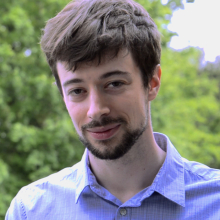
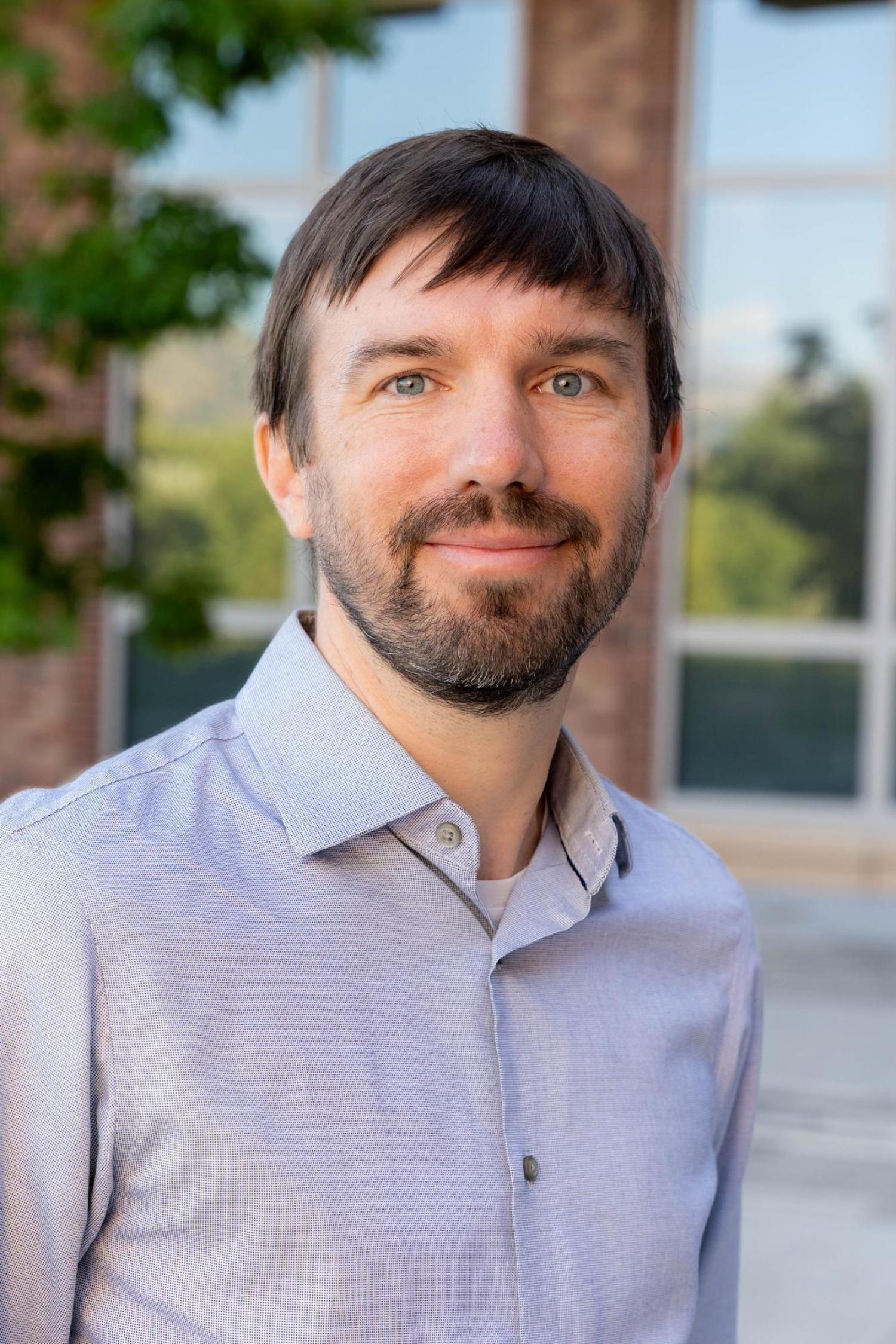
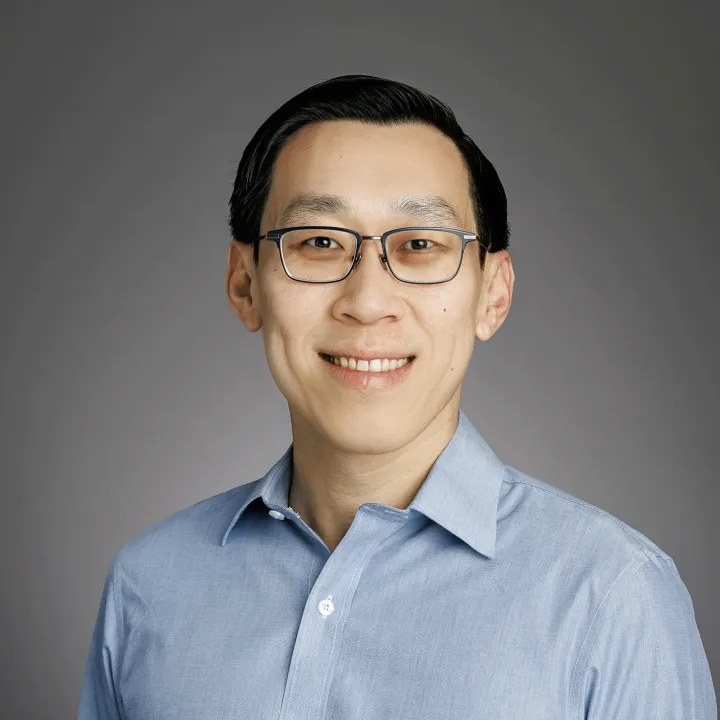
Renjie Feng is a Research Fellow in Mathematics and AI at the School of Mathematics and Statistics and the Sydney Mathematical Research Institute , University of Sydney. His work bridges probability theory, statistics, and applications in machine learning, deep learning, and artificial intelligence. His research interests focus on probability theory and its applications to machine learning , random matrix theory , and statistical physics . He investigates extreme value problems, spectral properties of random matrices, and topological features of random fields over Riemannian manifolds. Recent publications highlight trends in random matrix theory (GUE, GOE, GSE), extreme gap problems , determinantal point processes , and Wiener chaos . Collaborative works with F. Götze, D. Yao, and R. Adler emphasize U-statistics , multivariate linear statistics , and random topology inspired by Poisson point process studies.
Sug Woo Shin is a Professor of Mathematics at the University of California, Berkeley ( Math Genealogy , MathSciNet Profile ). His research focuses on Number Theory and Automorphic Forms, with significant contributions to the Langlands Program, Shimura varieties, and cohomology of arithmetic spaces. Editorial roles: Astérisque , Manuscripta Mathematica , Journal of the Korean Mathematical Society Recent research explores cohomological properties of locally symmetric spaces, tempered A-packets for classical groups, and modularity of symplectic Galois representations Collaborators include Ana Caraiani, Mark Kisin, Arno Kret, and Peter Scholze He has supervised PhD theses on topics like affine Deligne-Lusztig varieties, specialization maps in Scholze's category of diamonds, and statistical properties of automorphic representations. Teaching includes graduate courses on Number Theory (254A/254B), undergraduate Linear Algebra (110), and Calculus (1A), as well as seminars on global Langlands reciprocity and p-adic cohomology theories. Co-organized conferences include the BIRS workshop on Langlands programs (2025), PRIMA algebraic number theory sessions (2022), and KAST Symposium on automorphic forms (2021). His work appears in journals like Annals of Mathematics, Duke Mathematical Journal, and Compositio Mathematica.
Brent Pym is an Associate Professor in the Department of Mathematics and Statistics at McGill University. His research focuses on the intersection of differential, algebraic, and noncommutative geometry, with a particular emphasis on Poisson varieties and deformation quantization. He has held academic positions at the University of Edinburgh, University of Oxford, and was a Postdoctoral Fellow at McGill and the University of Toronto. Education: BScE in Engineering Physics, Queen's University (2007) MSc in Mathematics, University of Toronto (2008) PhD in Mathematics, University of Toronto (2013) Research Interests: Pym studies Poisson structures, their quantizations, and connections to mathematical physics. His work involves classical/derived algebraic geometry, D-modules, moduli spaces, the Stokes phenomenon, and multiple zeta values. Recent projects include holonomic Poisson manifolds, log symplectic structures, and software for symbolic calculations in deformation quantization. Awards: Lichnerowicz Prize (2018) Advising & Grants: Pym has openings for graduate students (admission 2026) and undergraduate projects (2026–27). He develops the Star Products software package for symbolic calculations in Poisson brackets and quantization. His work is supported by research collaborations and institutional grants. Labs & Teams: Pym collaborates with researchers in geometry and mathematical physics, contributing to projects in noncommutative algebra and geometric quantization. His software tools enhance symbolic computation in these fields.
Maxim Kontsevich has been a permanent professor at the Institut des Hautes Études Scientifiques (IHÉS) since 1995, holding the AXA-IHES Chair for Mathematics . He is also Professor at Rutgers University (one month per year since 1997) and was Professor at University of California, Berkeley (1993–1995). Born 25 August 1964 in Khimki, former USSR, he became a French citizen in 1999. Education: Ph.D. in Mathematics, University of Bonn, March 1992. Research Interests: Prof. Kontsevich’s work lies at the intersection of algebraic geometry , mathematical physics , and quantum theory . He introduced revolutionary ideas in mirror symmetry , non-commutative geometry , and deformation quantization , creating new algebraic structures that have found applications far beyond their original contexts. His current ERC Synergy Grant “ReNew Quantum” (2019-2025) explores recursive and exact new quantum theory . Publications & Trends: Across more than 50 influential papers, Kontsevich has consistently pushed the boundaries of enumerative geometry , motivic integration , and topological field theory . His recent work delves into symplectic aspects of homological algebra , motivic Donaldson-Thomas invariants , non-archimedean geometry , and integrable systems , revealing deep connections between geometry, algebra, and physics. Scientific Awards & Honors: Fields Medal (1998) Crafoord Prize (2008) Shaw Prize in Mathematical Sciences (2012) Breakthrough Prize in Fundamental Physics (2012) Breakthrough Prize in Mathematics (2014) ERC Synergy Grant “ReNew Quantum” (2019) AMS Moore Prize (2025) Doctor Honoris Causa: Aarhus University (2014), Universität Wien (2015), Syddansk Universitet (2023) Member of Académie des Sciences, Institut de France, Academia Europaea, National Academy of Sciences (foreign), London Mathematical Society (honorary) Grants & Leadership: As Principal Investigator of the ERC Synergy Grant “ReNew Quantum” (€10 million, 2019-2025), Kontsevich coordinates an international team advancing exact methods and resurgence in quantum field and string theories. Editorial Service & Community Roles: He serves on the editorial boards of Compositio Mathematica , Publications Mathématiques IHÉS , Journal of Noncommutative Geometry , and several other leading journals, shaping the direction of contemporary mathematical research.
David Bindel is an Associate Professor in the Department of Mathematics at Cornell University, affiliated with the College of Arts and Sciences, College of Engineering, and Cornell Ann S. Bowers College of Computing and Information Science. He earned his Ph.D. in Mathematics from the University of California, Berkeley in 2006. His research focuses on applied numerical linear algebra, eigenvalue problems, and their applications in plasma physics, network analysis, and nonlinear systems. He develops methods for analyzing complex systems, including magnetic confinement in stellarators, stability of MHD systems, and community detection in networks. His work bridges theoretical foundations with practical computational tools, such as formal verification of linear algebra algorithms and scalable Gaussian process models. Bindel’s research explores the interplay between structure and computation, leveraging eigenvalue analysis to address challenges in computer vision, opinion dynamics, and engineering design. He has contributed to advancements in numerical methods for large-scale systems, including iterative solvers, spectral approximation techniques, and stochastic optimization. His interdisciplinary approach spans applied mathematics, computer science, and physics, with applications in fusion energy, machine learning, and network science. Recent work highlights include high-order expansions for magnetic confinement, adaptive filtering for dynamical systems, and Bayesian optimization strategies. His publications emphasize rigorous analysis alongside computational scalability, addressing both theoretical and practical aspects of modern scientific computing. Despite no explicitly listed awards, his contributions reflect significant impact in his fields.
John Evans is an Associate Professor and Jack Rominger Faculty Fellow in the Department of Aerospace Engineering Sciences at the University of Colorado Boulder, affiliated with the Applied Mathematics program. He serves as Associate Chair for Undergraduate Curriculum and is part of the Aerospace Mechanics Research Center (AMREC). His research focuses on computational mechanics, particularly fluid dynamics, fluid-structure interaction, and turbulence modeling using high-order and structure-preserving methods. Evans holds a PhD (2011) and MS (2008) in Computational and Applied Mathematics from the University of Texas at Austin, and dual BS/MS degrees in Mathematics and Applied Mathematics from Rensselaer Polytechnic Institute (2006). Before joining CU Boulder, he was a postdoctoral fellow at the Institute for Computational Engineering and Sciences (ICES). His research interests include isogeometric analysis, immersed methods, and data-driven turbulence modeling. Notable contributions include development of divergence-conforming discretizations for incompressible flows, stabilized collocation methods, and invariant subgrid stress models. He leads the AMREC lab and collaborates on plasma-fueled propulsion systems and geometrically sensitive simulations. Key Awards: 2021: Rocky Mountain AIAA Educator of the Year 2021: Gallagher Young Investigator Medal 2019-2021: Clarivate Highly Cited Researcher Professional Activities: Editor of Engineering Computations, Senior AIAA Member, Simons Visiting Professor (2019) Evans' work bridges advanced numerical methods with real-world engineering challenges. His lab develops open-source tools like XIGA for multi-material problems and focuses on immersive simulation environments. Current projects explore turbulence closure models, plasma propulsion, and topology optimization with B-spline-based approaches.
Victor Ginzburg is a Professor in the Department of Mathematics at the University of Chicago. His research focuses on geometric representation theory and noncommutative geometry, with contributions to areas such as Hecke algebras, quantum groups, and mirror symmetry. He currently advises seven graduate students, though their specific projects vary widely. His work intersects with algebraic geometry, string theory, and mathematical physics. Key research themes include the application of algebraic geometry to representation theory, including studies on D-modules, quiver varieties, and symplectic reflection algebras. He has authored influential papers such as Non-commutative Symplectic Geometry (2001) and Symplectic reflection algebras (2002). His interests also extend to Calabi-Yau categories and operads, reflecting a deep engagement with modern geometric and algebraic structures.
Prof. Harry Hyungryul Baik is a Tenured Associate Professor at KAIST's Department of Mathematical Sciences since 2017. He holds a PhD from Cornell University (2014) and a B.S. from KAIST (2009), advised by William Thurston, John Hubbard, and Dylan Thurston. His research focuses on geometric topology, geometric group theory, and low-dimensional topology, with notable contributions to mapping class groups, Kleinian groups, and Teichmüller theory. Education: PhD in Mathematics (Cornell, 2014), B.S. in Mathematics (KAIST, 2009). Key research areas include asymptotic translation lengths, laminar groups, and circular orders of groups. He co-leads the KAIST-KIAS joint research group 2K-GATE as Director, emphasizing collaboration between topologists. Research highlights: Characterization of Fuchsian groups via laminations, unsmoothability of mapping class group actions on 1-manifolds, and exponential torsion growth in random 3-manifolds. His work bridges topology with dynamical systems and geometric group theory, often involving collaborations with institutions like KIAS and MPIM. Awards include the Sangsan Prize (2018), Young-KAST membership (2020–2023), and multiple grants from Samsung and POSCO. He advises 7 PhD students and has mentored 15+ alumni, many of whom hold postdoc positions globally. His lab actively hosts conferences like the KAIST Geometric Topology Fair. Labs/Teams: Director of 2K-GATE (KAIST-KIAS), core member of the KAIST Topology Research Group, collaborator with international networks including the Harvard-MIT-Princeton topology axis.
Mona Merling is an Associate Professor in the Department of Mathematics at the University of Pennsylvania, affiliated with the School of Arts and Sciences. She holds a Ph.D. from the University of Chicago (2014) under Peter May. Prior to Penn, she was a J.J. Sylvester Assistant Professor at Johns Hopkins University. Her research focuses on algebraic K-theory, its applications to number theory and manifold theory, and equivariant stable homotopy theory. She has held research positions at institutions like the Mathematical Sciences Research Institute (MSRI) and the Max Planck Institute for Mathematics. Merling teaches advanced courses in algebraic topology, homotopy theory, and calculus, including innovative programs like the Penn Directed Reading Program and collaborations with the Prison Teaching Initiative to provide education in incarcerated settings. She organizes conferences and workshops, such as the Algebraic Topology Bridge Summer Workshop, fostering accessibility in topology education. Her research explores cutting-edge topics like scissors congruence K-theory, equivariant infinite loop space theory, and parametrized cobordism categories. Recent work includes collaborations on derived scissors congruence and multiplicative equivariant K-theory, with applications to geometric and algebraic structures. Her grants include funding for social justice initiatives in education.
Rohil Prasad is a Miller Research Fellow at the University of California, Berkeley, appointed in 2023, and will join Princeton University as an Assistant Professor in 2025. His research lies at the intersection of geometry, topology, and dynamical systems, with a particular focus on conservative dynamics, pseudoholomorphic curves, and Floer theory. Education: PhD in Mathematics, Princeton University (2018–2023), advised by Helmut Hofer Research Interests: Prasad’s work spans several deep areas of modern mathematics, including: Conservative Dynamics: Studying systems that preserve volume or symplectic structures. Symplectic Geometry: Exploring geometric structures preserved under Hamiltonian flows. Low-Dimensional Topology: Investigating the topology of 3- and 4-dimensional manifolds. Floer Theory: Using pseudoholomorphic curves to study periodic orbits and invariants. His research has led to significant advances in understanding periodic orbits, invariant measures, and the structure of area-preserving maps. Awards and Honors: 2024 Brin Dynamical Systems Prize for Young Mathematicians Contact: rrprasad@berkeley.edu | Office: 968 Evans Hall
Dr. Jean-Christophe Nave is an Associate Professor in the Department of Mathematics and Statistics at McGill University, specializing in applied mathematics, numerical analysis, and computational methods. His research focuses on numerical methods for partial differential equations, fluid mechanics, interface problems, and computer graphics. He holds a PhD from UCSB (2004) and has held academic positions at MIT and McGill since 2005. Currently, he serves on committees such as the Steering Committee of the Institut des Sciences Mathematiques and the CRM Applied Mathematics Lab. His educational background includes a PhD under Professors Xu-Dong Liu and Sanjoy Banerjee. Key research areas include level set methods, fluid-structure interaction, and invariant numerical methods. Notable works include the Correction Function Method for interface problems and the Characteristic Mapping Method for advection problems. Nave’s publications span topics like Poisson equations with discontinuous coefficients, fluid dynamics simulations, and high-order numerical schemes. He has advised numerous graduate and undergraduate students, contributing to their research in applied mathematics and computational science. His work bridges theoretical rigor and practical applications in engineering and physics. He teaches advanced courses such as Numerical Analysis I/II and Computational Methods in Applied Mathematics. His research group collaborates on projects involving fluid dynamics, elasticity, and geometric algorithms, with a focus on developing robust numerical tools for complex systems.
David Nadler is a Professor in the Department of Mathematics at the University of California, Berkeley, appointed in 2012. His research centers on geometric representation theory and symplectic geometry, with significant contributions to the Langlands program, microlocal sheaf theory, and symplectic topology. He maintains an active research group and teaches courses ranging from undergraduate linear algebra to graduate algebraic topology and geometry. Nadler's research explores the interface of algebraic geometry, topology, and representation theory. His work in geometric representation theory focuses on Langlands duality, Springer theory, and Betti geometric Langlands. In symplectic geometry, he investigates microlocal sheaves, Fukaya categories, and Weinstein structures. His recent publications demonstrate a consistent focus on categorical methods in geometric Langlands correspondence and symplectic arborealization. His publications consistently emphasize categorical and geometric approaches to representation theory. Recent works cluster in three areas: (1) extensions of the geometric Langlands program to Betti cohomology settings, (2) microlocal analysis of sheaves on symplectic manifolds, and (3) combinatorial models in symplectic topology. This reflects sustained development of 'Betti geometric Langlands' as a distinct research program bridging topology and automorphic forms. Nadler has advised over a dozen PhD students since 2012, with dissertations spanning geometric representation theory, symplectic geometry, and algebraic topology. Student projects frequently investigate categorical aspects of geometric Langlands, microlocal sheaves, and combinatorial models in symplectic topology.
Ciprian Manolescu is a Professor of Mathematics at Stanford University, where he joined after serving as a professor at UCLA since 2008. He holds both his undergraduate degree and doctorate from Harvard University, advised by Peter Kronheimer. His research focuses on gauge theory, low-dimensional topology, and symplectic geometry, with notable contributions to Heegaard Floer theory, Khovanov homology, and the resolution of the Triangulation Conjecture. Manolescu’s academic accolades include the 2019 E.H. Moore Research Article Prize, the 2012 European Mathematical Society Prize, and a 2004 Clay Research Fellowship. He delivered an invited lecture at the 2018 International Congress of Mathematicians and became a Fellow of the American Mathematical Society in 2017. His work bridges advanced algebraic structures with geometric problems, particularly in understanding manifold invariants and topological constraints. His teaching includes the Polya Problem Solving Seminar (Math 193) at Stanford, and he advises students competing in the Putnam Mathematics Competition. Research trends in his publications emphasize applications of Floer homology to knot theory, 4-manifold topology, and the interplay between algebraic topology and quantum field theories. Education: PhD and BA in Mathematics, Harvard University Key Research Themes: Floer homology frameworks, geometric topology, knot invariants, and manifold classification Grants & Collaborations: Involved in NSF-funded projects like the FRG: Collaborative Research: Floer Homotopy Theory (2016)
Alfonso Giuseppe Tortorella is a Tenure Track Assistant Professor in the Department of Mathematics at the University of Salerno since October 31, 2022. Previously, he held research positions at CMUC (Center of Mathematics of the University of Coimbra), CMUP (Center of Mathematics of the University of Porto), and KU Leuven. He received his PhD in Mathematics from the University of Florence in 2017 under the supervision of Luca Vitagliano and Paolo de Bartolomeis. His educational background includes an MSc in Mathematics from the University of Salerno (2013) with honors, where he completed his thesis titled "Geometric methods of Hamiltonian mechanics" under Luca Vitagliano's guidance. Tortorella's research focuses on Poisson geometry in the broadest sense, with particular emphasis on deformation theory of coisotropic submanifolds in Jacobi manifolds, multiplicative structures on Lie groupoids, and VB-groupoids. His work explores the intersection of differential geometry, mathematical physics, and algebraic structures, developing sophisticated theoretical frameworks to understand geometric structures and their deformations. He has made significant contributions to understanding symplectic foliations, contact dual pairs, and the algebraic structures underlying Jacobi geometry. His most recent publications (2023-2025) demonstrate a consistent focus on deformation problems in Poisson and related geometries, with particular attention to coisotropic submanifolds in contact geometry, symplectic foliations, and the application of L∞ algebras to geometric deformation problems. His work shows increasing sophistication in handling higher structures and their applications to geometric problems. Abilitazione Scientifica Nazionale for Professore Associato in Geometria e Algebra (01/A2 - II Fascia) (May 24, 2021 - May 24, 2030) Qualification aux fonctions de Maître de conférences, section 25 - Mathématiques (December 31, 2018 - December 31, 2022) PhD internship at IM PAN awarded by WCMCS (December 2014) PhD scholarship from INdAM (October 2013) Scholarship from SMI (June 2013) Tortorella has advised multiple PhD, MSc, and BSc students, including Vanessa Oliveira (PhD, University of Porto), Antonio Maglio (PhD, University of Salerno), and Rodrigo de Oliveira Baptista (MSc, University of Porto). He has served on examination committees and as a reviewer for numerous prestigious mathematics journals. His collaborative work extends across international boundaries, with research stays at institutions in Italy, Portugal, Belgium, Poland, France, Germany, and Brazil. He is an active organizer of conferences and workshops, particularly in the field of Poisson geometry, serving on the organizing committees for events like Poisson 2024 and the INdAM Intensive Period on Poisson Geometry & Mathematical Physics.
Andre Wibisono serves as Assistant Professor in Yale University's Department of Computer Science with a secondary appointment in Statistics & Data Science, joining the faculty in 2021 after postdoctoral research at University of Wisconsin-Madison and Georgia Institute of Technology. His educational background includes: Ph.D. in Computer Science, UC Berkeley M.A. in Statistics, UC Berkeley M.Eng. in Computer Science, MIT S.B. in Mathematics and Computer Science, MIT Wibisono's research focuses on algorithm design for machine learning through optimization, sampling, and game theory , leveraging dynamical systems and information theory to develop accelerated discrete-time algorithms from continuous dynamics. His work provides theoretical foundations for efficient machine learning systems with applications in generative modeling and constrained optimization. Recent publications (2023-2025) demonstrate consistent innovation in Hamiltonian-based optimization , constrained-space sampling , and min-max game convergence , characterized by rigorous mathematical analysis connecting continuous dynamics to discrete algorithms. Key trends include randomized integration for acceleration, phi-divergence convergence guarantees, and symplectic geometry applications to mirror descent. Scientific recognition includes: NSF CAREER Award for developing algorithmic frameworks bridging continuous and discrete dynamics He actively mentors current students (Siddharth Mitra, Kaylee Yang, Jane Lee, Qiang Fu, Peter Wang) and has guided two postdocs to faculty positions. Research is funded through the NSF CAREER award and collaborative CIF grants focused on Hamiltonian dynamics for sampling and optimization. His Yale research group develops theoretical foundations for next-generation machine learning algorithms, emphasizing mathematical rigor in optimization and sampling with applications to generative modeling and constrained inference problems.