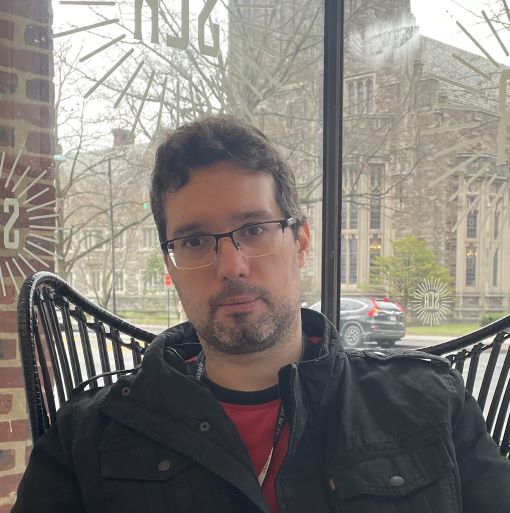
Daan van den Berg is a Lecturer in the Faculty of Science at Vrije Universiteit Amsterdam, with a focus on Artificial Intelligence. He is also affiliated with the Network Institute. His research interests include metaheuristic optimization, evolutionary algorithms, and computational intelligence. Recent work focuses on improving benchmark testing for algorithms, protein conformation sampling, and fractal analysis of computational problems. He has collaborated internationally on projects involving hybrid algorithms and entropy analysis. Education details are not explicitly provided in the text. His research output includes 22 publications, with recent works appearing in Springer Nature and conference proceedings like IJCCI and PPSN. He has contributed to studies on algorithm performance, problem instance complexity, and explainable optimization techniques. No scientific awards are listed. His advising and grant activities are unspecified in the text. He is actively involved in computational intelligence research groups and has collaborated across disciplines including bioinformatics and mathematics.
Andrey Nikolaev is a Teaching Professor in the Department of Mathematical Sciences at Stevens Institute of Technology's Charles V. Schaefer, Jr. School of Engineering and Science. His research focuses on group theory, computational complexity, and randomness in mathematical structures. Nikolaev's work investigates algorithmic problems in group theory including subset sum problems in branch groups, word problems in Baumslag-Gersten groups, and conjugacy problems in Heisenberg groups. He co-authored 'Complexity and Randomness in Group Theory' (2020), examining computational aspects of geometric group theory. Recent publications explore parameterized complexity, logspace computations in nilpotent groups, and nonstandard polynomial algebra. His research bridges theoretical computer science with algebraic structures, developing efficient algorithms for group-theoretic problems.
Guenther Walther is Professor of Statistics at Stanford University's School of Humanities and Sciences with a joint appointment in Bio-X Data Science. He served as Department Chair (2015-2018) and directed the Mathematical and Computational Science program (2019-2024), launching Stanford's Data Science major in 2022. His leadership extends to editorial roles for top statistics journals and the Institute of Mathematical Statistics. Walther earned his M.A. and Ph.D. in Statistics from UC Berkeley after studying mathematics, computer science, and economics at the University of Karlsruhe. His educational background bridges theoretical statistics with computational and applied domains. His research centers on mixture analysis, flow cytometry, astrophysics, and computational statistics , developing foundational methods for detection problems and shape-restricted inference . Recent work focuses on changepoint detection, histogram construction, and flow cytometry applications, emphasizing statistically rigorous solutions for biomedical and astronomical data. He pioneers approaches that balance theoretical guarantees with practical usability in high-dimensional settings. Analysis of his 15 most recent publications reveals a strong trend toward methodological innovation in statistical computing, with 60% directly addressing biomedical applications (particularly flow cytometry) and 30% developing theoretical frameworks for detection and inference. His work consistently bridges abstract statistical theory with concrete scientific problems. Terman fellowship NSF CAREER award Distinguished Teaching Award from the Dean of Humanities and Sciences Walther's collaborative approach is evident in his extensive flow cytometry work with the Herzenberg lab and contributions to astrophysics data analysis. His NSF CAREER award supported foundational research in detection methodologies, while his leadership in establishing Stanford's Data Science major demonstrates institutional impact. Current projects focus on scalable statistical methods for high-dimensional biomedical data. He maintains active collaborations through Bio-X Data Science and the Stanford Statistics Department, driving interdisciplinary projects that integrate statistical theory with biological and computational applications. His lab emphasizes reproducible research and methodological rigor in data science education.
Anna Gal is a Professor at the Department of Computer Science, University of Texas at Austin, specializing in computational complexity, communication complexity, coding theory, and circuit complexity. She has made significant contributions to understanding lower bound methods and complexity measures of Boolean functions. Ph.D. in Computer Science from University of Chicago (1995) Her research focuses on theoretical aspects of computer science, including Boolean function analysis, sensitivity vs. block sensitivity, and combinatorial structures in coding theory. Recent publications indicate a strong emphasis on complexity measures, certificate games, and interactions between coding theory and circuit complexity. Key trends include applications of communication complexity to non-monotone circuits and sensitivity analysis of transitive functions. Anna Gal has received prestigious awards, including the Machtey Award for best student paper at FOCS 1991 and the EATCS best paper award at ICALP Track A in 2003. She has advised multiple Ph.D. students, including Jeff Ford, Vladimir Trifonov, Andrew Mills, Keith Jing-Tang Jang, and Siddhesh Chaubal. Her teaching includes advanced courses like Analysis of Boolean Functions and Communication Complexity.
Akash Singha Roy is a Lecturer in the Department of Mathematics at the University of Georgia (UGA), where he completed his Ph.D. under Paul Pollack in July 2025. His research focuses on elementary, analytic, and combinatorial number theory, particularly the residue-class distribution of arithmetic functions and mean values of multiplicative functions. He will join Charles University, Prague, as a postdoctoral fellow in October 2025. Ph.D. in Mathematics, University of Georgia (2025) BSc. Honors in Mathematics and Computer Science, Chennai Mathematical Institute (2021) His work spans advanced analytic techniques, including the Siegel-Walfisz and Landau-Selberg-Delange methods, with applications to Benford's law, prime factor distributions, and algebraic structures like module theory and arithmetic geometry. He has coauthored publications with Vorrapan Chandee, Xiannan Li, Nathan McNew, and Paul Pollack. His recent publications extend classical analytic number theory methods to broader contexts, such as Dirichlet L-functions and hybrid families of additive/multiplicative functions. Key themes include residue-class equidistribution, statistical properties of arithmetic functions, and connections to Fourier coefficients of modular forms. Scientific Awards: William Armor Wills Memorial Scholarship Award (2024) UGA Graduate School Dean's Award (2023) Exemplary Counselor Award, Ross/Asia Mathematics Program (2019) At UGA, Singha Roy has taught Calculus I and Precalculus, contributed to curriculum design, and mentored students at the Ross Mathematics Program. He has refereed for journals like Monatshefte fur Mathematik and the Rose-Hulman Undergraduate Mathematics Journal.
Arne Meier is a Professor at Leibniz Universität Hannover, affiliated with the Faculty of Electrical Engineering and Computer Science and the Institute of Theoretical Computer Science. He heads the Algorithms research group, focusing on theoretical aspects of computer science with applications to artificial intelligence and database systems. Meier obtained all his academic degrees—Bachelor's, Master's, PhD, and Habilitation—at Leibniz Universität Hannover, establishing a strong foundation in theoretical computer science. His academic journey at the same institution reflects his deep commitment to advancing research in computational theory. Meier's research spans several interconnected areas in theoretical computer science. His primary focus is on complexity theory, particularly the parameterized complexity of problems in non-classical logics with applications to AI. He also investigates enumeration algorithms and the logical foundations of artificial intelligence. His work bridges theoretical computer science with practical applications in knowledge representation and reasoning systems. He has a notable interest in LaTeX and typography, having developed the 'timeline' package for creating timelines in LaTeX documents. His recent publications (2023-2025) demonstrate a consistent focus on the intersection of logic, complexity, and artificial intelligence. Meier's work shows progression from foundational research in dependence and team logics toward more applied areas in argumentation theory and database systems. His research increasingly addresses computational challenges in AI systems, particularly in reasoning under uncertainty and handling inconsistent information. Meier actively contributes to the academic community through extensive program committee service for major conferences including AAAI (2021, 2023, 2024, 2025), IJCAI (2021-2025), and FoIKS (2024 as Co-Chair, 2026). He has also served as a reviewer for numerous conferences and journals in theoretical computer science and artificial intelligence. His current research projects include the DAAD-funded 'Applications and Complexity of Logics in Semiring-Team-Semantics' (2024-2025) and the DFG project 'Team Logics: New Bridges to Database Repairs' (2023-2026). Previously, he led the DFG project 'Nonclassical logics: parametrised and enumeration complexity' (2013-2022) and the MWK project 'Innovation Plus: Komplexität von Algorithmen' (2020-2022). Meier leads the Algorithms research group at Leibniz Universität Hannover, which focuses on theoretical aspects of algorithms with applications to logic and artificial intelligence. The group's work spans complexity theory, logical formalisms, and their applications to computational problems in knowledge representation and database systems.
Konstantinos Draziotis is an Associate Professor at the Department of Informatics, School of Informatics, Aristotle University of Thessaloniki. His academic career at the university began as a Lecturer from 2013 to 2019, and he has been serving as an Associate Professor since 2019. His educational background includes a PhD in Mathematics from Aristotle University of Thessaloniki (2005) and a Bachelor's Degree in Mathematics from the same institution (1998). Draziotis specializes in Computational Number Theory and Cryptography , with a particular focus on Diophantine equations, elliptic curves, and cryptanalysis of digital signature schemes. His research bridges theoretical mathematics with practical cryptographic applications, especially in analyzing the security of cryptographic protocols and developing mathematical methods for solving complex number-theoretic problems. He has developed a Greek-language textbook on Introduction to Cryptography with Creative Commons licensing, demonstrating his commitment to accessible education in this field. His recent publications demonstrate a strong trend toward cryptanalysis of digital signature schemes (particularly DSA and ECDSA), lattice-based attacks , and number-theoretic approaches to cryptographic problems . His work spans both theoretical aspects of number theory (Diophantine equations, integer points on curves) and practical applications in cryptography (cryptosystem attacks, knapsack problems). The interdisciplinary nature of his research connects deep mathematical theory with real-world security applications, with publications consistently appearing in reputable journals like Information and Computation, Advances in Mathematics of Communications, and Theoretical Computer Science. Draziotis leads a crypto research group at the Aristotle University of Thessaloniki and actively contributes to open-source cryptographic and mathematical software ecosystems. His academic service includes participation in departmental administrative functions as indicated by various announcements on examination schedules, graduation ceremonies, and departmental operations visible on his website. He maintains collaborations with researchers including Dimitrios Poulakis, Marios Adamoudis, and Anastasia Papadopoulou, among others, reflecting an active research network in both Greek and international academic communities.
Jesper Nederlof is an Associate Professor in the Algorithms and Complexity group at the Department of Information and Computing Sciences, Faculty of Science, Utrecht University. His research focuses on designing efficient algorithms for computationally hard problems, particularly in the areas of parameterized complexity, graph algorithms, and NP-complete problems. He received his M.Sc. in Applied Computing Science from Utrecht University in 2008 and his Ph.D. from the University of Bergen in 2011 with the thesis 'Space and Time Efficient Structural Improvements of Dynamic Programming Algorithms' under supervision of Pinar Heggernes. Nederlof's research interests span multiple areas of theoretical computer science, with a particular focus on designing algorithms for NP-complete problems with small exponential worst-case run time. His work extends to algorithmic game theory, information theory, representation theory, approximation algorithms, and online algorithms. He has made significant contributions to parameterized complexity, particularly in developing algorithms parameterized by structural graph parameters like treewidth and cutwidth. His publication record shows a consistent output of high-quality research in top theoretical computer science venues. His recent work demonstrates trends toward tighter bounds for exponential-time algorithms, improved space complexity, and connections between different complexity hypotheses like ETH. Many papers focus on structural parameters of graphs to develop more efficient algorithms for fundamental problems like Hamiltonian cycle, Steiner tree, and subset sum. EATCS-IPEC Nerode Prize (2023) WG best paper award (2020) Nederlof has been involved in teaching courses on algorithms, (non)-linear optimization, graph theory, (vector) calculus, modeling, and management and product development. His research has been supported by various grants including an NWO open competition project during his postdoctoral period and an EU ERC Starting Grant for the project 'Finding Cracks in the wall of NP-Completeness' (2020-2025). As a member of the Algorithms and Complexity group at Utrecht University, Nederlof collaborates with researchers working on foundational aspects of computing, contributing to the group's reputation in theoretical computer science research.
Ambrus Gergely is a Research Fellow affiliated with the Geometry Department at the Hungarian Academy of Sciences. His work bridges discrete mathematics, convex geometry, and probability theory, focusing on geometric configurations, optimization, and combinatorial problems. Research Interests: Discrete Mathematics, Convex Geometry, Probability Theory, Discrete Analysis Grants: Combinatorics in Geometry and Number Theory (2020-2025), Limits of discrete structures (ERC, 2014-2019) His recent publications address vector balancing, Helly-type theorems, and geometric optimization, with a focus on convex bodies, planar sets avoiding unit distances, and extremal problems in discrete geometry. He has made significant contributions to understanding the interplay between convex geometry and probabilistic methods. Scientific Awards: János Bolyai Research Fellowship (Hungarian Academy of Sciences, 2015) Grünwald Géza Memorial Medal (Bolyai János Matematikai Társulat, 2009) Rényi Kató Award (Bolyai János Matematikai Társulat, 2006) Ambrus is part of the GeoScape Research group at the Rényi Institute, collaborating on problems related to convex sets, tight frames, and geometric algorithms.
Fernando Granha Jeronimo is an Assistant Professor at the Siebel School of Computing and Data Science, University of Illinois Urbana-Champaign. His research explores theoretical computer science with emphases on coding theory, expander graphs, quantum computing, and optimization. He holds a PhD from the University of Chicago, M.Sc./B.Sc. degrees from Unicamp (Brazil), and an engineering degree from Telecom Paris. His work investigates interactions between complexity theory, pseudorandomness, quantum algorithms, and high-dimensional expanders. Recent studies focus on explicit code constructions near information-theoretic bounds, quantum-classical complexity separations, and efficient decoding algorithms leveraging expander properties. Publications demonstrate consistent focus on coding theory (explicit codes, list decoding), quantum complexity (unentangled proofs, pseudoentanglement), and optimization (LP/SDP hierarchies). A trend toward quantum applications is evident in recent works on quantum LDPC codes and property testing. Awards & Fellowships: Simons-Berkeley Fellow Google Research Fellow TA Prize, University of Chicago (awarded twice) Advising & Grants: Actively recruits graduate students for his research group. Previously supported by Simons Institute and Google Research Fellowship during postdoctoral work at IAS. Current courses include quantum computing (CS 498) and advanced topics in codes/optimization (CS 598). Leads the Local-to-Global TCS Mentorship Program and research groups focused on coding theory, quantum complexity, and expander applications.
Roles and Affiliations: Aristides Pagourtzis is a Professor at the School of Electrical and Computer Engineering of the National Technical University of Athens (NTUA), leading the Computer Science Division. He also serves as Lead Researcher at the Archimedes Research Center (Athena RC) and heads the Computation and Reasoning Laboratory (CORELab). His academic career includes positions at institutions like the University of Liverpool and ETH Zürich. Education: Ph.D. in Electrical and Computer Engineering (1999) and Diploma in Electrical Engineering (1989), both from NTUA. Research Interests: Computational Complexity, Graph Algorithms, Distributed Algorithms, Cryptography, and Network Algorithms. Teaching: Teaches courses such as Algorithms and Complexity, Cryptography, and Advanced Topics in Theoretical Computer Science. Courses span undergraduate and postgraduate levels, emphasizing foundational and applied computer science concepts. Publications & Grants: Over 80 publications in journals like Theoretical Computer Science and conferences like CIAC and FCT. His research has been funded by grants from the US, EU, and national resources. Notable contributions include work on approximation algorithms, distributed computing, and cryptographic protocols. Service & Leadership: Served as co-chair for CIAC 2017 and FCT 2021. Active in academic service, organizing workshops and participating in committees for conferences such as IWOCA and ACM. Labs & Teams: Leads the CORELab, focusing on theoretical computer science and its applications. Collaborates on projects involving algorithm design, complexity analysis, and secure systems.
Arne Winterhof is a Senior Fellow at the Johann Radon Institute for Computational and Applied Mathematics (RICAM) of the Austrian Academy of Sciences. He holds the title of University Lecturer (Univ.-Doz.) and has extensive experience in academic leadership, including project leadership roles in multiple FWF-funded research projects. His primary affiliation is with RICAM's Applied Discrete Mathematics and Cryptography group. Winterhof earned his Diploma (summa cum laude) and PhD (summa cum laude) in Mathematics from TU Braunschweig (1994, 1996) and completed his Habilitation at the University of Vienna in 2001. He has held positions at institutions such as Temasek Laboratories (National University of Singapore) and has been a Senior Scientist and Fellow at RICAM since 2003. In 2016, he declined a Full Professorship offer at the University of Rostock. His research focuses on Finite Fields, Number Theory, Coding Theory, Cryptology, Combinatorics, and Cryptography. He has received prestigious awards, including the Edmund and Rosa Hlawka Prize (2004) and the Austrian Mathematical Society Advancement Award (2010). He serves on editorial boards for journals like Finite Fields and Their Applications and Cryptography and Communications . Winterhof has led numerous research projects, including Generalized Cyclotomic Mappings of Finite Fields (2025–2027) and On the Hierarchy of Measures of Pseudorandomness (2014–2018). His work emphasizes pseudorandom sequence design, cryptographic applications, and theoretical foundations in discrete mathematics.
Enrique Trevino is a Professor of Mathematics and Chair of the Mathematics and Computer Science Department at Lake Forest College . His research focuses on Analytic Number Theory and Computational Number Theory , with a strong emphasis on explicit estimates and algorithmic approaches to classical number theory problems. PhD in Mathematics from Dartmouth College (2011) Advisor: Carl Pomerance His work spans topics such as quadratic non-residues, parking functions, Egyptian fractions, and probabilistic methods in number theory. He has published extensively in journals like the American Mathematical Monthly , College Mathematics Journal , and Integers , often collaborating with students on research projects. Travel Grant from American Mathematical Society (2013) Swarthmore College Research Award (2011-2013) GAANN Fellowship (2006-2007) Top 200 in the 66th Putnam Exam (2005) Professor Trevino has supervised undergraduate theses on topics ranging from the probabilistic method to transcendental numbers and directed numerous Richter projects , including studies on Tupper’s Self-Referential Formula and perfect polynomials modulo 2. He also serves as a key organizer for mathematical competitions, leading Mexican teams at international Olympiads since 2017 and co-editing the United States Mathematical Olympiad.
Jeffrey C. Lagarias is the Harold Mead Stark Distinguished University Professor of Mathematics at the University of Michigan. His research spans Number Theory, Computational Complexity, Cryptography, and Discrete Geometry. He advises numerous graduate students, including those focusing on topics like Tetrahedral Packings, Polynomial Equations, and Zeta Functions. His work includes groundbreaking contributions to packing problems, dynamical systems, and the 3x+1 conjecture. Notable publications include 'Mysteries in Packing Regular Tetrahedra' (2012) and 'Li Coefficients for Automorphic L-Functions' (2007). He collaborates extensively with researchers like Yang Wang and Chuanming Zong. No awards are explicitly listed, though his academic stature reflects significant recognition. Lagarias teaches advanced mathematics courses and maintains an active research group. His lab focuses on interdisciplinary topics blending pure mathematics with applications in cryptography and optimization.
Krystal Taylor is an Associate Professor in the Department of Mathematics at The Ohio State University, Columbus. Her research focuses on geometric measure theory, harmonic analysis, and analysis on fractal sets, with applications to understanding the geometry of fractals through Fourier transforms and projection theory. She explores themes such as finite point configurations, distance problems, and nonlinear projection problems. Taylor has organized major workshops, including a 2024 Banff International Research Station workshop on geometric measure theory and harmonic analysis. Education: PhD in Mathematics from the University of Rochester (2012, advisor Alex Iosevich); postdoctoral fellowships at the Technion-Israel Institute of Technology and the University of Minnesota's Institute for Mathematics and Its Applications. Research Interests: Fractal geometry, harmonic analysis, geometric measure theory, and their applications to combinatorics and number theory. Her work often bridges pure mathematics with practical applications in data analysis and industry. Recent Activities: Editor for the Notices of the AMS and the Ohio State Mathematics Newsletter; co-organizer of the 2023 HAFS (Harmonic Analysis and Fractal Sets) conference. Upcoming speaking engagements include plenary talks at the Real Analysis Exchange Symposium in Madrid (2025) and invited lectures at CRM Barcelona and the Rényi Institute in Budapest (2024). Labs/Teams: Co-founded the Math to Industry seminar and organized the first international HAFS workshop in 2017. Active in mentoring junior mathematicians through workshops and special sessions at the Joint Mathematics Meetings.