Dr. Joseph Hyde is a Research Fellow in the Department of Mathematics at King’s College London, supervised by Matthew Jenssen. He holds a Research Associate position within the Probability research group. Previously, he was a Post-Doctoral Fellow at the University of Victoria (2022–2024) under Jonathan Noel, Natasha Morrison, and Bruce Reed, and a Research Assistant at the University of Warwick (2021–2022) with Hong Liu and Oleg Pikhurko. His research focuses on Extremal Combinatorics , Graph Theory , Ramsey Theory , and Combinatorial Number Theory . Notable contributions include resolving the 0-statement of Kohayakawa and Kreuter’s conjecture in random Ramsey theory, and work on spanning trees in pseudorandom graphs and clique subdivisions. Publications highlight interdisciplinary approaches in combinatorics and graph theory, often blending probabilistic methods with structural analysis. His work has been published in peer-reviewed journals and is available on his personal website.
Francesc Arandiga Llau is a Professor in the Department of Mathematics at the Faculty of Mathematics, Universitat de València, Spain. He is affiliated with the ANIMS (Numerical Analysis, Images, Multiresolution and Simulation) research group, where he conducts research in applied mathematics with a focus on numerical methods and their applications. Education: PhD from Universitat de València (1992), thesis on operator approximation and spectral radius continuity, supervised by Dr. Vicent Caselles Costa. His research interests center on Numerical Analysis , Approximation Theory , and Multiresolution Methods , with significant contributions to WENO schemes , nonlinear interpolation , and image and signal compression . His work often bridges theoretical developments with practical implementations in computational mathematics and engineering. He has made notable advances in the stability, accuracy, and adaptability of reconstruction techniques for piecewise smooth and discontinuous functions. The analysis of his recent publications reveals a consistent focus on high-order numerical methods, particularly in the context of image processing and data compression . His work leverages multiresolution analysis , radial basis functions , and adaptive interpolation to improve accuracy and efficiency. Themes across his articles include monotonicity preservation, error control, and the design of nonlinear schemes that avoid spurious oscillations near discontinuities. There are no scientific awards explicitly mentioned in the provided text. Francesc Arandiga has extensive collaborative research, particularly with scholars such as Rosa Donat, Dionisio F. Yáñez, Pep Mulet, and Antonio Baeza. His work has been supported through various research projects, though specific grants are not detailed in the text. He has advised students, including those who have completed theses under his supervision, although a full list is not provided. He is a key member of the ANIMS research group, which focuses on Numerical Analysis, Images, Multiresolution, and Simulation. This team works on developing and analyzing advanced computational methods for scientific and engineering applications, particularly in the areas of data representation, image processing, and numerical solutions to differential equations.
Jonna Gill is a Lecturer in the Department of Mathematics at Linköping University, affiliated with the research group Algebra, Geometry and Discrete Mathematics (ALGD). Her work bridges combinatorics, discrete optimization, and mathematical biology, particularly through the study of polytopes and phylogenetic tree structures. Her research focuses on discrete mathematical structures, including the k-assignment polytope, permutation patterns, and the geometry of evolutionary tree spaces. These areas lie at the intersection of algebraic combinatorics, geometric modeling, and theoretical computer science, with applications in optimization and phylogenetics. The published articles show a consistent trajectory in combinatorial geometry and its biological applications, particularly in understanding the structure of tree spaces and assignment problems through polyhedral methods. The research is theoretical but has implications in computational biology and discrete optimization. No scientific awards or honors are mentioned in the available texts. There is no information available regarding graduate student supervision, research grants, or external funding. Jonna Gill appears to be actively involved in research and teaching within the mathematics department, with a focus on theoretical contributions to discrete mathematics. No specific laboratory, research team, or collaborative center is mentioned in the provided content.
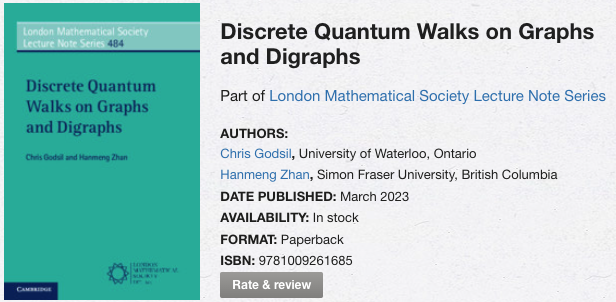
Hanmeng Zhan is an Assistant Professor in the Computer Science Department at Worcester Polytechnic Institute (WPI), where he conducts research at the intersection of algebraic graph theory, quantum information, and quantum computation. His work focuses on discrete and continuous quantum walks, graph spectra, association schemes, and their applications to quantum algorithms and communication. Ph.D. in Combinatorics and Optimization, University of Waterloo (Supervisor: Chris Godsil) Postdoctoral Fellow, Simon Fraser University (with Bojan Mohar) York Science Fellow, York University (with Ada Chan) Postdoctoral Fellow, Université de Montréal (Centre de Recherches Mathématiques, with Luc Vinet) His research lies in the theoretical foundations of quantum walks, including perfect and fractional state transfer, uniform mixing, and spectral analysis of graphs. He has co-authored a book, Discrete Quantum Walks on Graphs and Digraphs (Cambridge University Press, 2023), and published in leading journals such as Linear Algebra and its Applications , Electronic Journal of Combinatorics , Quantum Information Processing , and Journal of Physics A . The most recent articles highlight a sustained focus on quantum walk dynamics, particularly on state transfer phenomena, Laplacian-based walks, and spectral characterizations in structured graphs like circulants, Johnson schemes, and distance-regular graphs. His work often combines deep algebraic techniques with quantum information applications. Organizer, QIT Thinking Seminar, WPI Session Organizer, CMS and AMS Meetings (2023–2025) Mini-course on Discrete Quantum Walks, CMS Winter Meeting 2022 He has supervised undergraduate research through the Fields Undergraduate Summer Research Program and teaches core computer science courses such as Foundations of Computer Science and Theory of Computation at WPI. Previously, he taught courses in discrete mathematics, linear algebra, and quantum walks at Simon Fraser University, York University, and the University of Waterloo. He is actively involved in the combinatorics and quantum information communities, regularly presenting at international conferences including the Joint Mathematics Meetings, CMS meetings, CanaDAM, and specialized workshops on quantum simulation and walks.
Maciej Gierdziewicz serves as a Lecturer at the Department of Applied Informatics within the Faculty of Electrical Engineering, Automatics, Computer Science and Biomedical Engineering at AGH University of Science and Technology in Kraków, Poland. His primary workplace is room 305 in building C-2, and he holds both PhD and Engineer qualifications. His research spans Computational Neuroscience and Animal Genetics , with significant contributions in 3D modeling of presynaptic neural processes and genetic structure analysis of animal populations. In computational neuroscience, he develops sophisticated models of neurotransmitter flow and signal transmission in neurons, focusing on mesh quality and numerical simulation accuracy. His animal genetics work examines inbreeding coefficients, relationship matrices, and population structure in horse and dog breeds including Silesian horses, Tatra Shepherds, and Golden/Labrador Retrievers. Analysis of his 2013-2023 publications reveals two distinct but equally rigorous research trajectories: neural modeling (70% of recent work) emphasizing tetrahedral mesh optimization and diffusive modeling in presynaptic boutons, and animal genetics (30%) featuring detailed pedigree analyses of Polish-bred populations. Both lines demonstrate strong methodological focus on computational efficiency and geometric parameter optimization. No scientific awards or major fellowships are documented in available sources. There is no indication of graduate student advisement or external research grant management in the provided materials.
Agnes Korn is a linguist affiliated with the French National Center for Scientific Research (CNRS) at the Center for Research on the Iranian World (CeRMI). Her work spans historical linguistics, comparative linguistics, and typology, with a focus on Iranian languages, particularly Baluchi and Bashkardi. PhD in Comparative Linguistics (Indo-European Studies), Frankfurt am Main (2003) HDR (Habilitation) in Comparative Linguistics, Frankfurt am Main (2010) Master’s in Indo-European Studies, University of Vienna (1996) Her research explores the historical grammar of Persian, dialectological variation in Western Iran, and the documentation of minority Iranian languages. She has supervised theses through INALCO and contributed to projects on Bashkardi and Balochi dialects. Recent publications examine word order in Bashkardi (2025), grammaticalization in Iranian (2020), and isoglosses in Iranian classification (2019). She has received awards for excellence in Iranian studies and research cooperation. European Award of Iranian Studies (2007) Award for Research Cooperation and High Excellence in Science (2008) Visiting Fellow at Clare Hall and Jesus College, Cambridge (2015)
Dr. Martin Marinov is a researcher affiliated with RWTH Aachen University, specializing in computer graphics, geometric modeling, and 3D mesh processing. His work focuses on multiresolution modeling, subdivision surfaces, and GPU-accelerated algorithms for real-time rendering. Research areas: Subdivision surfaces, quad-dominant remeshing, scattered data approximation, and GPU computing. His publications include innovative methods for mesh decimation, feature preservation, and anisotropic remeshing, with applications in computer graphics and geometric modeling. Marinov has contributed to optimizing parameter correction for subdivision surfaces and developing robust algorithms for complex 3D models.
Liliane Pintelon serves as Full Professor at KU Leuven's Faculty of Engineering Science within the Department of Mechanical Engineering. She leads the Subdivision Maintenance and Health Care Logistics and holds key memberships in the Division Industrial Management, Traffic and Infrastructure, LIM - KU Leuven Institute for Mobility, Council of the Faculty of Engineering Science, POC Mobiliteit en Supply Chain, and Education-Support Committee Group Biomedical Sciences. Her research centers on systemic safety frameworks for human-robot collaboration in industrial and healthcare settings, with emphasis on risk assessment methodologies, maintenance optimization, and health care logistics. Current investigations integrate multi-criteria decision making for hospital wayfinding and supply chain resilience in robotic warehouse systems, addressing critical gaps in technology adoption and worker safety. Recent publications reveal a dominant trend toward system-wide safety validation in human-robot interdependencies, particularly through FMEA-PRAT hybrid models and empirical cobot safety readiness assessments. Her work consistently bridges industrial robotics with healthcare applications, demonstrating cross-sector applicability in warehouse management, hospital navigation, and maintenance-spare parts optimization. As primary supervisor for PhD candidates including N. Berx and A. Adriaensen, she directs major funded projects such as the Safety Readiness Model for Human-Robot Collaboration (2020-2024), Systemic Safety Assessment Method for Human-Robot Interdependencies (2018-2023), and Home Care Technology Management (2015-2025), reflecting sustained research leadership in operational systems engineering.
Juan Cebral is a Professor of Bioengineering and Mechanical Engineering at George Mason University (GMU). His research focuses on computational modeling of cerebral blood flow, particularly in the context of cerebral aneurysms. He holds a PhD in Computational Sciences and Informatics from GMU and an MSc in Physics from the University of Buenos Aires. Key research interests include understanding hemodynamic factors influencing aneurysm rupture, evaluating endovascular devices like flow diverters, and translating computational models into clinical applications. He collaborates with institutions such as Inova Hospitals, Mayo Clinic, and Philips Healthcare, with funding from NIH, American Heart Association, and industrial partners. His work bridges biomechanics, medical imaging, and clinical practice, addressing critical questions in aneurysm diagnosis, treatment, and prevention. Notable projects include studying wall vulnerability in aneurysms and optimizing flow-diverting device performance. He teaches graduate courses in Fluid Mechanics and High-Performance Computing. Publications span over two decades, with recent emphasis on fibrin accumulation modeling, hemodynamic effects of surgical procedures, and machine learning for aneurysm rupture prediction. Awards and honors are inferred from his extensive NIH and industry support.
Kehe Zhu is a Professor in the Department of Mathematics & Statistics at the University at Albany, SUNY . His research focuses on functional analysis, complex analysis, and operator theory, with significant contributions to spaces of analytic functions and operator properties. Contact: kzhu@albany.edu Research Interests : Functional analysis, complex analysis, and operator theory, particularly in the context of Bergman, Hardy, and Fock spaces. His work explores integral operators, embedding theorems, approximation theory, and spectral properties. Recent Article Trends : Recent publications highlight Fock spaces, Bergman spaces, Hardy spaces, and their compact embeddings. Topics include Carleson measures, kernel approximation, heat transforms, and Möbius group actions, reflecting deep interconnections between complex analysis and operator theory.
Angélica M. Osorno is the F.L. Griffin Professor of Mathematics in the Department of Mathematics and Statistics at Reed College. Her research focuses on algebraic topology , higher category theory , and their connections to higher K-theory . She received her PhD from MIT in 2010 under Mark Behrens and was a postdoc at the University of Chicago with Peter May. She co-organizes the Diagram Categories in Homotopy Theory group funded by the Pacific Institute for the Mathematical Sciences (PIMS) and serves as an editor for Orbita Mathematicae and Homology, Homotopy and Applications . Education: PhD in Mathematics, MIT (2010) Research Interests: Algebraic Topology Higher Category Theory Higher K-Theory Equivariant Homotopy Theory Publications: Over 15 recent articles in top journals like Advances in Mathematics , Algebraic & Geometric Topology , and J. Pure Appl. Algebra . Scientific Service: Co-organized the 4th Women in Topology Workshop (2023) and Homotopy Theory in the Ecliptic (2017). Teaching: Taught courses including Intro to Analysis , Discrete Structures , Linear Algebra , and Algebraic Topology . Advising: Advised graduate student Diego Manco .
Devrim Aydın is an Assistant Professor at the Mechanical Engineering Department of the Engineering Faculty , Eastern Mediterranean University. He holds a PhD in Sustainable Energy Technology from the University of Nottingham (2016) and specializes in absorption materials, solar thermal systems, and thermochemical energy storage. Education: BSc (2011): Yildiz Technical University, Mechanical Engineering MSc (2013): Yildiz Technical University, Heat-Process Subdivision PhD (2016): University of Nottingham, Institute of Sustainable Energy Technology His research focuses on innovative composite materials for absorption/adsorption-based heating, cooling, and energy storage, with experimental and numerical expertise in thermal processes. Dr. Aydın has published over 30 papers on topics including: Thermochemical heat storage optimization Salt-impregnated matrices Solar-assisted energy systems Hygrothermal modeling Nano-composite material development Latent heat storage for green buildings He has contributed to projects funded by InnovateUK and serves as a reviewer for journals such as Energy and Renewable and Sustainable Energy Reviews .
Dr. Nafiseh Atapour Senior Research Fellow in Physiology at Monash University since 2015. Holds a PhD in Neurophysiology and completed postdoctoral training at RIKEN Brain Science Institute (Japan), studying visual circuit plasticity. Her research focuses on neuronal plasticity, critical periods in development, inhibitory interneurons, and neurodevelopmental disorders like schizophrenia and epilepsy. Education & Training PhD in Neurophysiology Postdoctoral Fellowship: Prof. Takao K. Hensch’s Lab at RIKEN Brain Science Institute, Japan Research Projects Thalamic plasticity following cortical damage: recovery of vision (2023-2026, PCI) The effects of early exposure to bushfires on adult brain structure and function (2022-2026, CI) Awards Razi Award for Early-Career Scientists (1999) Gender Equity Travel Support Grant (2016) Key Research Themes Explores structural/physiological plasticity in visual circuits, developmental critical periods, and neurochemical markers of cortical neurons. Uses marmoset and mouse models to investigate epilepsy mechanisms and circuit rewiring post-brain injury. Her work contributes to UN SDGs related to health and well-being.
Juan José Rué Perna is an Associate Professor in the Department of Mathematics at Universitat Politècnica de Catalunya (UPC), where he serves in the Faculty of Mathematics and Statistics. He also holds the position of Director of CFIS (Centro de Formación Interdisciplinaria Superior) and maintains strong affiliation with the Centre de Recerca Matemàtica (CRM). His academic career spans prestigious institutions across Europe, including Freie Universität Berlin, CSIC-ICMAT in Madrid, and École Polytechnique in Paris. Licenciado en Matemáticas (5-year degree) Engineering degree in Telecommunications (5-year program) PhD in Applied Mathematics (2009), supervised by Professor Marc Noy Rué's research focuses on combinatorics and discrete mathematics, with expertise in combinatorial structures, random graphs, and enumerative problems. His work bridges theoretical mathematics with applications in computer science, particularly in structural graph theory and probabilistic methods. He has made significant contributions to the understanding of planar graphs, random discrete structures, and additive combinatorics problems. His research combines analytic techniques with combinatorial reasoning to solve challenging enumeration and structural problems. His recent publications demonstrate a consistent trajectory in combinatorial mathematics, with emphasis on planar structures, random discrete objects, and additive problems. The works span theoretical investigations of graph structures, enumeration techniques, and probabilistic approaches to combinatorial problems. His research group GAPCOMB (Geometric, Algebraic and Probabilistic Combinatorics) at UPC continues to produce influential work in these areas. Premi Albert Dou de la SCM Rué has successfully supervised multiple PhD students to completion, including Clément Requilé, Christoph Spiegel, Vasiliki Velona, and Maximilian Wötzel. His research has been supported through numerous competitive grants, including ERC projects, ExploreMaps, and participation in the Berlin Mathematical School. He has organized significant academic events such as EUROCOMB 2021 and various workshops on combinatorics and discrete mathematics. As leader of the GAPCOMB research group at UPC, Rué fosters collaboration between geometric, algebraic, and probabilistic approaches to combinatorial problems. The group maintains strong connections with international research centers including ICMAT in Madrid and institutions across Europe, contributing to the vibrant combinatorial research community in Spain and internationally.
James Calvin is a Professor in the Department of Computer Science at the New Jersey Institute of Technology (NJIT). His research focuses on optimization algorithms, global optimization techniques, convergence rate analysis, and mathematical modeling. He has led multiple federally funded projects, including studies on optimization algorithms for decision problems, efficient simulation of large-scale systems, and stochastic optimization methods. Education : Not explicitly detailed in the text. His research interests emphasize algorithmic development for complex systems, with specializations in global optimization algorithms, convergence rate analysis, and applications in image processing and mathematical modeling. Recent work includes advancements in centroid-based clustering algorithms and bi-objective decision-making frameworks. He has received grants from the National Science Foundation for projects such as 'Optimization Algorithms For Decision Problems With Many Variables' and 'Efficient Simulation of Large-Scale Systems.' Media coverage highlights his contributions to understanding mitochondrial proteins and wood elasticity. Grants & Projects : Optimization Algorithms For Decision Problems With Many Variables (2016–2019) Efficient Simulation of Large-Scale Systems (1999–2004) Calvin collaborates internationally on optimization challenges and has produced over 66 peer-reviewed publications since 1988.