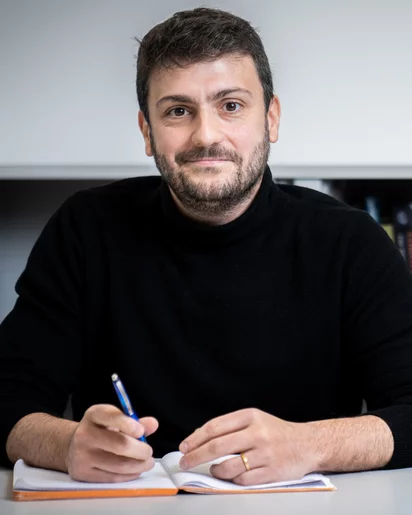
David Wentzlaff is a Professor of Electrical and Computer Engineering at Princeton University, with associated faculty roles in Computer Science and the High Meadows Environmental Institute (HMEI). He leads research in computing architecture, green computing, and sustainable system design. As Director of Undergraduate Studies, he shapes educational programs in his field. Education: Ph.D., Electrical Engineering, MIT (2012) M.S., Electrical Engineering and Computer Science, MIT (2002) B.S., Electrical Engineering, University of Illinois at Urbana-Champaign (2000) Research Focus: Future Computing Systems: Designing manycore architectures, cloud computing infrastructure, and chiplet-based systems for exascale computing. Sustainability: Developing energy-efficient hardware, recyclable computing systems, and eco-friendly decommissioning strategies. Hardware-Software Co-Design: Exploring FPGA integration, in-memory computing, and parallel processing frameworks. Advising & Grants: Advises 8 current graduate students, focusing on topics like chiplet design, neural acceleration, and sustainable computing. Recipient of NSF grants for projects like OpenPiton (open-source manycore research platform) and CAREER awards for energy-efficient architectures. Labs & Collaborations: Leads the Wentzlaff Research Group at Princeton. Develops open-source frameworks like PRGA (FPGA prototyping) and OpenPiton (manycore processor).
Paul Dosh is an Associate Professor of Political Science at Macalester College, where he has served since 2004. He previously taught at Carleton College and the University of California, Berkeley, and held roles as Director of Latin American Studies and Chair of the Political Science department. A Fulbright-Hays Scholar, his expertise spans Latin American politics, urban social movements, and comparative politics. He authored Demading the Land: Urban Popular Movements in Peru and Ecuador and contributes to journals like the Journal of Latin American Studies and NACLA Report on the Americas . Dr. Dosh holds a BA from Carleton College and a PhD from UC Berkeley. His teaching emphasizes Montessori-inspired methods, prioritizing self-teaching and civic engagement. Courses include Urban Latinx Power in U.S. Cities, Latin American Politics, and the Chuck Green Civic Engagement Fellowship. His research and activism focus on social justice, including co-founding Building Dignity in Lima, Peru, and advocating prison abolition. He has worked in 10 Latin American countries and received teaching awards for innovative pedagogy. Beyond academia, he and his wife Andrea enjoy salsa dancing. Recent work explores urban governance, political dynamics in Lima, and gender roles in social movements. His writing analyzes media influence on elections and resource conflicts in Bolivia and Ecuador. Awards: Fulbright-Hays Scholar Multiple Teaching Awards Advising & Grants: Advised numerous student research projects through the Senior Research Seminar. Active in community partnerships linking academic work to civic engagement initiatives. Labs/Teams: Co-founded Building Dignity community center (Lima) and served on the Children of Incarcerated Caregivers board.
Eunjung Lee serves as Assistant Professor of Business Analytics in the College of Business at Lewis University, bringing extensive industry experience from Samsung and LG alongside prior academic roles at Indiana State University. Her expertise bridges business analytics and educational technology with a pronounced focus on equity-driven research. Her educational foundation includes: Ph.D. in Information Technology Management, University of Wisconsin-Milwaukee M.B.A., Korea University B.S., Kwangwoon University Dr. Lee's research trajectory evolved from business analytics toward educational equity, with recent work emphasizing computational thinking in mathematics education, teacher preparation models, and machine learning applications for gifted identification. She investigates how digital tools transform pedagogy while addressing systemic barriers for underrepresented students. Analysis of her 2022-2025 publications reveals dominant themes in equitable gifted identification through cross-cultural validation of the HOPE rating scale, computational thinking integration in teacher training, and longitudinal studies of enrichment program impacts. Her methodology consistently combines quantitative analysis with equity-centered frameworks. No scientific awards were documented in available sources. While specific advising details remain unreported, her courses in Business Intelligence and Forecasting demonstrate applied analytics instruction. Research grants weren't specified in source materials. Collaborative structures like the Lowell Stahl Center for Entrepreneurship provide institutional context, though dedicated labs or research teams weren't explicitly referenced.
Xiaoxiao Zhou is an Assistant Professor in the Department of Biostatistics at the University of Alabama at Birmingham (UAB), affiliated with multiple centers including the Center for Outcomes and Effectiveness Research and Education (COERE), Center for Clinical and Translational Science (CCTS), and the Global Center for Craniofacial, Oral and Dental Disorders (GC-CODED). She holds a PhD in Statistics from The Chinese University of Hong Kong (2022) and completed a postdoctoral fellowship at Duke University's Department of Statistical Science. Her research focuses on causal inference, Bayesian methods, longitudinal data analysis, and survival analysis, with applications in Alzheimer’s disease, cardiovascular conditions, and neurodegenerative disorders. Dr. Zhou’s work integrates advanced statistical techniques with medical and behavioral data, including neuroimaging and latent variable modeling. Key areas include handling intercurrent events in clinical trials, causal mediation analysis, and joint modeling of longitudinal and survival outcomes. She collaborates widely with clinicians and biostatisticians to address real-world challenges in healthcare and disease progression studies. Her scholarly contributions span over a dozen peer-reviewed articles, emphasizing methodological innovations in biostatistics and their practical applications. She advises students such as Zhenying Ding and actively participates in academic committees. Outside academia, she enjoys outdoor activities like mountain hiking and weight lifting.
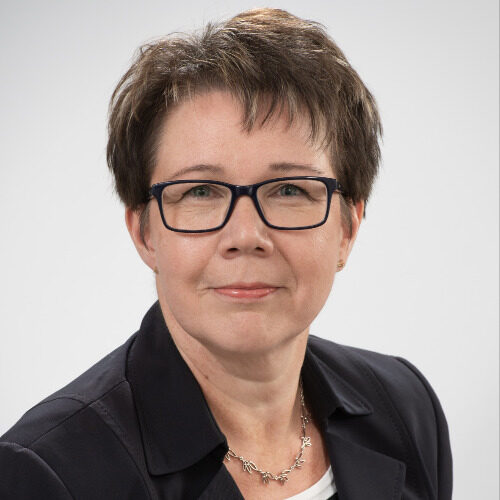
Ulla-Mari Kinnunen is a Professor of Health and Human Services Informatics at the University of Eastern Finland's Department of Health and Social Management, within the Faculty of Social Sciences and Business Studies. She also holds the title of Adjunct Professor in Evidence-Based Research and Development. Her research focuses on health informatics, digitalization in healthcare and social services, evidence-based practices, and informatics competencies for professionals and citizens. She chairs the Finnish nursing terminology (FinCC) and serves on the IMIA Nursing Informatics Board and the Finnish Centre for Evidence-Based Health Care. She supervises 16 doctoral students and coordinates the Health and Human Services Informatics (HHSI) Master’s program. She is a member of the Finnish Publication Forum (Panel 14) and the Editorial Board of JMIR Nursing. In 2021, she was awarded the IMIA fellowship as a Fellow of the International Academy of Health Sciences Informatics. Her research interests include structured data systems, classifications in electronic health records (EHR), and organizational factors influencing digitalization. Key projects include the 'FinCC' research group for nursing terminology and the 'House of Effectiveness' initiative. Her work emphasizes improving healthcare quality through informatics and evidence-based practices. Recent publications highlight studies on information systems implementation, digitalization challenges, and the role of informatics in interprofessional collaboration. She actively contributes to international health informatics education and policy, including the European Summer School in Health Informatics and the TIGER Initiative for workforce development. Grants and Projects: Research Project on Data Resources for Fire Investigation (2023–2025), IMIA Fellowship, and EU-funded initiatives like eHealth4all@eu. Labs/Teams: Health and Human Services Informatics Research Group, FinCC Research Group, and the Finnish Centre for Evidence-Based Health Care.
Mark D. Gross is a Professor of Computer Science and Director of the ATLAS Institute at the University of Colorado Boulder. His research focuses on modular robotics, tangible interaction design, digital fabrication, and computational design. He co-founded Modular Robotics and Blank Slate Systems, leveraging his expertise in educational technology and maker culture. Education: PhD in Design Theory & Methods from MIT. Academic history includes roles at Carnegie Mellon University and University of Washington Seattle. His work spans architecture, robotics, and human-computer interaction. Research Interests: Modular robotics and computationally enhanced construction kits Tangible interaction and e-textiles Shape-changing interfaces and swarm robotics Sketch-based interaction and digital fabrication Publications highlight advancements in collaborative AR systems, shape-changing interfaces (e.g., LiftTiles, ShapeBots), and accessible technologies like FluxMarker. His work bridges computational tools and creative design processes. Advising: Guided students such as Ryo Suzuki (PhD '20). Entrepreneurial ventures include companies spun off from research. Labs/Teams: Leads projects at the ATLAS Institute, emphasizing interdisciplinary collaboration in robotics, design, and human-centered computing.
Himika Bhattacharya is an Associate Professor in the Department of Women's and Gender Studies at Syracuse University, affiliated with the African American Studies and South Asian Studies programs. She holds a Ph.D. and specializes in qualitative research methods, transnational feminism, and South Asian studies. Research Focus: Caste, race, gendered violence, resistance, and solidarity, with a regional focus on India and the Himalayas. Affiliations: South Asia Center, Democratizing Knowledge collective. Her book Narrating Love and Violence (2017) examines caste, tribe, and state dynamics in Lahaul, India. She has secured grants like the CUSE Innovative Research Grant (2021–2024) for collaborative graduate education initiatives. Awards: Lead organizer of Syracuse University’s Inaugural Dalit History Month events (2022). Teaching includes feminist methodologies and courses fulfilling the South Asian Studies minor. She advises students on qualitative methods and transnational feminist frameworks.
Dr. Teresa Wang is a Senior Lecturer in Data Science at Monash University's Faculty of Information Technology, specializing in entity/user modeling, relational/structural machine learning, and graph/network analysis. She holds a Ph.D. from the University of Queensland and degrees from Nanjing University. Currently, she directs the Master of Data Science Program and teaches courses like FIT5201 Machine Learning. Her research focuses on social, e-commerce, and health data modeling, with notable projects including the Knowledge Enriched Approach for Effective Personalization (2025–2027) and collaborations on AI in Mental Health and Site Safety. Dr. Wang has co-authored over 59 publications, emphasizing areas like ontology matching and multimodal data analysis. She actively supervises PhD students and contributes to initiatives like the CSIRO Next Generation Graduates Program for clean energy and sustainability. Education: Ph.D. in Computer Science (2017), University of Queensland Master of Computer Science (2013), Nanjing University Bachelor of Software Engineering (2010), Nanjing University Research Interests: Entity modeling, spatio-temporal data analysis, graph mining, recommender systems, and health/medical records mining. She explores applications in social media, e-commerce, and healthcare sectors. Projects: "Knowledge Enriched Approach for Effective Personalization" (2025–2027) "AI for Clean Energy and Sustainability" (2023–2027) "CSIRO Next Generation Graduates Program: AI in Mental Health" (2023–2027) "Large-scale multimodal knowledge management" (2022–2025) Grants & Collaborations: Engaged with CSIRO, Crank Group, and Pola Practice Pty Ltd. Her work aligns with UN SDGs in education and sustainable energy systems. Labs/Teams: Part of the Monash Energy Institute and Monash Data Futures Institute, contributing to interdisciplinary AI and energy research.
Falk MÜLLER-RIEMENSCHNEIDER is an Associate Professor and Vice Dean (Research) at NUS Saw Swee Hock School of Public Health and holds a joint affiliation with NUS Yong Loo Lin School of Medicine. He leads the Physical Activity and Nutrition Determinants in Asia (PANDA) research programme. With a medical degree from the University of Cologne (2003) and advanced training in Public Health at the London School of Hygiene & Tropical Medicine (2005), he has built a career focused on cardiovascular disease prevention, physical activity promotion, and obesity epidemiology. His academic qualifications include a Doctoral degree from Charité University Medical Centre Berlin (2005) and Habilitation (2011). Professional roles include Senior Lecturer/Research Fellow positions at Charité (2005–2012), and administrative leadership roles such as Teaching Coordinator and Project Division Coordinator for Cardiovascular Research (2008–2012). Research interests center on lifestyle determinants of chronic diseases, with emphasis on physical activity interventions, dietary patterns, and early childhood development. Notable work includes the Singapore Preconception Study and the GUSTO cohort study, examining long-term health trajectories. Media engagements highlight his work on screen time effects in children and urban green space benefits. His recent publications (2021–2025) address mHealth intervention design, park-based physical activity, and 24-hour movement guidelines. Key themes include digital health adoption barriers, longitudinal cohort studies, and culturally tailored public health strategies.
Leah Doane is a Professor and Chair of the Department of Psychology at Arizona State University (ASU) since 2025. She holds affiliations with the Biodesign Center for Personalized Diagnostics and previously served as Associate Dean of Graduate Initiatives in the College of Liberal Arts and Sciences (2024). Her academic background includes a B.A. in Psychology from Cornell University (2002), M.A. and Ph.D. in Human Development and Social Policy from Northwestern University (2006/2008), and a postdoc at the University of Chicago in Psychiatry and Behavioral Neuroscience. Research focuses on developmental psychopathology, examining links between health behaviors, physiological stress (e.g., cortisol), and stressful experiences across childhood, adolescence, and emerging adulthood—with particular emphasis on Latinx youth and college transition challenges. Key themes include cultural adaptation, sleep health, epigenetic influences, and bicultural stress. Funded by NIH, CDC, and Army Research Institute, her work integrates ecological and ambulatory assessment methods. Leadership roles include Director of Faculty Success, Developmental Graduate Training Area Head, and Deputy Chair in ASU's Psychology Department. Awards include William T. Grant Foundation Scholar (2025-). Active in teaching advanced courses on research methods and thesis supervision, she mentors students through courses like Honors Thesis (PSY 493), Research (PSY 792), and Dissertation (PSY 799). Key grants include studies on Latino youth college pathways (Helios Education Foundation, 2015-2016), genetic/environmental influences on sleep and behavior (NICHD, 2015-2020), and culturally informed interventions. The Adolescent Stress and Emotion Lab (adolescentstressandemotionlab.org) serves as her research hub.
Dr. Timothy Fraser is a Computational Social Scientist serving as Ezra Systems Research Associate in Cornell University's Systems Engineering Program and Coordinator for the Center for Transportation, Environment, & Community Health (CTECH). Holding a PhD in Political Science from Northeastern University (2022), he focuses on climate change adaptation, disaster resilience, and energy policy using big data analytics, GIS, and AI. His work bridges computational methods with societal challenges, emphasizing community engagement and policy impact. Education: PhD in Political Science, Northeastern University (2022) MA in Political Science, Northeastern University BA in International and Global Studies, Middlebury College Research Interests: Fraser’s research integrates computational social science with environmental policy, exploring how social networks and governance structures influence cities' climate adaptation strategies. Key areas include renewable energy adoption, disaster evacuation dynamics, and pandemic response mechanisms. He employs mixed methods such as network analysis, statistical modeling, and fieldwork. Grants & Awards: Fulbright Fellowship (2016), Kyushu University Japan Foundation Doctoral Fellowship (2020) USDOT Multimillion Grant Administrator (2022-2023) Teaching & Mentorship: Fraser teaches statistical methods and research design at Cornell, advising over 30+ students in projects published in leading journals. He coordinates capstone teams and mentors researchers in data science and policy analysis. Labs & Projects: Leads the Climate Action in Transportation dashboard initiative (Gao Labs), developing tools for emissions visualization. Collaborates on UNDP social capital mapping projects in Mexico and Paraguay, applying spatial analysis techniques for vulnerable communities.
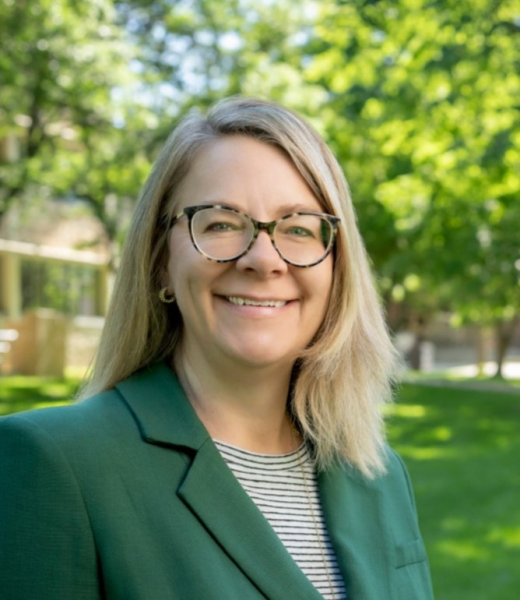
Kjerstin Thorson serves as the Dean of the College of Liberal Arts at Colorado State University, a position she assumed on August 1, 2024. Previously, she was the Brandt Endowed Professor of Political Communication and Associate Dean for Strategic Initiatives at Michigan State University’s College of Communication Arts & Sciences. An internationally recognized scholar, her research centers on digital platforms and their impact on civic life and culture. Her educational background includes: BA in English from Macalester College MA in Journalism from the University of Missouri-Columbia PhD in Mass Communication from the University of Wisconsin-Madison Thorson's research explores the intersection of digital media, political communication, and civic engagement. She investigates how social media platforms shape political participation, news consumption, and civic discourse, with a particular focus on young adults and historically marginalized communities. Her work addresses critical issues such as equity in digital civic infrastructure, the role of algorithms in political exposure, and the dynamics of online moderation and community governance. She examines both the empowering potentials and the challenges of digital media for democratic participation. Her recent publications (2023-2025) reveal a sustained investigation into platform governance, volunteer moderation, and the urban-rural divide in digital civic engagement. She also delves into Gen Z's civic behaviors, the spread of misinformation, and the evolving landscape of political learning on social media. Her work often employs mixed-methods approaches, combining digital trace data with surveys to understand complex media effects. Thorson has received notable recognition for her contributions: Michigan State University’s Teacher-Scholar Award 2022-2023 Fellow of the Big 10 Academic Alliance Leadership Program Her research has been supported by prestigious organizations including the National Science Foundation (NSF), the Social Science Research Council, and the Spencer Foundation. In her administrative roles, she has prioritized student success through initiatives like the Ignite the Future program, which supports first-generation and marginalized students, and has championed faculty development through the creation of a Center for Teaching and Learning. While specific advisees are not listed, her leadership in student success programs underscores her commitment to mentoring. Under her leadership at Michigan State University, the College of Communication Arts & Sciences expanded its revenue-generating partnerships, created a college-wide Center for Teaching and Learning, launched the Ignite the Future family of programs, and grew the esports initiative. She has also focused on improving culture and climate through promotion pathways for non-tenure track faculty, climate surveys, and community-building events.
Patricia K. Tong is an economist at RAND and a Professor of Policy Analysis at the RAND School of Public Policy. She specializes in public finance and labor economics, with a strong focus on military and civilian personnel policy, compensation, and health economics. Her research addresses critical issues in military personnel retention, family caregiving, retirement benefits, and access to mental and behavioral health services. Research Interests: Tong’s work combines qualitative and quantitative methods to evaluate monetary and nonmonetary compensation policies, labor market outcomes, and social welfare impacts. Her expertise spans economic policy, health economics, military personnel systems, and family support structures. She has led studies on Social Security survivor benefits, tax policy anti-poverty effects, and nurse staffing standards. Publication Trends: Her recent research centers on military compensation, health care access for service members and families, and financial inclusion. Articles reflect a consistent policy-oriented focus, often supporting governmental reviews such as the Quadrennial Review of Military Compensation, and addressing timely issues like pandemic caregiving and unbanked populations. Scientific Contributions: Published in top journals including American Economic Review and Health Economics Key contributor to national policy discussions on military pay, retention, and health care Research used to inform federal and state-level policy decisions Advising and Grants: While specific students are not listed, her leadership in major research projects indicates a supervisory and mentoring role. She has led federally funded studies on military compensation, health care access, and financial inclusion, demonstrating sustained grant support from defense and public policy agencies. Labs and Teams: Tong conducts research within RAND’s interdisciplinary policy teams, particularly those focused on defense, health, and economic security. Her work often involves collaboration with military stakeholders, federal agencies, and public health experts to develop actionable policy solutions.
Dr. Imad El Haddad serves as Group Head of the Molecular Cluster and Particle Processes group at the Laboratory of Atmospheric Chemistry (LAC), part of the Center for Energy and Environmental Sciences at Paul Scherrer Institute (PSI), Switzerland, since 2018. Previously, he held positions as Tenured Scientist and Deputy Head (2018-2019), Senior Scientist in the Smog Chamber group (2015-2018), and Postdoctoral Fellow (2011-2015) at PSI. His research aims to quantify how anthropogenic emissions alter atmospheric pollutant composition and impact Earth's climate and public health through molecular-level analysis using advanced mass spectrometry techniques. His academic background includes: Ph.D. in Atmospheric Chemistry, University of Provence, Marseille (2007-2011) Master's in Environmental Sciences (with distinction, rank 1/9), University of Provence (2006-2007) Master's in General Chemistry (with distinction, rank 1/10), Saint-Joseph University of Beirut (2005-2006) Bachelor of Science in Chemistry (with distinction, rank 1/14), Saint-Joseph University of Beirut (2002-2005) El Haddad's work centers on molecular fingerprinting of atmospheric aerosols , utilizing mass spectrometry (GC/MS, HPLC/APCI-MS2, HPLC/ESI-MS2) to identify primary and secondary molecular markers. He conducts smog chamber experiments to characterize emissions from wood burning, traffic, and cooking processes, determining secondary organic aerosol potential and oxidation state evolution. His group also studies in-cloud aqueous-phase aging and collaborates with global modelers to link aerosol composition to climate forcing and health outcomes like oxidative stress. Recent publications (2025-2024) reveal three dominant trends: (1) rigorous molecular-scale analysis of secondary aerosol formation under varying humidity/temperature, (2) source apportionment breakthroughs in diverse regions (India, Europe, Arctic) using 14C and AMS data, and (3) quantification of health-relevant aerosol properties such as oxidative potential through DTT assays. High-resolution mass spectrometry is a consistent methodological thread across these studies. His scientific awards include: MENRT research fellowship from French ministry of research (2007-2010) Excellence Scholarship (top 1% student, University of Saint Joseph, 2005) Distinction Prize (best student, University of Saint Joseph, 2005) As Group Head, El Haddad oversees the Molecular Cluster and Particle Processes group's research direction and mentorship of junior scientists. While specific grant details are absent from the text, his leadership in multi-institutional publications (e.g., CERN CLOUD, iCUPE) implies active grant management and international collaboration. The group's work bridges laboratory simulations, field deployments, and health/climate modeling to address air pollution complexities. The Molecular Cluster and Particle Processes group develops cutting-edge online/offline mass spectrometers for 1 Hz-resolution atmospheric analysis. They deploy instruments in laboratory smog chamber experiments and global field studies, focusing on molecular marker identification, emission source characterization, and aging process quantification. Collaborations with biochemists and climate modelers extend their impact beyond pure aerosol physics into health risk assessment and policy-relevant climate science.
Likoebe Maruping is a Professor of Computer Information Systems and Director of the Ph.D. program at Georgia State University's J. Mack Robinson College of Business. He is a member of the Center for Digital Innovation and serves as a senior editor for MIS Quarterly , having previously held editorial positions at Information Systems Research and the Journal of the Association for Information Systems . Previously, he taught at the University of Arkansas and the University of Louisville. Education: Ph.D. in Information Systems, University of Maryland, Robert H. Smith School of Business B.S. in Information Systems, University of Maryland, Robert H. Smith School of Business B.S. in International Business, University of Maryland, Robert H. Smith School of Business Maruping's research spans digital innovation , open source software development , agile methodologies , and team collaboration in dispersed settings . His work explores how leadership styles, particularly empowering leadership , can mitigate stress and improve performance in software development teams. He examines governance in digital platform ecosystems and investigates the relationship between digital technologies and social justice, as evidenced by his 2024 MIS Quarterly special issue contribution. His research often employs multilevel analysis approaches to connect micro and macro phenomena in information systems. Maruping's recent publications reveal a strategic shift toward examining AI innovation frameworks, platform ecosystem governance, and the social implications of technology. His 2025 work on AI innovation contrasts with traditional IT innovation through patent analysis, while his research on digital skill visibility in open source communities demonstrates practical applications of theoretical frameworks. These publications consistently bridge academic rigor with practical business implications. Editorial Recognition: Senior Editor, MIS Quarterly Former Associate Editor, Information Systems Research Former Associate Editor, MIS Quarterly Former Senior Editor, Journal of the Association for Information Systems As Ph.D. program director and former CIS department Ph.D. coordinator, Maruping has advised numerous doctoral students. His leadership extends to strategic program development, curriculum innovation, and enhancing recruitment of diverse doctoral candidates. He frequently leads workshops on multilevel theorizing, as evidenced by his 2023 workshop at Hong Kong Baptist University. His research has been supported through collaborations with major institutions and has influenced both academic discourse and industry practices in information systems management. Maruping is actively engaged with the Center for Digital Innovation at Robinson College of Business, which serves as his primary research hub. His work often involves cross-institutional collaborations with researchers from leading universities worldwide, reflecting the global nature of contemporary information systems research.