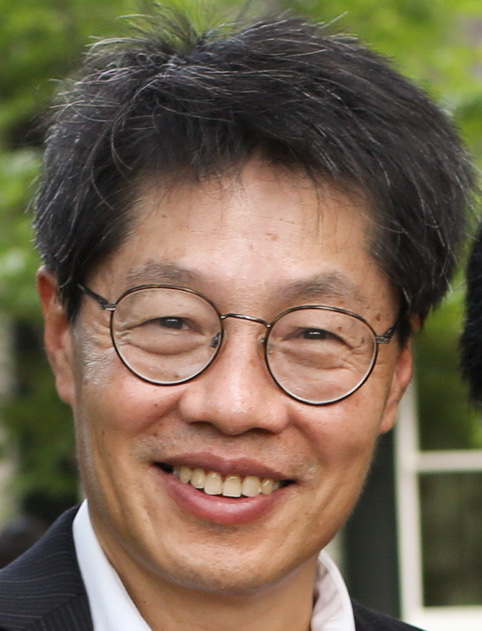
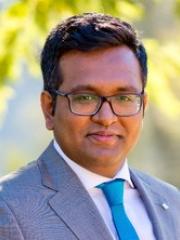
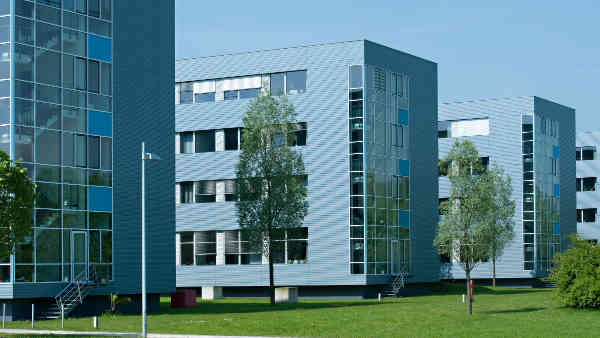
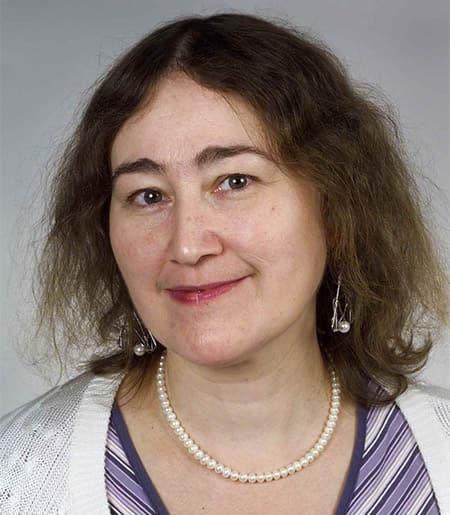
Professor Jocelyn McPhie is affiliated with the School of Natural Sciences, Earth Sciences at the University of Tasmania . Her research spans Volcanology , Resource Geoscience , and Igneous Petrology , focusing on submarine volcanism, ore deposit formation, and volcanic facies analysis. Her funded projects include studies on the Olympic Dam deposit and Heard Island volcanism . She has supervised numerous PhD and Master's students in topics like explosive eruptions , hydrovolcanic interactions , and volcanic-hosted mineralization . Key grants: Australian Research Council Linkage Projects , BHP Billiton funding Expertise: Argon-Argon dating , tephrostratigraphy , volcanic architecture
Tapio Ala-Nissilä is Professor of Physics at Aalto University School of Science, Finland, where he heads the Multiscale Statistical and Quantum Physics (MSP) group. He simultaneously serves as Head of the Interdisciplinary Centre for Mathematical Modelling and Professor of Applied Mathematics & Theoretical Physics at Loughborough University, UK, and as Adjunct Professor of Physics at Brown University, USA. His research spans statistical physics, quantum mechanics, and soft matter systems with emphasis on computational approaches. Key interests include complex fluids, nanofluids, polymer translocation, quantum thermodynamics, and open quantum systems. He extensively employs molecular dynamics, Monte Carlo methods, and density functional theory to study nanoscale phenomena in biological, material, and quantum contexts. Recent publications (2024-2025) reveal strong interdisciplinary trends across quantum materials, biophysics, and environmental engineering. Work focuses on thermal properties of 2D materials like graphene, protein dynamics in viral systems, novel surface phenomena in liquid-repellent materials, and advanced computational methods for many-body quantum systems. He directs the Multiscale Statistical and Quantum Physics group at Aalto University investigating fundamental quantum and statistical phenomena, and leads the Interdisciplinary Centre for Mathematical Modelling at Loughborough University fostering cross-departmental collaboration in applied mathematics.
Jian-Guo Liu is a Professor of Mathematics and Physics at Duke University, with primary affiliations in the Departments of Mathematics and Physics. His research encompasses applied mathematics, partial differential equations, kinetic theory, computational fluid dynamics, and stochastic algorithms. Professor Liu's work bridges theoretical modeling and numerical methods, particularly in complex systems involving nonlinear dynamics, fluid behavior, and emergent phenomena. Research interests focus on multiscale modeling of physical systems, including stochastic processes in chemical reactions, fluid-structure interactions, and materials science. Recent publications demonstrate strong emphasis on mathematical foundations of biological and physical systems, with recurring themes in Fokker-Planck dynamics, mean-field games, tumor growth modeling, and computational methods for interfacial phenomena. Publications showcase consistent focus on analytical and numerical solutions to high-dimensional problems, with applications ranging from medical imaging to electrochemistry. The work exhibits advanced techniques in asymptotic analysis, stochastic approximations, and geometric evolution equations.
Dr Adnan Sufian is an Honorary Lecturer at the School of Civil Engineering, University of Queensland, with expertise in multiscale mechanics of granular materials. His research bridges geotechnical engineering and computational modeling, focusing on fluid-soil interactions and civil infrastructure resilience. PhD from UNSW Sydney Visiting scholar at MIT Postdoctoral work at Imperial College London Industry experience with SMEC Australia His research addresses granular material behavior under complex conditions, including internal erosion dynamics in dams, particle migration in gap-graded soils, and seismic stability of engineered landfills. Methodologically, he employs CFD-DEM coupling , pore network models , and Voronoi tessellation for granular simulations. The 15 most recent publications highlight a focus on erosion mechanisms , filter design , seismic stability , and microcapsule retention in granular media. These works utilize computational methods (CFD-DEM, PNM-DEM) and experimental techniques (X-ray CT, time domain reflectometry) to analyze soil-fluid interactions. Dr Sufian is available for supervision, with current projects on resilient infrastructure and past completions investigating micro-scale erosion conditions and particle migration dynamics . His research has been supported by grants from ARC and UQ, including projects on real-time erosion prediction and geotechnical data integration. Key collaborations span physicists, mathematicians, and engineers , reflecting the interdisciplinary nature of his work on granular material behavior. The ARC Advance Timber Hub and partnerships with institutions like Imperial College London and UNSW Sydney further contextualize his academic network.
Hadrien Bense is a CNRS Researcher affiliated with the Institute of Acoustics at Le Mans Université , focusing on the Materials department. His work bridges acoustics, mechanics, and material science. Research interests include: Instabilities in slender structures Mechanical metamaterials Elastic waves in complex media Fluid-structure interactions Soft matter physics Capillary and surface forces Recent publications highlight his expertise in: Nonlinear mechanical pathways Metamaterial wave propagation Dielectric elastomer mechanics Capillary-driven adhesion phenomena Geometrically frustrated structures Electro-mechanical coupling He contributes to the LAUM (Laboratoire d'Acoustique de l'Université du Mans) laboratory, with research intersecting with transversal axes on Metamaterials , Nonlinear Acoustics , and Fluid-Structure Interactions .
Jean-Philippe Groby is a Research Director at CNRS working at the Laboratory of Acoustics of the University of Le Mans (LAUM), UMR6613 CNRS. He leads the "Acoustic Materials" research team, one of three research teams at LAUM, and chairs the Technical Committee "Acoustic Materials" of the European Acoustics Association (EAA). He also serves as an associate editor for npj Acoustics. Education: Habilitation à Diriger des Recherches (2017): "Acoustic wave propagation in lossy, structured and periodic media" at Université du Maine PhD (2005): "Modélisation de la propagation des ondes élastiques générées par un séisme proche ou éloigné à l'intérieur d'une ville" at Université de la Méditerranée - Aix-Marseille II Research Interests: Jean-Philippe Groby specializes in acoustic wave propagation through various media, with particular focus on metamaterials and porous media . His research spans theoretical modeling, experimental characterization, and practical applications of acoustic materials. His work has significant implications for noise control in urban environments, automotive and aerospace industries. He has pioneered techniques for designing materials that can manipulate sound waves with unprecedented precision, including perfect absorbers and diffusers that operate at subwavelength scales. Publication Trends: Groby's recent publications (2023-2025) demonstrate a strong focus on dual-function acoustic metamaterials that can simultaneously absorb and diffuse sound, Willis coupling phenomena in complex materials, and advanced characterization methods for anisotropic porous media. His work increasingly bridges theoretical acoustics with practical engineering applications, particularly in room acoustics, aerospace noise control, and architectural sound design. A notable trend is the development of causality-driven designs that optimize acoustic performance while minimizing material usage. Professional Activities: Associate Editor, npj Acoustics Chair, Technical Committee "Acoustic Materials" of the European Acoustics Association Editor of the book "Acoustic Waves in Periodic Structures, Metamaterials, and Porous Media: From Fundamentals to Industrial Applications" (Springer, 2021) Research Leadership: As leader of the "Acoustic Materials" team at LAUM, Groby oversees a vibrant research group focused on developing innovative acoustic solutions. His team has established strong collaborations with international research institutions and industry partners, particularly in the automotive and aerospace sectors. They have developed several patented technologies for sound absorption and control, including metaporous materials and acoustic meta-lenses.
Michael Vynnycky is an Affiliated Professor at KTH Royal Institute of Technology , specializing in mathematical modeling and numerical analysis of industrial metallurgical processes. His research focuses on continuous casting , electromagnetic stirring , and fluid-structure interactions in manufacturing systems. Key Research Areas: Continuous casting of metals, fluid dynamics, heat transfer, computational methods (FEM, CFD), inverse Stefan problems, and oscillation mark formation. Collaborations: Frequent collaboration with researchers like H. Fredriksson, B. Glaser, and A. Safavi Nick. Applications: Steel production, die casting, redox flow batteries, and polymer electrolyte fuel cells. Recent publications highlight work on blast furnace dynamics , muon radiography for structural analysis, and asymptotic modeling of gas-solid flows. His methodologies emphasize mathematical rigor and industrial relevance , as seen in studies on macrosegregation and electromagnetic flow control. Techniques: Leverages asymptotic analysis multiphysics simulation finite element methods computational fluid dynamics boundary reconstruction algorithms experimental validation to solve complex industrial problems. Email Contact: michaelv@kth.se
Meike Bos is a Researcher at Utrecht University 's Faculty of Science , specializing in Physical Oceanography within the Marine and Atmospheric Research division. Her work focuses on computational physics and numerical modeling of complex systems. Education : Doctoral degree in computational physics from Utrecht University (2024 thesis). Research Interests Transport mechanisms of macroplastics in ocean systems Development of parameterizations for unresolved physical processes Lagrangian analysis techniques using OceanParcels Soft condensed matter physics Dynamics of mucus strands and microswimmers Rotational diffusion in active rod suspensions Recent Publications Examine trends in computational modeling of: Disordered biological systems (mucus strands) Active probe dynamics in structured environments Environmental transport processes Collaborations Active in interdisciplinary research connecting oceanography and biophysics, with collaborations at Utrecht University and international institutions.
Mohammad Rafiee is an Adjunct Professor in the Department of Mechanical Engineering at the Faculty of Engineering, University of Ottawa. He holds affiliations with City University of Hong Kong, École Polytechnique de Montréal, National Research Council Canada, and Advanced Microelectronic Technologies, Sanmina. His research focuses on Advanced materials (graphene, carbon nanotubes, piezoelectric composites) Additive manufacturing (multi-material 3D/4D printing, coaxial deposition) Mechanical/thermal analysis of composite structures Smart devices (sensors, actuators, energy harvesters) Numerical modeling (finite element analysis, nonlinear dynamics) Recent publications highlight trends in Nonplanar additive manufacturing of piezoelectric devices Multiscale graphene/epoxy composites for vibration damping Thermal stability of nanomaterial-reinforced laminates 4D printing applications Structural health monitoring via machine learning Development of polymer-derived ceramics Scientific awards include Ontario Trillium Scholarship Fonds de Recherche du Québec – Nature et technologies (FRQNT) World’s Top 2% Scientists (Stanford, since 2020) Top 1% most cited authors in materials science
Yiqi Feng is a doctoral researcher at the Chair of Aerodynamics and Fluid Mechanics at Technical University of Munich, working under the supervision of Prof. Dr.-Ing. Nikolaus Adams. Currently completing their dissertation titled "Data-driven Methods on Optimizing Numerical Schemes for Complex Compressible Flows" with expected completion in 2025. Research focuses on the integration of machine learning techniques with computational fluid dynamics, specifically developing optimization frameworks for numerical schemes in compressible flow simulations. Key interests include Bayesian optimization, deep reinforcement learning applications, and high-order numerical methods for complex flow phenomena. The work bridges traditional fluid mechanics with modern data-driven approaches to enhance simulation accuracy and efficiency. Publications demonstrate a consistent research trajectory in developing adaptive optimization frameworks for fluid dynamics simulations, with increasing sophistication from 2022-2024. The research shows strong emphasis on multi-objective optimization techniques applied to numerical scheme design, particularly for handling compressible flows with complex shock structures and discontinuities. As part of TUM's Aerodynamics and Fluid Mechanics research group, the work contributes to the department's broader initiatives in flow simulation, wind tunnel testing, and computational methods development, supporting projects like CRC and FURADO mentioned in the institutional research structure.
Dr. Marina Romanova is a Senior Research Associate at Cornell University's Center for Radiophysics and Space Research (CCAPS) and a key member of the Carl Sagan Institute (CSI), affiliated with the Department of Astronomy. With over two decades of continuous service since 1996 (Visiting Scientist 1996, Research Associate 1999-2002, Senior Research Associate 2002-present), she is a leading specialist in computational astrophysics renowned for pioneering 3D magnetohydrodynamic (MHD) simulations of astrophysical phenomena. Education: 1973-1981: Undergraduate and graduate studies in Astronomy and Astrophysics at Moscow State University 1986: Ph.D. in Astrophysics and Radioastronomy from the Space Research Institute, Moscow, under joint supervision of Yakov Zeldovich and Gennady S. Bisnovatyi-Kogan Dr. Romanova's research revolutionized understanding of accretion processes through the first 3D MHD simulations of accretion onto rotating stars with tilted magnetic fields, explaining funnel streams, hot spots, and variability in young stars, neutron stars, and white dwarfs. She discovered the unstable accretion regime that accounts for stochastic light curves in classical T Tauri stars. Her current work focuses on planet-disk dynamics in protoplanetary systems, modeling planetary orbits within low-density cavities and at disk-cavity boundaries using advanced 3D MHD techniques. This research bridges theoretical astrophysics with observational data from missions like TESS. Analysis of her 15 most recent publications reveals a dominant focus on high-resolution computational modeling across three interconnected domains: (1) planet-disk interactions in protoplanetary systems, (2) accretion dynamics onto magnetized stars with complex magnetic topologies, and (3) outflow/jet launching mechanisms. Her work consistently integrates numerical simulations with observational astrophysics, demonstrating exceptional methodological rigor in addressing fundamental questions about stellar formation and planetary system evolution. As an active contributor to the Carl Sagan Institute, Dr. Romanova collaborates on interdisciplinary research at the intersection of astrophysics and astrobiology. Her work has received significant scientific attention, featured in NASA High-End Computing Program reports, Eurasia Review, and Science News for insights into young star behavior and implications for understanding our solar system's formation. Her sustained research productivity since the 1980s, including 2023 publications, underscores her enduring impact on computational astrophysics.
Dr. Joachim Eichhorn serves as a Senior Scientist (Researcher) in the Dynamic Meteorology group at Johannes Gutenberg University Mainz's Institute for Atmospheric Physics, where he has maintained continuous employment since 1990. His academic credentials include: Meteorology Diploma (University of Mainz, 1982) PhD in Meteorology (University of Mainz, 1989) Dr. Eichhorn's research centers on Atmospheric Dynamics with specialized expertise in Rossby Waves , Mountain Meteorology , and Micrometeorology . His work pioneers numerical modeling approaches for atmospheric flows, particularly through development of the MISKAM and KLIMM microscale models for urban pollution dispersion and complex terrain analysis. Key contributions include banner cloud formation mechanics, European heat wave dynamics, and traffic emissions' impact on historic structures. His 15-peer-reviewed publications (1988-2020) reveal evolving research trajectories from foundational urban climate modeling toward contemporary atmospheric predictability studies, consistently emphasizing practical environmental applications in air quality management and meteorological hazard prediction. As an integral member of the Dynamic Meteorology research group, Dr. Eichhorn collaborates on projects examining atmospheric extremes, Rossby wave packet properties, and mountain meteorology phenomena. No information regarding scientific awards, student advising, or grant funding is documented in available sources.
Tomas Kutavičius is an Associate Professor at the Jazz Department of Vytautas Magnus University. As both a jazz pianist/composer and a creator of academic music , he bridges improvisational spontaneity with rigorous compositional frameworks. His work spans theater scores , symphonic pieces , and chamber works , often reflecting nature-inspired metaphors and existential themes . His research focuses on the intersections of jazz and classical traditions , improvisation as a creative act , and music as therapy . He emphasizes emotional authenticity and structural purity , drawing parallels between natural rhythms and musical dramaturgy . Kutavičius' compositional trends reveal a shift from jazz ensembles to large-scale symphonic works , with a recurring interest in theatrical collaborations and symbolic motifs . His 2023 solo album Lake epitomizes his improvisational philosophy , while older works like Dieviškas šėlas (2013) showcase his mastery of orchestral dynamics . He teaches jazz improvisation and contemporary composition at Vytautas Magnus University, having previously taught at the M.K. Čiurlionis Art Gymnasium and Vilnius Choral Singing School. His pedagogical approach mirrors his artistic ethos: "shake off dirt to reveal the core" .
Wesley Burghardt serves as Associate Dean of Undergraduate Engineering and Professor of Chemical and Biological Engineering at Northwestern University's McCormick School of Engineering. Appointed in 1990, he previously chaired the Department of Chemical and Biological Engineering and oversees curriculum development, professional growth, and personal development initiatives for engineering undergraduates. His academic credentials include: Ph.D. in Chemical Engineering from Stanford University M.S. in Chemical Engineering from the University of Illinois B.S. in Chemical Engineering from the University of Illinois Burghardt's research pioneers optical and X-ray scattering methodologies to investigate complex fluid dynamics during polymer flow. Key focus areas encompass: Microstructure evolution in block copolymer gels under deformation Flow-induced crystallization mechanisms in polymers Rheological behavior of physically associating networks Nanocomposite orientation dynamics under shear In-situ structural characterization using synchrotron techniques Analysis of his 2018-2023 publications reveals dominant emphasis on Rheo-SAXS for capturing transient microstructure in deforming soft materials. His work systematically explores strain-temperature interdependencies in triblock gels, sphere-forming copolymer alignment mechanisms, and molecular origins of extensional strain hardening. Recent studies increasingly bridge polymer physics with biomedical applications through hydrogel research for 3D bioprinting and tissue engineering. No scientific awards were documented in the source materials. No student advising records or grant funding details were provided in the available content. His experimental program operates through a specialized laboratory focused on polymer rheology and advanced scattering techniques, supporting investigations into structure-property relationships in soft matter systems.
David A. Caughey is a Professor in the Department of Mechanical and Aerospace Engineering at Cornell University's College of Engineering. He has held visiting positions at Princeton University, NASA's Ames Research Center, the Air Force Research Laboratory, and the University of Wales. His career spans decades of computational methods development for fluid mechanics applications. B.S., Aeronautical and Astronautical Engineering, University of Michigan (1965) M.A. and Ph.D., Aerospace and Mechanical Sciences, Princeton University (1967, 1969) His research focuses on computational techniques for fluid mechanics problems, including transonic flows with shock waves, turbulent flows with chemical reactions, and unsteady flows involving fluid-structure interactions. Current work emphasizes finite-volume approximations on both structured and unstructured grid systems for efficient implicit algorithms and complex geometries. Recent publications show expertise in turbulence modeling, large eddy simulation, and educational CFD interface development. His 2006 obituary paper highlights academic historical contributions. Robert '55 and Vanne '57 Cowie Excellence in Teaching Award (2007) Honorary Professor, University of Wales (2005-2015) James M. and Marsha D. McCormick Award (2005) Special Service Citation, American Institute of Aeronautics and Astronautics (2004) Archie Carter Publishing Award, American Society of Civil Engineers (2003) Robert H. MacNeal Memorial Award (2003) Professor Caughey has contributed extensively to fluid dynamics research and engineering education, with ongoing collaborations at international institutions and NASA facilities.