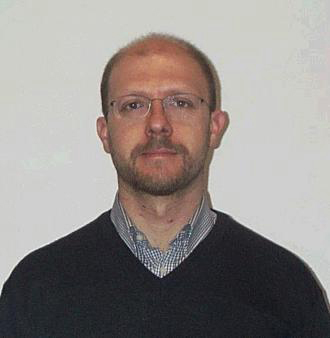
Dalius Gudeika is a Researcher at Vilnius University's Institute of Data Science and Digital Technologies, affiliated with the Educational Systems Group. His work is based at Akademijos Street 4, Vilnius. His research spans computational chemistry and materials science with focus areas: Computational Chemistry Materials Science Quantum Chemistry Organic Electronics Theoretical Chemistry Photophysics Specializing in density functional theory applications, he designs symmetric and asymmetric TADF (Thermally Activated Delayed Fluorescence) emitters for organic light-emitting diodes. His computational approach optimizes molecular structures for enhanced photophysical properties in OLED technologies. No scientific awards or honors were documented in available sources. There is no recorded information regarding doctoral students, research grants, or specialized laboratory teams. His current affiliation remains with the Educational Systems Group within the Institute of Data Science and Digital Technologies.
Robert Sitnik is a Professor and Dean of the Faculty of Mechatronics at Warsaw University of Technology, where he is affiliated with The Institute of Micromechanics and Photonics. He earned his Doctorate in 2002 and has established himself as a leading researcher in 3D optical measurement techniques and applications. His research focuses on 3D light measurement, optical shape analysis, structured light techniques, and 3D data processing with applications spanning cultural heritage documentation and medical imaging. As the leader of the 3D/4D Optical Surface Measurement Team, he has pioneered innovative approaches to surface measurement and documentation. His work demonstrates strong interdisciplinary connections between mechanical engineering, computer vision, and practical applications in both cultural preservation and healthcare. His research has led to significant advancements in 3D scanning technologies, particularly for human body analysis and cultural heritage conservation. His publications reveal a consistent research trajectory focused on improving accuracy, efficiency, and applicability of 3D measurement systems. His scientific impact is evidenced by 159 publications, an h-index of 18 in Scopus and 17 in Web of Science, and 103 promoted theses. His research has been supported by 22 projects, resulting in 1 patent and substantial contributions to both academic knowledge and practical applications. As an academic leader, he has supervised numerous students and researchers, contributing significantly to the development of expertise in optical measurement technologies. His work bridges theoretical research with real-world applications in medical diagnostics, cultural heritage preservation, and industrial measurement systems.
Zihe Gao serves as a tenure-track Assistant Professor in the Department of Electrical and Computer Engineering at Auburn University's College of Engineering since August 2023, following postdoctoral research at the University of Pennsylvania and industry experience at Meta (Facebook Reality Labs). His academic foundation includes: PhD in Electrical and Computer Engineering, University of Illinois Urbana-Champaign (2018) MS in Physics, University of Illinois Urbana-Champaign (2012) BS in Physics, Nanjing University (2011) Dr. Gao's research integrates optics, microelectronics, and physics to develop programmable photonic systems. His work focuses on controlling collective behaviors in multi-element photonic systems for scalable integrated chips, with applications spanning dynamically steerable laser sources and reconfigurable quantum optical platforms . Key methodologies include non-Hermitian physics, topological photonics, and spin-orbit coupling engineering. Analysis of his 2023-2025 publications reveals dominant trends in non-Hermitian photonic switching , high-dimensional quantum state manipulation , and topological semiconductor laser arrays . His team pioneers lithography-free reconfigurable photonics and spin-orbit microlasers for quantum key distribution, demonstrating strong industry-academia translation from prior Meta work on AR/VR structured-light systems. His scholarly trajectory shows continuous progression from VCSEL array fundamentals (PhD under Prof. Kent Choquette) to quantum-topological photonics (postdoc with Prof. Liang Feng), now establishing independent research at Auburn with emphasis on integrated quantum-classical hybrid systems.
Kristen L Knutson is an Associate Professor at Northwestern University's Feinberg School of Medicine, with dual appointments in the Departments of Neurology (Sleep Medicine) and Preventive Medicine (Epidemiology). She is affiliated with the Center for Circadian and Sleep Medicine, Institute for Public Health and Medicine (IPHAM), and Northwestern University Clinical and Translational Sciences Institute (NUCATS). Her research focuses on sleep health, circadian rhythms, and their associations with cardiometabolic and cognitive outcomes across diverse populations. Feinberg School of Medicine Center for Circadian and Sleep Medicine Institute for Public Health and Medicine (IPHAM) Her work examines environmental and behavioral influences on sleep quality, including racial disparities , household sleep environments , and circadian disruption . She leads studies like the DISCO (Disparities in Sleep and Cognition Outcomes) project and contributes to the CARDIA sleep ancillary studies. Recent publications highlight connections between light exposure , meal timing , and sleep disorders in cardiovascular and diabetes risk. Scientific trends in her 2024-2025 publications emphasize: Objective sleep measurement via actigraphy and wearable sensors Impact of circadian disruption on aging populations Environmental determinants (sound, light) of sleep health Intersection of sleep with racial segregation and social inequities Chrononutrition's role in metabolic regulation Long COVID fatigue and sleep disturbances
Dr. hab. Magdalena Skurzok is an Associate Professor at Jagiellonian University in Krakow, Poland, affiliated with the Faculty of Physics, Astronomy and Applied Computer Science. She conducts research in nuclear physics with a focus on exotic nuclear matter, particularly mesic nuclei and mesonic atoms. Her work bridges fundamental particle physics with practical medical applications through advanced detector systems including the J-PET scanner and SIDDHARTA-2 apparatus. Her educational background includes: Habilitation thesis: "Investigation of exotic nuclear matter in the form of mesic nuclei and mesonic atoms" (2024) Doctoral thesis: "Search for eta-mesic helium via dd -> 3Henpi0 reaction by means of the WASA-at-COSY facility" (2016) Diploma thesis: "Feasibility study of eta-mesic nuclei production by means of the WASA-at-COSY and COSY-TOF facilities" (2010) Dr. Skurzok's research primarily focuses on nuclear physics, particularly the investigation of exotic nuclear matter in the form of mesic nuclei and mesonic atoms. Her work explores the bound states of the eta meson with light atomic nuclei and kaon atoms, contributing to our understanding of strong interactions in nuclear systems. She is also involved in PET tomography research, developing novel imaging techniques with applications in medical diagnostics. Her experimental work utilizes advanced detector systems including the J-PET scanner and the SIDDHARTA-2 apparatus at the DAFNE collider. Analysis of Dr. Skurzok's recent publications reveals a strong focus on kaonic atoms research, precision X-ray spectroscopy, and PET imaging technology development. Her work bridges fundamental nuclear physics with practical medical applications, particularly in brain imaging and cancer diagnostics. The interdisciplinary nature of her research connects particle physics, nuclear spectroscopy, and medical imaging technologies. Dr. Skurzok is actively involved in several major research collaborations: SIDDHARTA-2 experiment at DAFNE collider for kaonic atoms research J-PET collaboration developing novel PET imaging technology AMADEUS experiment investigating low-energy K- interactions with nuclei WASA-at-COSY facility for mesic nuclei research Her laboratory work primarily involves the SIDDHARTA-2 apparatus for X-ray spectroscopy of kaonic atoms and the J-PET scanner for positron emission tomography. These advanced detector systems enable precision measurements of exotic nuclear phenomena and innovative medical imaging applications. Dr. Skurzok's research group collaborates extensively with international institutions including CERN, GSI, and various European research centers.
Yumiko Ishihama is a Professor at Waseda University's School of Education, specializing in the history of Tibet, Mongolia, and the Qing dynasty, with a focus on Buddhist political thought and Tibetan Buddhism. She earned her PhD in Literature from Waseda University and has led numerous JSPS-funded research projects. Her work extensively utilizes Tibetan, Mongolian, and Manchu sources to explore the intersections of religion and politics in Inner Asia. She is an active member of the Society for Inner Asian History, Mongolian Studies Association, and Tibetan Studies Association. In addition to her academic roles, she maintains an educational website on Tibetan culture and has had personal encounters with the 14th Dalai Lama, which significantly influenced her scholarly direction. Education: PhD in Literature, Waseda University Research Interests: Ishihama's research centers on the historical relationships between Tibet, Mongolia, and the Qing dynasty, with a particular emphasis on how Tibetan Buddhism influenced political structures and ideologies. She examines primary sources in Tibetan, Mongolian, and Manchu to reconstruct the religious and political narratives of Inner Asia. Her work sheds light on the concept of 'Buddhist government' (chos srid) and how it was shared and implemented across Tibetan, Mongol, and Manchu polities. Recent Articles and Trends: Her recent publications focus on the rituals and political symbolism of the Dalai Lama and Jebtsundampa incarnations, the role of Mongol princes in bridging Tibetan and Mongolian Buddhist worlds, and the intricate diplomatic relationships during the Qing dynasty. These works highlight her expertise in analyzing ceremonial practices, political expressions in religious texts, and cross-cultural exchanges in Inner Asia. Research Projects and Grants: Grant-in-Aid for Scientific Research on Tibetan Buddhist interactions under Russian rule (2017–2020) Comprehensive studies on Tibet and Mongolia during nation-building periods (2014–2017) Medieval Tibetan church history and biographies of Tsongkhapa (2004–2005) Basic research on Buddhist terminology in Sanskrit, Tibetan, Mongolian, and Chinese (2000–2001) Teaching and Seminars: She offers a wide range of courses in Asian history, Tibetan history, and social education content studies at both undergraduate and graduate levels. Her seminars are known for their depth and use of primary sources, encouraging students to engage with historical texts in their original languages.
Tim Schrabback is a Full Professor at the Institute for Astro- and Particle Physics , Faculty of Mathematics, Computer Science and Physics, University of Innsbruck . He leads research in extragalactic astrophysics, focusing on weak gravitational lensing, galaxy clusters, and cosmology through major international collaborations such as the Euclid Mission , eROSITA , DES , SPT , and HSC . His research interests include: Observational cosmology using galaxy clusters Weak and strong gravitational lensing Dark energy and large-scale structure X-ray and Sunyaev-Zel'dovich cluster surveys Machine learning applications in astrophysics Calibration of space-based instruments His recent publications (2023–2025) span high-impact journals including Astronomy & Astrophysics , Physical Review D , and Monthly Notices of the Royal Astronomical Society . The work emphasizes cosmological parameter estimation , cluster mass calibration , systematic error mitigation in weak lensing , and multi-messenger cosmology . A strong trend is the integration of data from optical, infrared, X-ray, and microwave surveys to constrain models of dark energy and modified gravity. Scientific contributions include: Leading roles in Euclid’s weak lensing and cluster science working groups Co-authorship on foundational Euclid mission papers Key contributions to eROSITA all-sky survey analysis Development of shear calibration techniques using deep learning Mass calibration of galaxy clusters via weak lensing He actively participates in advising and collaborative research, working closely with postdocs and early-career scientists such as Sebastian Grandis , Florian Kleinebreil , Henrik Jansen , and Lukas Linke . He has secured access to major datasets and leads analysis efforts in joint cluster cosmology programs. His public engagement includes frequent outreach lectures on astrophysics and telescope observation, particularly through the annual Astronacht events at the University of Innsbruck. He has also contributed to media interviews on cosmological tensions and galaxy cluster physics. He leads or participates in several research labs and teams: Euclid Weak Lensing Science Working Group eROSITA Cluster & Cosmology Working Group Institute for Astro- and Particle Physics Observing Team Alpine Cosmology Collaboration
Calem R. Hoffman is a Physicist at the Argonne National Laboratory , specializing in experimental and theoretical research on the structure of light nuclei. He earned his Ph.D. in Physics (Spring 2009) and B.S. in Physics (Fall 2003) from Florida State University. Research focuses on nuclear structure, radioactive beam experiments, and AI-driven accelerator optimization. Current programmatic leadership includes Autonomous Optimization of Secondary Beam Production and Delivery at the ATLAS In-Flight Facility. Key projects involve neutron-rich nuclei, quadrupole collectivity, and exotic isotope discovery. Scientific Awards : Argonne Director’s Fellow (2010–2012) Hoffman has held leadership roles in managing the ATLAS HELIOS User Program (2012–2018) and directing in-flight beam priorities. His work integrates advanced data analytics and AI for accelerator operations, supported by DOE grants.
Carmel O’Shannessy is a Senior Lecturer at the Australian National University’s School of Literature, Languages and Linguistics and an affiliate of the ARC Centre of Excellence for the Dynamics of Language (CoEDL) . Her work focuses on language contact, mixed languages, and child language acquisition, particularly in Indigenous Australian communities. Education: PhD in Linguistics (University of Sydney, Australia; Max Planck Institute for Psycholinguistics, The Netherlands, 2007) She has documented the development of Light Warlpiri , a new mixed language, since its emergence. Her research explores how children and adults contribute to contact-induced language change, with fieldwork in Central Australia since 1996. Key projects include her ARC Future Fellowship grant for tracking Indigenous children’s language development. Recent publications span topics like typology of Australian contact languages, child-directed speech modifications in Warlpiri, and sociolinguistic dynamics of youth language varieties. Her work appears in journals such as Journal of Pidgin and Creole Languages and Languages , as well as edited volumes like The Oxford Guide to Australian Languages . Scientific Awards: ARC Future Fellowship She has mentored students including Francois-Xavier Faucounau , Annie Kwai , and Zobule . Her interdisciplinary approach combines linguistic analysis, digital tools (e.g., the Little Kids Learning Languages app), and community collaboration. Labs/Teams: ARC Centre of Excellence for the Dynamics of Language (CoEDL)
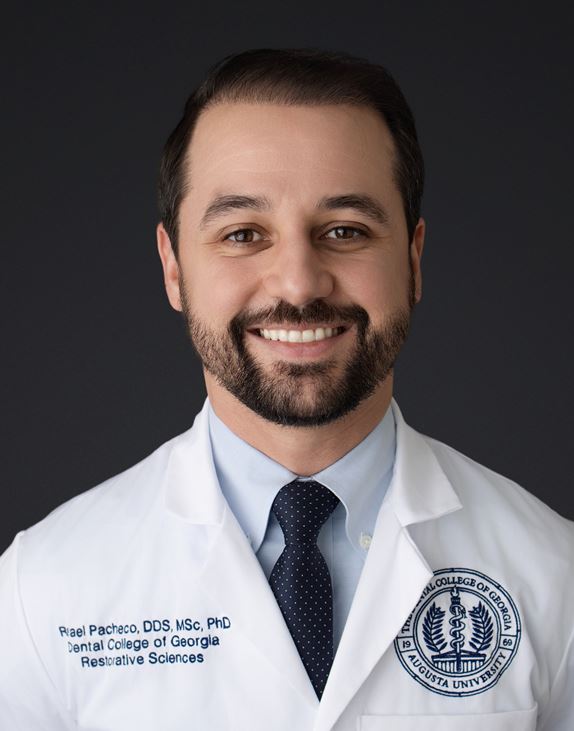
Rafael Pacheco serves as Associate Professor and Interim Associate Dean at Augusta University's Dental College of Georgia, holding dual appointments in the Department of Restorative Sciences (where he is Vice Chair) and Department of Oral Biology and Diagnostic Sciences. His academic credentials include: Ph.D. in Dental Materials, State University of Campinas (2017) MDS in Dental Materials, State University of Campinas (2012) DDS in Dentistry, State University of Campinas (2010) Dr. Pacheco's research emphasizes dental materials science and clinical applications , with core expertise in ceramic characterization, bonding protocols, and optical properties of restorative materials. His work bridges laboratory innovation with clinical dentistry to optimize restorative outcomes and educational methodologies. Recent publications (2024-2025) reveal concentrated focus on dental ceramics analysis, aging effects on material interfaces, and technology-enhanced dental education, demonstrating consistent contributions to biomaterials science and pedagogical innovation. His accolades include multiple teaching distinctions: Commitee MVP Faculty Award (2024) New Faculty Teaching Excellence Award (2024) Dental Faculty Award (Michigan Dental Association, 2022) Faculty Award (Sigma Phi Alpha, 2022) Outstanding Pre-Clinical Faculty Award (University of Detroit Mercy, 2021) Administratively, he chairs the Curriculum Committee and Search Committees for Operative Dentistry/Prosthodontics while leading the Digital Dentistry Taskforce. His professional service includes editorial roles for Dental Materials and The Journal of Prosthetic Dentistry since 2017, plus humanitarian dental mission coordination.
Stefano Invernizzi is an Associate Professor at the Department of Structural, Geotechnical and Building Engineering (DISEG) of Politecnico di Torino. His expertise spans civil and structural engineering, focusing on fracture mechanics, finite element analysis, and numerical modeling of historical masonry and concrete structures. Teaches Statics and structural analysis courses at the Faculty of Architecture. Supervised numerous PhD and degree theses on masonry, concrete, and computational mechanics. Research emphasizes scale effects on material strength, fractal properties of structural materials, contact mechanics, and seismic vulnerability of historical buildings. He co-developed the sequentially linear saw-tooth softening model for robust analysis of reinforced concrete structures. Collaborated with Prof. Jan Rots on computational mechanics and contributed to projects like TOMORROW (additive manufacturing for building walls) and DURA_LAM (nano-materials for timber durability). His work aligns with SDGs 9 (Industry Innovation) and 11 (Sustainable Cities). He leads the Laboratorio di Meccanica della Frattura and has authored over 30 publications in journals like Engineering Fracture Mechanics and International Journal of Fracture . His research integrates statistical theories of strength with nonlinear numerical simulations for disordered materials.
Yuri Rzhanov is a Research Professor at the Center for Coastal and Ocean Mapping at the University of New Hampshire , where he focuses on numerical modeling and image processing for marine applications. His work bridges semiconductor physics foundations with modern underwater 3D scene reconstruction and habitat classification. Education : Ph.D. in Semiconductor Physics, Academy of Science of Russia M.S. in Semiconductor Physics, Novosibirsk State University Research Interests center on 3D modeling/visualization , underwater image processing , refractive effect compensation , and benthic habitat classification using conventional/multispectral imagery. His career evolved from semiconductor quantum effects to solid-state nonlinear phenomena, then to marine signal/image processing. Key Collaborators : Co-investigators: Larry Mayer, Brian Calder, Jennifer Dijkstra, May-Win Thein Co-authors: John Hughes Clarke, Kim Lowell, Thomas Butkiewicz Grants include projects funded by the US Geological Survey , NOAA , and US Navy (2004–2024) related to seafloor mosaicing, unmanned underwater vehicle coordination, and marine acoustic/image data processing.
O. Remus Tutunea-Fatan is a Professor in the Department of Mechanical & Materials Engineering at Western University, with cross appointments in Biomedical Engineering and Electrical and Computer Engineering. His work focuses on laser polishing, CNC machining, and surface structuring for drag reduction and biomedical applications. Ph.D. in Mechanical Engineering, The University of Western Ontario M.E.Sc. and B.E.Sc. in Mechanical Engineering, Transilvania University, Romania Research interests include: Advanced CAD/CAM frameworks Laser remelting process optimization Biomedical device design Composite manufacturing techniques Surface topography analysis Artificial intelligence in process control Recent publications indicate expertise in: Laser polishing of metallic surfaces Riblet microstructures for drag reduction AI-driven process monitoring 5-axis machining error compensation Scientific recognition includes: Edward G. Pleva Award for Excellence in Teaching (Western University, 2023) Dr. Terry Base Memorial Teaching Award (2022 co-winner, 2021, 2019) R. Mohan Mathur Award (Faculty of Engineering, 2020) University Students' Council Teaching Honour Roll (2011-2012) Prof. Tutunea-Fatan serves as Associate Chair for Graduate Research Programs (2025-2027) Acting Associate Dean for Undergraduate Studies (2023-2024) Acting Chair, Department of Mechanical and Materials Engineering (2021-2022) He supervises over 40 graduate students and collaborates with industry partners including DuPont Safety and Construction, General Motors, and Active Industrial Solutions Inc.
Meng Gu is an Assistant Professor in the Department of Physics at The University of Hong Kong, where she conducts research on galaxy formation and stellar population synthesis. She holds the prestigious HKU-100 Scholar position and specializes in understanding the physical mechanisms driving the interplay between star formation and galaxy mass assembly. Education: Bachelor of Science (BSc) from Nanjing University (NJU) Master of Arts (MA) from Harvard University PhD from Harvard University, completed with Prof. Charlie Conroy Prof. Gu's research addresses fundamental questions in astrophysics regarding the stellar initial mass function of galaxies, its global and local variations, and implications for mass measurements. She investigates how environmental factors shape galaxy formation and evolution, particularly focusing on how massive galaxies grow and what spatial information of stellar populations reveals about these processes. Her work combines observational data with advanced modeling techniques to unravel the complex history of galaxy assembly. Analysis of Prof. Gu's publications reveals a consistent focus on massive galaxy evolution, with particular emphasis on the stellar initial mass function, galaxy cluster dynamics, and ultra-diffuse galaxies. Her research spans observational astronomy using major telescope facilities, theoretical modeling, and computational cosmology. The progression of her work shows increasing sophistication in connecting observational data with theoretical frameworks to understand galaxy formation mechanisms. Scientific Awards: HKU-100 Scholar Henry Norris Russell postdoctoral fellow at Princeton University Prof. Gu has secured research funding to utilize major observational facilities including Magellan Telescopes, ESO's Very Large Telescope, and the Sloan Digital Sky Surveys. She is preparing to leverage next-generation facilities like the James Webb Space Telescope (JWST) and Subaru Prime Focus Spectrograph (PFS) survey for future research. Her collaborative work spans multiple international institutions, reflecting the global nature of modern astrophysics research. Prof. Gu is actively involved in observational astronomy projects and collaborates with major research groups working on galaxy evolution. Her work with the MASSIVE survey represents a significant contribution to understanding the most massive galaxies in the nearby universe, utilizing high-quality spectroscopic data to constrain fundamental properties of stellar populations.
Posy Busby is an Associate Professor in the Department of Botany and Plant Pathology at Oregon State University, affiliated with the College of Agricultural Sciences. Her research focuses on plant microbiome ecology, particularly plant-fungal interactions and their roles in disease dynamics and community ecology. She leads the Busby Lab, which investigates endophyte impacts on plant health and explores microbiome applications in sustainable agriculture and reforestation. Busby has secured grants from USDA-NIFA and participates in the Andrews Forest LTER grant leadership. Her work integrates genomic and ecological approaches to study microbial community assembly, with recent emphasis on Populus and potato systems. Key research themes include host genotype influences on microbiome composition, priority effects in microbial colonization, and microbiome-mediated disease suppression. Collaborative projects, such as the continental-scale Populus mycobiome study with the Peay Lab, highlight her interdisciplinary approach. Busby’s publications emphasize fungal diversity, pathogen interactions, and microbiome functionality. Notable contributions include defining mechanisms of microbiome-plant genotype interactions and identifying beneficial endophytic yeasts in Populus. Her work has been featured in Nature Microbiology , Current Biology , and Annual Review of Phytopathology , reflecting her impact on both fundamental and applied plant science. Grants & Leadership: USDA-NIFA grant (2020), Co-PI on Andrews Forest LTER8 (2022), NSF CAREER Award (2022) Labs/Teams: Busby Lab, part of the OSU Plant Pathology Program Future Work: Expanding microbiome applications in climate-resilient agriculture and forest health