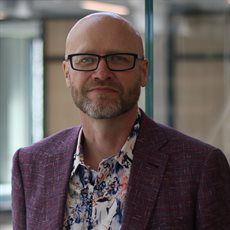
Christof Devriendt is a Professor at the Department of Applied Mechanics, Vrije Universiteit Brussel (VUB), Belgium, affiliated with the Acoustics & Vibrations Research Group. He leads major research initiatives including the Belgian Offshore Wind Innovation Centre and innovative wind energy systems projects. His work focuses on offshore renewable energy structures, structural health monitoring, and vibration analysis. With an h-index of 27 and 3139 citations, he has authored over 218 publications and supervised numerous research projects. Research Interests: Modal analysis of offshore wind turbines, fatigue assessment of foundations, health monitoring systems, and fluid-structure interactions in coastal engineering. His work addresses challenges in offshore wind energy infrastructure durability and operational safety. Recent Projects: FWOIRI19: Fan Array Wind Tunnel Development (2025–2028) FOD175: Clay Strength Research (2024–2027) FOD177: Offshore Wind Innovation Hub (2024–2027) Awards: Received the Best Paper Award (2nd place) in 2022 for collaborative research on wind turbine monitoring. His contributions span 49 academic activities including conference presentations and international collaborations.
Jan Helsen is a Professor of Engineering Technology at Vrije Universiteit Brussel (VUB), leading the Acoustics & Vibrations Research Group. His primary affiliation is within the Faculty of Engineering Technology, focusing on advanced research in renewable energy systems, offshore wind technology, and predictive maintenance. He actively collaborates with industry partners and governmental institutions, as seen in projects like the Belgian Offshore Wind Innovation Centre (2024–2027) and the INSPIRE initiative under the Sustainable Blue Economy Partnership. Helsen’s research emphasizes wind turbine reliability, fault detection algorithms, and AI-driven operational optimization. His work bridges mechanical engineering principles with data science, addressing challenges such as drivetrain health monitoring, wake effect modeling, and hybrid energy systems. Recent contributions include modular deep learning frameworks for wind farm power forecasting and reinforcement learning strategies for hybrid wind-hydrogen plants. He has secured significant funding through projects totaling over €10M, including the €3M ICON (Cloud-edge AI for Offshore Wind O&M) and the €2.5M INSPIRE initiative. Helsen’s team publishes extensively in journals like Mechanical Systems and Signal Processing and Wind Energy Science , with a focus on practical solutions for offshore energy challenges. His lab also pioneered datasets on hyperspectral analysis of additive manufacturing processes, demonstrating interdisciplinary reach. Key collaborations include INSA Lyon (France) for joint PhD programs and the Royal Meteorological Institute for weather simulation studies. Helsen’s work is cited over 1,078 times (h-index 16), reflecting his influence in advancing offshore wind infrastructure resilience and smart energy systems.
Mark Runacres is a Professor at the Vrije Universiteit Brussel (VUB), affiliated with the Faculty of Engineering Technology and the Department of Thermodynamics and Fluid Mechanics. He leads research groups focused on fluid dynamics, wind energy, and decarbonization technologies. His work bridges computational modeling, experimental validation, and real-world applications in renewable energy systems. His research interests include fluid mechanics, wind turbine aerodynamics, and data-driven modeling of complex systems. He has pioneered studies on vertical-axis wind turbines (VAWTs), wake dynamics, and turbulence effects on energy extraction efficiency. Recent projects involve optimizing high-altitude propellers and developing synthetic wind speed models for sustainable energy planning. Runacres has led over 20 funded projects, including the Flanders Institute for Decarbonisation Technologies (FIDT) initiative and the BRussels Institute for Thermal-fluid systems. His collaborations span academia and industry, addressing challenges in wind farm design, microclimate impact assessments, and sustainable urban energy solutions. He has authored/co-authored 120+ peer-reviewed publications and supervised multiple graduate theses. Current research emphasizes nonlinear system identification, multi-fidelity optimization, and bridging experimental data with predictive models for engineering systems.
Kristian Ladefoged Ebbehøj serves as an Industrial Postdoc in Solid Mechanics at the Department of Civil and Mechanical Engineering, Technical University of Denmark (DTU). His research focuses on advanced vibration analysis and damping estimation techniques for complex engineering systems. His primary research interests include structural dynamics of wind turbines, nonstationary system behavior, and Gaussian process modeling for vibration analysis. Key specializations involve short-term damping prediction in fluid-loaded structures and wind turbine systems under operational variability, with emphasis on environmental impact mitigation and real-time monitoring solutions. Recent publications demonstrate expertise in time-varying vibrating structures, where he develops model-based methods for damping estimation under nonstationary conditions. His work bridges theoretical dynamics with practical wind energy applications, particularly in blade vibration control and fluid-structure interaction phenomena. Scientific contributions include: Experimental validation of damping estimation methods for wind turbines (2024) Short-term model-based damping prediction for fluid-loaded structures (PhD thesis, 2024) Gaussian process time series models for operational variability compensation (2023) His research program 'Short-term model-based damping prediction for fluid-loaded structures' (2021-2024) involved collaboration with supervisors J.J. Thomsen, J.B. Høgsberg, and P. Couturier, with examination by A. Brandt and K. Worden. The project generated significant academic output with 7 publications including journal articles and conference proceedings, demonstrating strong industry relevance through the 'Industrial Postdoc' position.
Kenneth Thomsen serves as Head of the Wind Turbine Design Division within the Department of Wind and Energy Systems at the Technical University of Denmark (DTU) in Roskilde, Denmark. His leadership drives critical research in wind turbine validation and testing infrastructure for global renewable energy advancement. Thomsen's expertise centers on Wind Turbine Engineering with specialized focus in Design Load Engineering , Fatigue Load Engineering , and Extreme Load Analysis . His work tackles complex terrain challenges, load alleviation systems, and wind farm optimization, directly contributing to UN Sustainable Development Goals for clean energy. Research emphasizes practical solutions for offshore environments and energy system integration. Recent publications (2021-2024) demonstrate a clear trajectory toward real-world energy transition applications. Key themes include automated damage detection in turbine blades, energy island infrastructure development, and systemic approaches to wind industry growth constraints. His work bridges fundamental engineering with policy-level energy transition strategies, prioritizing cost reduction and grid stability. Thomsen actively mentors next-generation engineers through PhD supervision and examination: "Improving endurance of wind-turbine coatings for offshore environments" (PhD student: Johansen, N.F.-J., 2016-2020) "Aeroservoelastic stability analysis and design of wind turbines" (PhD student: Skjoldan, P. F., 2007-2011) His guidance focuses on solving industry-critical challenges in materials science and structural dynamics. As division head, Thomsen directs DTU's Wind Turbine Design Division at the Roskilde Test Centres. The team operates state-of-the-art facilities for full-scale turbine validation, specializing in load measurement, structural testing, and performance verification. Current collaborations span offshore coating durability, complex terrain energy yield assessment, and next-generation wind farm integration strategies.
Professor Gregory Kopp is a leading expert in Wind Engineering at the University of Birmingham, affiliated with the Department of Civil Engineering within the College of Engineering and Physical Sciences. He holds a PhD in Mechanical Engineering from the University of Toronto and is a registered Professional Engineer in Ontario. His research focuses on mitigating structural damage from extreme wind events such as hurricanes and tornadoes. PhD in Mechanical Engineering, University of Toronto, 1995 MEng in Mechanical Engineering, McMaster University, 1991 BESc in Mechanical Engineering, University of Manitoba, 1989 Dr. Kopp's research spans building aerodynamics, turbulent shear flows, and component load effects, employing model-scale and full-scale wind tunnel testing, as well as field damage surveys. His work directly informs engineering design standards and public policy. He has played key roles in ASCE standards development and international wind engineering organizations. His recent publications show a strong focus on wind loads on low-rise buildings, solar arrays, roof systems, and tornado damage assessment. Themes include quasi-steady modeling, turbulence effects, pressure fluctuations, and structural failure mechanisms. His work bridges experimental fluid dynamics and practical structural engineering applications. Chair, ASCE 49 Standards Committee Chair, ASCE 7 Chapter 31 Task Committee President, American Association of Wind Engineering (2013–2014) Guest Professor, Tokyo Polytechnic University Editorial Board, Journal of Wind Engineering and Industrial Aerodynamics Dr. Kopp has supervised numerous graduate students in wind engineering and bluff body aerodynamics. His research has been supported by extensive experimental programs, including the 'Three Little Pigs' Project, which combined wind tunnel and full-scale testing to improve residential building resilience. He leads a multidisciplinary team integrating fluid dynamics, structural testing, and data analysis to enhance wind-resistant design.
Olimpo Anaya-Lara is a Professor in the Department of Electronic and Electrical Engineering at the University of Strathclyde, Faculty of Engineering, United Kingdom. He is a leading expert in power system dynamics and control of wind energy systems, with significant contributions to grid integration, offshore wind technology, and renewable energy system stability. He serves on the Management Team of the EPSRC Centre for Doctoral Training in Wind and Marine Energy Systems and is the Course Director of the MSc in Wind Energy Systems. He has led Strathclyde’s participation in the European Energy Research Alliance (EERA) Joint Programme Wind and has held visiting positions at NTNU and SINTEF in Norway. PhD in Electrical Engineering, University of Glasgow, UK (2003) MSc in Electrical Engineering, Instituto Tecnologico de Morelia, Mexico (1997) BEng in Electrical Engineering, Instituto Tecnologico de Morelia, Mexico (1990) His research focuses on power system stability , modeling and control of wind power plants , HVDC transmission , offshore wind integration , and smart grid technologies . He has pioneered control strategies enabling wind farms to emulate synchronous generators, enhancing frequency and voltage support. His work spans advanced power converter systems, fault ride-through, and energy storage integration. He also explores hybrid systems combining wind with hydrogen production and hydropower flexibility. The most recent articles reflect a strong trend toward innovative offshore wind architectures (e.g., XROTOR), low-harmonic HVDC systems, wireless power transmission, and multi-energy systems integrating electricity, hydrogen, and storage. These works emphasize grid compatibility , reliability , and cost reduction in renewable energy deployment. Research spans disciplines including electrical engineering, power electronics, control systems, and sustainable energy. His scientific awards include: Young Presentation Award (2021) Poster Award Winner (2018) Visiting Scientist at SINTEF, Norway (2013) Visiting Professor at NTNU, Norway (2010) Professor Anaya-Lara has supervised numerous PhD and postgraduate research projects, including major grants such as the EPSRC CDT in Wind & Marine Energy Systems, STORE2HYDRO, and XROTOR. He teaches advanced topics in power system stability and wind generator control, and contributes to academic programs in China. He is actively involved in professional service, including editorial roles and conference organization. He leads and contributes to a high-tech multi-terminal DC-network hybrid test-bed for real-time hardware-in-the-loop experimentation, supporting both research and teaching in smart grid concepts.
Matthew Cole is a Research Fellow in the Department of Electronic and Electrical Engineering at the University of Strathclyde's Faculty of Engineering, specializing in advanced wind energy systems and grid integration solutions. His work bridges theoretical control algorithms with practical renewable energy applications. His research focuses on wind farm control strategies for grid stability, fatigue load reduction, and hybrid energy systems. Key interests include wind energy conversion, power system dynamics, control engineering for renewable integration, energy storage optimization, green hydrogen production, and ancillary service provision. He develops solutions for off-grid hydrogen systems, battery lifetime extension, and wind farm participation in frequency regulation. Analysis of his 2020-2023 publications reveals a trajectory toward integrated renewable systems, with increasing emphasis on green hydrogen and battery storage. His work combines computational modeling (Strathfarm, FarmConners benchmark), field validation, and critical reviews of grid service frameworks, demonstrating expertise in translating control theory into grid-supporting wind farm operations. Cole served as Research Co-investigator for the EPSRC Centre for Doctoral Training in Wind & Marine Energy Systems (2016-2023), training doctoral candidates in renewable energy systems. He actively contributes to international collaboration through IEA Wind Task 44 on Wind Farm Flow Control, participating in benchmarking initiatives with European research institutions. He is a core member of Strathclyde's Wind Energy & Control Group, which develops control algorithms addressing asset management requirements, grid code compliance, and performance optimization for offshore wind farms. The group's work focuses on reducing operational costs while enhancing grid stability through innovative control strategies.
Dr. inż. Maciej Pilch is a researcher at the Faculty of Civil Engineering, Kraków University of Technology. His work is centered on developing innovative luminescent sensor systems, particularly high-frequency Pressure Sensitive Paints (PSP), for aerodynamic testing of buildings and urban structures under dynamic wind loads. He leads a major research project funded by the National Science Centre (NCN) under the OPUS 28 program, receiving 2,815,600 PLN in funding. Faculty: Faculty of Civil Engineering Institution: Kraków University of Technology Research Laboratory: Environmental Aerodynamics Laboratory His research aims to overcome the limitations of current pressure measurement techniques by creating PSP systems with high sensitivity and fast response times for use in wind engineering. These systems will enable precise mapping of pressure distribution on complex surfaces, improving the safety and design of buildings in urban environments. Pilch’s research interests include luminescent sensors, aerodynamic testing, wind engineering, additive manufacturing, and photoelectric materials. His work has significant implications for urban planning, civil infrastructure resilience, and environmental safety. The recent award of "Budowa roku 2023" to the Environmental Aerodynamics Laboratory highlights the recognition of his institutional research environment. His research is supported by state-of-the-art infrastructure at PK, including large-scale aerodynamic tunnels. Dr. Pilch has received multiple competitive grants and scholarships, including: START scholarship (Foundation for Polish Science) NCN OPUS 28 FNP Proof of Concept (FENG) Inkubator Innowacyjności 4.0 Diamentowy Grant NCN PRELUDIUM 20 NCBiR LIDER Student Scientific Circles – Innovation programs (2023/2024, 2024/2025) He leads several research projects focused on luminescent sensors for wind turbines and advanced 3D printing techniques using photoelectric materials. There is no mention of formal advising roles or teaching load, but his leadership in research projects suggests mentorship of students and junior researchers. The Environmental Aerodynamics Laboratory, where his project is based, serves as a key facility for wind engineering research at PK.
Dr. Giuseppe Antonio Rosi is a Senior Scientist at the Institute of Fluid Mechanics, Faculty of Mechanical Engineering, Technical University of Braunschweig. His research focuses on experimental fluid dynamics, particularly solid-fluid suspensions, two-phase flows, ice accretion, and high-speed flows. PhD from Queen’s University M.Sc. from University of Calgary His work spans fundamental and applied research, including collaborations to advance battery-storage technologies and aerospace heat-load reduction through dense-suspension and particle-laden flow studies. Dr. Rosi contributes to the field through innovative measurement techniques and experimental data analysis, bridging academic and industrial applications in fluid mechanics.
David Robert Verelst is a Senior Researcher at the Department of Wind and Energy Systems, Technical University of Denmark (DTU), specializing in hydro-servo-aero-elastic wind turbine simulations and stability computations with focus on loads and control. He serves as project manager for the development of the aeroelastic software HAWC2 and has extensive experience in research project management and scientific software tool development. Dr. Verelst holds a PhD from DTU Wind Energy (2010-2013) and previously completed his Aerospace Engineering studies at TU Delft (2001-2010). His academic journey includes positions as Research Assistant (2010), Postdoc (2013-2015), and currently Senior Researcher at DTU. His research interests center on hydro-servo-aero-elastic wind turbine time domain simulations, stability computations, wind tunnel experiments, control theory, and design optimization principles. As an experienced Python developer with basic Fortran knowledge, he bridges computational methods with wind energy applications. His work contributes significantly to UN Sustainable Development Goals related to affordable and clean energy. Verelst's publication record shows consistent output in wind energy research, with recent focus on beam-like structures for wind turbine blades, typhoon wind patterns, offshore wind farm optimization, and aeroelastic modeling. His research demonstrates strong interdisciplinary connections between computational mechanics, atmospheric science, and renewable energy systems. Among his notable achievements is the development and management of HAWC2, a critical aeroelastic software tool widely used in wind turbine design and analysis. His work on floating offshore wind farms and typhoon impacts represents cutting-edge research in challenging wind energy environments. As an active supervisor, Dr. Verelst mentors PhD students including Antunes, A. M. and Müller, S., contributing to the next generation of wind energy researchers. His involvement in multiple projects through 2027 demonstrates his ongoing commitment to advancing wind energy technology and education.
Chris Ivanov is a Researcher in the Mechanical Engineering department at the National Renewable Energy Laboratory (NREL) . His work focuses on wind energy systems, structural dynamics, and computational modeling. Research Interests Chris Ivanov specializes in Wind Turbine Design Compressed Air Motors Aerodynamic and Structural Analysis Operational Load Validation Wildlife Collision Mitigation Renewable Energy Systems Publications Overview His recent research (2024) explores topics such as Wind-driven loading on PV systems Comparative rotor aeroacoustics Launcher design for turbine collision simulation Validation of aeroservoelastic models Field experiments in wind energy
Jon Keller is a researcher at the National Renewable Energy Laboratory (NREL) specializing in drivetrain technology for wind turbines. He leads projects focused on enhancing drivetrain performance, power density, and reliability, particularly through field testing at the NREL Flatirons Campus. Current affiliation: National Renewable Energy Laboratory (NREL) Past affiliation: U.S. Army at Redstone Arsenal Education: PhD in Aerospace Engineering, Pennsylvania State University Master’s in Aerospace Engineering, Pennsylvania State University Bachelor’s in Aerospace Engineering, Pennsylvania State University Jon’s research interests center on wind energy systems, with a focus on mechanical reliability, gearbox design, and drivetrain failure analysis. His work spans both theoretical and practical approaches, including the development of condition monitoring systems and advanced drivetrain models. Recent publications highlight his contributions to fiber-optic torque measurement, bending moment analysis in turbines, and offshore wind maintenance strategies. Collaborative efforts with institutions like the Department of Energy emphasize his role in advancing renewable energy frameworks.
Derek Slaughter is a Researcher in Software Engineering at the National Wind Technology Center , part of the National Renewable Energy Laboratory (NREL) . His work focuses on wind turbine engineering, combining software development with mechanical and aeroacoustic analysis. Research interests include: Wind Turbine Design (upwind/downwind configurations, blade dynamics) Aeroacoustic Modeling (sound pressure levels, amplitude modulation) Structural Load Analysis (fatigue loads, aeroelastic stability) Software Engineering for renewable energy systems Recent publications highlight collaborations with experts in wind energy, exploring rotor performance and simulation tools like OpenFAST. Key networks span the United States and global institutions. His work intersects Mechanical Engineering and Renewable Energy , with sub-fields in turbine aeroacoustics, computational modeling, and structural optimization.
Rafael Mudafort serves as Researcher IV in Software Engineering at the National Wind Technology Center within the National Renewable Energy Laboratory (NREL), where he drives advancements in scientific computing for wind energy research. His mission centers on enhancing software quality for implementing NREL's research initiatives through rigorous computational methodologies. Education: Bachelor of Aerospace Engineering from Embry-Riddle Aeronautical University Master of Mechanical and Aerospace Engineering from the University of Virginia Research Focus: Mudafort's work integrates high-performance computing with wind energy systems, specializing in parallel and distributed computing architectures, GPU-accelerated numerical methods, and multiphysics modeling. His research directly addresses critical challenges in wake modeling, turbine control systems, and sustainable software engineering practices for renewable energy applications. The National Wind Technology Center provides the experimental and computational infrastructure for advancing these methodologies. Publication Trends: Recent publications reveal a strong focus on wake steering optimization, software validation frameworks, and best practices for research software engineering. His work bridges theoretical fluid dynamics with practical software implementation, emphasizing computational efficiency and model accuracy for wind farm analysis tools. Key themes include deep array effects in turbine clusters, yaw misalignment impacts, and sustainable development of open-source wind energy software stacks. Awards: Better Scientific Software Fellowship (2023) Better Scientific Software Fellowship Honorable Mention (2022) Professional Engagement: As an active member of the United States Research Software Engineer Association, Mudafort contributes to community standards for research software development. His work demonstrates significant collaboration across NREL's wind energy research teams, with emphasis on translating scientific requirements into robust computational solutions. Research Environment: Based at NREL's National Wind Technology Center—one of the world's premier wind energy research facilities—Mudafort operates within a multidisciplinary ecosystem integrating field testing, computational modeling, and software development to advance wind energy technology.