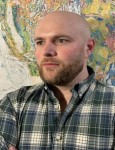
Giorgio De Guidi is an Associate Professor of Structural Geology at the Earth Sciences Section of the University of Catania, Italy. His academic roles include coordinating the GEO Area Steering Committee, serving as Deputy Director of the Cutgana Scientific Research Center, and participating in the CUG (Single Guarantee Committee) and GPS (Scientific Promotion Group). Research Interests: Focus on structural geology, tectonics, and earth sciences, with applications in geological modeling and field studies. Professional Roles: Deputy Director, Cutgana Scientific Research Center Coordinator, GEO Area Steering Committee Member, CUG and GPS committees Contact: Office: Corso Italia 57, Catania, Italy Email: giorgio.deguidi@unict.it Phone: ++39 954783704 Office Hours: Monday, 9:00am–11:00am
Daniel Keith Elkin is an Associate Professor and Programme Leader of BA Environmental Design and Interior Design at The Hong Kong Polytechnic University , with expertise in Spatial Agency Research and Design Making . He also serves as Deputy Specialism Leader of MDes Transitional Environments Design and is a member of the Research Institute for Land and Space (RILS) and the PolyU Academy for Interdisciplinary Research . Education: Master of Architecture (Cranbrook Academy of Art), Master of Architecture and Bachelor of Science in Architecture (University of Cincinnati) His research focuses on agency-driven design , sustainable architecture , and informal urbanism , with projects like the Tai O Village living lab exploring spatial agency in post-pandemic contexts. His work bridges the digital and analogue in design processes, emphasizing ethical encounters and community participation. Recent publications span urban informality , digital workflows for bamboo materials , and interdisciplinary design pedagogy . He received the Smart 50 Award (2021) and a Teaching Award (2020) . Elkin founded the HomeWise Research and Design platform and contributed to the 2020/21 Venice Biennale .
Dr. Alastair Curry is a Senior Lecturer in Physical Geography at the University of Hertfordshire, affiliated with the Department of Psychology, Sport and Geography within the School of Life and Medical Sciences. His research focuses on paraglacial, periglacial, and glacial geomorphology; Holocene landscape evolution; and Quaternary environmental change in upland Britain, the European Alps, and Norway. Geography, BA Hons (University of Oxford, 1995) Physical Geography, PhD (University of St Andrews, 1998) Learning & Teaching in Higher Education, Postgraduate Certificate (University of Hertfordshire, 2000) Biblical and Intercultural Studies, Certificate of Higher Education (The Open University, 2005) His work examines paraglacial reworking of glacigenic drift, debris flow sedimentology, and Schmidt hammer exposure dating. Recent projects explore Holocene slope evolution in Wales, paraglacial moraine stabilization in the Swiss Alps, and postglacial rock-slope failures in Norway. He has also contributed to Khmer-language geomorphological translations for Cambodian universities. Current roles include Joint Subject Group Lead for Geography, Environment and Planning (since 2020). Teaching specialisms span Geomorphology, Quaternary Science, Physical Geography, and Research Methods. Email: a.curry4@herts.ac.uk .
Dr. Charlotte Gladstone is a Research Associate and Lab Manager in the Department of Earth Sciences at the University of Cambridge. Her work focuses on sedimentology, volcanology, and fluid dynamics, with a particular emphasis on turbidites, pyroclastic density currents, and buoyancy-driven flows. Her research spans experimental investigations into gravity currents, convolute lamination formation, and volcanic processes. She has collaborated extensively with experts in geophysics and fluid mechanics, contributing to key publications in journals such as Sedimentology and Journal of Fluid Mechanics . Her publications highlight expertise in experimental design, sediment transport mechanisms, and flow dynamics. She has explored phenomena ranging from submarine turbidity currents to volcanic dome decompression events, advancing understanding in geological hazard assessment and fluid mechanical modeling. Dr. Gladstone has served as a co-author on multiple studies and is affiliated with institutions conducting energy and environmental flows research. Her work bridges theoretical modeling with real-world geological applications.
Jonas Didero Takodjou Wambo is an Assistant Professor in the Department of Geological Sciences at Lamar University’s College of Earth and Space Sciences. He holds a Ph.D. in Structural Geology and Ore Deposits (2021), a Post Graduate Teachers’ Diploma in Geology (2017), an M.Sc. in Structural Geology (2015), and a B.Sc. in Geological Sciences (2012), all from Cameroonian institutions. His research focuses on integrating Structural Geology, Tectonics, Petrology, and Geochemistry with advanced technologies like GIS, remote sensing, SEM/XRF, and machine learning to study Earth crustal evolution, mountain-building processes, and ore deposit formation. Key areas include gold exploration in Cameroon and Central African Republic, critical minerals, and deformation-mineralization relationships. Recent publications highlight his work on cassiterite deposit genesis, structural controls on gold mineralization, and geochronology of Pan-African granitoids. He teaches Structural Geology, Igneous/Metamorphic Petrology, Economic Geology, and Field Camp courses.
Andrea Artoni is an Associate Professor at the Department of Chemistry, Life Sciences and Environmental Sustainability, University of Parma, with over 30 years of experience in tectonic and sedimentological studies. His research focuses on collisional orogens in the Mediterranean region, particularly the Northern Apennines, Calabrian Arc, and Ionian Sea, addressing seismic hazards and fluid circulation in thrust belts. Researcher at University of Parma since 1999 National Scientific Qualification for Full Professor in Structural Geology Teaching courses in Earth Dynamics, Regional Geology, and Subsurface Geology His research interests include tectonics-sedimentation relationships in foredeep basins, paleogenetic evolution of Mediterranean orogens, and geological risks. He employs geological mapping, seismic interpretation, and bathymetric analysis across Italy, France, Spain, and Poland. Recent publications analyze the Sicily Channel's tectonic complexity, DNAPL migration in aquifers, and natural hydrogen exploration in the Apennines. He participates in international collaborations and field campaigns like the CALAQUAKES oceanographic mission.
Neil Davies is a Researcher in the Department of Earth Sciences at the University of Cambridge, specializing in sedimentary geology and paleoenvironments. His work explores the deep-time co-evolution of life and Earth surface processes, utilizing original fieldwork across six continents to analyze strata from the Precambrian to Pliocene. Department: Earth Sciences Email: nsd27@cam.ac.uk His research focuses on how organisms interacted with physical sedimentary processes over millions of years, with implications for evolutionary feedbacks and modern eco-geomorphic phenomena. Techniques include sedimentary logging, facies analysis, and advanced SEM work, complemented by meta-analysis of literature to understand ancient environmental changes. Recent publications highlight his interest in ichnology, sedimentology, and planetary geology, with projects spanning the Silurian-Devonian terrestrialization process, Permian-Triassic extinction, and human impacts on geological systems. Collaborative and fieldwork-driven, his work bridges evolutionary biology and Earth science. Neil mentors students in deep-time sedimentary-stratigraphic studies, emphasizing fieldwork and interdisciplinary approaches. His team trains in robust outcrop interpretation and sedimentary analysis to address gaps in knowledge about early land colonization and biogeomorphic feedbacks.
Emilie Hooft is a Professor in the Department of Earth Sciences at the University of Oregon , where she has worked since 2006. Her research focuses on volcanic plumbing systems, mantle plumes, and subduction zone dynamics, particularly in the Cascadia region. She leads field expeditions and employs advanced seismic imaging techniques. PhD from MIT/Woods Hole Oceanographic Institution BSc from University of Toronto Research interests include: Volcano-mantle interactions Subduction zone segmentation Magma transport mechanisms Seismic imaging methodologies Plume-ridge dynamics Recent publications analyze volcanic systems in Santorini, Cascadia, and the Galapagos using seismic tomography, waveform inversion, and geophysical modeling. Her work integrates interdisciplinary approaches with geodynamics and geochemistry. She advises graduate students in seismology and related fields and collaborates with Oregon Hazards Lab , Oregon Center for Volcanology , and UO Geophysics Group .
Dr. Arne Lohrberg is a scientific staff member in the Marine Geophysics and Hydroacoustics group at Christian-Albrechts-Universität zu Kiel since 2016. His research focuses on high-resolution seismic imaging of glacial landforms and methane seepage analysis in the North Sea and Baltic Sea. PhD in Marine Geophysics (2021, Kiel) M.Sc. in Geophysics (2016, Kiel) B.Sc. in Earth System Physics (2010-2013, Kiel) Key research areas include: Methane flux quantification in coastal environments Glacial paleolandscape reconstruction using seismic methods Pockmark formation and sediment-gas dynamics Hydroacoustic and sidescan sonar applications Tunnel valley architecture analysis Quaternary marine geology His recent publications (2013-2021) demonstrate expertise in integrating seismic, magnetic, and sonar data for gas seep detection, glacial landscape analysis, and Baltic Sea paleoenvironmental studies. Key collaborations include DFG SPP 1006 and ICDP programs.
Steven "Steve" P. Lundblad is a Professor of Geology and Chair of the Department of Geology at the University of Hawaiʻi at Hilo . His academic activities include teaching courses such as Geology 100 (Introduction to Environmental Geology), Geology 111 (Understanding the Earth), Geology 112 (History of the Earth and its Life), Geology 202 (Coasts and Beaches), and Geology 330 (Deformation of the Earth). He contributes to the EDXRF and Geoarchaeology Lab and collaborates with institutions like the Center for the Study of Active Volcanoes, Hawaiian Volcanoes Observatory, and Cascade Volcano Observatory. Research Interests : Focus on geological hazards, coastal systems, structural deformation, and climate impacts on landscapes. Key Topics : Plate tectonics, earthquakes, volcanic activity, coastal erosion, glacial studies, and sedimentary processes. Labs & Collaborations : EDXRF Lab Geoarchaeology Lab
Virginia Rammou is a Senior Lecturer and Head of Architectural Technology in the Department of Architecture at The Glasgow School of Art. She leads initiatives bridging academic frameworks with industry practices in architectural technology. Research Focus Her interdisciplinary research spans: Architectural Pedagogy : Innovating industry engagement strategies for technology education. Death & Space : Examining preferences for end-of-life environments and decision-making processes. Sustainable Constructability : Integrating climate literacy with tectonic principles in building design. Scholarly Output Recent works (2024-2025) reveal dual research streams: Educational methodologies for architectural technology, emphasizing industry collaboration and climate-responsive curricula. Socio-spatial analyses of deathscapes, exploring cultural, psychological, and design dimensions of mortality.
Professor Stewart Jamieson is a leading glaciologist and ice sheet modeller affiliated with the Department of Geography at Durham University. His research focuses on understanding long-term Antarctic landscape evolution, glacial geomorphology, and ice sheet behavior under climate change. By integrating numerical models with geological evidence, he investigates interactions between ice sheets, tectonics, and rivers across Antarctica, Greenland, Norway, Canada, Patagonia, and the Himalayas. University: Durham University Department: Geography Research Themes: Ice Sheet Modelling, Glaciology, Landscape Evolution Current Projects: ANTscape project for Antarctic paleotopographic maps Supervision: Mentoring PhD and MRes students in glacial dynamics His work on marine-terminating ice streams, subglacial hydrology, and paleotopographic reconstruction reveals critical insights into past and future ice sheet stability. Recent publications highlight his contributions to Antarctic ice discharge variability, Greenland shelf glaciation, and supraglacial lake dynamics.
Dr. Julia S. Maia is a researcher at the Institute of Space Research, German Aerospace Center (DLR) in Berlin, Germany. She serves as a corresponding author for significant research in planetary science, particularly focusing on Venus geophysics and seismology. Dr. Maia's research interests span multiple areas of planetary science with a focus on: Planetary Seismology and interior structure Thermal modeling of planetary lithospheres Venus geology and geophysics Comparative planetology between terrestrial bodies Seismogenic layer analysis across different planetary environments Her recent work demonstrates a strong emphasis on understanding Venus's potential for seismic activity through innovative approaches combining geophysical constraints with thermal evolution models. Dr. Maia's research has shown that Venus's seismogenic thickness varies spatially from less than 10 km at rift zones to over 30 km in regions associated with cold mantle downwellings, challenging previous assumptions about Venus's geological activity. As the lead author of significant publications in the field, Dr. Maia demonstrates expertise in computational modeling, data analysis, and interdisciplinary planetary research approaches. Her collaborative work spans multiple international institutions, indicating strong networking capabilities within the planetary science community.
Volker Oye is an Associate Professor in the Department of Meteorology and Oceanography at the University of Oslo . His work spans seismology, geophysics, and applied machine learning, with a focus on seismic hazard assessment, induced seismicity from subsurface fluid injection, and ambient seismic noise analysis. He actively contributes to CO 2 storage safety, geothermal energy monitoring, and urban seismic risk mitigation. Research Interests: Seismology, Geophysics, CO 2 Storage Monitoring, Fault Reactivation, Ambient Noise Analysis, Machine Learning Applications. Recent Publications highlight trends in seismic event relocation, induced seismicity from geothermal and CO 2 projects, urban construction monitoring with low-cost sensors, and planetary acoustic signal detection. His work integrates field observations, laboratory experiments, and advanced signal processing. Scientific Contributions: No explicit awards listed, but his collaborative projects and peer-reviewed articles demonstrate leadership in seismic risk assessment and geophysical technology innovation.
Dr. Wyatt Bain serves as an Assistant Professor and holds the Robert W. Hodder Chair in Economic Geology within the Department of Earth Sciences at Western University. His academic journey includes a B.S. in Geology and Geophysics from the University of Wisconsin (2011), an M.S. in Geology from the University of Nevada: Las Vegas (2015), and a Ph.D. in Geology from the University of Alberta (2020). His research program bridges fundamental and applied aspects of economic geology with a focus on mineral deposit formation. B.S. Geology and Geophysics, University of Wisconsin, 2011 M.S. Geology, University of Nevada: Las Vegas, 2015 Ph.D. Geology, University of Alberta, 2020 Dr. Bain's research centers on mineral deposits and the factors driving compositional evolution in magmatic, metamorphic, and metasomatic systems within the Earth's crust. His field-based approach integrates conventional petrology, fluid/melt inclusion analysis, field mapping, mineral analysis, and whole-rock geochemistry. His ongoing projects focus on PGE and Co resources in western Ontario and British Columbia, with fundamental research examining the genesis of ferrocarbonatites, IOCG/IOA/iron skarn deposits, and MIAC systems. His future research will expand to understanding critical mineral resources and training personnel for the geoscience industry. Analysis of Dr. Bain's publication record reveals a strong focus on economic geology with particular emphasis on iron oxide-apatite deposits, magmatic-hydrothermal transitions, and critical mineral systems. His work spans diverse geographical locations including Ontario, British Columbia, Nevada, Chile, Egypt, and China, demonstrating both regional expertise and global research perspective. The publications consistently employ advanced analytical techniques with a focus on understanding ore-forming processes through detailed textural and chemical analysis. Dr. Bain is actively recruiting MS and honors students for mineral resource-focused projects in Ontario, British Columbia, and the southwest US, indicating an expanding research program with field components across North America. His laboratory facilities are located in BGS 0162, complementing his office in BGS 1070 at Western University.