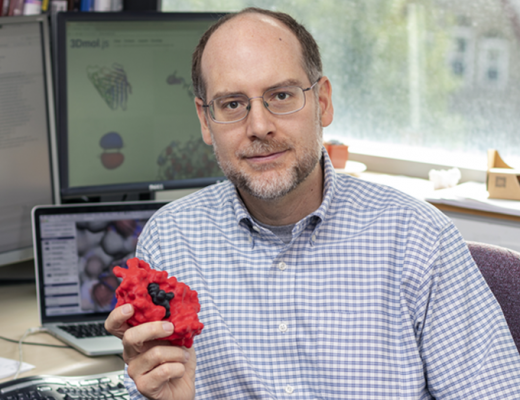
David Ryan Koes is an Associate Professor in the Department of Computational and Systems Biology at the University of Pittsburgh, affiliated with the Joint CMU-Pitt PhD Program in Computational Biology. His research focuses on computational drug discovery, deep learning, and discrete algorithms, aiming to develop novel methods for rapid drug development and open-source software tools. He holds an office at 3064 Biomedical Science Tower 3 and 748 Murdoch Building. Key roles include Associate Director of the CPCB program and leadership in initiatives like CompBio Academy. His software contributions include libmolgrid, gnina, and 3Dmol.js, which advance molecular modeling and visualization. Research interests emphasize AI-driven drug discovery, including molecular docking, pharmacophore modeling, and generative models for molecule design. Recent work involves deep learning for protein structure prediction and pharmacophore elucidation. He has secured NIH grants (e.g., R35GM140753) and collaborations with institutions like CMU and industry partners. Advising over 25 students in computational biology, biotech, and data science programs, Koes bridges academia and industry through projects like Pharmit and the Teach-Discover-Treat initiative. His lab's work spans from foundational ML research to applied drug discovery, with a focus on open science and reproducibility.
Prof. Alper SEZER is a faculty member at Ege University's Department of Civil Engineering (Faculty of Engineering), specializing in Geotechnics. His research focuses on geotechnical engineering, earthquake effects, soil mechanics, and sustainable development. He has conducted extensive studies on soil liquefaction, seismic site effects, and post-earthquake damage assessments in regions like Antakya, Izmir, and Adıyaman. His work integrates computational methods (e.g., genetic algorithms, artificial neural networks) with experimental geotechnics to improve soil characterization and disaster resilience. He has collaborated on projects analyzing valley effects, ground motion amplification, and the mechanical behavior of soils under cyclic loading. Education: Details not explicitly provided in text, inferred through academic publications and position. Research interests include geotechnical hazard mitigation, soil stabilization techniques (e.g., polymer-modified soils), and the application of fractal analysis to soil properties. His studies address practical challenges such as sulfate resistance in cement-stabilized soils and freeze-thaw resistance of fiber-reinforced materials. He has contributed to microzonation studies and seismic risk assessments in urban areas like Izmir Bay. Publications emphasize field reconnaissance findings from major earthquakes (e.g., 2020 Samos, 2023 Türkiye earthquakes) and laboratory experiments on soil behavior under dynamic loading. Awards and recognitions are not explicitly listed in the text. Grant activities and advising details are not provided, but his extensive publication record suggests sustained research funding. He is affiliated with geotechnical laboratories at Ege University, focusing on experimental testing and computational modeling in geotechnical engineering.
Katia Jaffres-Runser is a full Professor at Institut National Polytechnique de Toulouse (Toulouse INP) , affiliated with the ENSEEIHT engineering school and the IRIT laboratory , where she leads the RMESS team. She holds a PhD from INSA Lyon and completed a prestigious Marie Curie postdoctoral fellowship at Stevens Institute of Technology and INSA Lyon. PhD : Institut des Sciences Appliquées de Lyon (INSA Lyon), 2005 M.Sc. : INSA Lyon, 2002 Diplôme d’Ingénieur en Télécommunications : INSA Lyon, 2002 Her research centers on performance evaluation and optimization of networks , particularly in wireless sensor networks, IoT, embedded systems, and complex networks. She applies advanced techniques like Google Matrix analysis, game theory, and deep reinforcement learning to improve network reliability, synchronization, and efficiency. Her work spans theoretical modeling and practical implementations in avionics, automotive, and industrial systems. Her recent publications highlight a strong trend in time-sensitive networking (TSN) , network synchronization , AI-driven optimization , and complex network analysis using Wikipedia and trade data. She has led major projects like MACACO, GOIA, and the Maison du Quantique Occitanie, focusing on real-time, reliable, and intelligent networking solutions. Scientific Awards: Best Paper Award on Propagation, IEE International Conference on Antennas and Propagation, 2003 STIC Innovation Prize, 2005 Marie Curie Outgoing International Fellowship, 2007–2010 Prime d'Excellence Scientifique (2013–2016) PEDR (2017–2021) RIPEC C3 (2022–2025) She has advised PhD students and contributed to national and international scientific service, including committee memberships in CoNRS , HCERES , and ACM N²Women . She has served on award juries and grant review panels. Her leadership extends to being Vice-President for Education at Toulouse INP (2021–2024) and Team Leader of RMESS at IRIT (since 2024) . She is actively involved in research labs and collaborative teams such as: RMESS Team , IRIT Laboratory – leading research on network modeling and embedded systems MACACO Project – international collaboration on adaptive communication networks GOIA and APPLIGOOGLE Projects – applying Google Matrix to AI and complex networks IRT EDEN – evaluating determinism in embedded networking
Professor Zuheir Barsoum is a faculty member at KTH Royal Institute of Technology, serving as Vice Head (Research) in the Department of Engineering Mechanics. His research focuses on computational weld mechanics, fatigue assessment of materials, and structural integrity of welded joints. Key areas include high-frequency mechanical impact (HFMI) treatments for fatigue improvement, finite element analysis, and lightweight metal joining. Funded by VINNOVA, SSAB, Volvo, and others, his work addresses industrial challenges in structural durability. Current PhD students include Martin Edgren (bridge structural health monitoring), Mehdi Ghanadi (fatigue of high-strength steels), Yu Zhu (laser cladding simulations), and Kaushik Iyer (LCC modeling of welded structures). He teaches courses like Advanced Design of Welded Structures (SD2420) and oversees degree projects in Lightweight and Solid Mechanics. Notable achievements include the 2010 Henry Granjon Prize for fatigue design research. His startup Winteria AB commercializes digital quality assurance solutions for welding production, aligning with Industry 4.0 trends. Recent research emphasizes probabilistic fatigue modeling, machine learning for weld geometry analysis, and material defect characterization. Collaborations include Chalmers University and Swerim. His work bridges advanced manufacturing, computational mechanics, and industrial applications to enhance structural reliability and lifecycle cost optimization.
Steve Hostler, PhD, is an Assistant Professor in the Department of Mechanical and Aerospace Engineering at Case Western Reserve University's Case School of Engineering. His research focuses on thermal management, granular materials, and CO2 power/refrigeration cycles, with expertise in fluid mechanics, thermodynamics, and heat transfer. He teaches courses such as Design of Fluid and Thermal Elements (EMAE 355) and Advanced Heat Transfer (EMAE 459). Hostler holds a PhD in Mechanical Engineering from the California Institute of Technology (2005), an MS from the same institution (2001), and a BS from Case Western Reserve University (2000). His work bridges theoretical and applied engineering, addressing challenges in energy systems, material science, and biomedical thermal effects. His research spans combustion dynamics, thermal conductivity of nanomaterials, and energy conversion systems. Notable contributions include studies on polymer composites' thermal behavior and the development of CO2-based power cycles. He is a member of the American Society of Mechanical Engineers and the American Society for Engineering Education.
Martin Servin is an Associate Professor at the Department of Physics, Umeå University, and leads the Digital Physics research group within the UMIT Research Lab. His work focuses on computational modeling and simulation of granular materials, robots, and vehicles, with applications in AI-based control and perception. He holds a doctoral degree from Umeå University (2003) and has pioneered research in real-time physics simulation, particularly in the context of autonomous machinery and off-road robotics. Research Interests : Digital physics, granular materials simulation, autonomous systems, reinforcement learning, and simulation-to-reality transfer. His group develops advanced simulation tools for industries like forestry, mining, and construction. Key Projects : Mistra Digital Forest (2019–2026) AILUR (Digital Twin for AI-controlled Lunar Robotics) XSCAVE (Explainable, Safe Control for Heavy Machinery) Publications emphasize simulation methodologies, AI integration, and real-world validation across robotics, vehicle dynamics, and granular mechanics. Notable contributions include work on wheel loader dynamics, deep reinforcement learning for control systems, and terrain modeling. Awards include the Spin-off award for industry-grade physics in Unreal Engine (2018) , recognizing his role in Algoryx Simulations, a spin-off company commercializing his research. Labs/Teams : UMIT Research Lab, Digital Physics Group, and collaborations with Algoryx Simulations.
Ramya Korlakai Vinayak is the Dugald C. Jackson Assistant Professor in the Department of Electrical and Computer Engineering at the University of Wisconsin-Madison. She also holds affiliations with the Department of Computer Science and the Department of Statistics at UW-Madison. Her research program bridges theoretical machine learning with practical applications in data science and crowdsourcing. Education: PhD in Electrical Engineering from California Institute of Technology (Caltech), advised by Prof. Babak Hassibi B.Tech in Electrical Engineering with minor in Physics from Indian Institute of Technology Madras (IIT Madras) Dr. Vinayak's research focuses on developing theoretically grounded machine learning tools for reliable inference using data from human sources. Her work spans machine learning theory, statistical inference, and crowdsourcing systems, with particular emphasis on preference learning, metric learning, and robust dataset construction. She has pioneered methods for learning from limited pairwise comparisons, auto-labeling systems, and human-in-the-loop out-of-distribution detection. Her recent publications reveal a consistent trajectory toward building practical machine learning systems that incorporate human feedback while maintaining theoretical guarantees. The pattern shows increasing focus on ethical considerations in AI, particularly regarding bias in generative models and reliable human-AI collaboration frameworks. Scientific Awards: Faculty for the Future fellowship (2013-2015) from Schlumberger Foundation NSF CAREER Award American Family Funding Initiative Award with Fred Sala Dr. Vinayak leads an active research group with multiple PhD students across ECE and CS departments. She has secured significant research funding including an NSF grant for "Uncovering the cognitive and neural fingerprints that make each of us unique" in collaboration with Tim Rogers, Rob Nowak and Brad Postle. She is also co-organizing the MidWest Machine Learning Symposium and NeurIPS tutorials on dataset construction. Her research group operates at the intersection of theory and practice, developing mathematically grounded frameworks that address real-world challenges in dataset construction, human-AI collaboration, and reliable machine learning systems.
Dr. Changxing Dong is a Research Associate at the Leibniz Institute of Agricultural Development in Transition Economies (IAMO) since November 2010, specializing in agent-based modeling and agricultural policy simulation. He previously worked at Martin-Luther-University Halle-Wittenberg. Current affiliation: IAMO Department of Structural Development of Farms and Rural Areas Prior affiliation: Martin-Luther-University Halle-Wittenberg His research focuses on: Agent-based modeling of agricultural systems Ecosystem services quantification Land market dynamics and resilience Policy simulation tools (AgriPoliS) Multifunctional agricultural land use Recent publications highlight trends in: Deep reinforcement learning integration with agent-based models AgriPoliS software sustainability Spatial analysis of grazing intensity in Kazakhstan Simulation games for policy evaluation He collaborates extensively on projects like AgEnRes, AgriPoliS, MULTAGRI, and Rehwinkel Resilience, working with Alfons Balmann, Ruth Njiru, and Franziska Appel on AI-enhanced agricultural simulations.
Renata Borovica-Gajic is an Associate Professor in Data Analytics and an ARC DECRA Fellow at the School of Computing and Information Systems (CIS), University of Melbourne. She also serves as Associate Dean (Diversity and Inclusion) for the Faculty of Engineering and IT, demonstrating leadership in both research and academic community development. Her research lies at the intersection of database systems, machine learning, and artificial intelligence, with a vision of creating adaptive, self-driving database engines that optimize query execution in real-time. Her work spans learned indexes, query optimization, data quality, and data-driven traffic optimization, aiming to reduce costs and improve performance in data analytics. The recent publications reflect a strong trend toward integrating machine learning into core database operations—particularly through learned indexes, bandit-based tuning, and reinforcement learning for traffic systems. These works emphasize automation, provable guarantees, and real-time adaptation, showcasing a cohesive research agenda focused on intelligent, self-optimizing data systems. Her scientific excellence is recognized by numerous awards, including: L'Oréal-UNESCO for Women in Science Fellowship (2023) Victorian Young Tall Poppy (2024) Test of Time Award at SIGMOD 2022 Multiple Research and Teaching Excellence Awards from the University of Melbourne Google Research Inclusion Award (2021) She actively mentors PhD students and leads significant research projects funded by the Australian Research Council, Google, and Telstra. Her service includes roles as Associate Editor for SIGMOD Record, conference organization (e.g., aiDM, ADC, VLDB), and leadership in diversity and inclusion initiatives. She has also contributed to influential publications such as a chapter in the 7th edition of Database System Concepts . Her research lab focuses on AI-powered databases, traffic optimization via reinforcement learning, and self-healing data systems, positioning her at the forefront of next-generation data management.
Dr. Katalin KOPECSKÓ is Associate Professor in the Department of Engineering Geology and Geotechnics , Faculty of Civil Engineering, Budapest University of Technology and Economics (BME) . She lectures on construction-materials chemistry, durability and advanced concrete technologies, and maintains an active research portfolio spanning radioactive-waste solidification, geopolymer binders, supplementary cementitious materials and fibre-reinforced cementitious composites. Education & Academic Career Long-standing faculty member at BME Faculty of Civil Engineering (exact degrees not specified in text). Regular instructor for master-level courses: Alkali Activated Materials in Civil Engineering , Chemistry of Construction Materials , Durability of Construction Materials , Structure–Property Relations of Concrete . Holds weekly consultation hours on Thursdays 12–14 in building K, basement level, room 10/5. Research Focus Her research integrates materials science , geotechnical engineering and nuclear-waste management . Recent investigations include: Development of alkali-activated recipes for borate-rich liquid radioactive waste using limestone-portland blends. Application of semi-adiabatic calorimetry to identify optimal cement types for radioactive waste cementation. Enhancement of 3D-printing performance of concrete via metakaolin and silica fume. Long-term geotechnical and hydraulic impacts of municipal solid-waste leachate on soils. Durability of natural-fibre and nanocellulose-reinforced geopolymer mortars. Corrosion behaviour of vitrified high-level waste glass under simulated repository conditions. Across 2022-2025 she has published more than 40 peer-reviewed articles, reflecting a clear shift toward sustainable construction materials , nuclear environmental safety and advanced testing methodologies . Laboratory & Collaborative Environment Dr. KOPECSKÓ operates within BME’s well-equipped Engineering Geology and Geotechnics laboratories, where calorimetry facilities, geopolymer synthesis rigs and microstructural analysis tools support her projects. Close collaboration exists with the Vásárhelyi Pál Doctoral School and the national nuclear-waste management programme at Paks NPP, evidenced by joint publications on cemented-waste testing laboratories. Grants & Awards While specific grant numbers are not listed, her sustained output in high-impact journals and participation in national projects (e.g., NVKP_16-1-2016-0019 “Increasing the Chemical Resistance of Concrete”) indicate continuous external funding. Contact Office: Building K, basement, room 10/5, Budapest University of Technology and Economics. E-mail: kopecsko.katalin@emk.bme.hu Phone: +36 1 463 2238
Dr. Adèle Carradò is a Full Professor in Solid State Physics at the University of Strasbourg (UNISTRA), affiliated with the Institute of Physics and Chemistry of Materials (IPCMS). Her research focuses on bioactive coatings, surface characterization of metallic and multi-layer systems, and mechanical properties of hybrid materials. PhD in Mechanics and Material Science (University of Reims, 2001) HDR (University of Strasbourg, 2004) Research Assistant (University of Ancona, 1997-1998) Post-doc (CEA Saclay, 2002) Her work includes over 70 original articles, two patents, and 50+ invited lectures. She specializes in: Residual stress analysis via neutron and synchrotron radiation Functional thin films for biomedical applications Mechanical behavior of metal/polymer/metal systems 3-layered sandwich structures for lightweight design Zn-Mg alloys for orthopedic implants Surface grafting techniques for biomaterials Recent publications highlight advancements in: Biodegradable Zn-Mg alloys with PMMA coatings ATUM-SEM for bone microstructure analysis Forming mechanics of steel-glass fiber-reinforced composites Residual stress optimization in extruded and drawn materials She actively participates in international conferences and serves on executive committees for biomedical materials symposia.
Sesilja Aranko is an Assistant Professor at Aalto University , affiliated with the Department of Bioproducts and Biosystems. Her research focuses on protein engineering, biomolecular condensates, and sustainable materials derived from biological macromolecules. Research Groups : Cellular Engineering Email : sesilja.aranko@aalto.fi Her work explores protein self-assembly mechanisms, particularly in spider silk and collagen systems, leveraging liquid-liquid phase separation for advanced biomaterial design. Recent studies investigate how polymer length and modular protein architecture control condensate properties, alongside developing bio-inspired adhesives from recombinant proteins and nanocellulose. She has pioneered the use of Catcher/Tag click-reaction tools for protein engineering and developed sustainable methods for spider silk production with inherent functionalization potential. Collaborative projects span marine biology (sea cucumbers) and keratin waste upcycling for textile applications. Key methodologies include intein-mediated protein splicing, segmental isotopic labeling, and structural characterization of protein ligation systems. Her research bridges fundamental biophysics with industrial applications in sustainable chemistry and biomimetic composites.
Daniel Robertz is a University Professor of Algebra and Number Theory at RWTH Aachen University, Germany, with his office located at Pontdriesch 14/16, Room 102 in Aachen. He actively participates in several academic seminars including the Joint Algebra Seminar at RWTH Aachen University, the Kolchin Seminar in Differential Algebra (online/New York), and the Diff.-Equations and Singularities Seminar (online). Professor Robertz's research spans multiple mathematical disciplines with primary focus on Differential Algebra , Difference Algebra , Computer Algebra , Discrete Geometry , Simplicial Surfaces , Group Theory , Invariant Theory , and Algebraic Systems Theory . He has developed several influential Maple packages including Janet , Involutive , JanetOre , LDA , and OreModules that have advanced computational methods in algebraic analysis of differential systems. His scholarly output demonstrates a consistent focus on algorithmic approaches to differential equations with increasing interdisciplinary applications, particularly in structural engineering through discrete geometry and origami-inspired designs for carbon-reinforced concrete structures. This research trajectory shows how abstract mathematical concepts can solve practical engineering problems, especially in sustainable construction materials development. Editorial Board of Mathematics in Computer Science Special Issue in Honor of Vladimir Gerdt (2022) Applications of Computer Algebra (ACA 2017, Jerusalem) (2019) Professor Robertz has organized numerous international workshops on computational differential and difference algebra and maintains active research collaborations across mathematics, engineering, and materials science disciplines. His work on algebraic methods for structural design involves partnerships with researchers in civil engineering, architectural design, and materials science. He leads research activities in the Chair of Algebra and Number Theory at RWTH Aachen, where his team develops computational methods for algebraic analysis of differential systems. His group maintains strong international connections with research communities in computer algebra, differential algebra, and mathematical engineering applications.
Debabrota Basu is a tenured faculty member (Inria Starting Faculty Position - ISFP) at the Scool team (previously called SequeL) of Inria Centre at University of Lille in France. He teaches postgraduate-level courses on privacy, responsible machine learning, and research methods in AI at École normale supérieure-PSL University, Université de Lille, and Centrale Lille. He is also a member of the ELLIS Society (European Laboratory for Learning and Intelligent Systems) and the Paris unit of ELLIS. Dr. Basu earned his PhD in Computer Science from the Department of Computer Science, School of Computing, National University of Singapore, advised by Stéphane Bressan and Pierre Senellart. Prior to that, he obtained a B.E. degree with Honours in Electronics and Telecommunication Engineering from Jadavpur University. Before joining Inria, he was a postdoctoral researcher at Chalmers University of Technology's Data Science and AI Division. Dr. Basu's research focuses on constructing algorithms for developing efficient, robust, private, and ethical learning machines that solve real-world problems. His methodological approach blends statistics, machine learning, and optimization. His application interests span sustainable agro-ecology, medical and pharmaceutical applications, energy-efficient autonomous systems, and algorithmic audits. Recent collaborations include the Inria-Indian Statistical Institute associate team SeRAI for developing Sequential Testing and Learning Algorithms for Verifiably Robust and Responsible AI, and the Inria-INRAE collaboration on Resilient Agricultural Decision Making under Environmental Risks. His publication record demonstrates expertise in bandit algorithms, reinforcement learning, and privacy-preserving machine learning. Recent work shows a strong theoretical foundation with practical applications, particularly in pure exploration bandits, differential privacy mechanisms, constrained optimization, and fairness verification. His research bridges the gap between theoretical guarantees and real-world deployment challenges across multiple domains. Dr. Basu has received notable recognition for his contributions: Best Student Paper Award at ACM EAAMO 2022 for 'On Meritocracy in Optimal Set Selection' Young researcher (JCJC) grant from the French National Research Agency (ANR) in 2022 in 'Artificial Intelligence and Data Science' He leads the project 'RL under Real-life Constraints: Regrets and Algorithms' and supervises PhD students and postdoctoral researchers. His research is supported by multiple projects including REPUBLIC ('Vers l'IA responsable avec l'apprentissage par renforcement sous contraintes') and 'Foundations of robustness and reliability in artificial intelligence.' Dr. Basu actively collaborates with institutions worldwide, including establishing the RELIANT associate team with Kyoto University for investigating structured multi-armed bandit problems.
Professor Sławomir Borysiak is a distinguished academic at Poznań University of Technology, where he serves as Head of the Polymer Department within the Faculty of Chemical Technology. With a career spanning over two decades, he earned his Master of Science in Engineering in 1996, PhD in Chemical Sciences in 2000, completed his habilitation in 2013, and achieved the rank of university professor in 2020. His work bridges academic research and industry applications, serving as Faculty Coordinator for Cooperation with Industry and as a member of the University Team for Cooperation with the Economy. Current Position: Professor, Head of Polymer Department Institution: Poznań University of Technology, Faculty of Chemical Technology Scientific Disciplines: Chemical Sciences (75%), Materials Engineering (25%) ORCID: 0000-0003-3485-4787 Professor Borysiak's research focuses on the physicochemistry of polymers, plastics processing and recycling, and polymer composites containing renewable fillers of plant origin. His work extends to structural studies of low molecular weight compounds, minerals, polymers and nanomaterials, with particular emphasis on the functional properties of plastics and composite materials. His laboratory investigates innovative approaches to wood-polymer composites, nanocellulose applications, and sustainable material development. Analysis of Professor Borysiak's publication record reveals a strong focus on sustainable polymer composites, with particular emphasis on lignocellulosic materials, nanocellulose applications, and renewable fillers. His recent work shows increasing integration of nanotechnology with traditional polymer science, particularly in developing antimicrobial properties, enhanced mechanical characteristics, and improved sustainability profiles for polymer composites. The research spans fundamental material science to practical applications in construction, packaging, and biomedical fields. Professor Borysiak has received recognition through his appointment as Vice-Chairman of the University Disciplinary Committee for Doctoral Students and as a member of the Board of the Polish Chemical Society, Poznań Branch. He also serves on the Polish Society of Calorimetry and Thermal Analysis and the Awards Committee of the Polish Chemical Society. As an educator, Professor Borysiak has supervised multiple doctoral dissertations, including those of Majka Odalanowska (2023) and Aleksandra Grząbka-Zasadzińska (2017). His teaching portfolio includes courses on physicochemistry of polymers, composites, nanomaterials, polymer materials technology, and chemical technology. He maintains active scientific collaborations with institutions including University of Edinburgh, Institute of Molecular Physics of the Polish Academy of Sciences, Casimir the Great University in Bydgoszcz, and several other Polish universities. His laboratory focuses on polymer research with particular expertise in wood-plastic composites, nanocellulose applications, and sustainable material development. Current projects involve developing antimicrobial polymer composites, enhancing material properties through novel hybrid fillers, and investigating the effects of various treatments on lignocellulosic materials.