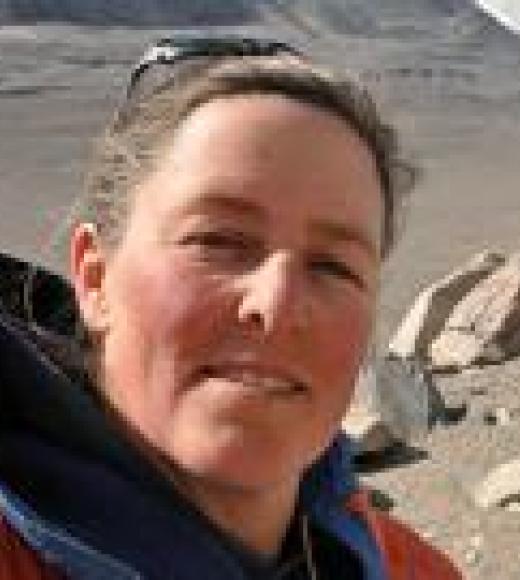
Dawn Y. Sumner is a Professor in the Department of Earth and Planetary Sciences at the University of California, Davis. Her research focuses on geobiology, paleobiology, and planetary science, particularly reconstructing ancient environments on Earth and Mars. She is a key member of NASA’s Mars Science Laboratory team, contributing to the Curiosity rover’s exploration of Gale Crater on Mars. Sumner’s work integrates field studies, lab analyses, and interdisciplinary approaches to understand microbial life’s role in shaping Earth’s history and potential habitability on other planets. Education: Ph.D., Massachusetts Institute of Technology (1995). Research interests include microbialite formation, Antarctic lake ecosystems, and the evolution of oxygenic photosynthesis. She investigates modern microbial communities in ice-covered lakes (e.g., Lake Vanda) to understand ancient environments and their biosignatures. Her scientific awards include the California Academy of Sciences Academy Fellow (2020) and Geological Society of America Fellow (2014). Sumner emphasizes inclusive education and supports student success in STEM through feminist research practices. Labs/Teams: W.M. Keck Center for Active Visualization in the Earth Sciences (KeckCAVES), Antarctic Lake Research Group.
Jonathan Snow is a Professor and Chair of the Department of Geology and Geophysics at Louisiana State University (LSU), College of Science. Previously, he held faculty positions at the University of Houston, including roles as Assistant Professor (2005–2008), Associate Professor (2008–2014), and Professor (2014–2019), and served as President of the Faculty Senate (2016). His academic journey includes a Bachelor’s in Geology from Indiana University (1983), Master’s from the University of Rochester (1986), PhD in Oceanography from MIT/WHOI (1993), and a Habilitation in Mineralogy from Universitat Mainz, Germany. Research interests focus on the Earth’s lithosphere formation, mantle melting processes, and oceanic crustal accretion. Key areas include mid-ocean ridge basalt petrogenesis, mantle noble metal geochemistry (Os, Re), and tectonics of fracture zones. Notable contributions include studies on the Arctic Ocean’s Gakkel and Lena Troughs, Hess Deep, and Shikoku Basin oceanic core complexes. Professional recognitions include NSF Graduate Fellowship (USA), Alexander von Humboldt Foundation Fellowship (Germany), DFG Heisenberg Program (Germany), and Japan Society for the Promotion of Science Fellowships. His work integrates field expeditions (e.g., ARKTIS cruises), laboratory geochemistry, and computational models to advance understanding of mantle dynamics and crustal evolution.
Yehuda Ben-Zion is a Professor of Earth Sciences at the University of Southern California (USC), affiliated with the Dornsife College of Letters, Arts and Sciences. He serves as Director of the Statewide California Earthquake Center (SCEC). His expertise lies in geophysics and seismology, with a focus on earthquake mechanics, fault dynamics, and seismic hazard assessment. He holds a Ph.D. in Geophysics and Seismology from USC (1990) and a B.S. in Geology and Physics from The Hebrew University of Jerusalem (1982). Research interests include physics of earthquakes and faults, high-resolution fault zone imaging, earthquake source properties, and dynamic rupture processes. Recent work emphasizes multi-scale modeling of rupture zones, seismic velocity monitoring using anthropogenic signals (e.g., train tremors), and probabilistic seismic hazard analysis frameworks like CyberShake. He leads projects such as Quakeworx, an open-source earthquake simulation platform, and investigates fault zone architecture in regions like the San Andreas, San Jacinto, and Marmara faults. His studies address critical questions about large earthquake mechanisms, ground motion prediction, and the interplay between tectonic stress and seismicity patterns. He has pioneered the use of dense seismic arrays and machine learning to analyze seismic data, advancing understanding of fault zone processes and their implications for hazard mitigation.
California Institute of Technology (Caltech)United States
Paul D. Asimow is the Eleanor and John R. McMillan Professor of Geology and Geochemistry at the California Institute of Technology (Caltech), part of the Division of Geological and Planetary Sciences. He holds a B.A. from Harvard University (1991), an M.S. (1993), and a Ph.D. (1997) from Caltech. His career progression includes roles as Assistant Professor (1999–2005), Associate Professor (2005–2010), and Professor (2010–present), with the McMillan Professorship since 2016. Education: A.B. in Geology, Harvard University, 1991 M.S. in Geology, Caltech, 1993 Ph.D. in Geology, Caltech, 1997 Research Interests: Focuses on computational, experimental, and observational approaches to igneous petrology and mineral physics. Key areas include adiabatic mantle melting, water's role in mantle dynamics, high-pressure mineral physics, and processes at mid-ocean ridges. His research utilizes advanced facilities like the Lindhurst Laboratory of Experimental Geophysics and the alphaMELTS software package for thermodynamic modeling. Articles Overview: Recent work spans planetary crust formation, Martian petrogenesis, and high-pressure mineral behavior. Themes include experimental techniques, computational modeling, and cosmochemical studies of meteorites. Awards and Honors: James B. Macelwane Medal (AGU) Frank Wigglesworth Clarke Medal (Geochemical Society) Richard P. Feynman Prize for Teaching Excellence (Caltech) Fellow of the American Geophysical Union Fellow of the Mineralogical Society of America Grants and Labs: Received NSF funding for developing an interactive phase equilibria curriculum. Leads the Lindhurst Laboratory, focusing on shock-wave experiments and high-pressure mineral physics. Collaborates on software tools like alphaMELTS and MAGMASOURCE. Labs and Teams: Active in the Caltech Shock Wave Laboratory, advancing experimental methods for planetary material studies. Engages in interdisciplinary projects on Mars geology and terrestrial planet formation.
Jeroen Tromp serves as the Blair Professor of Geology and Professor of Geosciences and Applied and Computational Mathematics at Princeton University, where he also directs the Princeton Institute for Computational Science and Engineering (PICSciE). His work centers on theoretical and computational seismology with applications across Earth and planetary sciences. His research interests focus on imaging Earth's interior through advanced computational techniques. Key areas include surface waves, free oscillations, body waves, seismic tomography, numerical simulations of 3-D wave propagation, and seismic hazard assessment. His group develops open-source software for acoustic, elastic and poroelastic wave propagation, addressing problems in exploration geophysics, regional and global seismology, and helioseismology. Current research trends show strong emphasis on Mars seismology (InSight mission), iron spin crossover in the lower mantle, tilted transverse isotropy in Earth's inner core, and crosstalk-free waveform inversion techniques across multiple scales. Tromp actively mentors graduate students and leads collaborative projects involving seismic wavefield imaging across planetary bodies. His group maintains strong connections with NASA's InSight mission and develops computational frameworks for global centroid moment tensor inversions. The research team operates within the Department of Geosciences, leveraging high-performance computing resources through PICSciE to tackle large-scale inverse problems in seismology.
Christopher D.P. Baxter is a Professor and Department Chair of Civil and Environmental Engineering at the College of Engineering, University of Rhode Island , with expertise in geotechnical engineering, offshore wind energy, and coastal resilience. He holds a Ph.D. in Civil Engineering from Virginia Tech (1999), an M.S. from Purdue University (1994), and a B.S. from Tufts University (1990). Research Focus: Geotechnical characterization of marine sediments, liquefaction resistance analysis, fiber-optic sensing for infrastructure monitoring, and coastal protection systems. Recent Publications: 15+ articles (2011–2025) covering topics like shear wave velocity, offshore wind foundation dynamics, and tsunami hazard modeling. Grants: Led projects on offshore wind monitoring (2019–2024) and fiber-optic seismic sensing (2021–2023). Key Collaborations: Work with teams on submarine landslide analysis, coastal dune reinforcement, and Rhode Island infrastructure resilience. His work bridges experimental geomechanics with practical coastal engineering solutions.
John H. Shaw is the Harry C. Dudley Professor of Structural and Economic Geology and Professor of Environmental Science & Engineering at Harvard University's School of Engineering and Applied Sciences (SEAS). He specializes in structural geology, earthquake hazards, and geomechanics, with a focus on thrust fault systems, fault-related folding, and seismic risk assessment in regions like California and China. His research integrates field observations, 3D modeling, and geomechanical simulations to understand fault dynamics and their implications for societal safety. Shaw's work emphasizes quantitative analysis of fault geometry, slip rates, and rupture processes. Key projects include modeling ground deformation during earthquakes, assessing seismic hazards in fold-thrust belts, and investigating reservoir-induced seismicity. He leads the Structural Geology & Earth Resources Group and contributes to collaborative initiatives like the Southern California Earthquake Center (SCEC). His articles highlight advancements in fault system modeling, including 3D structural reconstructions, distinct element method applications, and coupling geomechanical models with fluid flow simulations. Recent studies focus on the Wilmington blind-thrust fault beneath Los Angeles, the Ventura fault system, and tectonic evolution of the Canadian Rockies and Qaidam Basin. Shaw's research also addresses interdisciplinary challenges such as stochastic velocity modeling for earthquake ground motion prediction and developing open-source tools like the SCEC Unified Community Velocity Model (UCVM). His work bridges fundamental structural geology with applied seismic hazard mitigation strategies.
Robert M. Holt is a Professor in the Department of Geology and Geological Engineering at the University of Mississippi. His research focuses on geological CO2 sequestration, fluid transport in porous media, and hydrogeological characterization for nuclear waste disposal. Holt investigates how fluid behavior in heterogeneous geological formations impacts environmental processes ranging from carbon storage to groundwater contamination. His work examines the fundamental physics governing multiphase flow through porous and fractured geological media, with applications to contaminant transport, energy resources, and waste isolation. Holt has developed experimental methods for visualizing and modeling fluid behavior in heterogeneous subsurface environments, improving understanding of capillary processes and flow dynamics. Holt's research includes field studies of evaporite karst systems, geochemical assessments of aquifer systems, and investigations of hydraulic properties in low-permeability mudrocks. His work on CO2 injection monitoring has contributed to safer implementation of carbon sequestration technologies.
University of Illinois Urbana-ChampaignUnited States
Ahmed Elbanna is an Associate Professor at the University of Illinois Urbana-Champaign (UIUC), affiliated with the Grainger College of Engineering and the Department of Civil and Environmental Engineering. He holds a Ph.D. from Caltech (2011) and has been on UIUC faculty since 2013. His research focuses on mechanics of complex systems, including earthquake dynamics, metamaterials, and biomaterials. He has received prestigious awards such as the NSF CAREER Award (2018) and the Donald Biggar Willett Faculty Fellowship (2020). Education: Ph.D. Civil Engineering, California Institute of Technology (2011) M.S. Applied Mechanics, California Institute of Technology (2006) M.S. Structural Engineering, Cairo University (2005) B.S. Civil Engineering, Cairo University (2003) Research Interests: Elbanna’s work spans theoretical and applied mechanics, with emphasis on fracture, wave propagation, and critical phenomena in geophysical and biological systems. Key areas include: Earthquake mechanics and granular matter dynamics Mechanical metamaterials for wave control Networked biological materials (e.g., bone, hydrogels) Modeling epidemic dynamics during the COVID-19 pandemic Awards & Recognition: National Science Foundation CAREER Award (2018) Donald Biggar Willett Faculty Fellow (2020) Journal of Applied Mechanics Award (2019) UIUC Teaching Excellence Awards (2018–2024) Service & Leadership: Member of the UIUC Faculty Senate (2020–present) Co-Chair, Computational Mechanics Committee (ASCE EMI, 2024–present) Leader, Computational Science Group at Southern California Earthquake Center (2019–present) Labs & Groups: Leads the Mechanics of Complex Systems Lab at UIUC, focusing on interdisciplinary research in geophysics, materials science, and computational modeling.
Antonio Bobet is the Edgar B. and Hedwig M. Olson Professor in Civil Engineering at Purdue University's College of Engineering, affiliated with the Civil and Construction Engineering department. His research focuses on geomechanics, rock mechanics, seismic engineering, and lunar in-situ resource utilization. He leads studies on tunnel stability under seismic loads, fracture mechanics, and geophysical monitoring of rock systems. His work integrates experimental and numerical methods to address challenges in both terrestrial and extraterrestrial construction. Research interests include: Seismic response of underground structures Rock joint behavior and fracture propagation Lunar habitat construction using ISRU materials Geomechanical characterization of layered rocks Recent studies emphasize the interplay between geology, material properties, and structural stability. His publications analyze seismic precursors to rock failure, fracture roughness, and tunnel design under complex loading conditions. Awards and recognitions are listed under external faculty accolades. Advising and grants focus on geohazard mitigation and space infrastructure resilience. Lab affiliations include Purdue's geomechanics and geotechnical laboratories.
Jennifer C. McIntosh is a Professor and University Distinguished Scholar in the Department of Hydrology and Atmospheric Sciences at the University of Arizona (UA), with a joint appointment in the Department of Geosciences. She is also an Adjunct Professor at the University of Saskatchewan. Her academic roles include teaching advanced hydrogeology courses and advising graduate students. She holds a BA in Geology-Chemistry from Whitman College, MS and PhD in Geology from the University of Michigan, and completed a postdoctoral fellowship at Johns Hopkins University. Her research focuses on the interplay between hydrology, geochemistry, and microbiology in the Earth’s crust, spanning micro-to-macro scales. Key projects include studying subsurface fluid dynamics, microbial methane production, and the impacts of climate and human activities on groundwater systems. She has applied these methods to critical zones, sedimentary basins, and oil/gas reservoirs, with fieldwork in the Colorado Plateau, Paradox Basin, and Western Canada. McIntosh has received numerous awards for research and teaching, including the Blitzer Award for Excellence in Teaching Physics-Related Sciences (2019) and the UA Distinguished Scholar Award (2017). She actively serves on national committees for the US EPA, National Academies, and Nuclear Waste Technical Review Board. Education: BA (Whitman College), MS/PhD (University of Michigan), Postdoc (Johns Hopkins University) Notable Awards: GSA Fellow (2019), CIFAR Earth 4D Program (2019), Morton K. Blaustein Fellowship (2004) Labs/Teams: Jemez River Basin Critical Zone Observatory, Siljan Impact Structure Research Group Future Works: Investigating anthropogenic impacts on deep groundwater systems and astrobiology of subsurface microbes
Seth Finnegan is a Professor in the Department of Integrative Biology at the University of California, Berkeley, and affiliated with the University of California Museum of Paleontology. His research focuses on understanding the processes shaping marine ecosystems and biota from the late Neoproterozoic to the present, with a particular emphasis on the Ordovician Period and mass extinctions. He integrates field observations, laboratory data, and literature databases to study extinction selectivity, environmental proxies (e.g., stable isotopes, biomarkers), and ecosystem reconstructions. His lab, the Finnegan Lab, explores themes such as organism-environment interactions and the drivers of biodiversity changes. Finnegan’s work has been widely published in journals like Proceedings of the National Academy of Sciences and Geology , and he collaborates with institutions globally. Despite no listed awards here, his contributions to paleontology are significant.
Dr. John Warren Huntley is an Associate Professor in the Department of Geological Sciences at the University of Missouri. His research examines the fossil record of biotic interactions including parasitism, predation, and competition, with additional focus on conservation paleobiology and morphological disparity evolution. Dr. Huntley investigates host-parasite dynamics in marine bivalves, human impacts on mollusk populations, and Phanerozoic predation patterns. His work integrates stratigraphic paleobiology with ecological and evolutionary analyses to reconstruct historical ecosystem dynamics. His recent publications demonstrate expertise in paleoparasitology, taphonomy, and conservation paleobiology, applying novel analytical methods to questions about parasite-host coevolution, preservation biases, and extinction events. This research provides critical insights into long-term ecological patterns and biological responses to environmental change. Dr. Huntley has received significant recognition including an NSF CAREER Award and Humboldt Research Fellowship, and he co-edited the comprehensive volumes 'The Evolution and Fossil Record of Parasitism'.
Peter Shearer is a Professor of Geophysics at the Institute of Geophysics and Planetary Physics , affiliated with the Scripps Institution of Oceanography at the University of California, San Diego. His research focuses on observational seismology, mantle discontinuities, earthquake location methods, source properties, and seismicity patterns. Education: B.S. in Geology and Geophysics, Yale University (1978) Ph.D. in Geophysics, UCSD Scripps Institution (1986) Research Interests Shearer's work uses large seismic datasets to study Earth's interior structure, particularly mantle transition zones, lithospheric discontinuities, and earthquake triggering mechanisms. His methods include waveform cross-correlation relocation, SS precursor analysis, and seismic wave scattering studies. Scientific Contributions His publications span 40+ years, with recent works analyzing aftershock migration, mantle discontinuities, and fault weakening. Key themes include Global mantle imaging using teleseismic data High-resolution fault zone seismicity Deep Earth structure from scattered waves Scientific Awards AGU Fellow (1999) SIO Outstanding Teaching Award (2003) Lehmann Medal (AGU, 2020) National Academy of Sciences member (2009)
Dr. Alain Bonneville is a Lab Fellow and Geophysicist at Pacific Northwest National Laboratory (PNNL) and holds a Courtesy Professor appointment at Oregon State University's College of Earth, Ocean, and Atmospheric Sciences. With extensive experience in geological storage of CO2, geothermal energy, and geophysical monitoring techniques, Dr. Bonneville leads diverse research projects that bridge fundamental science and practical applications for energy and environmental challenges. Dr. Bonneville's educational background includes: PhD in Geophysics from the University of Montpellier, France MS in Petroleum Geophysics from IFP-School, Paris, France BS in Geology from the University of Lyon, France Dr. Bonneville's research spans several critical areas in Earth sciences and energy systems. His work on geothermal energy focuses on super-hot enhanced geothermal systems (EGS), site characterization, monitoring, and stimulation fluids. In geological CO2 storage, he investigates project management, site characterization, numerical modeling, and monitoring methods using potential fields and remote sensing. His expertise in geophysical methods includes heat flow measurements, gravity surveys, muon tomography development for borehole deployment, and remote sensing applications. Additional research areas encompass marine heat flow instrumentation development, thermal monitoring of active volcanoes, and intraplate volcanism studies in the Indian and Pacific Oceans. Dr. Bonneville has received significant recognition for his contributions to science, including: Membership in the Washington State Academy of Sciences Lab Fellow position at Pacific Northwest National Laboratory Executive Committee membership on the U.S. National Risk Assessment Partnership Scientific Committee membership at IFP-Energies Nouvelles, France He also holds two U.S. patents related to electrophilic acid gas-reactive fluids for enhanced fracturing and recovery of energy producing materials. Throughout his career, Dr. Bonneville has led significant research initiatives, including the PNNL Carbon Sequestration Initiative (2009-2013) and the European Marie Curie Research Training Network on Greenhouse Gas Removal (GRASP), which involved 14 academic and industrial institutions across 7 countries and supported 35 PhD students and post-docs. His work on the FutureGen 2.0 project demonstrates his leadership in large-scale carbon storage site characterization and monitoring program design. Dr. Bonneville maintains active collaborations with research teams at PNNL's Environmental Molecular Sciences Laboratory and works closely with Oregon State University's geoscience researchers. His laboratory work focuses on developing novel instrumentation for geophysical monitoring, particularly in the areas of muon tomography for subsurface characterization and thermal monitoring systems for geothermal and carbon storage applications.