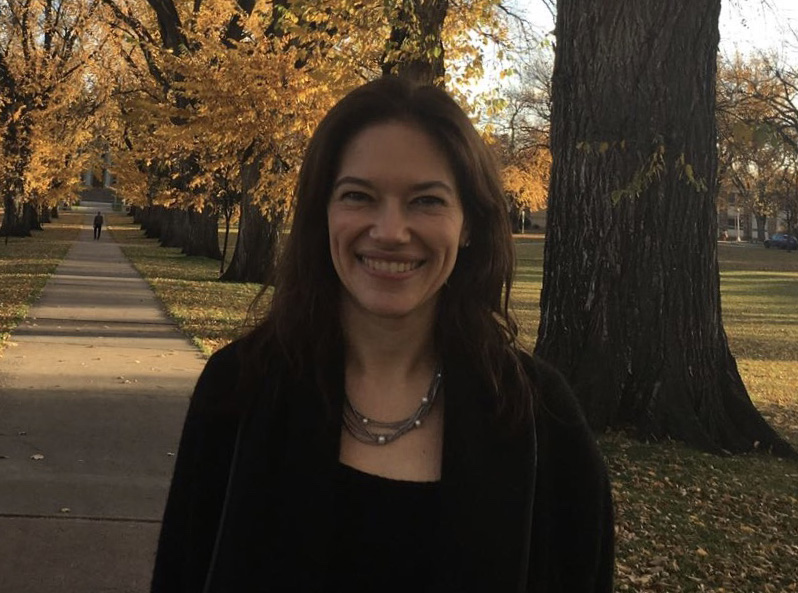
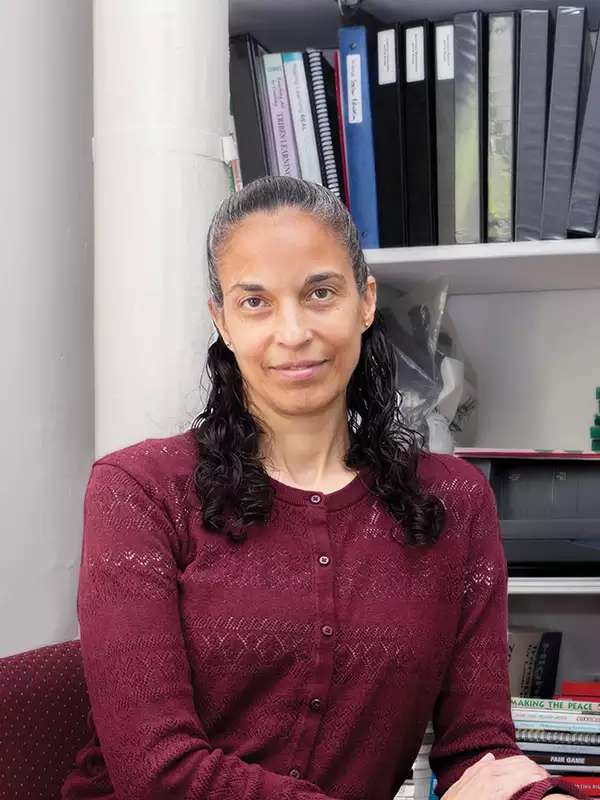
Maria Chudnovsky is a Professor of Mathematics at Princeton University and a former Professor of IEOR and Mathematics at Columbia University (2006-2014). Her research focuses on graph theory and combinatorics, with significant contributions to structural graph theory, perfect graphs, and algorithmic applications. Education: B.A. Summa Cum Laude (1996) and M.Sc. (1999) from Technion, Ph.D. (2003) from Princeton University Her work addresses fundamental problems in graph coloring, forbidden induced subgraphs, and combinatorial optimization, including the proof of the Strong Perfect Graph Theorem and development of algorithms for detecting graph structures. Notable awards include the MacArthur Foundation Fellowship (2013-2017), D.R. Fulkerson Prize (2009), and Henry Burchard Fine Professor of Mathematics (2022). She has held prestigious fellowships such as the Clay Mathematics Institute Research Fellowship (2003-2008). Grants: NSF DMS-EPSRC Grant DMS-2120644 (2021-2024), US Army Research Office Grant W911NF-16-1-0404 (2016-2020), and multiple NSF grants She has advised numerous PhD/MSc students and postdocs, including Sophie Spirkl, Mingxian Zhong, and Tara Abrishami. Her outreach includes popular science communication on YouTube's Numberphile and participation in initiatives promoting women in STEM.
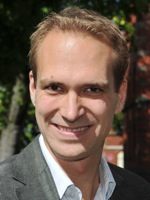
Sophie Spirkl is an Associate Professor (with tenure) in the Department of Combinatorics and Optimization at the University of Waterloo. Previously, she held postdoctoral positions at Princeton University (as an NSF postdoc and instructor, supervised by Maria Chudnovsky) and at Rutgers University (under Jeff Kahn). She earned her PhD from Princeton University under the guidance of Maria Chudnovsky and Paul Seymour. Her research focuses on graph theory and combinatorics, with notable contributions to induced subgraphs, tree decompositions, chromatic number properties, and structural graph theory. She is a recipient of the 2023 Sloan Research Fellowship and co-founded the diamond open-access journal Innovations in Graph Theory . Education: PhD in Mathematics, Princeton University (2016–2020) Postdoctoral Fellowships: Princeton (2020–2022), Rutgers (2018–2020) Research Interests: Dr. Spirkl’s work spans multiple areas of combinatorics, including structural graph theory, extremal graph theory, and algorithmic graph theory. She has published extensively on topics such as induced subgraph obstructions, χ-boundedness, tree decompositions, and the Erdős–Hajnal conjecture. Her research often intersects with theoretical computer science, particularly in parameterized complexity and graph colorings. Awards & Recognition: 2023 Sloan Research Fellowship Contributions to the Innovations in Graph Theory journal Academic Contributions: Her articles address foundational problems in graph theory, such as the Erdős–Hajnal conjecture for C₅, logarithmic treewidth in even-hole-free graphs, and induced saturation for cycles. She collaborates with leading researchers like Maria Chudnovsky and Paul Seymour, advancing the field through rigorous combinatorial analysis. Community Engagement: She coordinates the Women in Math Directed Reading Program at Waterloo, supporting underrepresented groups in mathematics. Her spouse, Logan Crew, is a Research Assistant Professor at the same institution.
Professor Rainer Böhme is a prominent academic in the field of IT security and privacy at the University of Münster's School of Business and Economics, Department of Information Systems. He also holds a professorship for Security and Privacy at the University of Innsbruck's Institute of Computer Science. His research spans multiple dimensions of digital security, with particular expertise in steganography, digital forensics, privacy-enhancing technologies, and the economic aspects of cybersecurity. Dr. Böhme earned his Doctoral Degree from TU Dresden's Faculty of Computer Science in 2008, following studies in Communications, Economics and Computer Science at Technische Universität Dresden and Université Paris XII. His academic journey includes positions as Assistant Professor at the University of Münster (2010-2015), Postdoctoral Fellow at the International Computer Science Institute in Berkeley (2009-2010), and Scientific Staff at TU Dresden's Chair of Privacy and Data Security. His research interests focus on steganography and steganalysis, digital forensics, privacy-enhancing technologies, security and usability, economic and behavioral aspects of information privacy, virtual currencies, and the economics of information security. His work bridges technical security mechanisms with economic and behavioral considerations, creating a unique interdisciplinary approach to cybersecurity challenges. Analysis of his recent publications reveals a strong trend toward the economics of security, particularly regarding blockchain technologies, cryptocurrency, and privacy valuation. His work increasingly examines the intersection of technical security mechanisms with market dynamics, regulatory frameworks, and user behavior. The research spans theoretical game-theoretic models, empirical studies of user behavior, and practical applications in digital forensics and privacy protection. Program Co-Chair, Financial Cryptography and Data Security (2015) Program Co-Chair, New Security Paradigms Workshop (NSPW) (2015) General Chair, 8th International Conference on IT Security Incident Management & IT Forensics (2014) Organizer and Program Co-Chair, 1st Workshop on Bitcoin Research (2014) Associate Editor, Electronic Commerce Research (since 2013) Associate Editor, EURASIP Journal on Information Security (since 2013) Professor Böhme has supervised multiple Master's theses in Information Systems, including work on static code analysis for smart contracts, remote maintenance protocol security, and application protection requirements in retail banking. His research is supported by significant grants from the German Federal Ministry of Research, Technology and Space, the DFG, and the EU FP7 program, with projects focusing on digital forensics, privacy-enhancing technologies, and cryptocurrency crime prevention. He leads the IT Security Research Group at the University of Münster, which investigates theoretical and applied aspects of information security with particular emphasis on the economic dimensions of security decisions.
Professor Stefan Maier holds the position of Head of School in Physics and Astronomy at Monash University. Previously, he served as the Lee Lucas Chair in Experimental Physics at Imperial College London (2007–2018) and built a new chair at Ludwig-Maximilians-Universität München (2019–2022). His research focuses on nanophotonics, plasmonics, and metasurface engineering, with emphasis on optical trapping, nonlinear optics, and novel photonic devices. Education: Bachelor’s degree in Physics, Technical University of Munich M.Sc. and Ph.D. in Applied Physics, California Institute of Technology (Caltech) Research Interests: Development of metamaterials and metasurfaces for light manipulation Applications of nanophotonics in sensing, imaging, and quantum technologies Optical trapping and plasmonic catalysis Nonlinear optical phenomena in nanostructured materials Articles Trends: Recent work emphasizes bound states in the continuum (BICs), 3D nanoprinted optical platforms, and active metasurfaces with tunable properties. Key themes include hybrid nanophotonics, ultra-high-Q resonators, and plasmonic nanomaterials for energy applications. Awards: ISI Highly Cited Researcher (2017–present) Grants/Projects: Chief Investigator in the All-on-chip twisted light modulator project (2022–2025) Leadership in Monash’s nanophotonics research team Labs/Teams: Directs a multidisciplinary lab at Monash focused on integrating 3D nanofabrication with optical physics, including collaborations in metafiber development and plasmonic biosensing.
Monika Henzinger is Professor at the Institute of Science and Technology Austria (ISTA), heading the research group of Theory and Applications of Algorithms. She also serves as Vice President for Technology Transfer at ISTA since 2024. Previously, she held professorships at the University of Vienna (2009-2023) and EPFL, Switzerland (2005-2009), was Director of Research at Google (1999-2005), and served as Assistant Professor at Cornell University. Professor Henzinger's research centers on efficient algorithms and data structures with three main thrusts. First, she investigates dynamic settings where program inputs are repeatedly updated, seeking solutions faster than restarting computations. Second, she develops privacy-preserving algorithms that add minimal noise to protect input data while maintaining efficiency. Third, she translates theoretically optimal algorithms into practical implementations for dynamically changing inputs. Her work consistently addresses resource conservation in data processing, particularly computing time and memory space, while exploring the theoretical limits of possible savings. Henzinger's recent publications (2024-2025) reveal strong trends in dynamic algorithms, differential privacy, and graph theory. Her research consistently bridges theoretical computer science with practical applications, focusing on algorithms that adapt to changing inputs while preserving computational efficiency and data privacy. She has made significant contributions to problems like dynamic matching, minimum cut computation, and privacy-preserving data analysis across various domains. Professor Henzinger has received numerous prestigious awards and honors: Wittgenstein Award (2021) Two ERC Advanced Grants (2014, 2021) Carus Medal of the German Academy of Sciences Leopoldina (2019) SIGIR Test of Time Award Fellow of the Association of Computing Machinery (2016) Member of the Austrian Academy of Sciences (2017) CAREER Development Award of the National Science Foundation Best paper Award at the Symposium on Discrete Algorithms (2024) Professor Henzinger currently advises PhD students Bardiya Aryanfard, Antoine El-Hayek, and Roodabeh Safavi Hemami, along with postdocs Anamay Chaturvedi and Niklas Hahn. Her research is supported by multiple significant grants including an ERC Advanced Grant for 'Design and Evaluation of Modern, Fully Dynamic Data Structures,' the FWF Wittgenstein Prize, and the WEAVE Project on 'Static and dynamic hierarchical graph decompositions.' She also serves as Principal Investigator for the FWF project 'Fast algorithms for a reactive network layer,' providing substantial funding for her innovative work in algorithms and data structures. Professor Henzinger leads the Theory and Applications of Algorithms research group at ISTA, which focuses on developing practical algorithms for dynamic environments. Her team investigates resource conservation in data processing, specializing in dynamic algorithms that efficiently handle changing inputs, privacy-preserving algorithms that minimize noise while protecting data, and translating theoretical algorithms into practical implementations. The group maintains a strong presence in theoretical computer science through regular publications in top conferences and journals, and collaborates extensively with institutions worldwide to advance algorithmic research.
Dr. Eli Strauss is a behavioral ecologist and Assistant Professor in the Department of Integrative Biology at Michigan State University , where he is establishing a lab focused on the evolution and ecology of social behavior. He co-directs the Mara Hyena Project , a long-term study of hyena behavior and ecology in Kenya. His research spans dominance hierarchies, longitudinal studies of animal societies, and computational methods for analyzing social dynamics. He has developed tools like the DynaRankR R package for inferring longitudinal dominance hierarchies and DomArchive for compiling dominance data. His work addresses challenges such as mismatched timescales in behavioral studies and demographic drivers of hierarchy dynamics, often using spotted hyenas as a model species. Dr. Strauss is currently recruiting lab members for graduate student, postdoc, and technical roles, with lab establishment planned for late 2025–Fall 2026. His publications reflect interdisciplinary interests in behavioral ecology, animal societies, and data-driven approaches to understanding dominance and social networks.
Brandon Seward is an Associate Professor of Mathematics at the University of California San Diego (UC San Diego), where they conduct research and teach in the Department of Mathematics. They use the pronouns they/them or he/him . Education Ph.D. in Mathematics, University of Michigan , 2015 Research Interests Their work lies at the intersection of ergodic theory, topological dynamics, descriptive set theory, and group theory . They investigate geometric, combinatorial, and entropic properties of actions of countable groups, with special emphasis on the divide between amenable and non-amenable groups. Publications & Research Impact Across 27 refereed papers (2014-2024), Seward has advanced entropy theory for non-amenable groups, Borel combinatorics of group actions, and structure theorems for measure-preserving actions. Their work has appeared in top journals such as Inventiones Mathematicae , Journal of the American Mathematical Society , and Duke Mathematical Journal . Scientific Awards Michael Brin Dynamical Systems Prize for Young Mathematicians (2018) – awarded for outstanding contributions to dynamical systems. Teaching & Mentorship Seward regularly teaches core undergraduate courses (e.g., Math 142A Introduction to Analysis) and organizes the UC San Diego Group Actions Seminar , a weekly research forum featuring international speakers. They serve as a faculty mentor and are actively involved in graduate student supervision and seminar coordination. Contact & Office Email: bseward@ucsd.edu Office: AP&M 5739, 9500 Gilman Drive, La Jolla, CA 92093-0112
Asaf Ferber is Associate Professor in Mathematics at University of California, Irvine, School of Physical Sciences. His research spans discrete mathematics including combinatorial games, random graphs, extremal hypergraph theory, and quantum computation. Research explores Hamiltonian cycles in random graphs, structural properties of pseudorandom graphs, and quantum algorithms for combinatorial problems. Recent work develops quantum approaches to graph learning and sparse recovery in random matrices. Awards: NSF CAREER Award Sloan Fellowship Distinguished Early Career Faculty Award for Research Air Force Research Grant NSF-BSF Grant Organizes conferences including SoCalDM Symposium and Desert Discrete Math Workshop, mentoring graduate students through UCI's Probability and Combinatorics Seminar.
Imogen Forbes-Macphail is an Assistant Professor at the University of California, Davis, specializing in the interdisciplinary intersections of nineteenth-century British poetry and mathematical thought. Her current book project, Line and Number: Formal Problems in Nineteenth-Century Poetry and Mathematics , examines how Victorian poets and mathematicians engaged with analogous formal challenges. Victorian Poetry Caucus Representative, North American Victorian Studies Association Co-Editor (with Anna Henchman), Special Issue of Nineteenth-Century Gender Studies on women’s writing and scientific knowledge production (“Longing to Know”) Research Focus: Forbes-Macphail’s work bridges literary formalism and historical scientific methodologies, particularly exploring topics like computational proof, topological poetics, and the mysticism inherent in Victorian-era mathematical and poetic discourse. Her interdisciplinary approach highlights how mathematical concepts influenced poetic structures and vice versa. Scientific Contributions: Her publications span analyses of the Four-Color Theorem, Ada Lovelace’s literary-scientific legacy, and the gendered dynamics of 19th-century knowledge production. Key trends include the aestheticization of mathematical rigor, the role of formalism in shaping Victorian intellectual paradigms, and crossdisciplinary epistemological inquiries. Honorable Mention, “Expanding the Field” Essay Prize, Northeast Victorian Studies Association (2022) Susan Morgan Graduate Student Essay Prize, Interdisciplinary Nineteenth-Century Studies (2019) Sally Mitchell Prize, North American Victorian Studies Association (2018) Honorable Mention, Susan Morgan Graduate Student Essay Prize (2018) Sussex-Samuel Prize, Australasian Universities Language and Literature Association (2013) Forbes-Macphail’s teaching includes courses such as ENL 164: Writing Science Publications , emphasizing the synthesis of scientific and literary communication. She previously held a Junior Fellowship at the Harvard Society of Fellows (2022–25), underscoring her prominence in Victorian studies.
María Rivera Maulucci is the Ann Whitney Olin Professor of Education and serves as the Education Program Director/Chair at Barnard College, Columbia University. She is a proud alumna of Barnard (Class of 1988) and has been a faculty member since 2004. Her work centers on urban education, science pedagogy, and teacher development with a strong commitment to equity and social justice. Education: BS, Barnard College, Columbia University MFS, Yale School of Forestry & Environmental Studies M.Phil, Teachers College, Columbia University Ph.D., Teachers College, Columbia University Her research focuses on how teachers learn to teach for social justice, emphasizing the role of language, identity, and emotions in teacher development. She employs qualitative research and evaluation methods to explore transformative pedagogical practices in urban science education. Her scholarship bridges formal and informal learning contexts and investigates the interplay between teacher agency and structural constraints. Her recent publications and presentations highlight a sustained focus on equity, critical science inquiry, teacher identity, and professional development. She has contributed extensively to journals such as Journal of Research in Science Teaching and Cultural Studies of Science Education , and has authored chapters on social justice, identity, and assessment in science education. Scientific Awards: Barnard College Emily Gregory Teaching Award (2018) National Association for Research in Science Teaching Equity and Ethics Scholar (2007) She is the Principal Investigator of the NSF-funded Barnard College Robert Noyce Teacher Education Scholars Program, which supports future science teachers in urban schools. She advises students and collaborates with national organizations, including the National Association for Research in Science Teaching, Association for Science Teacher Education, and American Educational Research Association. Her teaching includes courses such as Science in the City , Urban School Practicum , and Performance Assessment of Teaching . She is actively engaged in professional development initiatives and has led workshops on family engineering nights, multicultural pedagogy, and social justice in science education. Her lab and programmatic work centers on the Noyce Scholars Program, which functions as a living laboratory for preparing socially conscious science educators.
Emily A. Gasser is an Associate Professor in the Linguistics Department at Swarthmore College , specializing in Austronesian languages , Wallacea & northwest New Guinea , and language documentation . Her research spans phonology, morphology, typology , and language contact , with a focus on endangered languages and computational phylogenetics . She is currently on sabbatical for the 2025-26 academic year, conducting fieldwork in Manokwari, writing a Wamesa grammar, and developing new courses. Research Interests include: Language documentation and fieldwork in Austronesian and Papuan-speaking regions Phonological variation and vowel harmony systems Typological surveys of adnominal possession and morphological structures Interaction between prosodic features in media speech and socio-phonetics Computational tools for historical linguistics and classifier system analysis Recent publications focus on vowel harmony , prosodic perception , and possessive constructions across Wallacea and Northwest New Guinea. She edits volumes on Austronesian-Papuan language contact and contributes to open-access research initiatives.
Clark Olson is a Professor in the Division of Computing & Software Systems at the University of Washington Bothell, part of the School of Science, Technology, Engineering & Mathematics. He earned his Ph.D. in Computer Science from UC Berkeley (1994), M.S. in Electrical Engineering (1990), and B.S. in Computer Engineering (1989) from the University of Washington, Seattle. Education: Ph.D. in Computer Science (2017) from University of California, Berkeley M.S. in Electrical Engineering (1990) from University of Washington, Seattle B.S. in Computer Engineering (1989) from University of Washington, Seattle His research focuses on computer vision, robot navigation, and clustering algorithms. He has developed techniques for Mars rover terrain mapping, subspace clustering, and geometric feature matching. His work bridges theory and application in autonomous systems and image analysis. Analysis of his publications reveals expertise in computer vision (8 papers), clustering algorithms (4 papers), and robotics (5 papers). Key subtopics include Mars exploration (3 papers), Hough transforms (3 papers), and probabilistic methods (3 papers). Professor Olson teaches courses ranging from introductory programming (CSS 161-162) to advanced topics in computer vision (CSS 487-587) and algorithm design (CSS 549). He also advises on the CSSE Capstone (CSS 497) projects requiring rigorous prerequisites and structured evaluation criteria.
Gordon Plotkin is a Professor at the School of Informatics, University of Edinburgh, where he is affiliated with the Laboratory for Foundations of Computer Science (LFCS). His research lies at the intersection of theoretical computer science and programming language semantics, with a profound influence on the formal understanding of computation. His research interests include Programming Language Theory, Semantics of Programming Languages, Domain Theory, Operational Semantics, Lambda Calculus, Type Theory, Concurrency Theory, and Algebraic Effects. His seminal work on structural operational semantics and domain theory has laid the foundation for modern semantics of programming languages. His publications span over five decades, showing a sustained and evolving research trajectory from foundational work in lambda calculus and domain theory to recent contributions in algebraic effects, probabilistic computation, and biochemical systems modeling. The articles demonstrate a consistent focus on formal methods, mathematical rigor, and the algebraic structure of computational effects. He has collaborated with leading researchers including Martín Abadi, John Power, Glynn Winskel, and John Reynolds. His work continues to influence both theoretical and practical developments in programming languages and systems. Gordon Plotkin has made foundational contributions to computer science, particularly through his development of structural operational semantics and domain-theoretic models of computation. He has advised numerous researchers and supervised many influential PhD theses, though specific student names are not listed in the provided text. His work has been supported by long-standing affiliations with the Laboratory for Foundations of Computer Science and the University of Edinburgh, and he has contributed to major collaborative projects in programming language design and verification. He is associated with several research groups and labs, most notably the Laboratory for Foundations of Computer Science (LFCS), which serves as a hub for theoretical research in programming languages, semantics, and logic at the University of Edinburgh.
Yongmin Liu is a Professor in Mechanical and Industrial Engineering and Electrical & Computer Engineering at Northeastern University, and a member of the Cross-College Magnetics Center. He holds a PhD in Applied Science and Technology from UC Berkeley (2009), with earlier degrees from Nanjing University. His research focuses on nano-optics, metamaterials, plasmonics, and their applications in optical devices and systems. His interdisciplinary work bridges engineering, physics, and AI, with notable contributions to metasurface design and optical neural networks. Education: PhD, Applied Science and Technology, UC Berkeley (2009) M.S. and B.S., Physics, Nanjing University (2003, 2000) Research Interests: Nano-optics, nanoscale materials engineering, metamaterials, plasmonics, and applied physics. His group develops novel optical materials and devices for applications like super-resolution imaging, efficient light harvesting, and biomedical detection. Recent projects include AI-driven photonic materials design and meta-optical neural networks. Key Achievements: Recipient of the Søren Buus Outstanding Research Award (2024) NSF CAREER Award (2017) and ONR Young Investigator Award (2016) Elected SPIE Fellow (2023) and Optica Fellow (2023) Lab & Collaborations: Head of the Yongmin Liu Research Group, collaborating with institutions like Georgia Tech and Purdue University. Recent grants include a $1.5M NSF DMREF grant for AI-driven photonic materials and a $468K NSF grant for meta-optical neural networks.
Assoc Prof Ng Teng Yong is an Associate Professor at the School of Mechanical & Aerospace Engineering (NTU), specializing in numerical modeling and simulation. With a background as Research Manager at A*STAR Institute of High Performance Computing, his work spans materials science, nanotechnology, and aerospace engineering. Current focus on graphene-based desalination membranes Expertise in molecular dynamics simulations Investigates nanoscale fluid mechanics and structural dynamics Recent publications highlight advancements in energy-efficient electrodialysis, smart robotics, and nonlinear vibration analysis. His interdisciplinary approach integrates computational methods with experimental validation in additive manufacturing and soft material mechanics.