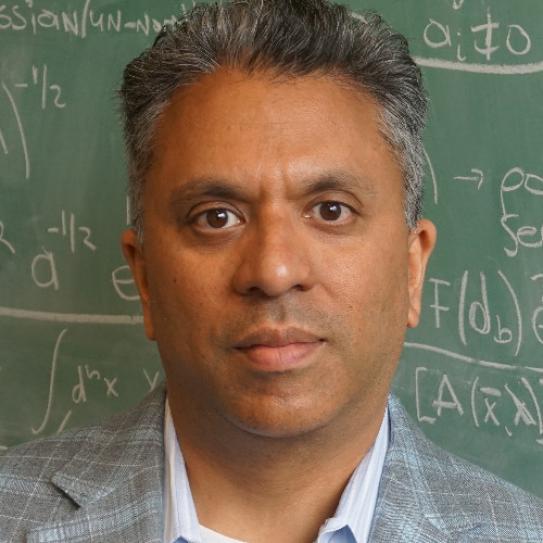
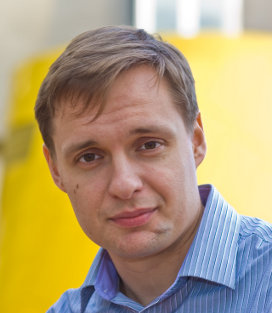
Stephen Wright is a Professor in the Department of Computer Sciences at the University of Wisconsin-Madison, serving as Department Chair from 2023-2025. He previously held roles at Argonne National Laboratory (1990-2001) and the University of Chicago (2000-2001). His research focuses on computational optimization, with applications in data science, machine learning, and engineering. He co-authored seminal books such as Numerical Optimization (with J. Nocedal) and Optimization for Data Analysis (with B. Recht). Wright leads the Wisconsin Institute for Discovery's research initiatives and has developed widely-used optimization software like PCx and SpaRSA . Key awards include the 2024 George B. Dantzig Prize, 2020 Khachiyan Prize, and SIAM Fellow status since 2011. He has served as editor-in-chief of the SIAM Journal on Optimization and Mathematical Programming, Series B . His teaching includes courses on nonlinear optimization (CS726) and introductory optimization (CS524). Wright’s work bridges theory and practice, emphasizing scalable algorithms and interdisciplinary applications.
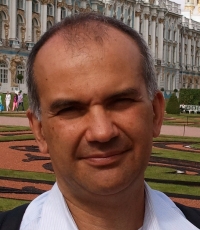
Jean-Christophe Olivo-Marin is the Head of the Biological Image Analysis Unit and Director of the Carnot Pasteur Institute for Microbes and Health at the Institut Pasteur in Paris, France. He previously served as Director of the Department of Cell Biology and Infection (2010–2014) and continues to lead impactful research at the intersection of biology, computation, and imaging. His research focuses on bioimage informatics , developing computational methods in Machine learning and deep learning for image analysis Bayesian tracking and optical flow algorithms Statistical modeling of spatial patterns in biological systems Mathematical imaging and computational cell biophysics Digital pathology and cancer microenvironment analysis His work enables rigorous quantitative analysis of complex biological phenomena such as cell motility, host-pathogen interactions, and neural dynamics. His recent publications (2024–2025) reflect a strong trend toward AI integration in bioimaging , with advances in deep learning-based segmentation (e.g., Deep ContourFlow), large-scale image annotation (SAMJ), and frameworks for evaluating neuron tracking. There is also a focus on spatial analysis in disease contexts , particularly in cancer and neurodevelopment, combining deep learning with spatial statistics. He has been awarded research funding for projects including Next-generation Structured Illumination Microscopy (SIM) Machine learning for cancer detection using FFOCT Compressive sensing in biological imaging Statistical analysis of spatial coupling in bioimaging (SODA) Olivo-Marin actively mentors students and postdoctoral researchers and contributes to open science through the development and maintenance of Icy , a widely used open-source bioimage analysis platform. He regularly participates in international conferences such as QBI, ICPR, and NEUBIAS, and leads advanced training courses, including the upcoming Advanced Bioimage Analysis with Artificial Intelligence (AI) course at Institut Pasteur in 2026. He leads a dynamic research unit with PhD students, postdocs, and engineers working on cutting-edge image analysis challenges. The team fosters collaboration across disciplines and institutions, promoting open science and community-driven software development.
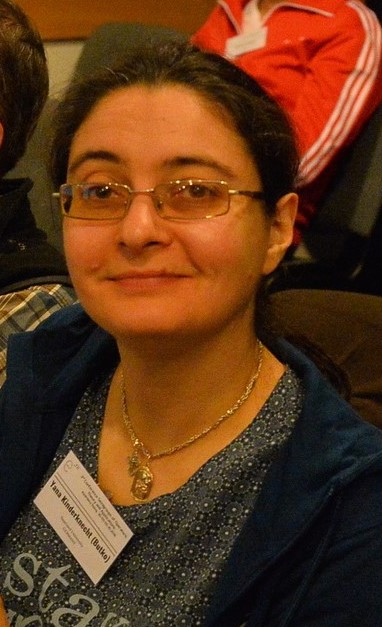
Dr. Yana Kinderknecht (née Butko) is an Associate Professor at the Department of Mathematics , Universität des Saarlandes . Her work bridges Functional Analysis , Stochastic Analysis , and Mathematical Physics , with a focus on Partial Differential Equations (PDEs) and Operator Theory . She has authored 22 publications since 2004, including preprints in zbMATH Open , and actively contributes to Chernoff approximation methods for semigroups.
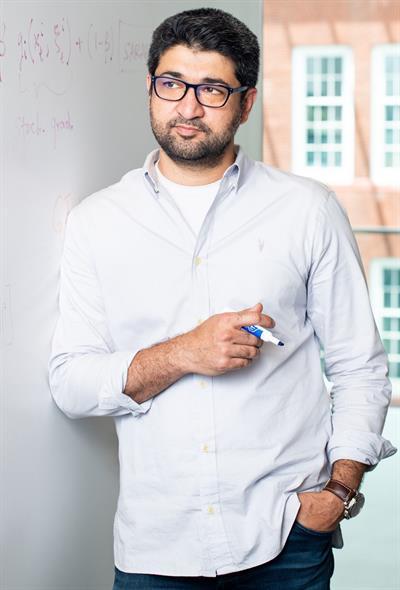
Rupak Chatterjee is an Industry Assistant Professor in the Department of Applied Physics at New York University's Tandon School of Engineering. His research bridges quantum information/computation and mathematical physics, with a focus on quantum algorithms for machine learning, optimization, operator algebras, and quantum mechanical systems. Education: Postdoctoral Scholar, Physics (James Franck Institute, University of Chicago) Ph.D. & M.S., Physics (Stony Brook University) M.Math., Mathematics (University of Waterloo) B.Sc., Physics (University of Calgary) Chatterjee's research explores quantum systems for machine learning, quantum optimization protocols, and mathematical frameworks like C∗-algebras and supersymmetric quantum mechanics. His work integrates theoretical rigor with applications in quantum computing and complex physical systems. His recent publications (2019–2024) demonstrate a strong emphasis on quantum entanglement, chaos in optomechanical systems, adiabatic quantum optimization, and relativistic quantum mechanics. Several publications also apply quantum methods to finance and diffusion modeling. No awards, student advising, or grant information is documented in the provided text.
Anna Scaglione is a Professor in the Department of Electrical and Computer Engineering at Cornell University's College of Engineering, based at Cornell Tech. She rejoined the faculty in September 2021 after holding professorial positions at Arizona State University, UC Davis, and earlier at Cornell (2001–2008). She earned her M.Sc. in 1995 and Ph.D. in 1999 from Cornell University. Research Interests: Her work centers on statistical signal processing with applications in communication networks, electric power systems, intelligent infrastructure, and network science. Key areas include graph signal processing, federated learning, differential privacy, reinforcement learning for energy systems, and cyber-physical security in smart grids. She integrates machine learning, optimization, and control theory to address challenges in modern power systems and IoT. The 15 most recent publications (2021–2025) reveal a dominant trend in privacy-preserving and AI-driven solutions for power systems. Her research emphasizes federated learning , graph neural networks , differential privacy , and reinforcement learning applied to grid stability, cybersecurity, and distributed energy management. There is a strong focus on graph signal processing for power grid modeling and anomaly detection, as well as synthetic data generation and secure transactive energy platforms . IEEE Fellow (2011) IEEE Signal Processing Transactions Best Paper Award (2000) IEEE Donald G. Fink Prize Paper Award (2013) IEEE Signal Processing Society Young Author Best Paper Award (2013, with Lin Li) IEEE Smart Grid Communications Technical Committee Technical Achievement Award (2020) IEEE SPS Distinguished Lecturer (2019–2020) Dr. Scaglione has advised students including Lin Li, whose work earned a best paper award. She has secured significant research grants related to smart grid security, privacy, and optimization. Her editorial leadership includes Editor-in-Chief of IEEE Signal Processing Letters (2012–2013) and Deputy Editor-in-Chief of IEEE Transactions on Control of Networked Systems . She has served on IEEE technical committees, steering committees, and as General or Technical Chair for major conferences such as SPAWC, SmartGridComm, and GlobalSIP. She leads research in smart grid signal processing , secure distributed energy systems , and privacy-aware machine learning for infrastructure . Her team develops frameworks like Grid-GSP (Graph Signal Processing for power grids), SoDa (synthetic solar data), and CIGAR (cybersecurity via inverter reconfiguration). She is involved in blockchain-based transactive energy platforms and resilient simulation environments for critical infrastructure.
Immaculate Oliva is an Associate Professor at the Department of Methods and Models for Economy, Territory and Finance within Sapienza University of Rome's Faculty of Economics. She teaches Quantitative Finance, Methods and Models for Finance, and Financial Mathematics courses for undergraduate and graduate programs in Finance and Economics. Her office hours are held weekly on Mondays from 14:30 to 16:30, available both in-person and remotely via scheduled appointments. Her research specializes in mathematical finance with focus areas including: Optimal portfolio allocation in continuous-time models Derivative valuation and structured products design Counterparty credit risk management frameworks Portfolio insurance strategies (CPPI/TIPP) Stochastic processes with jumps and co-jumps Actuarial solutions for longevity risk Recent publications (2020-2025) demonstrate strong focus on portfolio insurance mechanisms, derivatives pricing under jump diffusion models, counterparty risk quantification, and computational methods for financial equations. Her work frequently combines theoretical rigor with practical applications in energy markets, pension systems, and cryptocurrency trading. She coordinates research projects including: Facing emerging risks: an actuarial perspective Actuarial and financial risk management solutions in a pandemic mortality framework and supervises thesis students through structured guidance documented in her Vademecum.
Soummya Kar is the Buhl Professor of Electrical and Computer Engineering at Carnegie Mellon University (CMU). He holds a Ph.D. (2010) and B.Tech (2005) in Electrical Engineering from CMU and IIT Kharagpur, respectively, and has been a Postdoctoral Research Associate at Princeton University (2010-2011). Research Interests: Decision-making in large-scale networked systems, stochastic systems, multi-agent control, and data science with applications in cyber-physical systems and smart energy grids. Scientific Awards: IEEE Fellow (2022) Dean’s Early Career Fellowship (2016) Wilton E. Scott Institute for Energy Innovation - Energy Fellow Recent Article Trends: His work focuses on distributed optimization, secure inference in sensor networks, smart grid resilience, and coded computing for fault tolerance, with keywords spanning Computer Science , Control Theory , and Energy Systems . Students & Team: He advises current and former Ph.D. students including Brian Swenson (Penn State), Javad Mohammadi (UT Austin), and Sergio Pequito (TU Delft), alongside postdoctoral researchers like Panayiotis Moutis. His research involves collaborations with labs such as CyLab Security and Privacy Institute and the Wilton E. Scott Institute for Energy Innovation.
Dr. Víctor Mañosa Fernández is a full Professor at the Universitat Politècnica de Catalunya (UPC), affiliated with the Department of Mathematics and the School of Industrial, Aerospace, and Audiovisual Engineering of Terrassa (ESEIAAT). He leads research within the UPCDS Dynamical Systems Group and is part of the BarcelonaTech Mathematics Institute (IMTECNBC). Affiliations: Professor at the Department of Mathematics, UPC Member of the UPCDS Dynamical Systems Research Group Institut de Matemàtiques de la UPC-BarcelonaTech Research Expertise: His work focuses on dynamical systems, nonlinear dynamics, difference equations, and bifurcation theory. Specific interests include integrable maps, periodic solutions, invariant manifolds, and applications to mathematical physics and engineering systems. Recent Contributions: Recent studies explore Kahan-Hirota-Kimura maps, invariant graphs in piecewise linear systems, and periodic traveling wave persistence. He also investigates global periodicity conditions and stability indices in both continuous and discrete systems. Grants & Projects: He has led multiple competitive projects, including the UPCDS group's funding and research on dynamical systems applications. Collaborations span control theory, nonlinear analysis, and interdisciplinary applications. Publications: Over 190 academic contributions, including articles in Journal of Differential Equations , Nonlinear Dynamics , and Communications in Nonlinear Science . Key topics include Hamiltonian systems, discrete integrability, and bifurcation phenomena.
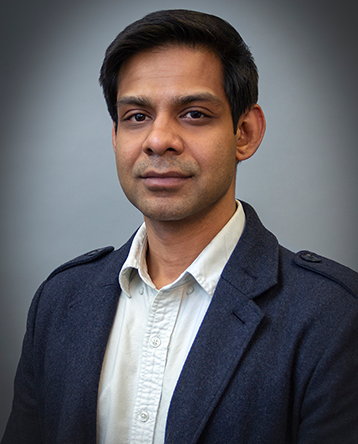
Usman Khan is a Professor of Electrical and Computer Engineering and Computer Science at Tufts University's School of Engineering. He directs the Signal Processing and RoboTic Networks (SPARTN) laboratory and holds editorial roles in IEEE Transactions on Signal Processing and related journals. His research focuses on optimization, machine learning, signal processing, and decentralized algorithms, with applications in autonomous systems, IoT, and smart cities. He received the NSF CAREER Award (2014) and is a Senior Member of IEEE. Education: Ph.D., Carnegie Mellon University (2009) M.S., University of Wisconsin–Madison (2004) B.S., University of Engineering and Technology Lahore (2002) Research Interests: Usman Khan's work spans data and network science, systems control, and optimization algorithms for autonomous systems, driverless vehicles, and smart infrastructure. Key areas include distributed optimization, electrocatalytic materials, and networked estimation techniques. Recent Contributions: His recent publications address distributed optimization under delays, electrocatalytic material synthesis, and robust consensus algorithms for multi-agent systems. Notable awards include the EURASIP Best Journal Paper (2022). Grants & Leadership: He has led NSF-funded projects on distributed monitoring systems and smart infrastructure. His professional activities include roles in conference organizing and journal reviewing across IEEE domains. Labs & Teams: The SPARTN lab at Tufts focuses on advancing networked signal processing and robotic systems for real-world applications.
Ivo Couckuyt is an Assistant Professor at the Faculty of Engineering and Architecture , Ghent University, affiliated with the Department of Information Technology and the Internet Technology and Data Science Lab . He actively contributes to research projects funded by the Research Foundation - Flanders (FWO) and regional grants. Bayesian multi-objective optimization Surrogate modeling for engineering Uncertainty quantification Radar-based healthcare systems His research spans machine learning , computational engineering , and multi-fidelity simulations , with recent work focusing on physics-informed optimization, efficient data transmission for radar systems, and nuclear fuel analysis. Publications emphasize Bayesian frameworks and gradient-enhanced kriging for complex systems. As a PhD supervisor and promotor , he has guided 16 doctoral researchers across diverse topics including microwave filters , metamaterials , and radar healthcare applications . Current projects target additive manufacturing for electric machines and data-efficient generative models , combining uncertainty quantification with multi-physics simulations .
Yury Polyanskiy is a Professor of Electrical Engineering and Computer Science at the Massachusetts Institute of Technology (MIT), affiliated with the Laboratory for Information and Decision Systems (LIDS), the Institute for Data, Systems, and Society (IDSS), and the MIT Statistics and Data Science Center. He holds a Ph.D. from Princeton University (2010) and an M.S. from the Moscow Institute of Physics and Technology (2005). His research focuses on information theory, machine learning, statistical inference, error-correcting codes, and wireless communication. He has contributed to fundamental limits of communication systems, finite-blocklength analysis, and applications of information theory to learning and signal processing. Notable awards include the 2020 IEEE Information Theory Society James Massey Award, the 2013 NSF CAREER Award, and the 2011 IEEE Information Theory Society Paper Award. His work spans theoretical advancements and practical applications, including the development of the SPECTRE toolbox for short-packet communication. He is also co-authoring a textbook on information theory. Recent research highlights include studies on quantization techniques for machine learning (e.g., NestQuant), transformer-based empirical Bayes methods, and novel approaches to massive random access in wireless networks (e.g., unsourced multiple access). His contributions bridge information theory and modern data science, addressing challenges in high-dimensional data representation, neural network dynamics, and efficient communication architectures.
Emre Onur Kahya is a Professor at the Department of Physics Engineering, Istanbul Technical University. His primary research focuses on theoretical cosmology, quantum gravity, and inflationary physics. He has been the Principal Investigator (PI) on multiple projects funded by TÜBİTAK and BAP, including studies on adiabatic modes, conformally coupled scalars during inflation, and optimization methods in artificial learning. His work addresses fundamental questions in cosmology such as observational tensions in cosmic models, quantum effects on scalar fields, and gravitational wave physics. He has received notable awards including the Young Scientist Award (2016), Mustafa Parlar Research Encouragement Award (2017), and the GEBİP Outstanding Young Scientist Award (2015). His publications span topics like Horndeski gravity, Carrollian fermion quantization, and constraints on gravitational wave delays using IceCube data. Kahya’s research also involves collaborations on testing modified gravity models, dark energy survey results, and pulsar timing experiments. Key projects include studies on adiabatic solutions on limited manifolds, constraint equations in quantum gravity, and inflationary attractors. His work bridges theoretical frameworks with observational data, contributing to advancements in cosmological models and quantum field theory in curved spacetime.
Prof. Dr. Atabey Kaygun is a full-time Professor at the Department of Mathematics within the Faculty of Letters at Istanbul Technical University. His primary research focuses on pure mathematics including Topology, Geometry, Algebra, and Number Theory, with significant contributions to applied fields like Topological Data Analysis and Quantum Algebra. He holds a PhD from Ohio State University and has held academic positions internationally including at Bahçeşehir University, Max Planck Institute for Mathematics, and the University of Buenos Aires. Research Interests: Prof. Kaygun's work bridges theoretical mathematics with computational applications. His core expertise includes: Algebraic topology (Cyclic Homology, Hochschild Cohomology) Quantum algebra (Hopf algebras, Quantum Groups) Computational topology (Persistent Homology, Topological Data Analysis) Interdisciplinary applications in machine learning and Ottoman historical analysis Publication Trends: His recent articles (2018-2024) demonstrate a dual focus: Theoretical developments in noncommutative geometry and quantum algebras Applied computational methods for topological data analysis and historical text mining Emerging work in educational data mining and stochastic process classification Research Projects & Advising: He leads projects funded by Istanbul Technical University's BAP program: Lefschetz Numbers and Cartan Determinant Conjecture (2022-2024) Dold-Kan Theorem for Crossed Simplicial Groups (2021-2022) Relationships between Topological Data Analysis and Machine Learning (2020-2022) Currently supervising 14 graduate theses in mathematics and computational methods.
Enrico Tronci is a Full Professor in the Department of Computer Science at Università degli Studi di Roma La Sapienza , Italy. His research focuses on model checking, formal verification, and synthesis of cyber-physical systems, with applications to mission-critical and safety-critical domains such as space systems, smart grids, and healthcare. He leads the Model Checking Lab (MCLab) and has coordinated numerous national and international research projects funded by organizations including the European Community (EC), European Space Agency (ESA), and Italian Ministry of University and Research (MUR). Research Highlights : Automatic control software synthesis from closed-loop specifications Model checking algorithms for hybrid and stochastic systems Technology transfer in sectors like energy, transportation, and aerospace Teaching : Undergraduate: Software Engineering (Fall 2024) Graduate: Automatic Verification of Intelligent Systems (Fall 2024), Verification and Validation of Intelligent Systems (Spring 2025) Scientific Awards : Recipient of the IBM-Italia 1987 prize for best thesis in Artificial Intelligence Publications Trends : 2024: Scaling up model checking for cyber-physical systems via HPC 2023: Hormonal impact on behavior and fault-tolerant sensor deployments 2021-2022: In silico clinical trials, smart grid management, and scenario enumeration 2020: AI-guided diabetes patient modeling and forensic psychiatry applications Software Tools : QKS (Quantized Kontrol Synthesizer) NashMV (MAD systems verification) CMurphi (Hybrid systems model checker) FHP-Murphi (Probabilistic verification) BSP (Boolean symbolic programming)
Dr. Ilai Bistritz is an Assistant Professor at the School of Industrial and Intelligent Systems Engineering and School of Electrical and Computer Engineering , Tel Aviv University , with a PhD in Electrical Engineering (2023) from Stanford University under Nicholas Bambos . His research bridges Game Theory , Distributed Control , and Multiagent Learning , focusing on decentralized decision-making in networked systems like autonomous vehicles , smart grids , and epidemic modeling . His work addresses challenges in Distributed Optimization where agents operate with limited communication and feedback, such as in multiplayer bandits and delayed adversarial environments . He has developed algorithms for max-min fairness , non-myopic informational cascades , and delay-robust regret minimization , achieving theoretical breakthroughs in Networked Artificial Intelligence . Scientific awards include the Best Student Paper Award at IEEE WCNC 2018 and Best Student Paper Finalist at WODES 2020 . His research emphasizes privacy-preserving protocols, scalable architectures, and applications in health monitoring , energy systems , and wireless networks .