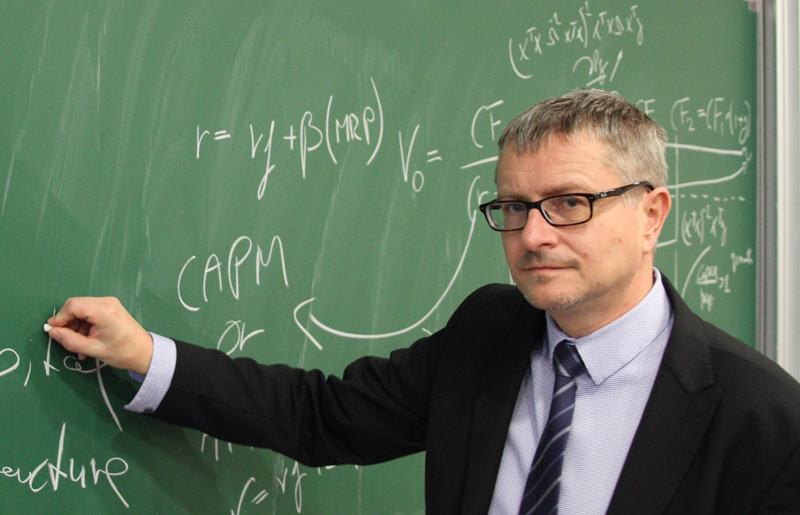
Jan Hanousek is a Professor of Economics at CERGE-EI (joint institution of Charles University and Czech Academy of Sciences) and Senior Researcher at the Economics Institute of the Czech Academy of Sciences. His academic career spans over three decades, including visiting positions at Princeton University and University of Michigan . He holds a PhD in Statistics and undergraduate degree in Probability Theory from Charles University. Research Focus : Applied econometrics, corporate finance, public finance, and transition economies Teaching : Statistics, econometrics, and applied economics Key Awards : 2014/2015 Katherine Terrell teaching award; 2009 Czech Science Foundation's Presidential Award His publications in top journals like Journal of Economic Literature and Journal of Corporate Finance focus on corruption, FDI spillovers, privatization effects, and financial markets in emerging economies. His work has been featured on CEPR's Policy Portal VOX . Scientific Awards : 2014/2015 Education price (Jan Svejnar & Katherine Terrell teaching price at CERGE-EI) 2009 Czech Science Foundation's Presidential Award for research on Czech corporate efficiency
Wilbur John Coleman is a Full Professor of Business Administration at Duke University's Fuqua School of Business and holds a secondary appointment as Professor in the Department of Economics at Trinity College of Arts & Sciences since 2008. He earned his Ph.D. in Economics from the University of Chicago in 1987. Prior to Duke, he worked at the Federal Reserve System in Washington D.C. His research focuses on macroeconomics, monetary policy, structural transformation, ethnic conflict, and technology adoption. He has published extensively in top journals such as the Journal of Economic Dynamics and Control and the American Economic Review. His research interests include the effects of taxation and corruption on economic growth, the dynamics of ethnic conflict, and the adoption of technology in developing economies. He has also contributed to computational methods for solving dynamic economic models. Recent work explores the interplay between corruption and supply-side policies, as well as the economic motivations behind ethnic conflicts. Teaching roles include courses on global economics, international finance, and corporate finance across Duke's MBA programs. He has been a pioneer in integrating advanced technology into distance learning at Fuqua. His academic career includes roles from Visiting Assistant Professor (1992–1995) to Full Professor (2001–present).
Dr. Jing Fu is a Lecturer at the School of Engineering, RMIT University in Australia. Her research focuses on applying optimization algorithms and machine learning to telecommunications, wireless networks, and edge computing. She specializes in restless bandit models for dynamic resource allocation, multi-agent coordination, and energy-efficient systems design. Key areas include satellite communications, radar systems, and distributed computing architectures. Her work bridges theoretical operations research with practical applications in 5G/6G networks, UAV communication platforms, and smart sensor networks. She has published extensively on topics like beam scheduling, edge computing offloading strategies, and adaptive wireless protocols. Current supervision interests span neural networks for sensor systems, IoT resource allocation, and next-generation mega satellite networks. Research Themes: AI-driven network optimization, distributed radar systems, energy-efficient edge computing Key Projects: Reinforcement learning-based IoT resource allocation 6G wireless communication with AI integration Optimal beam scheduling for phased array radars Collaborations: Active in multi-disciplinary projects involving telecommunications, aerospace engineering, and computer science Dr. Fu supervises research projects on neural networks for telecommunications, adaptive wireless techniques, and satellite formation flying. She is based at RMIT's City Campus and open to guiding postgraduate research in her areas of expertise.
Professor Olivier Buzzi is a leading academic in geotechnical engineering at the University of Newcastle, Australia. He holds the position of Professor in the School of Engineering's Civil Engineering department. His expertise spans rock mechanics, expansive soils, unsaturated soil mechanics, and geotechnical engineering design. Buzzi completed his PhD at Université Joseph Fourier in France before joining Newcastle University in 2005, progressing through roles as Lecturer (2007), Senior Lecturer (2009), Associate Professor (2012), and full Professor (2018). Education : Ecole Normale Supérieure de Cachan (1997–2000) Master's in Rock Joints (University Joseph Fourier, 2001) PhD in Hydromechanical Behavior of Geomaterials (University Joseph Fourier, 2004) Research Focus : Buzzi's work centers on experimental rock mechanics, rock joint behavior, and soil microstructure. He has pioneered studies on rockfall mitigation, sensor development for soil behavior tracking, and numerical modeling of geomechanical systems. His research integrates advanced experimental methods with computational approaches, such as computational homogenization and stochastic shear strength prediction for large rock discontinuities. Key Contributions : He co-developed a novel coating to measure soil shrinkage and advanced rockfall mesh performance analysis. His work on fragmentation survival probabilities and dynamic impact modeling has improved rockfall hazard assessment. Buzzi has also contributed to geothermal energy extraction strategies and coal fire mitigation through large-scale grants. Awards & Recognition : 2022 Chandrakant Desai Research Excellence Medal 2016 Vice Chancellor’s Award for Research Supervision Excellence 2011 Outstanding Young Investigator Award (IACMAG) Grants & Supervision : Holder of ARC grants and industry partnerships, Buzzi has supervised numerous postgraduate students. His work bridges academic research with practical applications in infrastructure design and environmental geotechnics. Labs & Teams : Active in the ARC Centre of Excellence for Geotechnical Science & Engineering (CGSE), he collaborates internationally on rock mechanics and unsaturated soil projects.
Yumin Wang is Assistant Professor at the University of Manitoba's Asper School of Business and F. Ross Johnson Fellow at the Warren Centre for Actuarial Studies and Research. Her research focuses on: Variable and index-linked annuity products Pension economics and intergenerational risk-sharing Stochastic control applications in finance and insurance Optimal contract design for retirement vehicles Her recent publications examine target benefit pension plans, VIX-linked retirement structures, and variable annuity fee mechanisms. Research consistently demonstrates sophisticated mathematical modeling of retirement product design with emphasis on risk management and optimal policyholder-insurer alignment. Honors include the F. Ross Johnson Fellowship recognizing her contributions to actuarial science.
Martin Uecker is a Professor at the Institute of Biomedical Imaging at TU Graz. His research focuses on advanced MRI reconstruction techniques, real-time imaging, and open-source software tools like the Berkeley Advanced Reconstruction Toolbox (BART). He specializes in developing methods for fast and accurate medical imaging, including applications in cardiac MRI, fetal brain imaging, and disease monitoring. His work emphasizes reproducibility, quantitative imaging, and clinical translation. Key research areas include generative models for MRI reconstruction, model-based inversion of the Bloch equations, and interactive real-time MRI systems. His team collaborates on projects involving hardware-software integration, such as portable MRI scanners and MRI-guided interventions. Notable contributions include advancements in multi-echo radial FLASH techniques, motion-resolved T1 mapping, and Bayesian uncertainty estimation in imaging. Uecker’s publications highlight innovations in accelerating MRI acquisition and reconstruction, with applications in pulmonary function assessment, neonatal imaging, and cardiovascular diagnostics. His work bridges theoretical physics, computational methods, and clinical practice, fostering open-source frameworks to democratize access to cutting-edge imaging tools.
Prof. Michael Beer is the Executive Director of the Institute for Risk and Reliability at Leibniz University Hannover. He holds a professorship in the Faculty of Civil Engineering and Geodetic Science and serves on the Faculty Council. His research focuses on structural reliability, uncertainty quantification, and risk analysis with applications in civil engineering systems. He leads the Collaborative Research Centres (CRC) 871 and 1463, addressing regeneration of complex capital goods and offshore megastructure design, respectively. His work integrates machine learning, Bayesian methods, and stochastic modeling to address challenges in seismic vulnerability, geotechnical systems, and reliability-based design optimization. Beer is also a member of the Leibniz Research Centre Energy 2050, emphasizing interdisciplinary energy systems research. Beer's research interests span probabilistic modeling of dynamic systems, uncertainty propagation in engineering systems, and data-driven methods for reliability assessment. His recent publications emphasize computational methods for reliability, machine learning applications, and seismic risk analysis. He actively contributes to academic leadership roles, including editorial boards and research center management.
Marcus ANG Teck Meng is an Associate Professor of Operations Management (Education) at the Lee Kong Chian School of Business, Singapore Management University. He is also the Academic Director and Track Coordinator of the International Trading Institute (ITI). His academic journey began at the National University of Singapore, where he earned dual B.Sc. degrees in Mathematics, followed by an S.M. in High Performance Computing and a Ph.D. in 2008. Ph.D., National University of Singapore, 2008 S.M., High Performance Computing for Engineering Systems, Singapore-MIT Alliance under NUS, 2003 B.Sc. (Hon), Mathematics, National University of Singapore, 2002 B.Sc., Mathematics, National University of Singapore, 2001 His research focuses on the theoretical and applied aspects of operations management, particularly in inventory management , stochastic models , and robust optimization . His work bridges mathematical rigor with real-world applications in supply chains, healthcare, and e-commerce. He has made significant contributions to warehouse storage optimization, hospital resource planning, and online retail fulfillment under uncertainty. The recent articles reflect a strong trend in applying robust optimization and stochastic modeling to logistics and service operations. His research spans domains such as healthcare analytics, e-commerce fulfillment, and inventory systems. Keywords like operations research , supply chain management , and data analytics dominate, with sub-fields including appointment scheduling, risk measures, and warehouse layout optimization. His teaching excellence has been widely recognized: Winner, SMU Undergraduate Excellent Teacher Award (2020) Winner, SMU Undergraduate Innovative Teacher Award (2018) Nominee, SMU Undergraduate Innovative Teacher Award (2021, 2022) Multiple appearances on SMU Dean’s Teaching Honour List (Undergraduate and Postgraduate) MPA Research Fellow (AY2019–2023) Dean’s List, NUS Department of Mathematics (AY1998–2001) He leads the International Trading Institute (ITI) and has been involved in pedagogical innovation through TEL grant-funded projects such as Inn or Out and Pricing Boss . While no formal list of advisees is provided, his role as Academic Director and course coordinator suggests active mentorship and supervision of students in operations and analytics. He has no known lab or research team explicitly mentioned, but his case studies and projects indicate strong industry engagement and applied research leadership.
Kjell Arne Brekke is a Professor in the Department of Economics at the University of Oslo, Faculty of Social Sciences. He is actively engaged in research and teaching, with a strong focus on behavioral, environmental, and resource economics. He is affiliated with the Centre for Equality, Social Organization, and Performance (ESOP) and the Health Economics Research Network (HERO). His office is located at Eilert Sundts hus, Moltke Moes vei 31, and he is available on Wednesdays from 10:00–11:00 or by appointment. Dr. Polit. in Economics, University of Oslo, 1990 Cand. scient. in Mathematics, University of Oslo, 1983 His primary research interests include Behavioral Economics , Experimental Economics , Environmental and Resource Economics , and Real Options with Stochastic Analysis . His work investigates how moral motivation, social norms, and psychological factors influence economic decisions, particularly in contexts involving public goods, climate change, and inequality. He explores how individuals respond to framing, scarcity, and social expectations in cooperative settings. The recent articles highlight a consistent research trajectory centered on social preferences , moral motivation , and behavioral responses to environmental and public policy challenges . Themes such as polarization, cooperation under scarcity, framing effects, and the measurement of health and income inequality recur across publications. His methodological approach blends theoretical modeling with experimental and empirical analysis, often addressing policy-relevant questions in sustainability and welfare economics. While no specific awards are listed in the provided text, his sustained publication record in top journals like Journal of Public Economics , Ecological Economics , PNAS , and Land Economics reflects significant scholarly impact. Kjell Arne Brekke has supervised numerous students, though specific names are not provided. He has held leadership roles, including Chair of the Master’s Thesis Committee since 2010. His research has been supported by projects such as ESOP and collaborations with institutions like Statistics Norway and Stanford University. He has contributed to modeling uncertainty in energy markets and analyzing the behavioral foundations of green production and consumer choices. He is actively involved in research groups including ESOP and HERO, which focus on equality, social organization, health economics, and performance. These affiliations support interdisciplinary research on welfare, inequality, and sustainable development.
Grégory Batt is a Researcher and Head of the InBio joint research group at the Institut Pasteur and Inria Paris. The lab operates at the intersection of wet and dry biology, focusing on systems and synthetic biology with an emphasis on automation, modeling, and real-time control of cellular processes. The team is affiliated with both institutions and hosts a multidisciplinary group of researchers, engineers, and students. The research interests of Grégory Batt span systems biology, synthetic biology, quantitative modeling, lab automation, bioproduction, and single-cell analysis . His work integrates computational and experimental approaches to develop frameworks for understanding and controlling cellular behavior. Key methodologies include the use of synthetic biology, microfluidics, optogenetics, and robotics. The lab has developed innovative software tools such as ReacSight and MicroMator to enable automated and reactive experimentation. Recent publications highlight trends in real-time control of bioproduction, optimization of protein secretion, parameter inference in stochastic models, and ecological frameworks for antibiotic resistance . These works demonstrate a strong focus on integrating modeling with high-throughput experimentation to solve problems in biotechnology and medicine. Scientific contributions include: Development of ReacSight for bioreactor automation and reactive control Creation of MicroMator for reactive microscopy Application of ecological concepts to bacterial antibiotic responses Modeling stochastic kinetics coupled with auxiliary processes Batt advises several PhD students and postdoctoral researchers, including Henri Galez, Alicia Da Silva, Cecilia Capela, and Viktoriia Gross. His lab has received support from ANR, Inria, and other funding bodies. The InBio team operates a state-of-the-art laboratory equipped with bioreactors, liquid handling robots, flow cytometers, automated microscopes, and high-performance computing resources, enabling advanced research at both population and single-cell levels. The lab, located at the Yersin and Lwoff buildings of the Institut Pasteur in Paris, fosters a collaborative environment integrating molecular biology, microbiology, and computational modeling to advance quantitative understanding of cellular systems.
Gerhard Wellein is a Professor for High Performance Computing at the Department of Computer Science of Friedrich-Alexander-Universität Erlangen-Nürnberg (FAU). He is the head of NHR@FAU (Erlangen National Center for High Performance Computing) and a member of the board of directors of the German NHR-Alliance. Since 2024, he has also served as a Visiting Professor for HPC at the Delft Institute of Applied Mathematics, Delft University of Technology. He holds a PhD in theoretical physics from the University of Bayreuth and has over two decades of experience in HPC education and research. Research Interests: His research focuses on performance modeling and engineering, architecture-specific code optimization, novel parallelization techniques, and the development of hardware-efficient building blocks for sparse linear algebra and stencil solvers. His work bridges computer science, applied mathematics, and computational physics, aiming to maximize efficiency on current and future HPC architectures, including exascale systems. Publication Trends: His recent publications emphasize analytical performance modeling (e.g., Roofline, oscillator models), energy efficiency, GPU optimization, and scalable linear algebra. They reflect a strong focus on both theoretical modeling and practical implementation, with applications in CFD, quantum physics, and molecular dynamics. Scientific Awards: 2011 Informatics Europe Curriculum Best Practices Award (shared with Jan Treibig and Georg Hager) for outstanding teaching contributions in HPC. Grants and Advising: He has led numerous third-party funded projects from the EU, BMBF, and DFG, including EoCoE-III, ESSEX, EXASTEEL, and ProPE. These projects focus on exascale software, performance engineering, fault tolerance, and multiscale simulation. He has mentored multiple researchers and students, contributing to the development of tools such as LIKWID, ClusterCockpit, and GEOPM. Labs and Teams: He leads the HPC research group at FAU and is deeply involved in national and international HPC initiatives. His team collaborates extensively on open-source HPC software and performance tools, fostering a strong community-driven approach to performance engineering.
Adrián García Gutiérrez is a Professor in the Department of Aerospace Engineering at the University of León's College of Engineering. His research focuses on aerospace systems, uncertainty quantification in CFD, atmospheric boundary layer modeling, and airship technology. Recent publications highlight his work in parallel orbital propagation algorithms, stochastic optimization of high-altitude platforms, and neural network applications for wind profiling. Key trends include aerodynamic modeling under uncertainty and interdisciplinary approaches combining turbulence analysis with LiDAR measurements. He contributes to educational innovation in aerospace engineering through simulation-based learning tools and leads the GITA Tecnología Aeroespacial research group.
Torben Juul Andersen is a Professor at Copenhagen Business School's Department of International Economics, Government and Business. His work focuses on strategic risk leadership, global uncertainty management, and adaptive organizational frameworks. He has published over 200 works including books like Business and Policy Challenges of Global Uncertainty (2025) and frequently contributes to media discussions on risk governance. Research Interests: Strategic Risk Management Leadership in Crisis Environments Global Economic Policy Resilient Organizational Design Interactive Information Processing Systems Sustainable Corporate Strategy Recent Work Trends: His 2023-2025 publications emphasize frontline empowerment, decentralized control systems, and frameworks for managing strategic uncertainty. Articles like Drop kontrollen (2025) advocate for leadership models that reduce hierarchical control to improve adaptive capacity. Grants & Activities: Organized the 2021 ACM Collective Intelligence Conference and delivered over 10 keynotes on topics like 'Dynamic Adaptation Through Interactive Information Processing' (2024) and 'Sustainable Global Practices' (2024). Active in Danish media commentary on risk management and economic policy. Labs/Teams: Leads CBS's Strategic Responsiveness Research Group focusing on enterprise risk governance and adaptive strategy-making processes. Collaborates with World Scientific and other academic publishers on edited volumes addressing global business challenges.
Christos Thrampoulidis is an Assistant Professor in the Department of Electrical and Computer Engineering at the University of British Columbia (UBC), part of the Faculty of Applied Science. Previously, he held the same position at the University of California, Santa Barbara (2018–2020) and was a Postdoctoral Researcher at MIT (2016–2018). He earned his Ph.D. and M.Sc. in Electrical Engineering from Caltech (2016 and 2012) and a Diploma in ECE from the University of Patras, Greece (2011). His research focuses on machine learning theory , optimization , high-dimensional statistics , and statistical signal processing . Specific interests include the theoretical foundations of deep learning, neural collapse phenomena, and the analysis of overparameterized models. He has contributed to understanding imbalanced data challenges, model compression, and safe optimization techniques. Key academic achievements include the Qualcomm Innovation Fellowship (2014) and the A. Mentzeolopoulos Fellowship . He teaches graduate courses on Optimization and Signals & Systems at UBC. His research group (MILD Group) actively explores topics like language model geometry, federated learning, and algorithmic reasoning in transformers. Notable publications include work on neural-collapse geometry, imbalance-aware learning, and the theoretical underpinnings of transformers. He advises multiple Ph.D., M.Sc., and undergraduate students, fostering a collaborative environment centered on equity, diversity, and inclusion.
Prof. Julija Zavadlav is an Assistant Professor of Multiscale Modeling of Liquid Materials at the Technische Universität München (TUM), affiliated with the TUM School of Engineering and Design. Her research integrates physical modeling with machine learning and Bayesian techniques to develop multi-scale simulation frameworks for diverse applications in bioinformatics and engineering. Education: She earned her PhD in Physics from the University of Ljubljana (2015) and conducted postdoctoral research at ETH Zurich (2016–2019), where she received an ETH Postdoctoral Fellowship. Since 2019, she has held her current position at TUM. Research Interests: Her work focuses on advancing machine learning potentials, Bayesian uncertainty quantification, and multi-scale modeling for complex systems like ionic liquids, metal-organic frameworks, and biomolecules. Her ERC Starting Grant (2022) supports the SupraModel project, emphasizing scalable and interpretable models. Awards: Golden Teaching Award 2022 (Best Lecture), ERC Starting Grant 2022, and ETH Postdoctoral Fellowship. Her recent publications emphasize neural network potentials, transfer learning, and computational tools like JaxSGMC for Bayesian analysis. Grants and Labs: While specific lab names are not mentioned, her ERC grant underscores active funding. No formal student advisee list is provided, but her collaborative work suggests involvement in training next-generation computational scientists.