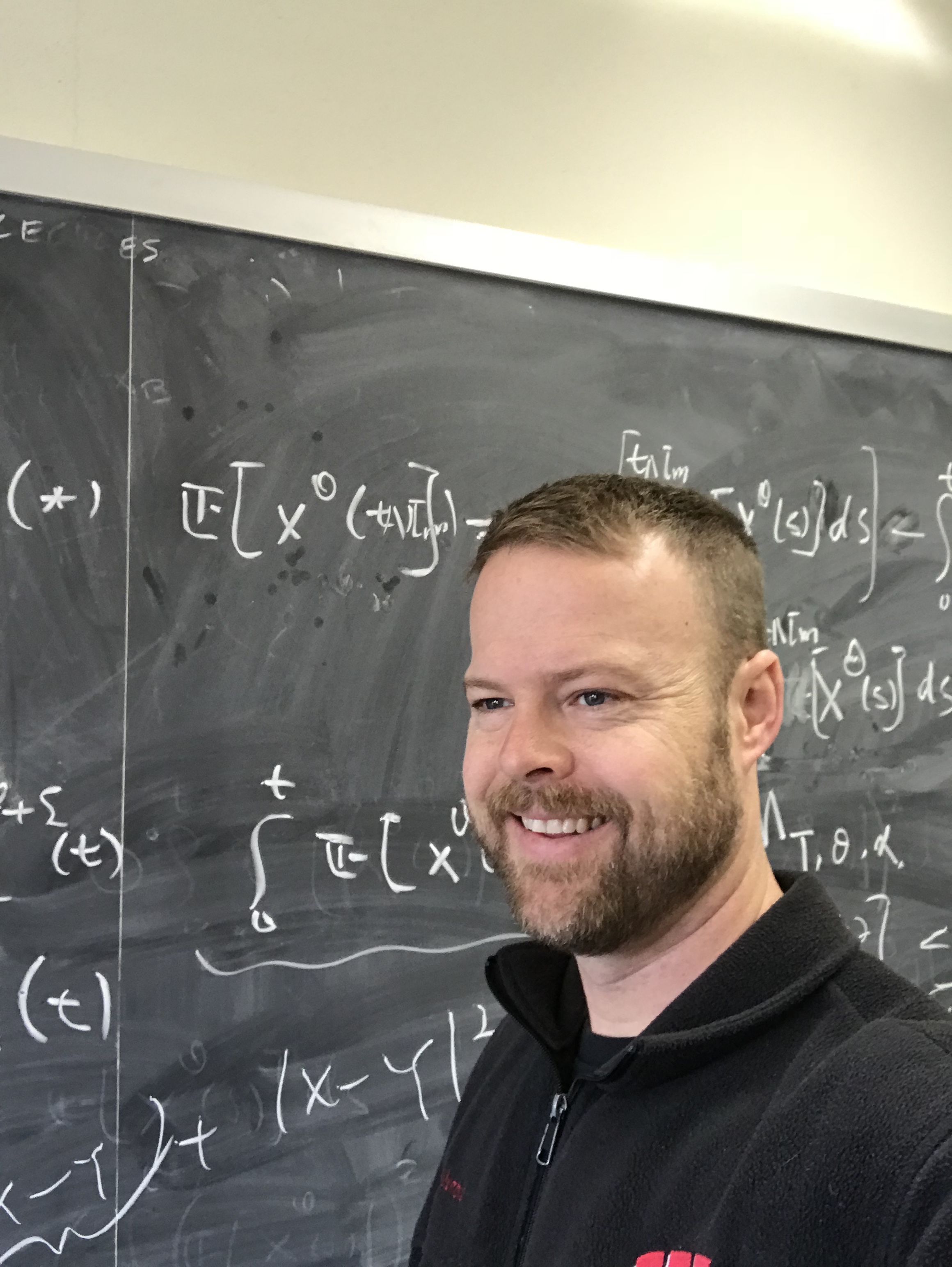
Dr. Nicolas Francois is an Associate Professor in the Department of Materials Physics at Australian National University (ANU), specializing in experimental geomaterials physics, soft matter, and fluid hydrodynamics. He leads the X-ray Tomography and Applications Research Group, combining curiosity-driven and applied research in out-of-equilibrium systems. ARC Industry Fellow (2024-2030): Improving Australian iron ore comminution for green steel production ARC DECRA Fellow (2016-2018): Biofilms in two-dimensional turbulent flows His research spans fundamental questions in: Fragmentation of solid materials Autonomous devices powered by chaotic flows Hydrodynamic waves Stochastic thermodynamics Granular matter Polymer rheology and applied areas in: Comminution of geomaterials Mechanics of fractured rocks Wave-energy conversion Environmental fluid mechanics Publications reveal a trajectory focused on X-ray tomography applications, granular dynamics, and turbulence-driven systems. He utilizes advanced imaging techniques to study material failure mechanisms and fluid-structure interactions, contributing to fields ranging from green steel production to biofilm dynamics. Current student projects and grants emphasize sustainable resource processing and fundamental fluid physics.
Kohei Nakajima is an Associate Professor at the Department of Intelligent Mechano-Informatics, Graduate School of Information Science and Technology, The University of Tokyo. He holds concurrent positions at the Department of Creative Informatics and the Next Generation Artificial Intelligence Research Center (AI Center). As an Endowed Chair in Advanced Artificial Intelligence Education, he leads the Physical Intelligence Lab, which focuses on the intersection of soft robotics, nonlinear dynamics, and physical computing. His research interests center on Physical Reservoir Computing (PRC), a paradigm that exploits the natural dynamics of physical systems for computation, with applications in soft robotics, spintronics, and quantum machine learning. Nakajima's work demonstrates how physical systems can inherently process information without traditional digital computation, leveraging phenomena like chaos, bifurcations, and embodied intelligence. Nakajima's publications reveal a strong focus on understanding how physical systems can perform computational tasks. His recent work spans from biological applications (jellyfish cyborgs, ostrich-inspired robotics) to fundamental theoretical advances in reservoir computing. The research demonstrates how physical phenomena can be harnessed for information processing, with implications for energy-efficient computing and novel robotic control paradigms. As the organizer of the Reservoir Computing Seminar, Nakajima has built a vibrant research community exploring the nature of information processing across disciplines. His lab actively recruits graduate students and postdocs, indicating strong research momentum and institutional support for his work in physical intelligence.
Duong Nguyen serves as an Assistant Professor in the School of Electrical, Computer and Energy Engineering at Arizona State University. His research integrates operations research, artificial intelligence, economics, and engineering to develop mathematical models for decision-making in large-scale networked systems including cloud/edge computing, smart grids, and crowdsourcing. He directs the NEMO research group focused on building intelligent multi-agent platforms through optimization and market design. His educational credentials include: Ph.D. in Electrical and Computer Engineering from the University of British Columbia (2020) M.Sc. in Telecommunications from INRS, University of Quebec (2014) B.Sc. in Electronic and Telecommunications from Hanoi University of Science and Technology (2011) Dr. Nguyen's research spans Operations Research, Artificial Intelligence, Decision-Making, Market Design, and Optimization with applications in edge computing, power systems, and network economics. His work emphasizes robust algorithms for uncertain environments and secure multi-agent platforms, recently expanding into quantum machine learning and privacy-preserving distributed systems. Current projects address decentralized federated learning, dynamic pricing, and EV charging network design. Analysis of his publication record reveals consistent focus on distributed optimization techniques for edge/cloud systems, with increasing integration of game theory and quantum computing. His work demonstrates strong methodological innovation in handling spatio-temporal uncertainty while addressing practical challenges in energy flexibility and secure genomic computation. His scientific recognition includes: Finalist for Best Student Paper Award at American Control Conference (ACC) 2024 Finalist for Best Paper Award at International Symposium on Modeling and Optimization in Mobile, Ad Hoc, and Wireless Networks (WiOpt) 2023 Dr. Nguyen actively mentors Ph.D. students including Jiaming Cheng and Long Vu, with student-led research achieving significant recognition. His NEMO group collaborates with institutions including ETH Zurich on projects spanning autonomous driving, edge AI, and quantum optimization. Current research directions emphasize fair resource allocation, privacy-preserving learning, and dynamic pricing frameworks for next-generation networked systems.
Peter W. Glynn is the Thomas Ford Professor in the Department of Management Science and Engineering (MS&E) at Stanford University's School of Engineering, and also holds a courtesy appointment in the Department of Electrical Engineering. Additionally, he serves as a Senior Fellow of the Hong Kong Institute for Advanced Study at City University of Hong Kong. His distinguished career spans over four decades, with significant contributions to the fields of simulation, computational probability, and stochastic modeling. Professor Glynn received his Ph.D. in Operations Research from Stanford University in 1982 and his B.S. with Honors in Mathematics from Carleton University in 1978. His academic journey began at the University of Wisconsin at Madison (1982-1987) before returning to Stanford, where he has held various leadership positions including Deputy Chair of MS&E (1999-2005), Director of Stanford's Institute for Computational and Mathematical Engineering (2006-2010), and Chair of MS&E (2011-2015). His research interests focus on simulation , computational probability , queueing theory , statistical inference for stochastic processes , and stochastic modeling . Professor Glynn's work has developed algorithms widely used across the field of Monte Carlo simulation, with applications in financial risk management, service systems engineering, logistics, and retail operations. His recent publications demonstrate continued innovation in areas such as numerical methods for stochastic systems, rare-event simulation, and analysis of queueing systems under various traffic conditions, showing a strong trajectory of advancing both theoretical foundations and practical applications. Professor Glynn's scholarly contributions have been recognized with numerous prestigious awards, including: Fellow of INFORMS (2007) Fellow of the Institute of Mathematical Statistics (1998) John von Neumann Theory Prize from INFORMS (2010) Member of the US National Academy of Engineering (2012) Lifetime Professional Achievement Award, INFORMS Simulation Society (2021) Philip McCord Morse Lecturer, INFORMS (2020) Throughout his career, Professor Glynn has mentored numerous doctoral students whose research has made significant contributions to operations research and related fields. His editorial service has been extensive, including founding Editor-in-Chief of Stochastic Systems and service on the editorial boards of leading journals in operations research, probability, and statistics. His professional service extends to numerous advisory boards and committees at national and international levels, reflecting his standing as a leader in his field.
Christa Cuchiero is a Professor at the Department of Statistics and Operations Research , University of Vienna , and an elected member of the Austrian Young Academy (Junge Akademie) since 2020. Her research bridges rigorous mathematics and cutting-edge applications in finance, machine learning, and stochastic analysis. Education: Christa earned her M.Sc. in 2006 from TU Wien with a thesis on affine interest-rate models, her Ph.D. in 2011 from ETH Zürich on affine and polynomial processes, and completed her Habilitation at the University of Vienna in 2018 on high-dimensional finance beyond classical paradigms. Research Interests: Her work centers on affine and polynomial processes , stochastic portfolio theory , signature methods , and infinite-dimensional stochastic analysis . Recent projects explore signature-based neural SDEs for option calibration, measure-valued diffusions for energy markets, and universal approximation properties of signature transforms. Awards & Recognition: Among her accolades are the FWF START Award 2019 , the Bruti-Liberati Visiting Fellowship 2018 , the ETH Medal 2012 for an outstanding Ph.D. dissertation, and the Prix de l’Institut Europlace de Finance 2017 for the best paper in finance. Contact: christa.cuchiero@univie.ac.at , Kolingasse 14-16, 05.47, 1090 Wien, Austria.
Jie Chen is an Assistant Professor in the Department of Mechanical Engineering at Virginia Tech's College of Engineering. Their research bridges machine learning with engineering analysis and design under uncertainty, focusing on process-structure-property-performance relationships. PhD, Mechanical Engineering (2022) – Arizona State University MS, Civil Engineering (2018) – Beihang University BS, Civil Engineering (2015) – Beihang University Research interests include: physics-informed machine learning, uncertainty quantification, predictive maintenance, materials design, and advanced manufacturing. The SEAD Lab develops methods to integrate engineering analysis into stochastic machine learning algorithms and uses AI for knowledge discovery in uncertain environments. Recent publications emphasize: Digital twin frameworks combining machine learning and Bayesian optimization Graph neural networks for high-entropy alloy and molecular mixture property prediction Physics-guided neural networks for fatigue life analysis of additively manufactured alloys Uncertainty quantification in imbalanced regression tasks and multi-fidelity data fusion Real-time imaging of polymer deformation mechanisms The lab actively mentors students, including PhD candidate Yisheng Lu, and manages projects in predictive maintenance, fatigue modeling, and materials design.
Amir Ardestani-Jaafari is an Associate Professor at the Faculty of Management , University of British Columbia Okanagan, with affiliations to the Institute for the Sustainability (IGS) . His office is located at EME 4111, and he can be reached at amir.ardestani@ubc.ca or 250.807.8108. Postdoctoral Fellow in Operations Management, McGill University Ph.D. in Management Science, HEC Montreal M.Sc. and B.Sc. in Industrial Engineering, Tehran Polytechnic Dr. Ardestani-Jaafari’s research focuses on Healthcare Operations , Supply Chain Management , and Business Analytics , with particular emphasis on robust optimization techniques for facility location, demand uncertainty, and network design. His work integrates mathematical modeling with real-world healthcare and logistics challenges. Recent publications demonstrate expertise in Two-stage Robust Optimization for equity-driven facility location, Text Mining in telemedicine appointment systems, and Decision-dependent Uncertainty in network interdiction. He has explored applications in Home Healthcare , Cancer Screening Networks , and Global Sourcing Compliance using advanced optimization frameworks. Dr. Ardestani-Jaafari is affiliated with key research centers including the UBC Optimization Center (COCANA) , Materials and Manufacturing Research Institute (MMRI) , and GERAD Research Center . While student advising information isn't explicitly stated, his technical contributions span algorithm development for inventory problems, network design methodologies, and computational solutions for complex operations management challenges.
Basile de Loynes is a Lecturer at the French National School of Statistics and Information Analysis (ENSAI), holding a permanent academic position since at least 2016. He maintains a dual affiliation as a CREST (Center for Research in Economics and Statistics) Affiliated Member, contributing to interdisciplinary economic-statistical research. His academic trajectory includes a postdoctoral position at the University of Neuchâtel (2012), followed by temporary lecturer roles at the University of Burgundy (2013-2014) and University of Strasbourg (2014-2016). His research centers on advanced probability theory with specific expertise in stochastic processes on non-Euclidean structures. Key areas include: Random walks on algebraic structures (groups, groupoids, tilings, graphs) Poisson-Martin boundary theory and potential analysis Long memory processes and invariance principles Graph signal processing with Fourier/wavelet methods His publication record shows consistent output in top-tier journals since 2012, with recent work (2021-2023) focusing on graph-based signal denoising and differential privacy applications. Analysis of his 10 most recent publications reveals a strong methodological thread connecting classical probability theory with modern graph-based signal processing. Approximately 60% of his work since 2016 involves graph-structured stochastic models, demonstrating an evolving research trajectory from theoretical random walk properties toward applied graph signal analysis. The recurring subfields across publications include Markov additive processes, spectral graph theory, and wavelet transforms on non-Euclidean domains. His academic service includes developing comprehensive teaching materials for core probability and measure theory courses at ENSAI, with publicly available lecture notes and examinations dating back to 2016.
Dr. Duarte Guerreiro Tomé Antunes is an Assistant Professor at the Department of Mechanical Engineering , Eindhoven University of Technology (TU/e), specializing in control theory. He is affiliated with the Control Systems Technology Group and focuses on optimal/stochastic control and networked control systems. Research emphasizes overcoming the curse of dimensionality in large-dimensional systems through approximate control strategies. Explores event-triggered control for networked systems with latency and computational constraints. Teaches Optimal Control and Dynamic Programming , Training Project 4 , and Robotic Seminars . Publications highlight advancements in: Event-triggered methods for linear quadratic control Stability analysis of networked systems with asynchronous links Frequency-domain modeling of control loops with data losses Switched system regulation via informed policies
Jingbo Liu is an Assistant Professor in the Department of Statistics at the University of Illinois, Urbana-Champaign, with an affiliate appointment in Electrical and Computer Engineering. He received his B.E. (2012) from Tsinghua University, M.A. (2014) and Ph.D. (2018) from Princeton University, all in Electrical Engineering, followed by a postdoc at MIT IDSS. Education Ph.D. in Electrical Engineering, Princeton University (2018) M.A. in Electrical Engineering, Princeton University (2014) B.E. in Electronic Engineering, Tsinghua University (2012) His research focuses on statistical inference under systems constraints, information-theoretic inequalities, graphical models, and applications of high-dimensional probability to information sciences. Key areas include mutual covering bounds, hypercontractivity, Brascamp-Lieb inequalities, and their connections to machine learning and communication systems. Recent work applies information theory to generative AI, analyzing diffusion models' utility, privacy enhancements, and computational efficiency. He also investigates statistical physics techniques for high-dimensional problems like Lasso distributional limits and tensor model free energy, with applications in variable selection and PCA. Scientific awards include the Thomas M. Cover Dissertation Award (2018) and Princeton's Wallace Memorial Fellowship (2016). Courses taught include STAT 578 (High-Dimensional Statistics), STAT 430 (Nonparametric Statistics), and STAT 542 (Statistical Learning).
Associate Professor Vera Hemmelmayr is affiliated with the Institute of Transport Economics and Logistics at the Vienna University of Economics and Business . Her research spans Operations Research , Logistics , Supply Chain Management , and Circular Economy , with a focus on vehicle routing , city logistics , and metaheuristics . She has led major projects like CREATE_AT (circular timber supply chains) and Sustainable Urban Deliveries . Research trends in her recent work include real-time optimization algorithms for railway disruptions, sustainable urban freight solutions , and integrated railcar fleet management . Her publications often bridge transport policy with computational methods , emphasizing green supply chains and smart city logistics . 2025: Preis für innovative Lehre 2017: Best Application Paper Honorable Mentions (IIE Transactions) 2012: Dr.-Maria-Schaumayer-Habilitationsstipendium 2012: WU Visiting Fellow 2005: Prämierung ausgezeichneter Diplomarbeiten She has supervised research projects on topics including two-echelon delivery systems , railway disruption management , and digital transformation in logistics, while contributing to policy frameworks for circular economy in transportation.
Peter Richtarik is a Professor at the King Abdullah University of Science and Technology (KAUST), specializing in Machine Learning, Optimization, and Federated Learning. He actively teaches courses such as Stochastic Gradient Descent Methods and mentors PhD and MS students like Konstantin Burlachenko, Kai Yi, and Lukang Sun. His research spans distributed optimization, parameter-efficient fine-tuning, and theoretical frameworks for non-convex and non-smooth problems. Recent work includes 2025 contributions to Bernoulli-LoRA (theoretical PEFT) and Gluon (LMO-based optimizers). He co-developed Thanos (block-wise pruning) and BurTorch (CPU-optimized training framework). His publications focus on communication efficiency ( ATA , LoCoDL ), differential privacy ( DP-RBCD ), and stochastic proximal methods. Richtarik received the Charles Broyden Prize for his work on quasi-Newton methods. He frequently presents at workshops like MLSS in Senegal and FLOW seminars.
James Martin is a Lecturer at the Department of Statistics, University of Oxford . He is affiliated with St Hugh's College and has been actively involved in organizing probability seminars since 2018. Research Interests Probability theory Random graphs and percolation Interacting particle systems Models of random growth and coagulation-fragmentation Queueing networks Combinatorial games Teaching Courses: Prelims Probability , Part A Probability , Part B Statistical Lifetime Models , Part C Probabilistic Combinatorics His publications focus on probability theory , statistical physics , and combinatorial structures . Recent work includes studies on last-passage percolation, multispecies exclusion processes, and integrable probability models. James Martin collaborates with researchers from institutions such as Uppsala University, University of Cambridge, Imperial College London, and Kyoto University. He has been a key organizer for the Oxford Probability Seminar since 2018.
David F. Anderson is the Vilas Distinguished Achievement Professor of Mathematics at the Department of Mathematics, University of Wisconsin-Madison. He has maintained an active research and teaching career spanning over two decades with significant contributions to mathematical biology and stochastic modeling. Dr. Anderson's research focuses on the interface of mathematics and biology, specifically in mathematical systems biology and algorithm design for stochastic models in biological systems. His work has fundamentally advanced chemical reaction network theory, stochastic processes in biochemical systems, and computational methods for analyzing complex biological phenomena. He has developed numerous numerical techniques for simulating and analyzing reaction networks with applications across systems biology. An analysis of his recent publications reveals a sustained focus on mathematical properties of stochastic reaction networks, with increasing emphasis on connections between chemical systems and computational frameworks. His later work explores reaction networks as computing devices, implementing arithmetic operations and neural network functionalities through biochemical processes, while maintaining rigorous mathematical analysis of network properties like ergodicity, mixing times, and solution structures. Simons Fellow (2022) Vilas Associates Award (2016) IMA Prize in Mathematics (2014) Dr. Anderson has successfully guided nine PhD students to completion, with recent graduates including Aidan Howells (2024), Tung Nguyen (2021), Chaojie Yuan (2020), Kurt Ehlert (2019), and Jinsu Kim (2018). His current graduate student is Jingyi Ma. His research has been supported by prestigious fellowships including the Simons Fellowship, indicating substantial research funding, though specific grant details aren't provided in the source material. While specific laboratory facilities aren't described in the text, Dr. Anderson maintains an active research group evidenced by continuous publications, regular PhD student completions, and collaborations with numerous researchers including Daniele Cappelletti, Jinsu Kim, and Tung Nguyen. His research program demonstrates sustained productivity with publications spanning from 2005 to the present.
Prof. Dr. Jochen Garcke is a faculty member at the Institute for Numerical Simulation, University of Bonn, with a dual affiliation at Fraunhofer SCAI's Department of Numerical Data-Based Prediction. His work bridges numerical simulation and machine learning, focusing on high-dimensional problems, sparse grids, and optimal control. Key research themes: Sparse grids, machine learning for simulations, reinforcement learning, uncertainty quantification Teaching includes courses on Numerical Methods in Science and Technology and Scientific Computing , emphasizing practical machine learning applications. Recent publications explore hybrid models combining data-driven and physics-based approaches in automotive engineering, wind turbines, and geoscientific modeling. His group employs adaptive sparse grids, graph algorithms, and spectral methods to tackle challenges in crash simulations, fluctuating renewable energy systems, and turbulent flow analysis. Collaborations span Fraunhofer SCAI and industry 4.0 initiatives.