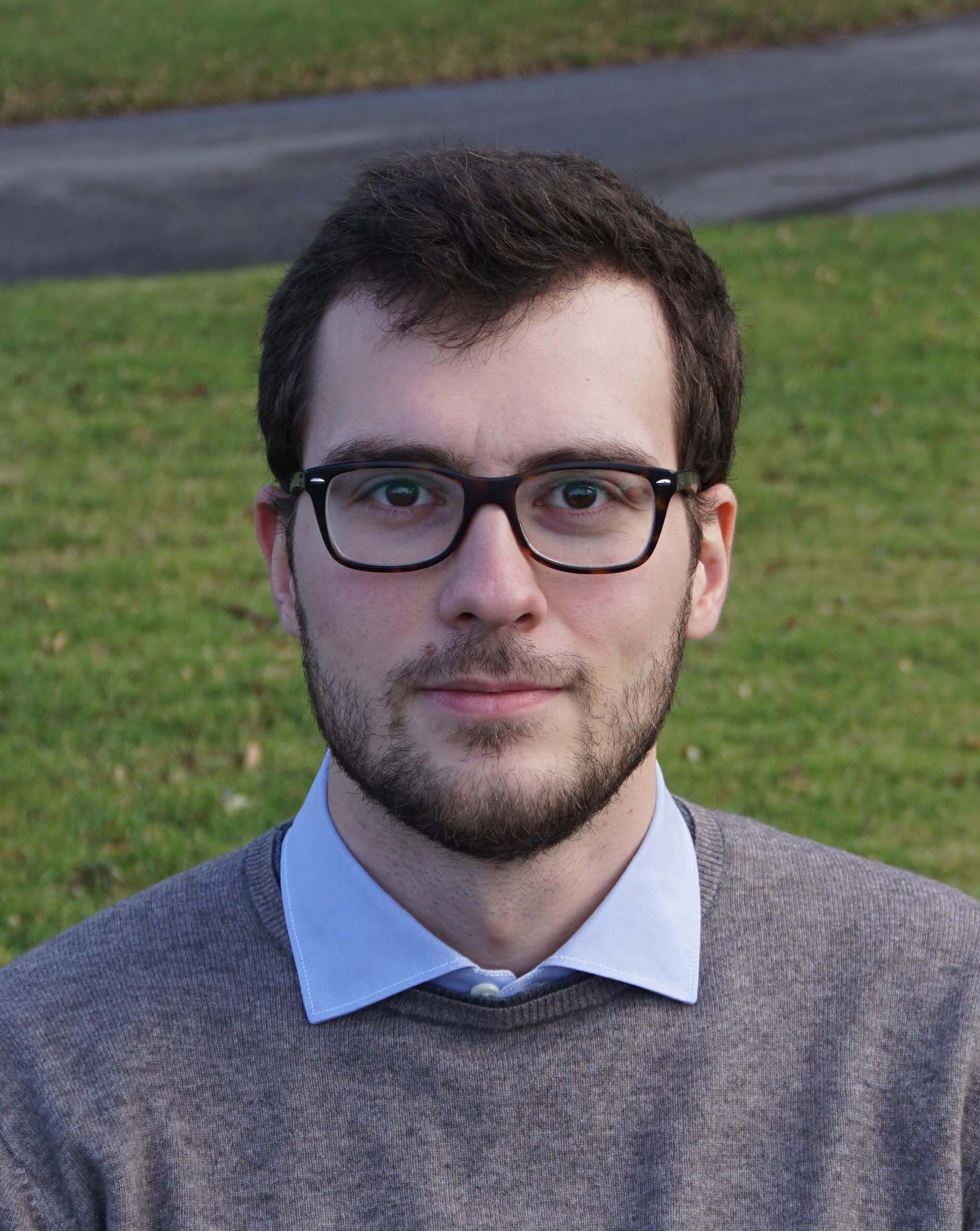
Michele Ruggeri is an Assistant Professor of Numerical Analysis (RTD-B) at the Department of Mathematics, University of Bologna, and an Honorary Lecturer at the University of Strathclyde, UK. His research focuses on numerical analysis of partial differential equations in materials science and engineering, including liquid crystal theory, micromagnetism, nonlinear elasticity, and spintronics. He is also active in developing numerical methods for uncertainty quantification and model order reduction. Education: PhD in Technical Mathematics (TU Wien, Austria), Laurea Magistrale in Mathematics (University of Pavia, Italy), and a Diploma in Science and Technology from Scuola Universitaria Superiore IUSS, Italy. He holds a Fellowship (FHEA) from Advance HE and a PGCert in Learning & Teaching in Higher Education from the University of Strathclyde. His work emphasizes finite element methods and their applications, with contributions to computational micromagnetics and software development (e.g., Commics). He is affiliated with the (AM)² Research Center on Applied Mathematics and ARCES at the University of Bologna. Awards: Fellowship (FHEA), Advance HE, UK. Key Projects: Development of numerical methods for micromagnetic simulations, uncertainty quantification in stochastic models. Contact: m.ruggeri@unibo.it
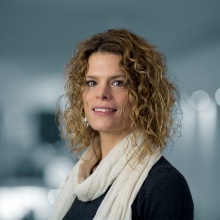
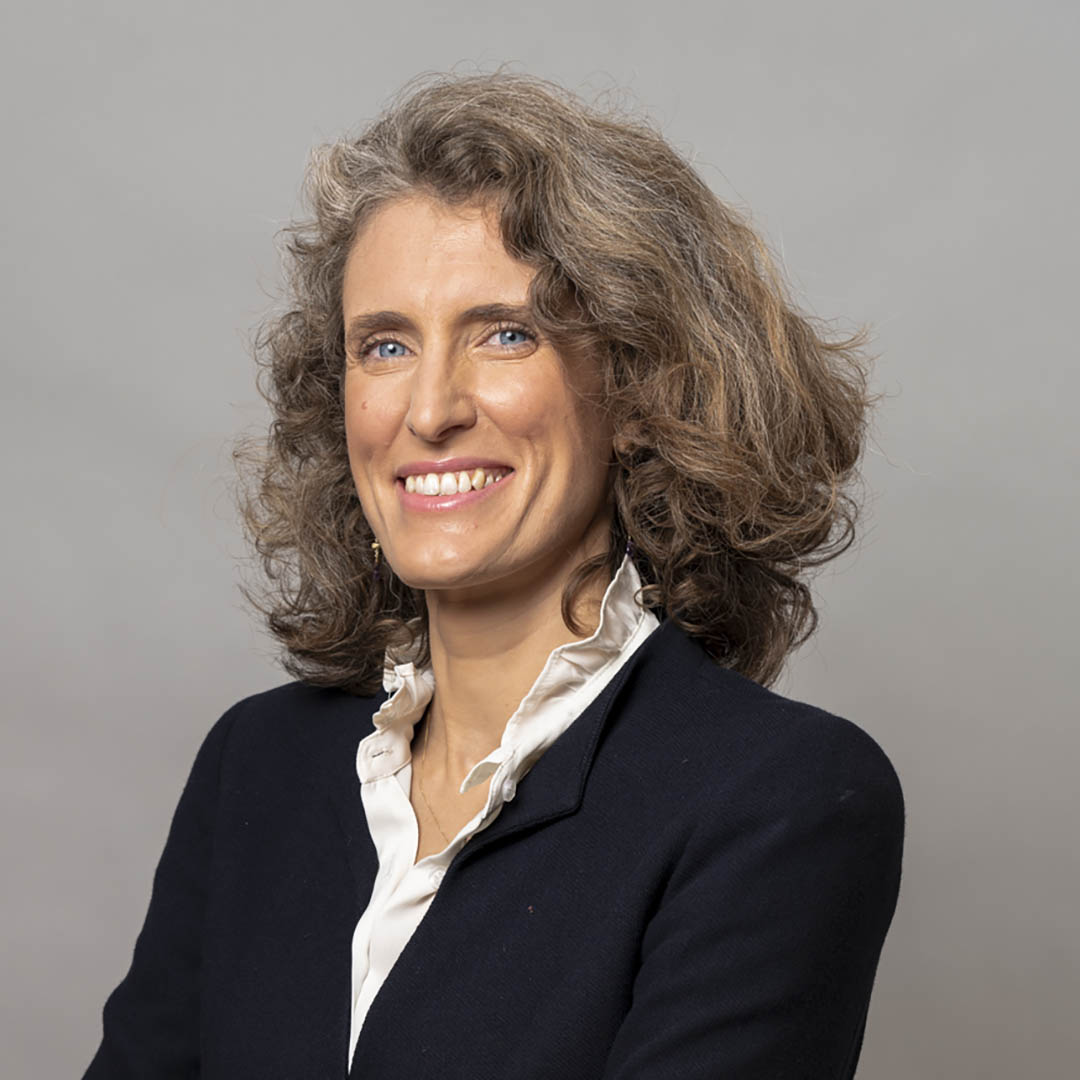
Andrea Barth is a W3-Professor of Computational Methods for Uncertainty Quantification at the University of Stuttgart, leading the Research Group for Computational Methods for Uncertainty Quantification within the Excellence Cluster for Simulation Technology. She holds a Ph.D. from the University of Oslo (2009) and has held positions at ETH Zürich and the University of Stuttgart. Her work focuses on stochastic partial differential equations, numerical methods for uncertainty quantification, and applications in engineering and natural sciences. Education: Ph.D. in Mathematics, University of Oslo (2006–2009) Lecturer/Postdoc at ETH Zürich (2010–2013) Junior Professor at University of Stuttgart (2013–2017) Research Interests: Stochastic PDEs, uncertainty quantification, Monte Carlo methods, Bayesian inverse problems, and numerical analysis of random fields. Her work bridges stochastic analysis and numerical simulations, addressing challenges in modeling and simulating complex systems with uncertainties. Grants & Funding: Principal Investigator in projects like 'Data-Integrated Simulation Science' (ExC 2075) and 'Quantitative Methods for Visual Computing' (SFB/TRR 161). Her research also explores applications in porous media, carbon dioxide storage, and optical flow analysis. Supervision: Advised PhD students including Oliver König, Fabio Musco, and Robin Merkle. Current students focus on topics like deep learning for stochastic PDEs and continuous level Monte Carlo methods.
Dr. Mohammad Naraghi is a Professor in the Department of Mechanical Engineering at Manhattan University, specializing in thermal analysis of rocket engines, sustainable building systems, and radiative heat transfer. His research focuses on rocket thermal evaluation (RTE), solar energy optimization, and crystal growth processes. He holds a PhD from the University of Akron, MS from the University of Wales, and BS from the University of Tehran. Research areas include: Thermal modeling of regeneratively cooled rocket engines Radiative heat transfer in enclosures and aerospace systems Solar energy systems optimization (panel orientation, photovoltaic plants) Energy dynamics of green buildings and data centers CFD analysis of fluid flow and heat transfer in propulsion systems His 30+ years of publications span advanced thermal modeling techniques, including RTE software development and stochastic methods. Key contributions include NASA-recognized rocket engine thermal models and a patented seasonally selective building façade. Grants include NASA-funded rocket thermal research and ARPA/AFOSR crystal growth projects. Awards include ASME Fellow, AIAA Associate Fellow, and multiple NASA/ASEE fellowships. Teaching includes courses on solar energy systems, fluid mechanics, and green building energy dynamics. Advises graduate students in mechanical engineering and contributes to industry partnerships through applied thermal research.
Lars BEEX is a Senior Research Scientist at the University of Luxembourg's Faculty of Science, Technology and Medicine, Department of Engineering. He holds the right to supervise PhD students and has directed five to completion. His research focuses on computational mechanics of solids, including Bayesian inference, multiscale methods, and quasicontinuum approaches, with applications to materials like textiles, foams, and medical devices. His academic journey includes a PhD from Eindhoven University of Technology (2008-2012), supervised by Marc Geers and Ron Peerlings, as well as MSc and BSc degrees from the same institution. **Research Interests:** - Computational mechanics of solids - Bayesian inference and uncertainty quantification - Multiscale modeling (quasicontinuum method) - Mechanical modeling of fibrous and discrete materials - Phase-field damage models - Contact mechanics and elastoplasticity **Awards:** - Biezeno Solid Mechanics Award 2013 (Best PhD thesis in solid mechanics, Netherlands) - Cum laude distinction for both MSc and BSc degrees **Industrial Collaborations:** - SISTO Armaturen - IEE - Kiswire International **Teaching:** - Numerical methods for continuous optimization - Courses for Computer Science, Mathematical Modelling, and Engineering students **Lab/Affiliations:** - Legato Team (part of the University of Luxembourg's engineering research cluster)
Professor Zuheir Barsoum is a faculty member at KTH Royal Institute of Technology, serving as Vice Head (Research) in the Department of Engineering Mechanics. His research focuses on computational weld mechanics, fatigue assessment of materials, and structural integrity of welded joints. Key areas include high-frequency mechanical impact (HFMI) treatments for fatigue improvement, finite element analysis, and lightweight metal joining. Funded by VINNOVA, SSAB, Volvo, and others, his work addresses industrial challenges in structural durability. Current PhD students include Martin Edgren (bridge structural health monitoring), Mehdi Ghanadi (fatigue of high-strength steels), Yu Zhu (laser cladding simulations), and Kaushik Iyer (LCC modeling of welded structures). He teaches courses like Advanced Design of Welded Structures (SD2420) and oversees degree projects in Lightweight and Solid Mechanics. Notable achievements include the 2010 Henry Granjon Prize for fatigue design research. His startup Winteria AB commercializes digital quality assurance solutions for welding production, aligning with Industry 4.0 trends. Recent research emphasizes probabilistic fatigue modeling, machine learning for weld geometry analysis, and material defect characterization. Collaborations include Chalmers University and Swerim. His work bridges advanced manufacturing, computational mechanics, and industrial applications to enhance structural reliability and lifecycle cost optimization.
Prof. Thomas Weiland is a Full Professor of Computational Electromagnetics at the Technische Universität Darmstadt since 1989. His research focuses on numerical methods, computational engineering, and multiphysics simulation techniques, particularly in accelerator physics and beam dynamics. He holds a Dr.-Ing. from TU Darmstadt and has held postdoctoral and research positions at CERN and TU Darmstadt. His work includes pioneering contributions to electromagnetic field simulations, including advanced finite element methods, discontinuous Galerkin techniques, and boundary element approaches. Education highlights include his Diplom in Electrical Engineering from TU Darmstadt (1975) and a Habilitation in Experimental Physics from the University of Hamburg (1984). His research spans computational electromagnetics, accelerator physics, and numerical methods for electromagnetic field problems. Notable areas of innovation include transparent boundary conditions, eigenmode calculations, and high-performance simulation frameworks for rotating systems and particle accelerators. His publications emphasize advancements in electromagnetic simulation tools, such as the MagPEEC method and Trefftz-discontinuous Galerkin approaches. Collaborative projects include modeling RF photoinjectors for light sources and electrohydrodynamic droplet dynamics. Technical contributions also extend to wake field analysis in particle accelerators and SAR distribution studies in bioelectromagnetics. Research interests further include multiphysics coupling (thermal-electromagnetic effects in surge arresters), stochastic modeling of electromagnetic systems, and field-circuit co-simulation techniques. His work addresses challenges in large-scale eigenvalue problems, adaptive mesh optimization, and high-precision numerical methods for complex geometries.
Matt Allen is a Professor in the Department of Mechanical Engineering at Brigham Young University (BYU), within the College of Engineering. He previously held faculty positions at the University of Wisconsin-Madison in the Engineering Physics Department, progressing from Assistant to Associate to Full Professor. His research group, the BYU Structural Dynamics Research Group, is actively engaged in experimental and analytical studies of complex dynamic systems. Ph.D. and M.S. in Mechanical Engineering, Georgia Institute of Technology (2005) B.S. in Mechanical Engineering, Brigham Young University (2001) Postdoctoral Appointee, Sandia National Laboratories (2005–2006) Dr. Allen’s research centers on structural dynamics, with a strong emphasis on nonlinear dynamics , experimental mechanics , and vibrations . His team develops innovative methods to characterize and model systems where traditional modeling fails—such as structures with large deformations, frictional joints, or complex interfaces. Key research thrusts include nonlinear normal modes, substructuring for nonlinear systems, damping characterization in bolted joints, and test-based model updating. His work bridges engineering structures and biomechanical systems, such as human gait dynamics. The research publications reflect a consistent focus on nonlinear structural dynamics , experimental system identification , and model validation . Trends show increasing integration of computational methods like harmonic balance and reduced-order modeling with experimental data, particularly for spacecraft, aircraft, and mechanical joints. The work is highly interdisciplinary, intersecting mechanical, aerospace, and civil engineering. Dominick J. DeMichele Award, Society for Experimental Mechanics B. J. Lazan Award, Society for Experimental Mechanics NASA NESC Group Achievement Award for work on nonlinear joints in the MPCV Young Investigator Award, Air Force Office of Scientific Research Dr. Allen has advised numerous graduate students, many of whom appear as co-authors on publications. He has secured over $3.3 million in research funding as principal investigator, with total project funding exceeding $5.5 million when including funds managed by collaborators. He is actively involved in professional service, including editorial roles for Experimental Mechanics and Experimental Techniques , and leadership in the Society for Experimental Mechanics. He teaches core courses in dynamics, vibrations, and modeling at both BYU and previously at UW-Madison. He leads the BYU Structural Dynamics Research Group, which focuses on developing experimental and analytical tools for understanding complex dynamic behavior in engineering and biological systems. The group emphasizes rigorous validation, interdisciplinary collaboration, and real-world application in aerospace, automotive, and biomechanical domains.
Ole Andre Øiseth is a Professor at the Department of Structural Engineering, Norwegian University of Science and Technology (NTNU), specializing in structural dynamics with focus on bridges and marine structures. He leads the structural mechanics research group. Research Interests: Wind Engineering Bridge Aerodynamics Structural Health Monitoring Operational Modal Analysis Fluid-Structure Interaction Extreme Load Analysis Key Contributions: Developed nonlinear force models for bridge aerodynamics Advanced Kalman filter techniques for wind load identification Environmental contour methods for bridge design Automated monitoring systems for long-span bridges
Professor Albert Turon Travesa is a faculty member in the Department of Mechanical and Industrial Construction Engineering at the University of Girona (Spain), where he leads the Mechanics of Continuum Media and Theory of Structures research area. He serves as Head of Department and is affiliated with the AMADE research group. His research focuses on characterizing mechanical behavior of composite materials, developing non-deterministic modeling strategies for structural prediction, and advancing fatigue life estimation techniques. Key contributions include cohesive zone modeling, delamination growth analysis, and machine learning applications in materials science. He has authored over 100 top-tier journal papers, appears in Stanford's World Top 2% Scientists, and Research.com's Mechanical & Aerospace Engineering ranking. Awards include the 2022 ICREA Acadèmia grant and 2024 Air and Space Academy Medal for composite materials advancements in European aeronautics. His 15 most recent publications span fatigue modeling, delamination mechanics, and computational strategies, primarily applied to aerospace composites. Current work emphasizes probabilistic approaches, ply orientation effects, and residual strength prediction after damage accumulation. ICREA Acadèmia Award (2022) Air and Space Academy Medal (2024) Active collaborations with aeronautical industries include technology transfer projects on composite material implementation. His research combines experimental validation with numerical simulation to bridge theoretical modeling and industrial application.
Oliver G. Ernst is a Professor of Numerical Analysis at Technische Universität Chemnitz . His research focuses on Numerical Analysis , Uncertainty Quantification , and Inverse Problems , with applications in Thermo-Hydro-Mechanical (THM) processes , Electromagnetics , and Stochastic Partial Differential Equations . He is associated with the Numerical Analysis group at TU Chemnitz. Key Research Areas : Efficient numerical methods for PDEs Krylov subspace techniques Stochastic finite element methods Multi-physics modeling Geoscientific applications Recent Publications (2025-2010): THM simulations under uncertainty Neural network PDE solvers Bayesian inversion frameworks Rational Krylov algorithms Deflated restarting strategies Collaborations : TU Bergakademie Freiberg University of Manchester Technical University of Munich University of Maryland University of Geneva Software Development : Contributor to OpenGeoSys platform Developer of FEMALY MATLAB library Academic Recognition : h-index 32, i10-index 66, with over 4423 citations since 2020.
Rafael Sebastian is a Full Professor at Universitat de Valencia and General Director for Science and Research of the Generalitat Valenciana. He leads the Computational Multiscale Simulation Lab (CoMMLab) and collaborates with institutions like Oxford University and Yale University. Department of Computer Science, Universitat de Valencia CoMMLab Founder Spanish Network of Excellence in Cardiac Modeling His research focuses on multi-scale computational models and artificial intelligence for patient-specific cardiac simulations , aiming to improve arrhythmia risk stratification and therapy planning . Key topics include cardiac conduction system modeling , scar-related ventricular tachycardia , and machine learning pipelines for clinical applications. Recent publications emphasize automata-based simulations for atrial arrhythmias, machine learning in arrhythmia localization, and 3D geometric characterization of aortic diseases. Trends show integration of computational modeling with clinical data and medical imaging . Scientific Awards: Best Poster Award, Functional Imaging and Modeling of the Heart (2021) Cum Laude Award, SPIE Medical Imaging (2009) Student Presentation Award (2011) He has supervised 7 PhD/Master students and led grants exceeding €1 million, including projects like iSARC-GENETICS and iCardioTwins , focusing on digital twin technology and cardiac disease stratification .
B. F. Spencer Jr. is the Nathan M. and Anne M. Newmark Endowed Chair in Civil Engineering at the University of Illinois at Urbana-Champaign, where he directs the Multi-Axial Full-Scale Sub-Structured Testing & Simulation Facility and the Smart Structures Technology Laboratory. He joined the university in 2002 after serving as Leo E. and Patti Ruth Linbeck Professor of Engineering at the University of Notre Dame (1985-2002). Education includes: Ph.D. in Theoretical and Applied Mechanics, University of Illinois at Urbana-Champaign (1985) M.S. in Theoretical and Applied Mechanics, University of Illinois at Urbana-Champaign (1983) B.S. in Mechanical Engineering, University of Missouri-Rolla (1981) His research focuses on pioneering innovations in structural health monitoring, stochastic mechanics, and smart sensor technologies. Key areas include development of wireless sensor networks for real-time infrastructure assessment, seismic hazard mitigation strategies, and AI-driven damage detection systems. His work bridges theoretical computational mechanics with practical civil engineering applications to enhance resilience against natural disasters. Recent publications emphasize digital twins, UAV-based structural inspection, machine learning for damage identification, and advanced sensor networks. Trends show strong integration of AI, 3D visualization, and edge computing for rapid post-disaster evaluation and predictive maintenance of critical infrastructure. Major scientific honors: ASCE Housner Medal (2015) J.M. Ko Medal (2014) Foreign Member of Polish Academy of Sciences (2005) Structural Health Monitoring Person of the Year (2011) JSPS Fellowships (1999, 2000) He leads significant infrastructure projects including NSF-funded facilities and industry collaborations. Laboratory initiatives involve full-scale testing of bridges, gates, and seismic mitigation systems. Educational outreach includes K-12 STEM programs like 'Shakes and Quakes' to inspire future engineers.
Jonathan Jeffers is a Professor of Mechanical Engineering and Associate Dean for Enterprise at Imperial College London's Faculty of Engineering. He leads the Medical Engineering division, focusing on healthcare technology and improving surgical treatments for osteoarthritis. His research spans biomedical engineering, clinical sciences, and materials engineering, with affiliations to networks like the Additive Manufacturing Network and the Centre for Blast Injury Studies. He co-founded OSSTEC and Additive Instruments, advancing implant and surgical tool technologies. His work emphasizes additive manufacturing in orthopedics, including stiffness-matched knee implants and regenerative biomaterials. Awards include an NIHR Research Professorship. Education: BSc in Mechanical Engineering from Trinity College Dublin and PhD from the University of Southampton. Research Interests: Development of regenerative orthopedic implants, biomechanics of joint surgery, and integration of machine learning in surgical customization. His team explores material properties of lattice structures and their application in bone scaffolds. Recent projects include optimizing hip resurfacing techniques and reducing implant revision risks via advanced materials and surgical tools. Key Contributions: Co-developed ceramic hip resurfacing implants with long-term success and pioneered automated implant customization using CT/X-ray data. His work on capsular mechanics post-arthroplasty has advanced surgical techniques. Industry collaborations include Finsbury Orthopaedics and Embody Orthopaedic, blending academic and industrial innovation. Labs/Teams: Medical Engineering division at Imperial, leading a 50-member team in healthcare tech. Active in the Institute for Deep Tech Entrepreneurship, fostering academic-industry partnerships.
Clemens V. Verhoosel is an Associate Professor in Computational Methods for Model- and Data-Driven Engineering at Eindhoven University of Technology (TU/e). He holds positions in the Department of Mechanical Engineering under the Energy Technology and Fluid Dynamics section, and is affiliated with the EAISI Foundational initiative. His research focuses on scan-based immersed isogeometric analysis, uncertainty quantification, and Bayesian inference for complex engineering problems. He leads the Group Verhoosel and manages the Engineering Mechanics Graduate School since 2018. Education: MSc (Aerospace Engineering, TU Delft, 2005, cum laude PhD, TU Delft, 2009). Postdoctoral research at University of Texas at Austin (2009-2010). Awarded NWO VENI Grant (2011). Research interests include numerical methods for solid mechanics, fluid dynamics, coupled problems, and applications in biomedical engineering (e.g., cardiac mechanics). He develops open-source tools like the Nutils toolkit and collaborates with industry partners such as Evalf Computing. Key contributions include isogeometric analysis for fracture mechanics, phase-field models, and mesh-free simulation workflows. Honors: NWO Veni Award (2011). Teaching includes Advanced Discretization Techniques and Scientific Computing courses. Active in professional activities, including invited talks on cardiac mechanics and computational methods.
Alexandra Bugalho De Moura is an Associate Professor of Statistics and Actuarial Sciences at the Department of Mathematics, ISEG-University of Lisbon. She coordinates curricular units in Actuarial Sciences, Statistics, and Data Analysis, and leads the Master's in Actuarial Sciences program. Her academic journey includes a PhD in Mathematical Engineering from Politecnico di Milano (2007), a BSc in Applied Mathematics and Computing from IST, University of Lisbon (2001), and a Master’s in Actuarial Sciences from ISEG (2018). Her research focuses on actuarial sciences, particularly optimal reinsurance with dependencies, and climate risk analysis using climate and insurance loss data. Previously, she contributed to computational hemodynamics modeling cerebral aneurysms and blood flow dynamics. She has led an FCT-funded project on optimal reinsurance and supervised over 30 master’s theses in actuarial risk theory and data science applications. Professional experience includes roles as Post-Doctoral Fellow at CEMAT (2007–2014) and teaching positions since 2000. She has published extensively in top journals like European Actuarial Journal and Computer Methods in Biomechanics and Biomedical Engineering , with over 20 peer-reviewed articles and book chapters. Her work bridges mathematical rigor with practical applications in insurance risk modeling, climate-related financial risks, and biomedical engineering. Current research explores dependencies in reinsurance treaties and climate-driven insurance loss patterns.