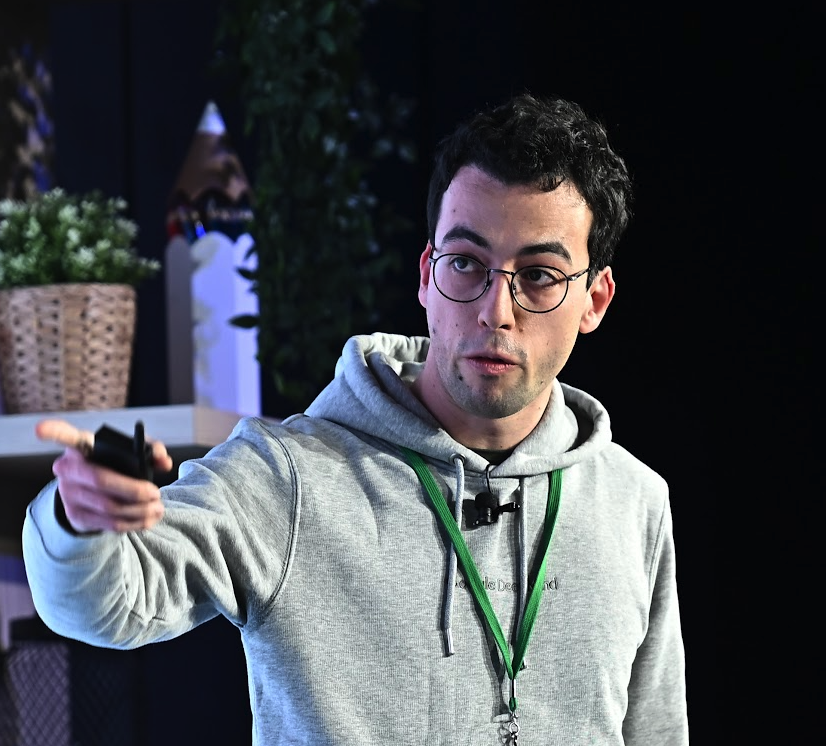
Stefano NASINI is an Associate Professor at the University of Lille 3, specializing in Quantitative Methods within the Economics and Mathematics Sciences. He holds a HDR (Habilitation à Diriger des Recherches) from the University of Lille 3 (2021), a Ph.D. in Statistics and Operations Research from the Polytechnic University of Catalonia (2015), and a Master in Statistics (2011). His research focuses on optimization, complex networks, statistical inference, and microeconomic applications. He has held academic positions including a post-doctoral role at IESE Business School (2014–2016) and a visiting researcher role at the University of Lisbon (2014). His work spans scheduling optimization, network analysis, financial contagion modeling, and energy system planning. Key contributions include specialized algorithms for large-scale optimization problems and frameworks for decentralized portfolio management. He is a member of the LEM research group and teaches courses in optimization, econometrics, and social network analysis at the Grande École and MSc levels. Publications highlight interdisciplinary applications, including network-based diffusion models, multi-market financial strategies, and dynamic choice analysis. His research bridges theoretical advancements in operations research with practical challenges in economics, energy, and transportation systems. No scientific awards are explicitly listed in the provided materials. His advising roles and grants are not detailed here, but his extensive publication record reflects active collaboration within academic and applied domains.
Eric Grivel is a Professor at the University of Bordeaux affiliated with the IMS Bordeaux (Integration Laboratory from Materials to Systems). His research focuses on Signal and Image Processing Spectral Analysis Stochastic Process Modeling His work spans theoretical contributions to signal processing and practical applications in radar systems and biomedical signal analysis. Key trends in his recent publications include Optimization of Detrended Fluctuation Analysis (DFA) for Hurst exponent estimation Development of divergence metrics for comparing ARMA and Gaussian processes Waveform design in MIMO OFDM DFRC (Dual Function Radar-Communication) systems Integration of AI tools like ChatGPT in educational signal processing projects Collaborations and industrial partnerships evident in his publications involve institutions such as Indian Institute of Science Thales Airborne Systems STMicroelectronics CEA Leti Slb (Schlumberger)
Salim ROSTAMI is an Associate Professor at the IÉSEG School of Management in France, specializing in Operations Management. He holds a Ph.D. in Economics and Mathematics Sciences from KU Leuven (2019) and a Master’s in Engineering from KU Leuven (2013), alongside a Bachelor’s in Industrial Engineering from Ferdowsi University of Mashhad (2012). His research focuses on scheduling under uncertainty, project planning, combinatorial optimization, and healthcare logistics. Notable achievements include the 2016 2nd Best Conference Paper Award from the University of Valencia. Education: Ph.D., Economics and Mathematics Sciences, Operations Management, KU Leuven, Belgium (2019) Master, Engineering, Operations Research, KU Leuven, Belgium (2013) Bachelor, Engineering, Industrial Engineering, Ferdowsi University of Mashhad, Iran (2012) His work spans stochastic resource-constrained project scheduling, sequential testing of systems, and chemotherapy appointment scheduling. He has published widely in journals like the European Journal of Operational Research and Flexible Services and Manufacturing Journal. Teaching roles include courses on operations management and project management across undergraduate and graduate programs. Awards: 2016: 2nd Best Conference Paper Award, University of Valencia His research emphasizes practical applications in healthcare and project management, leveraging dynamic programming and metaheuristic algorithms. Collaborations include work with institutions like École des Mines de Saint-Étienne and KU Leuven.
Freddy Bouchet is a Directeur de Recherche at CNRS and a Professeur attaché at École Normale Supérieure de Paris (ENS-PSL). His work bridges mathematical physics, climate science, data science, and statistical mechanics , focusing on turbulent flows, climate extremes, and large deviation theory . He will lead the Laboratoire de Météorologie Dynamique (LMD) starting 2025. Research Themes : Statistical mechanics of geophysical flows (Jupiter's jets, ocean currents). Large deviation theory for rare events in turbulence and climate. Non-equilibrium phase transitions in atmospheric/oceanic systems. Ensemble inequivalence in systems with long-range interactions. Scientific Awards : Three Physicists Prize Collaborations : Tapio Schneider, Antoine Venaille, J. Laurie, O. Zaboronski, B. Dubrulle, A. Venaille. Labs & Teams : Climate and Statistical Mechanics group at ENS de Lyon Future director of Laboratoire de Météorologie Dynamique (LMD/IPSL) Publications span climate dynamics, turbulence, statistical mechanics, and large deviation theory , with applications to Jupiter's atmosphere, ocean vortices, and non-equilibrium systems . His work often challenges paradigms like Tsallis non-extensive statistics.
Francis Bach is a Professor and researcher at INRIA, leading the SIERRA project-team since 2011, which is part of the Computer Science Department at Ecole Normale Supérieure (ENS) within PSL Research University. His work bridges CNRS, ENS, and INRIA as a joint research effort. Elected to the French Academy of Sciences in 2020, he currently runs the ERC project SEQUOIA following his previous ERC project SIERRA (2009-2014). His research spans statistical machine learning with focus on optimization, sparse methods, kernel-based learning, neural networks, graphical models, and signal processing. Bach completed his Ph.D. in Computer Science at U.C. Berkeley under Professor Michael Jordan, followed by work at Ecole des Mines de Paris and the WILLOW project-team at INRIA/ENS/CNRS (2007-2010). His recent book "Learning Theory from First Principles" was published by MIT Press in December 2024. Bach's publication record shows consistent high-impact contributions across machine learning theory and applications, with recent work focusing on conformal prediction, diffusion models, optimization theory, and learning theory foundations. His research demonstrates strong connections between theoretical guarantees and practical algorithms, with applications spanning generative modeling, robust optimization, and statistical inference. Elected to French Academy of Sciences (2020) ERC project SIERRA (2009-2014) ERC project SEQUOIA (current) Author of "Learning Theory from First Principles" (MIT Press, 2024) Bach actively mentors numerous PhD students and postdocs, with many alumni now holding faculty positions at institutions like EPFL, Ecole Polytechnique, University of Washington, and University of Montreal. His teaching includes advanced courses on learning theory at ENS's Master's programs. He regularly presents tutorials at major conferences including COLT, NeurIPS, and ICML, demonstrating his leadership in the theoretical machine learning community.
Dond Asha Kisan is an Assistant Professor at the School of Mathematics , Indian Institute of Science Education and Research Thiruvananthapuram (IISER TVM). His research focuses on numerical analysis and computational mathematics , particularly in finite element methods for partial differential equations. He can be contacted at ashadond@iisertvm.ac.in or via phone at +91 (0)471-2778247. PhD : Mathematics, Indian Institute of Technology Bombay M.Sc. : Mathematics, K.T.H.M. College, Nashik Kisan's research spans adaptive finite element methods , stabilized formulations for convection-diffusion problems , and optimal control governed by Stokes equations . His work includes convergence analysis, nonconforming discretizations, and hybrid numerical schemes. Recent publications (2023-2025) address stochastic modeling in liquid crystal physics, advanced WENO schemes, and adaptive algorithms for control problems. Scientific Awards : No explicit awards mentioned in the data, though he held prestigious postdoctoral fellowships including National Post-Doctoral Fellowship and NBHM Post-Doctoral Fellowship. Kisan has extensive teaching experience , including MATLAB workshops and undergraduate course assistantships. He has presented at major international conferences like ICIAM and Hyperbolic Problems, demonstrating global engagement in computational mathematics.
Mingsheng Ying is a Distinguished Professor and Research Director of the Centre for Quantum Computation and Intelligent Systems (QCIS) at the Faculty of Engineering and Information Technology, University of Technology Sydney, Australia. He also holds the position of Cheung Kong Professor at the State Key Laboratory of Intelligent Technology and Systems, Department of Computer Science and Technology, Tsinghua University, Beijing, China. Professor Ying graduated from the Department of Mathematics, Fuzhou Teachers College, Jiangxi, China, in 1981. His primary research interests span quantum computation (particularly quantum programming and model-checking quantum systems), programming theory and formal methods, and the foundations of artificial intelligence (focusing on logic and uncertainty). As an author of the books "Foundations of Quantum Programming" (Elsevier - Morgan Kaufmann 2016) and "Topology in Process Calculus: Approximate Correctness and Infinite Evolution of Concurrent Programs" (Springer-Verlag, 2001), he has published over 100 papers in top international journals and conferences. His recent research publications demonstrate a strong focus on quantum programming languages, verification techniques for quantum systems, and the theoretical foundations of quantum computation. The trend in his work shows increasing emphasis on formal verification methods for quantum systems, particularly model-checking techniques for quantum Markov chains and quantum processes. His research bridges theoretical computer science with quantum information theory, creating frameworks for reliable quantum software development. Editorial Board, Artificial Intelligence, Elsevier, Amsterdam Editorial Board, Fuzzy Sets and Systems, Elsevier, Amsterdam Vice President, International Fuzzy Systems Association (elected in 2005) Program Chair, IFSA 2005, World Congress of International Fuzzy Systems Association Chairman, Chinese Association of Fuzzy Systems and Mathematics Professor Ying has secured significant research funding including multiple Australian Research Council Discovery Projects such as "Model-checking quantum Markov chains: towards verification techniques for quantum cryptographic systems" (2013-2015) and "Process algebra approach to distributed quantum computation and secure quantum communication" (2011-2013). His work has also received funding from the National Natural Science Foundation of China and Tsinghua University. At QCIS, he leads research in quantum software theory and methodology, with applications in quantum cryptography and secure communication.
Grégoire Allaire is a Professor of Applied Mathematics at École Polytechnique, where he leads research in shape optimization , homogenization , and multi-scale modeling . His work bridges theoretical and applied domains, focusing on partial differential equations (PDEs), composite materials, and computational methods.
Yvain Bruned is a Professor of Mathematics at Université de Lorraine, Nancy, France, where he leads research in singular stochastic partial differential equations and related fields. He serves as Principal Investigator for the ERC Starting Grant LoRDeT (2023-2028), which focuses on advancing the theory of decorated trees and Hopf algebraic structures for solving singular SPDEs and dispersive PDEs at low regularity. Previously, he was a Lecturer at the University of Edinburgh (2019-2022) and completed postdoctoral work at Imperial College London and University of Warwick under Martin Hairer. His educational background includes: PhD in Mathematics (2012-2015), UPMC (Paris 6), on "Singular KPZ type equations" under Lorenzo Zambotti Master 2 in Probability and Statistics, ENS Cachan / Rennes 1, with honors Master 1 in Mathematics, ENS Cachan, with honors Bachelor in Mathematics and Computer Science, University of Rennes 1, with honors Student at ENS Cachan Brittany extension (2009-2013) Classes Préparatoires in Mathematics and Physics (2007-2009) Bruned's research centers on singular stochastic partial differential equations, with particular focus on Regularity Structures, renormalization theory, and their connections to Hopf algebras. His work bridges theoretical mathematics with applications in quantum field theory, wave turbulence, and numerical analysis. He has developed novel approaches using decorated trees to handle renormalization procedures for singular SPDEs and has extended these methods to dispersive PDEs with random initial data. His research program aims to establish existence and uniqueness results for quasilinear and dispersive SPDEs while developing algebraic tools through deformations of Hopf algebras. His extensive publication record demonstrates consistent contributions to the field of singular SPDEs, with a clear trajectory from foundational work on Regularity Structures to more recent applications in dispersive PDEs and numerical methods. The publications reveal a strong collaborative network with leading researchers in stochastic analysis, mathematical physics, and algebra. His work shows increasing sophistication in handling renormalization procedures through algebraic structures, with recent papers exploring connections between different mathematical frameworks. His major scientific recognition includes: ERC Starting Grant LoRDeT (2023-2028) Bruned actively supervises a large group of researchers, currently advising 4 PhD students and 2 postdoctoral researchers at Université de Lorraine, with several former PhD students having completed their degrees at the University of Edinburgh. His ERC grant has enabled him to organize multiple international workshops in Nancy, fostering collaboration between researchers in singular SPDEs, algebraic structures, and numerical analysis. The grant also supports the development of software platforms for decorated trees and their Hopf algebraic structures. As Principal Investigator of the ERC LoRDeT project, Bruned leads a vibrant research team based at the Elie Cartan Institute of Lorraine, which includes postdocs, PhD students, and visiting researchers. The team regularly organizes specialized workshops on topics including operads, symmetries for quantum field theory, and normal forms for singular dynamics, creating a dynamic research environment that bridges multiple mathematical disciplines.
Dr. Yi-Ping Fang is an Assistant Professor at the EDF Chair SSEC with a joint appointment at the Industrial Engineering Laboratory, CentraleSupélec, Université Paris-Saclay, France. His research focuses on computational methods for risk, vulnerability, and resilience analysis of critical infrastructures including smart grids, electrified transportation, and interdependent lifeline systems. Risk Analysis Resilience Engineering Optimization Under Uncertainty Game Theory Applications His work applies advanced techniques like distributionally robust optimization, POMDP modeling, and interdependency analysis to enhance infrastructure resilience against climate change, natural hazards, and intentional attacks. Publications demonstrate expertise in hybrid optimization algorithms, stochastic modeling, and network vulnerability assessment. Recent trends include: Smart grid resilience enhancement Uncertainty quantification in infrastructure systems Multi-stage decision modeling Game-theoretic approaches for interdependent networks Integration of deep learning for dynamic system prediction
Pierre Marion is a Researcher at INRIA Paris, working within the Sierra research team since September 2025. His work focuses on the theoretical foundations of deep learning and he is beginning to explore applications of AI in mathematics. Marion has established collaborations across multiple institutions including EPFL, Sorbonne Université, and Google DeepMind. His educational background includes: Engineering degree from École polytechnique (2015-2018) with specialization in Applied Mathematics Master's degree from Sorbonne Université (2019-2020) PhD from Sorbonne Université (2020-2023) under the supervision of Gérard Biau and Jean-Philippe Vert Postdoctoral research at EPFL (2024) supervised by Lénaïc Chizat Marion's research interests primarily focus on the theory of deep learning, where he investigates the optimization and statistical properties of various neural network architectures. His work spans from shallow networks to complex generative models, with a particular emphasis on understanding the mathematical foundations that govern deep learning performance. Recently, he has begun exploring applications of AI in mathematical research, aiming to bridge the gap between theoretical machine learning and mathematical discovery. His research often combines rigorous theoretical analysis with practical implications for training deep neural networks. Analysis of Marion's recent publications reveals several key trends in his research. He has made significant contributions to understanding the role of large learning rates in optimization dynamics, demonstrating how they can accelerate convergence in logistic regression and prevent memorization in score-based generative models. His work on attention mechanisms has provided theoretical guarantees for their effectiveness in specific tasks like single-location regression and clustering. Additionally, Marion has extensively studied the connections between residual networks and neural ordinary differential equations , establishing generalization bounds and exploring scaling properties in the large-depth regime. His earlier work included contributions to natural language processing and quasi-Monte Carlo methods, reflecting a broad mathematical foundation that informs his current deep learning research. Marion has received several notable scientific awards: Runner-up PhD Award of AFIA (French Association for Artificial Intelligence) in 2024 Google PhD Fellowship in 2022 Ecole polytechnique Grand Prize of Research Internships in 2018 As an advisor, Marion currently supervises PhD student Yu-Han Wu (since 2024), with whom he has co-authored multiple publications on large learning rates and denoising score matching. Previously, he co-supervised several Master's students including Seorim Park, Yerkin Yesbay, and Nathan Doumèche. Marion has been actively involved in the machine learning community through conference organization (NeurIPS@Paris meetups), session chairing (ICSDS 2022), and extensive reviewing activities. He has served as a reviewer for top journals including JASA and Annals of Statistics, and conferences including NeurIPS and ICLR, where he was recognized as a top reviewer at NeurIPS 2023. Marion is a member of the Sierra research team at INRIA Paris, which focuses on machine learning theory and applications. He has also collaborated with researchers at CREST (Center for Research in Economics and Statistics), as evidenced by his participation in seminars organized by Anna Korba and Karim Lounici. His work often bridges theoretical computer science, statistics, and applied mathematics, reflecting the interdisciplinary nature of modern machine learning research.
Jaouad Mourtada is an Assistant Professor in the Department of Statistics at ENSAE/CREST, École Nationale de la Statistique et de l'Administration Économique since September 2020. Previously, he was a postdoctoral researcher at the Laboratory for Computational and Statistical Learning at the University of Genoa (2019-2020). He completed his PhD in Statistics at École Polytechnique under the supervision of Stéphane Gaïffas and Erwan Scornet. His educational background includes a Master's degree in Mathematics with specialization in Probability and Random Models (2016), a Master's degree in Fundamental Mathematics (2015), and a Bachelor's degree in Mathematics from Pierre and Marie Curie University and École Normale Supérieure (2013). Dr. Mourtada's research focuses on the intersection of statistics and learning theory, with particular interest in high-dimensional statistics, online learning, and density estimation. His work explores the complexity of prediction and estimation problems through rigorous theoretical analysis. His research spans statistical learning theory, robust statistics, and the theoretical foundations of machine learning algorithms. His publication record since 2017 demonstrates consistent contributions to top-tier venues in statistics and machine learning, with recent work focusing on universal coding, aggregation methods, robust regression, and the theoretical analysis of kernel methods and random forests. His research shows a progression from online learning and expert aggregation to more complex statistical learning problems involving high-dimensional data and model misspecification. He teaches courses including Statistical Learning Theory for Master 2 Data Science students and Probability Theory at ENSAE. His teaching spans theoretical foundations of machine learning and core probability concepts for advanced statistics students.
Charbel Jose Chiappetta Jabbour is a Professeur Eminent and Head of the Systèmes d’Information, Supply Chain Management & aide à la Décision department at NEOMA Business School in France. He holds a Habilitation à diriger un doctorat from the University of São Paulo, Brazil. His research focuses on green and circular supply chains , Industry 4.0 , and sustainability integration in operations management. He has been included in Clarivate/Web of Science Highly Cited Researchers and received the British Academy of Management’s Best Paper Award (2019). Education & Career: Completed Habilitation at University of São Paulo (Brazil) International experience across Brazil, Japan, Scotland, England, and France Former Associate Editor of Journal of Cleaner Production Research Interests: His work bridges theory and practice in sustainable supply chain design, circular economy frameworks, and the human dimension of operations. He emphasizes integrating Industry 4.0 technologies with sustainability goals, and has pioneered studies on blockchain in supply chain digitalization. Grants & Projects: Principal Investigator/Co-Investigator on projects funded by Innovate UK, Midlands Engine UK, FAPESP Focus areas: Sustainable supply chain resilience, circular economy adoption Labs/Teams: Leads the Systèmes d’Information department and collaborates with global networks on sustainability initiatives.
Prof. Tijani CHAHED is a Professor at Telecom SudParis, part of Université Paris-Saclay, affiliated with the SAMOVAR laboratory and the NeSS research group. His work focuses on network optimization, edge computing, machine learning applications in telecommunications, and game-theoretical frameworks for distributed systems. He holds a position in the Department of Computer Science and Telecommunications. His research spans resource allocation in 5G/6G networks, energy efficiency strategies for mobile infrastructure, reinforcement learning for dynamic systems, and coalitional game theory for multi-agent systems. Key contributions include optimization of cache allocation in edge computing, latency-critical traffic management (URLLC), and strategic investment models for distributed computing infrastructures. Selected articles highlight advances in edge computing resource management, metaverse data transport over 5G, and energy-efficient sleep mode control for base stations. His work often intersects with industrial applications in green networks and smart grid integration for mobile infrastructure. Collaborations involve institutions like École Polytechnique, INRIA, and industry partners in telecommunications. Current projects include 6G network architectures, metaverse-enabled edge services, and decentralized resource allocation frameworks. Labs/Teams: SAMOVAR Lab (Signal and Media Access Networks, Optical and Radio Networks), NeSS Group (Networked Systems and Services).
Omar Rifki is an Associate Professor (Maître de Conférences) specializing in combinatorial optimization and artificial intelligence applications. His research bridges theoretical computer science with practical logistics challenges, focusing on routing problems, process mining, and machine learning integration for complex decision systems. His core research interests include phase transitions in NP-hard problems, vehicle routing optimization under time constraints, and healthcare process modeling. Rifki's work demonstrates a consistent pattern of integrating reinforcement learning with traditional optimization techniques to solve large-scale real-world problems in transportation and logistics, with particular emphasis on spatio-temporal data effects and collaborative systems. Analysis of his 15 publications (2019-2025) reveals three dominant research thrusts: (1) Fundamental studies of combinatorial problem hardness using phase transition frameworks, (2) Practical applications of deep reinforcement learning in vehicle routing and taxi assignment, and (3) Healthcare process optimization through advanced process mining techniques. His work consistently addresses scalability challenges in real-world implementations while maintaining theoretical rigor. No scientific awards were documented in the provided materials. His collaborative work with researchers like Christine Solnon and Thierry Garaix indicates active participation in European operations research communities, though specific grant details remain unreported. Rifki's research shows increasing integration of graph theory and machine learning in transportation applications, particularly evident in his Lyon City case studies on autonomous ride-sharing systems.