Antonio Lucadamo is an Associate Professor at the Department of Law, Economics, Management and Quantitative Methods (DEMM) of the University of Sannio. His research focuses on statistical modeling, decision analysis, and multivariate methods with applications in diverse fields such as financial markets, cultural festivals, environmental science, and healthcare evaluation. Key Research Areas : Decision theory, ordinal data handling, AHP methodology, environmental quality assessment Recent Collaborations : Pietro Amenta, Ida Camminatiello, Gabriella Marcarelli, and Matteo Rossi Publication Trends : His work spans from foundational statistical techniques (e.g., co-inertia analysis, Taguchi index generalization) to applied studies in financial decision-making, festival loyalty models, and environmental quality assessment. Notable subfields include pairwise comparison matrices, OWA operators, and spectral soil analysis. Contact : antonio.lucadamo@unisannio.it
Valeria D'Amato is an Associate Professor at the Department of Methods and Models for Economy, Territory, and Finance of Sapienza University of Rome . Her academic work focuses on actuarial science, risk management, and statistical modeling. Fields of Interest : Actuarial Science, Risk Management, Machine Learning, Climate Risk, Financial Mathematics, Demographic Economics Email : valeria.damato@uniroma1.it Recent research highlights include: Developing machine learning models to assess climate risk sharing in tourism insurance and ESG score prediction. Analyzing frailty-based mortality models for longevity risk reserving and pandemic-related mortality shocks. Investigating cyber risk dependence using vine copula frameworks and geospatial pricing strategies. Her publications span journals like Frontiers in Applied Mathematics and Statistics , Applied Stochastic Models in Business and Industry , and Risks , reflecting interdisciplinary approaches to modern risk assessment challenges.
Marco Geraci is a Professor at the Department of Methods and Models for Economy, Territory and Finance at Sapienza University of Rome . He teaches courses such as Statistics for Health Economics and Computational Tools for Finance . His research focuses on Statistical Methods in Health Sciences , including Quantile Inference , Random-Effects Models , Multivariate Statistics , and Missing Data Analysis . He also specializes in Accelerometer Data , Physical Activity , and Pediatric Oncology . His recent publications emphasize Quantile Regression applications in Public Health , Environmental Science , and Health Economics . Methodological contributions include Directional Quantile Classifiers , Functional Quantile Regression , and Laplace Distribution Projections . Themes span Biostatistics , Surgical Safety , and Maternal/Child Health Disparities .
Lea Petrella is a Full Professor at the Department of Methods and Models for Economics, Territory, and Finance, Sapienza University of Rome. She teaches courses in Time Series Analysis and Advanced Statistical Methods , focusing on practical applications using R software. Research Interests: Quantile regression, Graphical models, Hidden Markov Models, Risk measures, and Time Series analysis Key Projects: Generalized Dynamic Graphical Models for pandemic impacts, Penalized quantile regression for risk assessment, Multivariate quantile regression frameworks Her recent publications include: 2025: Mid-quantile mixed graphical models for public shootings 2025: Spatial quantile random forests for economic mobility 2024: Expectile hidden Markov models for cryptocurrency returns 2024: Mixed-frequency quantile regressions for risk forecasting She supervises postdocs and PhD students including Maria Saiz, Beatrice Foroni, and Valentina Raponi. Her work spans financial risk modeling, environmental statistics, and biomedical applications. Email: Lea.Petrella@uniroma1.it or lea.petrella@uniroma1.it
Domenico Vitale is a Researcher at the Department of Methods and Models for Economy, Territory, and Finance within Sapienza University of Rome . His work spans environmental statistics, economic modeling, and data science. He teaches courses including Time Series Analysis (6 CFU), Introduction to Spatial Data (3 CFU), and Basic Statistics for Business Sciences. Office hours are held in Room 420, 4th Floor, Faculty of Economics. Research Focus : Eddy covariance data processing and quality control Statistical modeling of environmental and economic phenomena Machine learning applications for survey data and flux measurements Time series alignment and prewhitening techniques Recent Publications explore topics like quasi-formal employment modeling, carbon flux scaling frameworks, and pandemic dynamics. His work integrates interdisciplinary methodologies from climate science to econometrics. Labs and Collaboration : Active in DidaLab , Spinelli Lab , and ICOS Ecosystem Stations , focusing on standardized environmental data processing.
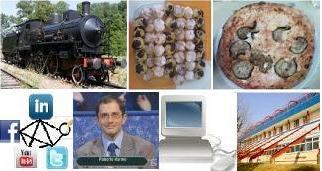
Roberto Marmo is a Professor of Computer Science at the University of Pavia since the 2022/23 academic year. His research spans multiple domains including Artificial Intelligence , Computer Vision , and Social Media Mining . He earned his PhD in Information Engineering at Pavia's Computer Vision and Multimedia Lab after completing a Computer Science degree at the University of Salerno. Core Expertise: Data Science, AI Algorithms, Scientific Visualization Industry Applications: Anti-fraud Systems, Tourism Analytics, Transportation Sign Recognition His academic work demonstrates consistent interdisciplinary innovation: 2020: Encyclopedia contributions on Cybersecurity and Social Engineering 2017: Market analysis through social media mining 2010: Social network architecture research Key collaborations include: IBM's Web 2.0 Security Encyclopedia Italian Tourist Railways Association (application of IT to heritage tourism) Academic-Industry Partnerships in transportation sign recognition His technical contributions include: Neural network applications in geological analysis Operational risk visualization frameworks SOS gesture recognition systems e-learning performance dashboards Available for consulting and training services in AI, data analysis, and scientific visualization.
Simona Ester Rombo is a Full Professor in the Department of Mathematics and Computer Science at Università degli Studi di Palermo (UNIPA), Italy. Her research spans computational biology, bioinformatics, network analysis, and big data approaches applied to biological and social systems. Her primary research interests include: Bioinformatics and computational genomics, particularly focusing on lncRNA-disease associations and RNA editing Network analysis and graph algorithms for biological and social networks Development of software tools for large-scale data analysis in biology Machine learning applications in drug discovery and repurposing Big data approaches for genomic sequence analysis and social network analysis Professor Rombo's publications demonstrate a strong focus on developing computational methods for biological network analysis, with particular emphasis on protein-protein interaction networks, molecular interaction networks, and lncRNA-disease association prediction. Her work bridges computer science and biology, creating practical tools and algorithms that address real biological challenges. Her scientific contributions include: Development of DIAMIN, a software library for distributed analysis of molecular interaction networks Creation of FEDRO, a tool for discovering candidate ORFs in plants with RNA editing Research on topological properties of biological networks and their functional implications Applications of network analysis to drug discovery and repurposing Professor Rombo actively teaches courses related to big data management and software engineering, mentoring students in computer science and artificial intelligence programs. Her office is located at Via Archirafi 34, Floor 2, Room 220 at UNIPA, with office hours on Mondays from 9:30 to 13:30.
Marco Locatelli is a Full Professor in the Department of Computer Engineering at the University of Parma, Italy. His research focuses on Global Optimization , Operations Research , and Computational Mathematics , with applications in Robotics and Optimization Algorithms . Education: Ph.D. in Computational Mathematics and Operations Research (University of Milano/Napoli, 1997); Laurea in Computer Science (University of Milano, 1992). Positions: Post-Doc (University of Trier, Firenze); Assistant/Associate Professor (University of Torino); Full Professor (University of Parma since 2010). His research spans Global Optimization over intervals, multistart algorithms, concave optimization, packing problems, and convex underestimators. Recent work includes Multi-Agent Pathfinding and Speed Planning with energy/time optimization, leveraging Machine Learning and Dynamic Programming . He has received distinguished accolades, including the Europt Fellow (2018), Best Paper in the Journal of Global Optimization (2016), and co-authored a SIAM-published book on Global Optimization (2013). He serves on editorial boards of top-tier journals like Computational Optimization and Applications and Operations Research Letters . Scientific Awards: Al Zimmermann's Programming Contest Winner (Circle Packing) AIRO Award for Daniele Depetrini's Master Thesis (2007) Chairman's Recognition of Outstanding Paper (2009 IEEE Congress) Europt Fellow (2018) His teaching includes Operations Research and Algorithms for Decision Support across multiple Italian universities (Torino, Parma, Firenze). He has contributed to Research Projects like MoSPRAS, MOST, and COSO, addressing real-world optimization challenges in healthcare, robotics, and transportation.
Fabio Palomba is an Associate Professor at the Department of Computer Science , University of Salerno, Italy. He earned a European PhD in Management & Information Technology (2017), funded by University of Salerno and University of Molise, under advisor Prof. Andrea De Lucia. His research spans software maintenance and evolution , empirical software engineering , and ML systems quality . Recipient of IEEE Computer Society Best PhD Thesis Award (2017) Multiple Distinguished Paper Awards from ACM/SIGSOFT and IEEE/TCSE Recipient of prestigious SNSF Ambizione grant (2019) and IEEE Rising Star Award (2023) His work investigates fairness-aware practices in ML , technical debt in AI systems , and LLM applications in software engineering . Recent studies focus on automated requirements generation via RECOVER, quantum software engineering , and socio-technical community smells in ML-enabled systems, with empirical analyses across large datasets. Key editorial roles include Elsevier's Information and Software Technology Journal (2022-), Springer's Empirical Software Engineering Journal (2021-), and IEEE Transactions on Software Engineering (2020-). He has served as program co-chair for SANER 2024 , ICPC 2021 , and multiple conference tracks. 16 Distinguished Reviewer Awards for his refereeing work Co-authored 80+ journal papers , 100+ conference papers , and advised 300+ theses
Federico Bergenti is an Associate Professor in Computer Science at the University of Parma, affiliated with the Department of Industrial Systems and Technologies Engineering (DISTI) and the Department of Mathematics, Physics, and Computer Science. He serves as Chair of the AI Lab since 2015 and is actively involved in teaching Artificial Intelligence, Software Engineering, and related courses across multiple degree programs. His educational background includes a Laurea degree (M.Sc.) in Electronic Engineering from the University of Parma (1998) and a Ph.D. in Information Technologies from the same institution (2002). Prior to his academic career, he worked at CSELT S.p.A. (1998-1999) and CNIT (2000-2006). Bergenti's research primarily focuses on Artificial Intelligence and Software Engineering, with special emphasis on multi-agent systems. His work spans agent communication languages, architectures for agent-based middleware, reusability in agent systems, and more recently, agent programming languages based on constraint logic programming. He is among the founders of the JADE initiative and remains active in the Agent-Oriented Software Engineering research community. Analysis of his recent publications reveals a consistent research trajectory centered on agent-oriented programming (particularly JADEScript), indoor positioning systems, neural-symbolic integration, and mathematical modeling of multi-agent dynamics using kinetic theory approaches. His work demonstrates strong interdisciplinary connections between computer science, mathematics, and engineering applications. Professionally, Bergenti has coordinated various scientific initiatives, served on the Senior Program Committee of the AAMAS international conference since 2006, hosted the IEEE WETICE conference in Parma in 2014, and served as Program Chair for WETICE 2016. He has participated in numerous European Commission-funded research projects under the 5th and 6th Framework Programmes. He leads the AI Lab at the University of Parma, where his team develops practical applications of agent-based systems, including indoor localization technologies, health assistance systems, and social network modeling. His research combines theoretical foundations with real-world implementations, particularly through the JADE multi-agent framework.
Prof. Federico Solari is a fixed-term researcher at the Department of Industrial Systems and Technologies Engineering (DISTI) at the University of Parma. He teaches courses including Food Industry Systems (Second Cycle Degree in Engineering for the Food Industry) and Mechanical Plant and Equipment (First Cycle Degree in Mechanical Engineering). Academic Appointments: Second Cycle Degree (2021–2025), First Cycle Degree (2019–2023) Research Focus: IoT applications in agriculture, sustainable logistics, computer vision for food quality, and inventory management for perishable goods His recent publications address trends in innovative teaching methodologies, smart agricultural systems, post-COVID supply chain sustainability, and optimization of reordering policies using advanced statistical techniques. He collaborates with researchers like Eleonora Bottani and Giovanni Romagnoli on food industry systems.
Emma Perracchione is an Associate Professor in the Department of Mathematical Sciences "G.L. Lagrange" (DISMA) at Politecnico di Torino, where she conducts research at the intersection of approximation theory, machine learning, and scientific computing. Her work focuses on kernel-based methods, inverse problems, and applications in space weather and solar physics. She is actively involved in teaching and research leadership, including PhD supervision and national projects. PhD in Mathematics, University of Turin (2017, cum laude) M.Sc. and B.Sc. in Mathematics, University of Turin (2013, 2011) Her research interests center on approximation theory and its applications, particularly greedy methods and two-layered kernel machines used for feature reduction in geomagnetic storm forecasting and optimal sampling for solar nanosatellites. These efforts contribute significantly to advancements in inverse problems and scientific computing . Her expertise spans machine learning , imaging , and data-driven modeling , with applications in climate action and space weather. The most recent publications highlight a strong trend in developing and analyzing variably scaled kernels , feature selection via greedy algorithms, and machine learning applications in solar and astrophysical contexts. These works integrate numerical analysis with real-world data from solar wind and imaging instruments, demonstrating a blend of theoretical rigor and practical relevance. Scientific awards received include: GNCS Young Researchers Funding (2020) GNCS Young Researchers Funding (2016) "Luciana Picco Botta" Study Award (2015) COST Short Term Scientific Mission (STSM) grant (2015) Emma Perracchione supervises PhD student Matteo Trombini in the Mathematical Sciences program (40th cycle, 2025–ongoing) and leads the PRIN-funded project GOSSIP – Greedy Optimal Sampling for Solar Inverse Problems (2025–2027). She has taught various courses including Linear Algebra and Geometry , Numerical Methods and Scientific Computing , and advanced topics on Kernels for Machine Learning in aerospace, automotive, and computer science engineering programs. She is a member of the Space Weather Italian Community (SWICo) and the National Scientific Computing Group (GNCS-INdAM) , and serves as Guest Editor for Dolomites Research Notes on Approximation . She has also participated in organizing major conferences such as DWCAA24 and GIMC-SIMAI Young.
Riccardo Focardi is a Full Professor at Ca' Foscari University of Venice in the Department of Environmental Sciences, Computer Science and Statistics. He has held this position since September 2017, following roles as Associate Professor (2013–2017) and Researcher (1996–2002). He is also co-founder and Chief Scientist of Cryptosense and 10Sec, startups focused on cybersecurity and IoT security solutions. Education: PhD in Computer Science from the University of Bologna (1999), Laurea cum laude in Computer Science (1993). Research focuses on cybersecurity, cryptography, formal methods for security protocol analysis, and secure hardware/software systems. Notable projects include the Cryptosense Analyzer tool for cryptographic device analysis and contributions to IoT security via 10Sec's fingerprinting technologies. His work on PKCS#11 vulnerabilities and padding oracle attacks has significantly impacted practical cryptographic security. Publications emphasize applied cryptography, API security, and IoT systems. Recent work explores GAN-based authentication (EUAS-GAN) and zero-shot malware detection (Z-MDZS). Over 110 publications span top venues like CRYPTO, CCS, and IEEE S&P. Leadership roles include coordinating national cybersecurity projects (e.g., POR FESR 2017–2020), chairing conferences (ITASEC 2017, CSF 2007), and directing Ca' Foscari's Computer Science PhD program (2012–2019). Active in public engagement, including media appearances on cybersecurity trends. Labs/Teams: Cryptosense (founded 2013), 10Sec (2020), and the DAIS department's security research group. Supervised over 10 PhD students, contributing to academic-industry collaborations in secure systems.
Filippo Bergamasco is an Associate Professor at Ca' Foscari University of Venice, affiliated with the Department of Environmental Sciences, Computer Science and Statistics. He is a member of the Scientific Committee of the Center for Studies on Port Economics and Management (DAIS). His work bridges computer vision, environmental monitoring, and oceanography, with a focus on developing advanced imaging techniques for ocean wave analysis and stereo reconstruction. He leads projects like the WASS pipeline, an open-source tool for 3D stereo reconstruction of ocean waves, and collaborates on studies involving rogue wave dynamics, low-cost sensors, and Arctic sea-state analysis. His research leverages machine learning, deep learning, and real-time systems to address challenges in environmental and marine sciences. Research interests include computer vision applications in oceanography, stereo imaging systems, wave dynamics modeling, and environmental monitoring technologies. He has contributed to over 80 peer-reviewed publications, with recent works focusing on real-time wave tracking, 3D reconstruction, and the integration of physics-driven models with neural networks. His expertise spans interdisciplinary collaborations, including projects on fish oil's impact on wind waves and the development of robust camera calibration methods. He actively publishes in top journals like IEEE Transactions on Image Processing, Ocean Modelling, and Physical Review Letters, and engages in international conferences such as ECCV and ICPRAM.
Paolo Falcarin is an Associate Professor at Ca' Foscari University of Venice, affiliated with the Department of Environmental Sciences, Computer Science and Statistics. His research focuses on cybersecurity, software engineering, and AI compliance, with notable contributions to software protection mechanisms, reverse engineering defenses, and cyber-physical systems. He actively participates in editorial roles for journals like Computers & Security and serves on program committees for IEEE/ACM conferences. Key Projects: ASPIRE (EU FP7), SERICS (PNRR), and Flexymob (Currant s.r.l.) Research Interests: Cybersecurity Knowledge Graphs, Runtime Security (Falco), AI Act Compliance, and Software Renewability His work bridges theoretical cybersecurity advancements with practical applications in distributed systems and IoT. Recent publications emphasize anomaly detection in large-scale systems and regulatory compliance frameworks for AI.