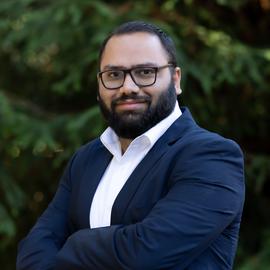
Prof. Yair Weiss is a faculty member at the School of Computer Science and Engineering, The Hebrew University of Jerusalem . He holds a PhD in Brain and Cognitive Sciences from MIT and an MSC in Applied Mathematics from Tel-Aviv University. Education: MSc in Applied Mathematics, Tel-Aviv University (1993) PhD in Brain and Cognitive Sciences, MIT (1998) His research focuses on Human and Machine Vision , Machine Learning , Bayesian Methods , and Neural Computation . Recent work explores adversarial examples, generative models, and robustness in neural networks. Recent publications highlight trends in: Understanding neural network representations Advancements in GANs and adversarial training Image restoration and translation techniques Perceptual distance modeling Bayesian approaches to computer vision Mathematical analysis of deep learning architectures
Dieu Tien Bui is a Full Professor in the Department of Business and IT at the University of South-Eastern Norway (USN) School of Business. His research focuses on Geospatial Artificial Intelligence Machine Learning GIS and Remote Sensing Natural Hazard Modeling Environmental Problems (landslides, floods, soil salinity, biomass) . He has contributed to over 15 recent publications in journals like Science of the Total Environment , Remote Sensing , and Geomorphology , emphasizing hybrid AI models for landslide and flood susceptibility. His work spans Vietnam, India, China, and Iran with applications in climate change adaptation and disaster management. Scientific Awards: Global Highly Cited Researcher PhD Supervision: He has supervised 8 PhD students at institutions including USN, NTNU, and Vietnamese universities.
Dr. Janis Nötzel is a senior researcher at the Chair of Theoretical Information Technology (Technische Universität München) and leads his independent Emmy Noether research group. Previously, he held a postdoctoral position at Universitat Autónoma de Barcelona and contributed to 5G practical implementations at TU Dresden's 5G Lab. His research spans quantum information theory, physical layer security, and machine learning applications. Key focuses include Quantum channel capacities under adversarial conditions Entanglement-assisted communication Quantum software frameworks (QuNetSim, QuReed) Interplay between classical and quantum communication Security analysis for 6G networks Resource optimization in quantum systems Recent publications (2023-2025) showcase innovations in Quantum satellite communication architectures Hybrid quantum-classical clustering algorithms Photonic processor instability modeling Covert capacity of compound channels Quantum key distribution resilience Free-space Bessel beam communication He actively collaborates with 6G-life research hub and contributes to quantum network simulation tools. Grants include funding from DFG (Leibniz Program), BMBF (6G-life, Q.Link.X), and StMWi (6G Zukunftslabor Bayern).
John G. Lynch, Jr. is University of Colorado Distinguished Professor at the Leeds School of Business, University of Colorado-Boulder. He also serves as Inaugural Director of the Initiative for Global Business Impact and is affiliated with the Center for Research on Consumer Financial Decision Making. Previously, from 2022-2024, he served as Executive Director of the Marketing Science Institute, a nonprofit think tank bridging industry and academia. He has held prestigious faculty positions at University of Florida (1979-1996) as Graduate Research Professor and at Duke University's Fuqua School of Business (1996-2009) as Roy J. Bostock Professor of Marketing. Lynch received his BA in economics, MA in psychology, and PhD in psychology from the University of Illinois at Urbana-Champaign. His academic journey spans over four decades with significant contributions to consumer behavior research. He is the founding Director of the Center for Research on Consumer Financial Decision Making and founding co-chair of the Boulder Summer Conference on Consumer Financial Decision Making. He served on the Academic Research Council of the US Consumer Financial Protection Bureau from 2017-2020. Lynch's research focuses on the cognitive psychology of consumer decision-making, particularly consumer financial decision-making since joining CU in 2009. His work spans consumer financial decision making, financial knowledge and well-being, planning for money and time, and research methodology validity. His publications reveal a strong emphasis on financial education effectiveness, couples' financial responsibility division, retirement savings behavior, and methodological rigor in marketing research. The recent publications show increasing focus on financial education, privacy regulation, statistical methodology, and the intersection of financial and physical health. Lynch has received numerous prestigious awards including the 2025 American Marketing Association-Irwin-McGraw Hill Award for Distinguished Marketing Educator of the Year (the highest honor in academic marketing), Paul D. Converse Award for Outstanding Contributions to Marketing Science, and the Society for Consumer Psychology's Distinguished Scientific Achievement Award. He is a Fellow of the American Marketing Association, Association for Consumer Research, and American Psychological Association/Society for Consumer Psychology - one of only six scholars worldwide to achieve this triple distinction. As an educator, Lynch has taught undergraduate Principles of Marketing, Marketing Research, and Senior Seminar in Marketing at CU. He has also taught MBA electives on market intelligence and PhD courses on marketing strategy and experimental design. He has supervised or co-supervised 100 PhD dissertations, with former students now on faculties of leading business schools worldwide. His teaching excellence has been recognized with multiple awards including Leeds MBA Elective Teaching Excellence Awards in 2011 and 2013.
Santiago Barreda is an Associate Professor in the Department of Linguistics at the University of California, Davis, specializing in speech perception and phonetic analysis. His research examines how acoustic properties of speech convey speaker characteristics including age, gender, and physical attributes. Education: Ph.D. in Linguistics (Phonetics), University of Alberta, 2013 M.A. in Hispanic Studies (Language and Linguistics), University of Western Ontario, 2008 B.A. in Linguistics and Spanish Language and Literature, University of Western Ontario, 2006 Research Focus: Dr. Barreda employs behavioral experiments and statistical modeling to investigate perceptual mechanisms in speech recognition. His work bridges theoretical phonetics with practical applications, particularly in vowel normalization techniques and formant tracking algorithms. Key questions address how listeners extract speaker identity from acoustic cues and interpret social characteristics through vocal signals. Publication Trends: Recent publications (2020-2025) reveal three dominant themes: computational phonetic tools (FastTrack, phonTools), perception of social/physical speaker characteristics from children's voices, and interdisciplinary public health research on speech-related aerosol transmission. His work demonstrates strong methodological consistency in combining acoustic analysis with perceptual validation. Scientific Awards: No scientific awards were mentioned in the source material. Advising and Grants: The provided documentation does not specify graduate student advising roles or external grant funding. Technical Contributions: Dr. Barreda develops open-source phonetic analysis software including FastTrack (Praat-based formant tracking) and the phonTools R package, which have become standard resources in acoustic phonetic research.
Professor Brett Hayes is a distinguished cognitive psychologist at the University of New South Wales, serving in the School of Psychology. He is the founding Director of the Sydney Thinking and Reasoning (STAR) Laboratory, which he has led for over 15 years, securing more than $4 million in competitive research funding. Professor Hayes has previously held the position of Head of the School of Psychology and served as a member of the Australian Research Council (ARC) College of Experts. His research expertise spans reasoning, concept learning, memory, and developmental changes in these cognitive processes. Professor Hayes employs both experimental investigation and computational modeling in his work, with a particular focus on applying fundamental cognitive research to practical problems in forensic and clinical decision-making, early childhood education, and climate change science communication. His research has significant interdisciplinary applications across psychology, education, and environmental science. Professor Hayes has published extensively in top cognitive science journals, with his most recent work focusing on inductive reasoning, sampling assumptions, learning traps, and consensus perception. His research demonstrates consistent innovation in understanding how people process information, make decisions under uncertainty, and develop reasoning abilities across the lifespan. His scientific contributions include numerous journal articles, book chapters, and co-authored textbooks on developmental psychology. Professor Hayes has also contributed to teaching through courses such as PSYC3341 Developmental Psychology (which he chairs), PSYC3221 Cognitive Science, and PSYC2061 Developmental and Social Psychology. Professor Hayes maintains an active research program with ongoing collaborations across multiple institutions, as evidenced by his numerous co-authored publications. His laboratory continues to advance our understanding of human cognition through rigorous experimental work and theoretical development.
Matias Zaldarriaga is the Richard Black Professor in the School of Natural Sciences at the Institute for Advanced Study (IAS), Princeton. His research focuses on theoretical cosmology, gravitational waves, and the Cosmic Microwave Background (CMB). He has held previous faculty positions at Harvard University (2003-2009) and New York University (2001-2002). Education: Ph.D. in Physics, Massachusetts Institute of Technology, 1998 Licenciado en Ciencias Físicas, Universidad de Buenos Aires, 1994 Zaldarriaga's work centers on decoding the early universe through CMB analysis and gravitational-wave astrophysics. He investigates inflation, large-scale structure formation, and black hole dynamics, leveraging advanced statistical methods to probe fundamental physics from cosmological data. His recent publications (2023-2025) demonstrate a strong focus on gravitational-wave data analysis, including novel algorithms for detecting binary black hole mergers, constraints on inflationary physics from large-scale surveys, and modeling supermassive black hole evolution. Key themes include higher-order waveform harmonics, pulsar timing arrays, and computational innovations for gravitational-wave astronomy. Awards and Honors: Gruber Cosmology Prize (2021) MacArthur Fellowship (2006) European Physical Society Gribov Medal (2005) Sloan Fellowship (2004) Helen B. Warner Prize, American Astronomical Society (2003) Packard Fellowship (2001) He collaborates extensively with international teams (e.g., LIGO-Virgo-KAGRA, DESI) and mentors researchers in cosmology and astrophysics. His group develops open-source tools for gravitational-wave inference and cosmological parameter estimation.
Pierre-Henri Paris is an Associate Professor (Maître de Conférences) at Paris-Saclay University since September 2024. Previously, he worked as a Postdoctoral Researcher at Telecom Paris (Institut Polytechnique de Paris) from September 2020 to August 2024. His academic journey includes a PhD in Artificial Intelligence from Sorbonne University and CNAM (Conservatoire National des Arts et Métiers) completed in 2020. Education: PhD in Artificial Intelligence, 2020, Sorbonne University and CNAM M.Sc. in Artificial Intelligence, 2016, CNAM M.Sc. in Mathematics, 2008, CY Cergy Paris University (incomplete) Pierre-Henri Paris's research focuses on the intersection of artificial intelligence, knowledge representation, and natural language processing. His work particularly emphasizes knowledge graphs, entity linking, and data quality. He has made significant contributions to projects like YAGO 4.5, which enhances knowledge bases with cleaner, logically consistent structures, and MAFALDA, a benchmark for fallacy classification. His research often bridges theoretical foundations with practical applications, particularly in how knowledge can be effectively represented, extracted, and utilized in complex systems. His recent publications reveal a strong focus on knowledge graph enhancement, semantic representation, and natural language understanding. The work on YAGO 4.5 demonstrates his commitment to creating more robust knowledge bases, while MAFALDA shows his interest in the intersection of language understanding and logical reasoning. His research trajectory indicates a consistent exploration of how structured knowledge can be integrated with linguistic analysis to create more intelligent systems. Advising: PhD students: Simon Coumes (2022-), Chadi Helwe (2022-2024), François Amat (2022-) Master's students: Syrine El Aoud (2021), Ayoub Mountassir (2013-2015) Bachelor's students: Khalil Halloul (2013-2014) Pierre-Henri Paris is actively involved in teaching at Paris-Saclay University, where he instructs courses including Introduction to Machine Learning, Introduction to Neural Networks, Algorithms for Data Science, Databases, and Data Warehousing. His teaching reflects his research expertise, providing students with both theoretical foundations and practical applications in artificial intelligence and data science.
Thomas Walter is a Professor at Mines ParisTech and Director of the Centre for Computational Biology (CBIO) , a research group affiliated with the Institut Curie and INSERM . His work focuses on applying Machine Learning and Computer Vision to biomedical image analysis, particularly in high-content screening and computational pathology . He also serves as Deputy Director of the Computational Oncology (U1331) unit and leads the Statistical Learning and Modeling of Biological Systems team. PhD in Medical Image Analysis (2003, Mines ParisTech) Postdoctoral work at EMBL (European Molecular Biology Laboratory) Director of CBIO since 2018 Holder of a PRAIRIE Chair (Paris Artificial Intelligence Research Institute) since 2019 Dr. Walter's research bridges biomedical imaging , machine learning , and cancer genomics . Key areas include: Statistical reconstruction of biological networks Prediction of tumor progression at genomic/transcriptomic levels Development of deep learning methods for cell cycle analysis Integration of multi-omics data for precision oncology Tools for spatial transcriptomics (e.g., autoFISH, RNA2seg) Recent publications highlight his work in spatial transcriptomics , immunotherapy outcome prediction , and deep learning for digital pathology . His team has developed open-source tools like FISH-quant and pyHiM for single-molecule RNA imaging analysis. Scientific Honors: PRAIRIE Chair (2019) for AI research in life sciences Dr. Walter actively contributes to teaching deep learning for image analysis in multiple graduate programs across France, including courses at Mines ParisTech , Université Paris-Saclay , and Institut Curie . His software tools (FISH-quant, pyHiM) and methodological frameworks (e.g., Cut-Detector, PointFISH) have become standard resources in bioimage informatics.
Lars Augestad Lochstoer is a Professor of Finance at the UCLA Anderson School of Management, where he teaches Empirical Methods in Finance and Data Analytics and Machine Learning in the Master of Financial Engineering program. He previously held faculty positions at Columbia University and London Business School, and served on the Asset Allocation Advisory Committee for the Norwegian Sovereign Wealth Fund from 2016 to 2022. Dr. Lochstoer earned his Ph.D. in Finance from the University of California, Berkeley's Haas School of Business in 2005, following his Sivilingeniør Business Economics degree from the Norwegian University of Science and Technology in 1999. His research focuses on understanding the economic mechanisms that drive asset prices, including stock market return dynamics, cross-sectional stock returns, exchange rates, and commodity markets. He has made significant contributions to asset pricing literature, particularly in volatility expectations, risk-return tradeoffs, and currency risk. His publication record reveals a strong focus on behavioral aspects of asset pricing, with recurring themes of investor expectations, volatility dynamics, and market anomalies. His work often combines theoretical models with empirical evidence, frequently incorporating quantitative methods and data science approaches. Recent publications show increasing attention to currency risk and multi-horizon risk-return relationships, reflecting evolving market conditions and research interests. EFA Viz Risk Management Prize for best paper in Energy Markets, Securities and Prices (2009) Michigan Ross School of Business Mitsui Finance Symposium Best Discussant Award (2012) UCLA Anderson Excellence in Teaching Award (2017, 2020, 2021) RFS Distinguished Referee Award (2021) As an active member of the academic finance community, Lochstoer serves as an associate editor for the Review of Finance and the Critical Finance Review, having previously served in the same capacity for the Review of Financial Studies. His professional service includes committee roles in major finance associations and extensive reviewing for top finance and economics journals. He has also contributed to practical finance through his service on the Asset Allocation Advisory Committee for the Norwegian Sovereign Wealth Fund.
Frank Chan is a Professor of Information Systems at ESSEC Business School in France, where he currently serves as Department Head of Information Systems, Decision Sciences and Statistics (2022-2025). He has been with ESSEC since 2013, progressing from Assistant Professor to Associate Professor and now Professor. His academic career focuses on the intersection of information systems, public administration, and organizational behavior. Dr. Chan earned his Ph.D. in Information Systems from Hong Kong University of Science and Technology (HKUST) in 2010 and completed his BBA in Information Systems and Finance from the same institution in 2003. His educational background provided the foundation for his research in technology implementation and electronic government. His research interests span electronic government, technology implementation, agile methodologies, and internet privacy. Dr. Chan's work examines how digital technologies transform public services, organizational processes, and citizen experiences. He investigates the human aspects of technology adoption, including leadership dynamics in agile teams, citizen satisfaction with e-government services, and privacy concerns in digital environments. His multidisciplinary approach combines insights from information systems, public administration, and organizational behavior. Analysis of Dr. Chan's publication record reveals a consistent focus on e-government systems and technology implementation, with increasing attention to agile development methodologies in recent years. His work demonstrates a progression from foundational technology adoption studies to more nuanced investigations of leadership dynamics, privacy concerns, and the societal impacts of digital initiatives. The interdisciplinary nature of his research bridges business, public administration, and technology domains. Pacific Asia Conference on Information Systems Best Associate Editor Award (2022) International Conference on Information Systems Outstanding Associate Editor Award (2019) MIS Quarterly Reviewer of the Year Award (2019) MIS Quarterly Reviewer of the Year Award (2018) Journal of Operations Management Ambassador Award (2017) Finalist for Journal of Operations Management Jack Meredith Best Paper Award (2012) As a Senior Editor for Information Systems Journal since 2021 (previously Associate Editor 2016-2020), Dr. Chan has significantly contributed to the academic community. He has served as Track Co-Chair for major conferences including International Conference on Information Systems and Pacific Asia Conference on Information Systems. His consulting work with United Nations ESCAP on digitalization of tax administrations in Asia demonstrates the real-world impact of his expertise. Dr. Chan teaches courses in Research Design, Quantitative Research Methods, and Digital Business at ESSEC.
Carsten Rott is a Professor in the Department of Physics & Astronomy at the University of Utah and holds the Jack W. Keuffel Memorial Chair until December 2025. His academic journey began with a Ph.D. in Physics from Purdue University (2004), preceded by undergraduate studies at the Universität Hannover. Rott has held academic positions at institutions including The Ohio State University (CCAPP Senior Fellow 2009-2013), Penn State University (postdoc 2005-2008), and Sungkyunkwan University in South Korea (Assistant Professor 2013-2017, Associate Professor 2017-2025). He has been a member of the IceCube Neutrino Telescope collaboration since 2005 and serves on committees like the IceCube-Gen2 Coordination Committee and JSNS2 Speakers Board. His research spans Particle Physics , Neutrino Astronomy , and Dark Matter Detection . Key projects include analyzing IceCube data for sterile neutrino signatures, studying cosmic-ray anisotropy, and investigating terrestrial gamma-ray flashes. Notable achievements include the Bruno Rossi Prize (2021) for high-energy astrophysics contributions. Rott's work involves multimessenger observations (neutrinos, gamma-rays, radio signals) and detector calibration innovations, such as those for the JSNS2 experiment. Recent publications focus on atmospheric neutrino oscillation parameters, TGF spectroscopy, and dark matter constraints. He employs machine learning techniques (CNNs) for event reconstruction and leads initiatives like the IceCube Master Class for student engagement. Grants include funding for IceCube upgrades (2024-2026) and Hyper-Kamiokande collaborations (2023-2026). As department chair since 2023, Rott continues to bridge experimental particle physics with astrophysical discoveries.
Sean Andersson is a Professor in Mechanical Engineering and Systems Engineering at the College of Engineering, Boston University, and serves as Director of the BU Robotics Lab. His research bridges systems and control theory with applications in nanotechnology , atomic force microscopy , and robotics . His work in nanobioscience focuses on single molecule tracking and high-speed imaging in atomic force and fluorescence microscopy, leveraging control theory to enhance imaging capabilities. In robotics, he develops stochastic control methods for autonomous systems operating in complex environments, emphasizing multi-agent systems , sparsely sampled data , and symbolic control frameworks . Recent publications highlight trends in receding horizon control , persistent monitoring , neural style transfer for imaging , and stochastic policy optimization . The Andersson Lab also explores compressive sensing and optimal control for sensor networks and nanoscale fluid dynamics.
Sainyam Galhotra is an Assistant Professor in the Department of Computer Science at Cornell University. His research focuses on developing data science tools for effective and responsible analytics, leveraging techniques from causal inference, data management, theoretical computer science, machine learning, and human-computer interaction to address challenges in trustworthy system design including robustness, explainability, and fairness. Education: Postdoc: University of Chicago PhD: University of Massachusetts Amherst (supervised by Barna Saha) BTech: Indian Institute of Technology Delhi (IIT Delhi) (supervised by Prof. Amitabha Bagchi) Research Interests: Dr. Galhotra's research spans several interconnected areas in data science and artificial intelligence. His work primarily focuses on Responsible Data Science , where he develops methods to ensure that data-driven systems operate fairly and transparently. Within this broad area, his specific interests include: Causal Inference techniques for understanding cause-effect relationships in complex data Algorithmic Fairness approaches to mitigate bias in machine learning systems Explainable AI methods that make black-box models more interpretable Data Management systems for efficient and reliable data processing Entity Resolution techniques for integrating data from multiple sources Trustworthy System Design that addresses robustness, explainability, and fairness His recent publications demonstrate a clear trend toward developing frameworks that combine causal reasoning with practical data management systems, particularly focusing on how to make data-driven decisions more transparent and equitable. The intersection of database systems with fairness considerations appears to be a particularly active area of his research. Scientific Awards: Rising Star in Data Science at the Data Science Institute, UChicago (Oct 2021) Computing Innovation Fellowship Award Recipient (by CRA, CCC and NSF) (Apr 2021) DAAD AInet Fellow (Feb 2021) ACM SIGMOD Entity Resolution Programming Contest – Top 5 finalist (May 2020) Most reproducible paper award in SIGMOD 2018 and 2019 (Jun 2019) First recipient of Krithi Ramamritham Computer Science Scholarship (Jun 2019) Best paper award in SIGSOFT FSE 2017 (May 2017) Dr. Galhotra is actively seeking students to collaborate with on his research projects. His work has been supported by various fellowships and awards, including the prestigious Computing Innovation Fellowship. He has mentored several students through his research projects, with a focus on developing the next generation of data scientists who can build responsible and trustworthy systems. His research group appears to focus on the intersection of database systems and responsible AI, developing tools like HypeR for causal reasoning, Ver for view discovery, and Nexus for correlation discovery in spatio-temporal data. This work suggests a cohesive research agenda centered around making data systems more transparent, fair, and user-friendly.
Christian Igel is a Professor at the Department of Computer Science, University of Copenhagen, and serves as director of the SCIENCE AI Centre . He is also a co-lead of the Pioneer Centre for Artificial Intelligence in Denmark. His academic journey includes a Doctoral degree from Bielefeld University (2002) and a Habilitation degree from Ruhr-University Bochum (2010). Igel is a Juniorprofessor (2002–2010) and has held editorial roles at journals like KI - Künstliche Intelligenz and Artificial Intelligence Journal . Doctoral degree: Faculty of Technology, Bielefeld University, Germany (2002) Habilitation degree: Department of Electrical Engineering and Information Sciences, Ruhr-University Bochum, Germany (2010) His research spans Machine Learning , focusing on Support Vector Machines , Evolution Strategies , Reinforcement Learning , Deep Neural Networks , and PAC-Bayesian Analysis . He applies these methods to Environmental Monitoring , Medical Diagnostics , and Climate Research . Recent publications highlight work on adversarial machine learning , environmentally sustainable AI , and tree resource mapping using deep learning. His scientific awards include being a ELLIS Fellow . Igel’s software tools like Shark , woody , and Multi-Planar UNet are widely used in research and industry. Notable grants and collaborations involve projects with European Lab for Learning and Intelligent Systems (ELLIS) , SCIENCE AI Centre , and international teams in Denmark , Germany , and France . His lab leadership emphasizes open-source frameworks and reproducible research. Editorial Roles: German Journal on Artificial Intelligence , Evolutionary Computation Journal , Artificial Intelligence Journal Software Projects: Shark , woody , Multi-Planar UNet , U-Time Collaborations: SCIENCE AI Centre , Pioneer Centre for Artificial Intelligence , European Lab for Learning and Intelligent Systems