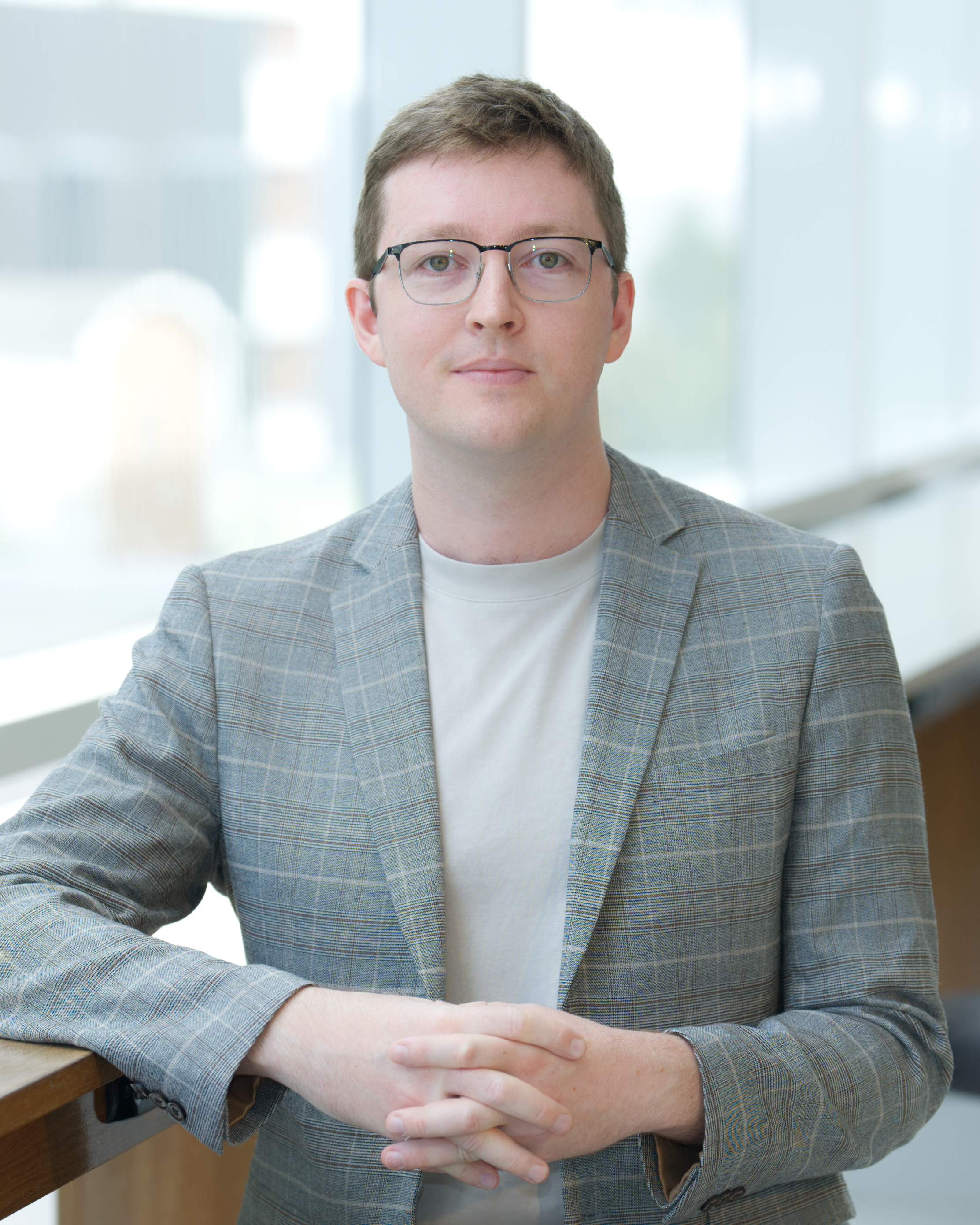
Dr. Klaas Staal is a Lecturer at the Department of Quantitative Economics (QDEM) within the Faculty of Law and Economics at Johannes Gutenberg University Mainz. He teaches courses such as Mathematics, Statistics II, Time Series Analysis, and Programming at both undergraduate and graduate levels. His expertise spans quantitative methods, econometrics, and data analysis, with a focus on practical applications using tools like Stata. Research interests include time series analysis and statistical modeling, though specific details are truncated in available records. Consultation hours are by appointment in Room ..., House of Law & Economics II. Contact: kstaal@uni-mainz.de .
Julien Pascal, PhD, is a Researcher at the Central Bank of Luxembourg. He holds a PhD in Economics from Sciences Po (2020), a Master's in Economics from Sciences Po (2016), a Bachelor of Mathematics from UPMC Sorbonne Universités (2015), and a Bachelor of Social Sciences from Sciences Po (2013). His research focuses on Labor Economics, Macroeconomics, Urban Economics, and computational methods like dynamic programming and neural networks applied to economic modeling. Notable projects include analyzing heterogeneity in macroeconomic models and exploring commuting costs' impact on employment dynamics. He has taught graduate courses such as Econometrics II, Applied Statistics for Business and Economics, and Introduction to Econometrics and Statistics. His technical expertise includes Julia, R, Stata, Python, and SQL. He contributed to open-source projects like MSM.jl and SMM.jl , focusing on economic model estimation and optimization.
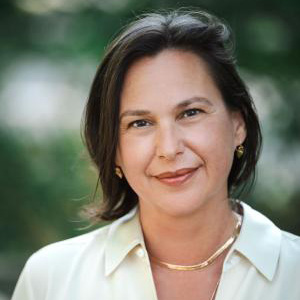
Dr. Marlous Hall is an Associate Professor in Epidemiology at the University of Leeds, affiliated with the Leeds Institute of Cardiovascular and Metabolic Medicine (LICAMM). She serves as Deputy Head of the Clinical and Population Sciences Department and co-leads the Leeds Institute for Data Analytics (LIDA) Health Community. Her expertise lies in advanced analytical methods applied to large clinical datasets, focusing on cardiovascular survivorship, multimorbidity, and causal inference. She holds a Sir Henry Wellcome Fellowship and has established the Survivorship and Multimorbidity Epidemiology Research Group. Educations: BSc Mathematics (University of Sheffield), MSc Statistics (University of Sheffield), PhD in Paediatric Cancer Epidemiology (University of Leeds) Professional Roles: Co-Director of the British Heart Foundation PhD Programme, Member of LICAMM Executive Committees, and Fellow of the Higher Education Academy Her research emphasizes multimorbidity patterns in cardiovascular patients, frailty management, and improving guideline adherence. Recent work includes analyzing 1.6 million cardiac surgery patients and 56 million myocardial infarction survivors. She supervises multiple PhD students exploring topics like anticoagulation in atrial fibrillation and blood pressure management in frail populations. Awards: Sir Henry Wellcome Fellowship (2014), University Academic Fellowship (2017) Labs/Teams: Survivorship and Multimorbidity Epidemiology Research Group, Leeds Institute for Data Analytics
Ulrich Kohler is a Professor for Methods of Empirical Social Research at the Faculty of Economics and Social Sciences, University of Potsdam, a position he has held since 2012. His work bridges sociology, political science, and quantitative methodology, with a strong focus on social inequality and democratic participation. He leads a research team involved in multiple funded projects and contributes actively to open science through software development and teaching materials. His research interests center on the causes and consequences of social inequality, particularly in education, political participation, and life risks. He employs advanced quantitative methods, including longitudinal analysis, decomposition techniques, and survey methodology. His work often compares Germany and the USA, examining how institutional contexts shape inequality. He has developed influential tools like the KHB method and PSID data access packages, widely used in social sciences. The recent publications and projects reflect a consistent focus on inequality across domains: educational choices (Latin/Greek), political non-participation, health disparities, and environmental decision-making. His methodological contributions include web scraping, survey coding, and multilevel modeling tools, showing a strong commitment to reproducible and transparent research. He also emphasizes teaching, offering courses and online materials in empirical methods. Lorenz von Stein Prize 2002 Kohler supervises bachelor’s and master’s theses and has led major research projects funded by the German Research Foundation (DFG), including studies on life risks, educational transitions (EDUCHANGE), and citizen participation. His team includes research assistants and project staff, and he collaborates with institutions like the WZB Berlin Social Science Center. He does not list specific PhD students, but his mentorship is evident through thesis supervision and project leadership. He leads the Chair of Methods of Empirical Social Research, which conducts ongoing research on social inequality, voting behavior, and educational transitions. The team develops software tools (e.g., Stata packages khb, twostep, psidtools) and maintains online teaching resources. The chair is involved in both national and international collaborations, particularly in longitudinal data analysis and comparative social research.
Tore Bersvendsen is an Assistant Professor at the School of Business and Law, University of Agder (UiA), Norway, specializing in empirical health economics and econometric methodology with strong ties to public administration and socioeconomics. His research portfolio demonstrates deep expertise in: Health economics of home-based rehabilitation and reablement programs Advanced econometric techniques for policy evaluation Socioeconomic analysis of vulnerable populations and public service delivery Recent publications (2020-2024) reveal a dual focus: methodological contributions to panel data econometrics (notably slope heterogeneity testing) and applied evaluations of healthcare/social interventions, particularly for elderly care and low-income families. His EU-funded project work on BRIDGES 5.0 and Gi-NI reflects growing engagement with digital-green transition challenges. Scientific awards: None documented in available sources. Bersvendsen actively participates in major collaborative grants including BRIDGES 5.0 (Bridging Risks to an Inclusive Digital and Green future by Enhancing workforce Skills for industry 5.0) and the Gi-NI EU project, though specific student advising relationships aren't publicly cataloged. His 2024 project report demonstrates cross-institutional coordination on institutional capacity building. He contributes to UiA's Economics research group, fostering interdisciplinary work that connects quantitative methods with real-world social policy challenges, particularly in Norway's welfare context.
Patrick Laub is a Senior Lecturer at the UNSW School of Risk and Actuarial Studies, where he teaches courses in artificial intelligence and machine learning with a focus on risk and insurance applications. His academic work bridges the gap between advanced computational methods and practical actuarial problems. Patrick holds a joint PhD in computational applied probability completed between the University of Queensland and Aarhus University. He also possesses degrees in software engineering and mathematics, providing him with a strong interdisciplinary foundation for his research. His research focuses on computationally challenging problems in actuarial data science, with particular emphasis on natural catastrophe modeling and artificial intelligence applications. Key areas of investigation include Hawkes processes for modeling contagion in insurance claims, Approximate Bayesian Computation for fitting complex insurance loss models, and Empirical Dynamic Modeling for analyzing complex temporal dependencies. His work addresses critical challenges in risk assessment, particularly for extreme events where traditional statistical methods may be inadequate. Analysis of Patrick's recent publications reveals a strong trend toward integrating advanced statistical methodologies with practical actuarial applications. His work spans from theoretical developments in point processes and Bayesian inference to practical implementations in computational environments. A notable theme is the application of machine learning techniques to traditional actuarial problems, particularly in the areas of catastrophe modeling and risk prediction. Patrick has developed and taught innovative courses since 2022, including 'Artificial Intelligence & Deep Learning and their Applications to Risk and Insurance' (ACTL3143 and ACTL5111) and 'Statistical Machine Learning for Risk and Actuarial Applications' (ACTL5110). These courses reflect his commitment to preparing students for the evolving landscape of data-driven risk management in the insurance industry. His research is supported by UNSW's strong infrastructure for computational research, though specific lab affiliations are not explicitly mentioned in the available information. Patrick maintains an active research program with numerous publications across statistics, actuarial science, and computational methods.
Gregory Bruich is a Lecturer in the Department of Economics at Harvard University, affiliated with the Faculty of Arts and Sciences. His research focuses on public economics, with expertise in econometrics and labor economics. He is a highly awarded educator, recognized by students and institutions including the Rhodes Trust and Harvard College. He teaches Ph.D.-level econometrics and large undergraduate courses like Economics 1123 and Economics 50 (co-taught with Raj Chetty). His advising work has produced seven Hoopes Prize-winning theses, supported by FAS research grants. He also develops online courses on EdX addressing social and economic disparities through big data analysis. Education: Ph.D. in Economics from Harvard University. Teaching roles include Economics 2110 (Ph.D.), Economics 1123 (undergraduate), and API 202 Z at Harvard Kennedy School. His research grants and advising span over thirty senior theses across Economics, Applied Math, Social Studies, and Statistics. Awards: John R. Marquand Award, Rhodes Inspirational Educator Award, multiple teaching commendations Advising: Faculty Adviser for 30+ senior theses; three FAS grants for Hoopes Prize-winning work Online Education: Co-developed EdX courses like 'Big Data Solutions for Social and Economic Disparities' His technical contributions include econometric tools for robust variance estimation and statistical testing methods, shared via Stata code repositories.
Mengjie Xu is an Assistant Professor of Accounting at Duke University's Fuqua School of Business. Her research focuses on financial accounting, corporate governance, and information economics, particularly analyzing how information creation and dissemination influence market participant strategies and outcomes. She holds a background from Frankfurt School of Finance & Management. Key research areas include high-frequency data analysis, social media-driven insights (e.g., Reddit, Twitter), EDGAR database tracing, and Glassdoor-based workplace studies. She has developed methodologies for parsing satellite imagery, short-sale data, and SEC filings. Technical expertise spans Python, Stata, SAS, and API integrations for data collection. Her work bridges accounting theory with practical data science, emphasizing replicable workflows for complex datasets. No scientific awards are explicitly mentioned in the sources provided.
Jenny Trinitapoli is a Professor of Sociology and Director of the Committee for International Social Science Research at the University of Chicago. She holds a B.A. from Marquette University (1999), M.A. (2004), and Ph.D. (2007) from the University of Texas at Austin. Her research bridges social demography and the sociology of religion, focusing on Sub-Saharan Africa, particularly Malawi. She leads the Tsogolo la Thanzi (TLT) longitudinal study examining how young adults navigate relationships, sex, and childbearing amid the HIV/AIDS epidemic. Supported by grants from the National Institute of Child Health and Human Development, the study emphasizes demographic processes and their intersection with cultural meaning systems. Key research themes include HIV/AIDS impact on social behavior, fertility decisions in disease-affected regions, and the role of religion in health outcomes. Her work often addresses methodological challenges in longitudinal data collection and the ethical dimensions of field research. Trinitapoli has published widely on AIDS-related topics, demographic trends, and faith-based responses to health crises. Her 2023 book *An Epidemic of Uncertainty* synthesizes findings from the TLT study, while her methodological contributions include the 'printcase' Stata command for data visualization. Grants and awards: Principal Investigator of the TLT study funded by NICHD. No explicit awards listed, but her sustained research leadership indicates significant recognition in her field. Labs/Teams: Tsogolo la Thanzi research center in Balaka, Malawi, employing over 20 local staff. Collaborates with international health and demographic institutions.
Miguel Quetglas Oliver is an Associate Professor at the Department of Applied Economics within the University of the Balearic Islands (UIB) , where he has taught since 2004. He holds dual degrees in Mathematical Sciences (Fundamental Mathematics) from Universidad Complutense de Madrid (1999) and Economics (Quantitative Economics) from UNED (2004), completing doctoral coursework in Economic Globalization and Social Welfare at UIB (2007). Licenciado en Ciencias Matemáticas, Universidad Complutense de Madrid (1999) Licenciado en Economía, UNED (2004) Doctoral coursework, UIB (2007) His research bridges quantitative economics and biomedical data analysis , focusing on platelet preservation technologies and AI applications in transfusional medicine . He has contributed to studies on UV-riboflavin treatment of platelets and cryopreservation methods, while maintaining expertise in econometric modeling and tourism monitoring . As an educator, he teaches Economic Data Analysis and Final Degree Projects across multiple UIB programs including Economics, Business Administration, Tourism, and Mathematics. His software proficiency spans R, STATA, C++ and statistical programming languages. A fluent English and German speaker, he also serves on the Council of the Department of Applied Economics and the Official College of Economists of the Balearic Islands.
Antonio Luciano Martire is a Researcher at Sapienza University of Rome, affiliated with the Department of Methods and Models for Economy, Territory, and Finance within the Faculty of Economics. He teaches courses including Computer Science and Excel Laboratory for Business and Quantitative Finance, with office hours held on Wednesdays from 11-12 AM. His educational background includes a Bachelor's Degree in Mathematics (2008), Doctorate in Mathematics for Economic and Financial Applications (2012), and a Specialization Diploma in Applied Econometrics (2014), all from Sapienza University of Rome. Martire's research focuses on mathematical finance, computational methods, and actuarial science, with particular expertise in Volterra integral equations, options pricing models, and quantitative finance applications. His work bridges theoretical mathematics with practical financial applications, developing numerical methods for complex financial instruments and insurance products. His recent publications (2020-2024) demonstrate a consistent research trajectory in developing numerical solutions for integral equations with applications to financial derivatives, insurance products, and cryptocurrency markets. The research shows increasing sophistication in computational approaches, including neural network applications to fractional calculus problems. Martire has extensive teaching experience, having taught Financial Mathematics Laboratory and Quantitative Finance courses since 2013. His technical expertise includes scientific software (Matlab, Mathematica, R, STATA) and programming languages (C/C++).
Dami Kabiawu is an Associate Professor in the Practice of Business at the School of Business, Rensselaer Polytechnic Institute. She holds a Ph.D. from Rensselaer Polytechnic Institute, an MBA from Clark Atlanta University, and a B.S. from London Southbank University. A Chartered Financial Analyst (CFA) Charterholder, she integrates industry experience from IBM and Ford Motor Company into her academic work. Ph.D., Rensselaer Polytechnic Institute, NY MBA, Clark Atlanta University B.S., London Southbank University CFA Charterholder Her research and teaching focus on Investments, Corporate Finance, Behavioral Finance, and Quantitative Analysis . She has developed financial models using Python, VBA, PHP, Perl, Stata, SQL, and Excel, applying real-world rigor to classroom instruction across undergraduate and graduate finance, accounting, and statistics courses. The two recent publications highlight her scholarly interests in Corporate Social Responsibility in the oil and gas industry and factors influencing graduate student success , particularly in diverse, global business programs. These works reflect a thematic focus on ethical business practices and inclusive educational outcomes. Her scientific recognition includes: Chartered Financial Analyst (CFA) Charterholder Dr. Kabiawu has delivered over 2,800 lectures and actively contributes to academic and professional communities. She serves on the Board of Trustees for Empowerment Academy Charter School in New Jersey, demonstrating sustained engagement in educational leadership and community service. While specific grant details are not mentioned, her conference presentations and publications indicate active research mentorship and collaboration. She is involved in professional academic communities, having presented at major conferences including the International Association for Business and Society (IABS), European Academy of Management (EURAM), and Financial Management Association (FMA). Her work bridges academia and industry, emphasizing practical applications in finance and inclusive educational strategies.
Mattia Albertini is a Post-Doctoral Researcher at the Institute for Economic Research (IRE) within the Faculty of Economics at Università della Svizzera italiana (USI). He previously completed his Ph.D. at the Institute of Economics (IdEP), USI, and participated in the Swiss Program for Beginning Doctoral Students in Economics. He holds a Master of Science in Economics with a minor in Data Science from USI and a Bachelor in Economics from the University of Pavia. Bachelor in Economics, University of Pavia Master of Science in Economics (minor in Data Science), Università della Svizzera italiana Ph.D. in Economics, Università della Svizzera italiana Swiss Program for Beginning Doctoral Students in Economics, Swiss National Bank His research focuses on applied microeconometrics with applications in health, labor, public, urban, and environmental economics. A recurring theme in his work is the spatial dimension of economic outcomes, including residential integration, real estate market dynamics, and geographic proximity to borders or hazards. He integrates data science techniques, particularly programming in Python and STATA, to develop tools for empirical analysis and reproducible research. The collection of articles reflects a strong trend in applied econometrics, causal inference, and spatial analysis. His work spans health economics (e.g., benzodiazepine prescribing), labor and urban economics (e.g., migration, job accessibility), and environmental and insurance economics (e.g., natural hazard impacts). Methodologically, he engages with difference-in-differences, event study designs, spatial modeling, and text analysis, often building or applying computational tools to address research questions. He has contributed to teaching at both the Bachelor's and Master's levels, particularly in microeconomics, macroeconomics, and data-intensive courses such as Textual Analysis and Spatial Data for Economists. Teaching Assistant, Microeconomics A (Bachelor) Teaching Assistant, Macroeconomics B (Bachelor) Teaching Assistant, Textual Analysis and Spatial Data for Economists (Master) Mattia Albertini is actively involved in open science, sharing code for econometric methods, data visualization, and application development (e.g., a gluten-checking app) on GitHub. His interdisciplinary approach combines economic theory, statistical modeling, and computational tools to investigate real-world policy-relevant questions.
Professor Gerhard Kling holds a Chair in Finance at the University of Aberdeen's Business School. He has previously served as Professor of International Business and Management at SOAS University of London and Professor of Finance at the University of Southampton, with earlier academic roles at UWE and Utrecht University. His interdisciplinary expertise bridges finance, applied mathematics, and data science. PhD in Economics, University of Tuebingen Diplom Volkswirt (Economics), LMU Munich MSc and BSc in Mathematics, Open University PG Cert in Higher Education, UWE His research focuses on Corporate Finance, Corporate Governance, Financial Technology, and Financial Inclusion , with applications in China and Asia. He integrates mathematical modeling and programming (Python, Stata, MATLAB) into financial analysis. His recent work explores climate finance, digital health data, and the political economy of CSR in emerging markets. His 15 most recent publications reflect a strong trend toward interdisciplinary research combining finance with data science, sustainability, and public policy. He frequently publishes in top journals such as European Journal of Finance , World Development , and Asia Pacific Business Review , often addressing issues of financial inclusion, fintech, and cross-border corporate strategy. British Academy of Management, Best Full Paper Award (2019) Leslie Walshaw Award in Mathematics (2019) Financial Management Best Paper Award (2018) Dissertation Prize, International Economic History Association (2006) New Researcher Prize, Economic History Society (2004) Professor Kling supervises postgraduate research and teaches courses in Big Data, Artificial Intelligence, and Financial Crime. He is the Programme Leader for the MSc FinTech and leads research funded by ESRC and NSFC on China's financial system. He is active in public engagement through his YouTube channel YUNIKARN, where he shares content on data science and academic writing. He contributes to the academic community as Associate Editor of the European Journal of Finance and member of the editorial board of the Asia Pacific Business Review . He is also affiliated with the Centre for Labour Market Research and the Africa-Asia Centre for Sustainability at Aberdeen.
Nicholas J.G. Winter is an Associate Professor and Associate Department Chair in the Department of Politics at the University of Virginia, within the College of Arts and Sciences. He specializes in American politics, political psychology, and methodology, with a focus on how race, gender, and identity influence public opinion through framing and cognitive mechanisms. Education: B.A. in Political Science, University of Chicago Ph.D. in Political Science, University of Michigan Research Interests: Nicholas Winter's research centers on public opinion, political psychology, and the intersection of gender, race, and politics. He investigates how political rhetoric subtly activates cognitive schemas related to race and gender, shaping attitudes on seemingly unrelated policies such as Social Security, health care, and welfare. His methodological work focuses on statistical analysis, experimental design, survey data collection, and semi-automated content analysis, particularly in digital and audiovisual political communication. He is also a developer of analytical tools for the Stata statistical software. Research Trends: His recent publications reveal a consistent focus on identity-based polarization, gendered political behavior, and data quality in survey research. Articles like 'Hostile Sexism, Benevolent Sexism, and American Elections' and 'Gendered (and Racialized) Partisan Polarization' highlight how identity shapes electoral evaluations. Simultaneously, methodological contributions such as 'The Shape of and Solutions to the MTurk Quality Crisis' demonstrate his commitment to rigorous, replicable research practices. His work bridges theory and empirical innovation in political science. Scientific Awards: Best Paper Award, Women & Politics Research Section, American Political Science Association Annual Meeting (2018) Advising and Grants: While specific advisees are not listed, Winter has mentored research through collaborative publications and methodological training. His work on survey integrity and content analysis tools suggests involvement in funded research projects, particularly those involving digital data collection and experimental methods. He has contributed to improving research infrastructure through open protocols and software development. Labs and Teams: Nicholas Winter collaborates with scholars such as Ryan Kennedy, Scott Clifford, and Tyler Burleigh on survey methodology and data quality. His programming work in Stata and engagement with online coding platforms indicate participation in research teams focused on computational political science and reproducible methods.