Max Planck Institute for Evolutionary AnthropologyGermany
Martin Haspelmath is a Senior Research Scientist at the Department of Linguistic and Cultural Evolution at the Max Planck Institute for Evolutionary Anthropology (MPI-EVA), Leipzig, and an honorary (adjunct) professor at Leipzig University. His research focuses on comparative linguistics, language universals, and typology, particularly in syntactic and morphological systems. He co-edited the World Atlas of Language Structures (2005/2013) and co-founded Language Science Press . Education: PhD in Linguistics, Freie Universität Berlin (1990–1993) MA in Linguistics, University of Cologne and University at Buffalo (1985–1989) Undergraduate studies in Linguistics, University of Vienna (1983–1985) Research Interests: Haspelmath investigates global grammatical diversity, form-function correspondences, and universals in syntax, morphology, and lexical systems. His work emphasizes comparative concepts for cross-linguistic analysis and critiques traditional grammatical categories. Grants & Projects: ERC project leader at Leipzig University (2015–2020) Co-creator of Grambank , an open-access database of grammatical structures Leading initiatives for open-access publication and linguistic data sharing Labs/Teams: Active in the MPI's Department of Linguistic and Cultural Evolution, collaborating on projects like APICS (Atlas of Pidgin and Creole Language Structures) and ValPal (Valency Patterns Leipzig).
Laura Becker is an Assistant Professor at the Department of General Linguistics, University of Freiburg. Her research focuses on linguistic typology, quantitative methodology, and the role of coding efficiency in grammatical structures. She holds a PhD exploring article systems across languages and has contributed to cross-linguistic studies on syntax, morphology, and sociolinguistics. Her work emphasizes statistical rigor and computational tools, such as the glottospace R package for geospatial linguistic analysis. Recent projects include investigating phoneme inventories in Polynesian languages and socio-linguistic influences on conditional constructions. Publications highlight her expertise in morphosyntax, language contact, and corpus-based approaches. No scientific awards are explicitly mentioned in the provided materials. Dr. Becker has advised no recorded students in the available data and has not listed specific grants or labs. Her current research trends prioritize quantitative frameworks to address typological and evolutionary questions in linguistics.
Dr. Claudia Wegener is a Researcher at the Department of Linguistics, University of Cologne, specializing in General Linguistics. Her work focuses on language documentation, speech-gesture interaction, and Papuan/Austronesian languages like Savosavo and Gela. She holds a PhD from Radboud University Nijmegen (2008) and has conducted extensive fieldwork in the Solomon Islands and Malaysia. Previous Positions: Research Assistant, University of Cologne (2017–present) Postdoctoral Researcher at MPI for Psycholinguistics, Radboud University (2002–2011) DoBeS Project Leader for Savosavo documentation Research Interests Her research spans: Socio-linguistic aspects of gesture systems Morphosyntactic typology of Papuan languages Lexical semantics and kinship terminology Documentation methodologies for endangered languages Publications Her work includes a landmark grammar of Savosavo (2012), co-edited volumes on language documentation (2011), and influential articles on gesture studies (2022) and motion event encoding (2022). Projects Leading the Savosavo-Gela Documentation Project (DoBeS-funded) Contributions to MPI's Endangered Languages Documentation Archive Collaborations with Australian National University and University of Manchester Her research bridges linguistic theory with applied documentation, emphasizing community-driven preservation strategies.
Taiseer Abdalla Elfadil Eisa is a researcher actively contributing to data science, machine learning, and academic integrity. His work spans plagiarism detection in scientific figures and digital media, robotic manipulation in cluttered environments, and Arabic speech dataset development for demographic analysis. He has collaborated with scholars from institutions in Malaysia, Saudi Arabia, and Yemen. His research interests include: Text and image-based plagiarism detection Machine learning for speech and facial analysis Computer vision for academic integrity Data mining for scientific publications Recent publications focus on: Arabic speech datasets (2024) Deepfake detection (2023) Robotic manipulation (2022) Systematic literature reviews (2015-2020)
Max Planck Institute for Empirical AestheticsGermany
Dr. Camila Bruder is a Researcher at the Max Planck Institute for Empirical Aesthetics in the Department of Music, where she has been working since completing her PhD in 2025. Her research focuses on aesthetic preferences, music cognition and perception, and singing performance, with particular expertise in voice preferences and the relationship between music and language. Dr. Bruder's educational background spans multiple disciplines, reflecting her interdisciplinary approach to music research. She holds a Dr. phil. from Freiburg University of Music (2025), a Master of Arts in Systematic Musicology from Universität Hamburg (2014-2018), a Bachelor's degree in Music - Singing from the State University of Sao Paulo (2009-2013), a Master of Sciences in Human Physiology from the University of Sao Paulo (2005-2007), and a Bachelor's degree in Biology from the University of Sao Paulo (2000-2004). Her research examines how humans categorize acoustic information, particularly focusing on the boundaries between music and speech, and investigating the factors that influence singing voice preferences. She has developed innovative methodologies for measuring individual differences in aesthetic judgment of voices, demonstrating that appreciation of singing and speaking voices is highly idiosyncratic. Her work bridges empirical aesthetics, cognitive psychology, and musicology, with a particular emphasis on both perceptual and acoustic features of vocal expression. Analysis of her recent publications reveals a consistent focus on voice perception across multiple contexts - from singing performance to lullabies to synthetic voices. Her research shows that perceptual features (rather than purely acoustic measurements) better predict singing voice preferences, and that classical singers demonstrate proficiency across multiple singing styles. She has also contributed to large-scale cross-cultural research on universal features of music and speech. Degree completion grant from Universität Hamburg (2017/2018) Forumpreis für hervorragende Hausarbeit from Forum Musikwissenschaft an der Universität Hamburg (2018) Music Department's Award of Excellence for Bachelor Thesis in Music (2013) Research scholarship from CAPES, Brazil (2006-2007) Dr. Bruder has developed the CoVox dataset of contrasting vocalizations, which provides valuable resources for researchers studying voice perception across genres and contexts. Her work on lullaby vocal qualities contributes to developmental psychology and cross-cultural studies of infant-directed communication. She collaborates extensively with researchers across disciplines, including prominent figures like David Poeppel and Patrick Larrouy-Maestri.
German National Library of Science and TechnologyGermany
Prof. Sören Auer is the Director of the German National Library of Science and Technology (TIB) and Professor of Data Science and Digital Libraries at Leibniz Universität Hannover's Faculty of Electrical Engineering and Computer Science . With academic positions at Dresden, Yekaterinburg, Leipzig, Pennsylvania, Bonn, and Fraunhofer Society, his career focuses on semantic technologies , knowledge engineering , and Artificial Intelligence Research Data Management Open Science Knowledge Graphs . He leads the Open Research Knowledge Graph (ORKG) initiative and co-founded DBpedia and eccenca.com . His research spans data science , AI-driven knowledge representation , and digital library systems . He has supervised numerous PhD theses and final-year theses while offering courses on Knowledge Engineering Semantic Web Technologies Data Integration Scientific Data Management . The technical focus includes semantic data interlinking , neuro-symbolic AI , and contextual metadata frameworks . As a recipient of prestigious awards including ERC Consolidator Grant SWSA Ten-Year Award ESWC 7-Year Best Paper Award OpenCourseware Innovation Award , Prof. Auer has led major projects like BigDataEurope and contributes to standards in W3C , NFDI , and EOSC . His recent publications demonstrate advancements in ontology alignment , LLM-driven schema discovery , and hybrid AI systems for scholarly knowledge organization.
Josef Ruppenhofer is a computational linguist working as a Researcher at FernUniversität in Hagen, where he contributes to the CATALPA research cluster. Since March 2023, he has served as a Research Assistant at the research professorship for Computational Linguistics in the DAKODA project, which focuses on applying NLP methods to study second language acquisition. His work bridges theoretical linguistics with practical applications in language education technology. Dr. Ruppenhofer earned his PhD in Linguistics from the University of California at Berkeley in 2004, following MA degrees from UC Berkeley (1999) and the University of Colorado at Boulder (1997). His academic journey includes postdoctoral positions at prestigious institutions including the International Computer Science Institute in Berkeley, Saarland University, Hildesheim University, and the Leibniz-Institute for the German Language. Ruppenhofer's research centers on applying computational methods to linguistic phenomena, with particular expertise in frame semantics, construction grammar, and corpus linguistics. His work spans educational applications of NLP, sentiment analysis, and the challenging domain of offensive language detection. He has developed innovative approaches for analyzing learner language corpora and identifying implicit forms of abusive language that deviate from social norms. Analysis of his recent publications reveals a consistent focus on the intersection of theoretical linguistics and practical language technology applications. His work shows increasing specialization in analyzing implicit forms of abusive language and developing methods for operationalizing developmental stages in second language acquisition, particularly for German as a foreign language. The DAKODA project represents a major focus of his current research trajectory. Ruppenhofer actively contributes to the computational linguistics community through his work on FrameNet (celebrating its 25th anniversary in his 2024 publications) and the development of linguistic resources for analyzing user-generated content and parliamentary discourse. His methodological approach consistently combines theoretical linguistic insights with practical computational techniques. As a member of the CATALPA research cluster, Ruppenhofer collaborates with an interdisciplinary team working at the intersection of language education, theoretical linguistics, and computational methods. His current work in the DAKODA project involves building tools and methodologies for analyzing learner corpora to better understand developmental stages in second language acquisition.
Lukas Aspöck is a Senior Researcher at the Hearing Technology and Acoustics department of RWTH Aachen University . His work focuses on Acoustic Virtual Reality , Room and Building Acoustics , and Binaural Technology , with applications in urban soundscapes, educational environments, and hearing aid research. He collaborates extensively with the AUDICTIVE Priority Program SPP2236 on auditory cognition in virtual environments. Current role: Senior Researcher (Akademischer Oberrat) since 2025 Core research areas: Real-time auralization, psychoacoustic evaluation, and multimodal perception Research trends include: Acoustic simulation for urban environments and building façades Impact of voice quality on educational listening effort Development of immersive VR environments for auditory experiments Validation of room acoustic simulation models
Max Planck Institute for Evolutionary AnthropologyGermany
Olena Shcherbakova is a doctoral researcher at the Department of Linguistic and Cultural Evolution of the Max Planck Institute for Evolutionary Anthropology. Her work focuses on phylogenetic methods, spatiophylogenetic modeling, and causal inference to study large-scale patterns in language evolution and typological variation. She holds a BA and MA in Philology from the National Technical University of Ukraine (Kyiv Polytechnic Institute) and completed an exchange program at Friedrich Schiller University Jena. Her research explores grammatical complexity dynamics, sociolinguistic influences on language structure, and the evolutionary pathways of gender systems. Key findings include evidence that grammatical complexity (fusion and informativity) is primarily inherited rather than adapting to sociolinguistic changes, and that societies of strangers do not correlate with simpler languages. She has contributed to cross-linguistic studies on argument structure signaling and collaborated on global analyses comparing music and speech acoustics. Shcherbakova's methods include computational phylogenetics, spatiotemporal modeling, and comparative approaches across language families like Austronesian, Bantu, and Indo-European. She co-developed the CHIELD database for tracking causal hypotheses in evolutionary linguistics and has published in journals such as Science Advances , Journal of Language Evolution , and Scientific Reports .
Mary Stevens is a Research Fellow at the Institute of Phonetics and Speech Processing (IPS) at Ludwig Maximilian University of Munich. Her work focuses on sound change, the phonetics-phonology interface, and experimental phonetics. She holds a PhD from the University of Melbourne (2007), following degrees from the Australian National University (B.A., 2000) and the University of Melbourne (B.A. (Hons), 2001). Stevens has been affiliated with the IPS since 2010, initially as a Humboldt Foundation-funded postdoctoral researcher and later as a full research fellow. Her research investigates how phonetic variation leads to permanent sound changes, particularly focusing on /s/-to-/sh/ retraction in languages like English and Italian. Current projects include a DFG-funded study (2018–2025) modeling the actuation of sound change through agent-based simulations. Key interests include computational modeling, sociophonetics, and linguistic typology. Publications span experimental phonetics, sound change dynamics, and computational linguistics. She collaborates internationally, notably with John Harrington and Frank Kleber, on projects exploring agent-based modeling and phonetic variation. Stevens also engages in interdisciplinary work, such as applying phonetic analysis to clinical communication training in medicine. Grants and Funding: DFG project (2018–2025) on modeling sound change actuation. Labs/Teams: Active member of the IPS research group, contributing to the Bavarian Archive for Speech Signals (BAS) and the MAMPF database for speech processing.
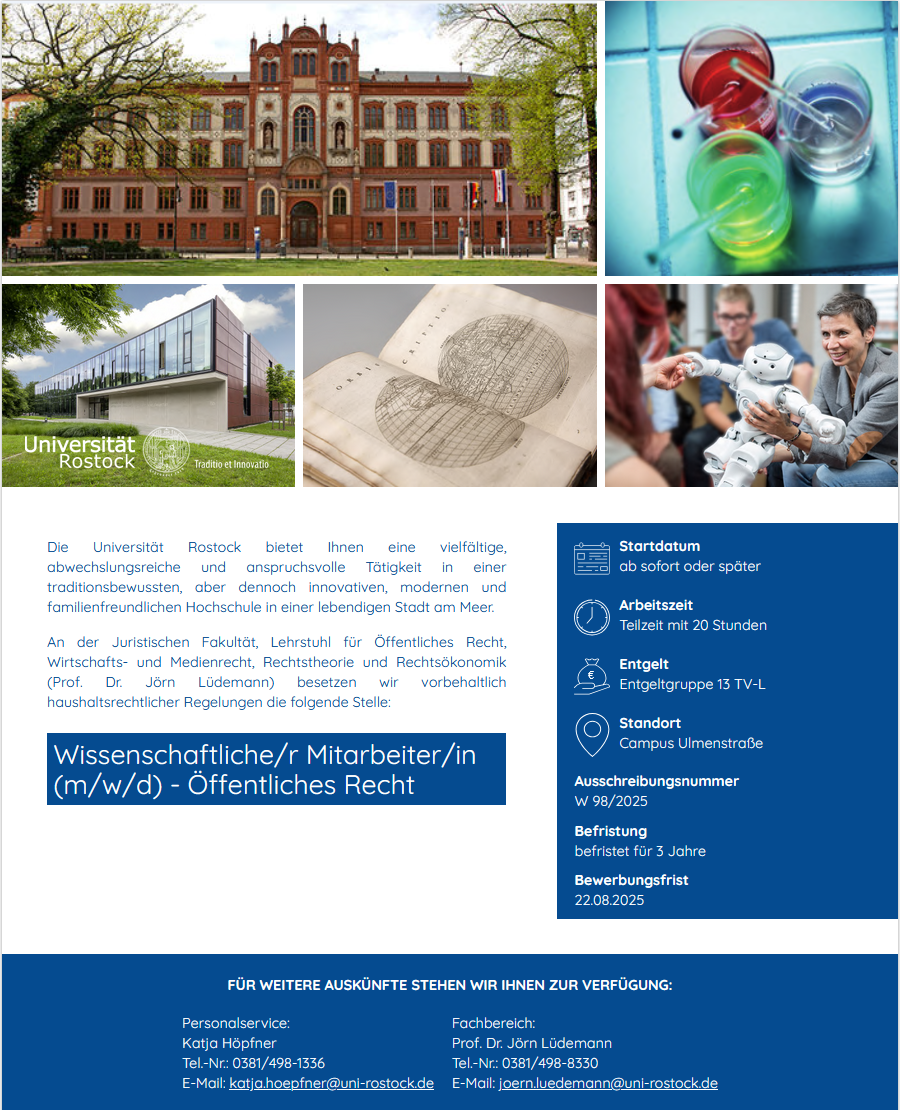
Prof. Dr. Jörn Lüdemann holds the Chair of Public Law, Business and Media Law, Legal Theory and Legal Economics at the University of Rostock . He co-organizes the Forum for Public and European Commercial Law and the Rostock Talks on State, Economy and Society , fostering interdisciplinary dialogues between academics, practitioners, and students. Research Focus : Constitutional law, digital transformation, media regulation, AI governance, and European economic law. Teaching : Offers courses on fundamental rights and public/commercial law, with a strong emphasis on interdisciplinary approaches. His Series on Law and Digitalization (Nomos) publishes groundbreaking works on digital legal challenges. Recent contributions include commentaries on the Digital Services Act and autonomous systems liability . He frequently collaborates with EU institutions and international legal experts, including in the Legal Treasure project . Prof. Lüdemann supervises doctoral and master's theses on public law topics. His team includes research staff like Cédric Van Innis (crowdfunding regulation) and Julia Flatt (digital governance). Student assistants such as Jule Pickenbach (recipient of the Deutschlandstipendium) and Hannes Goerke (Friedrich Naumann Foundation scholarship) contribute to his projects.
Alice Mitchell is Junior Professor for Anthropological Linguistics of Africa at the University of Cologne's Institute for African Studies within the Faculty of Arts and Humanities. Her research focuses on anthropological linguistics, interactional sociolinguistics, and language documentation, with particular emphasis on African languages and cultures. Her work examines linguistic practices related to kinship, social hierarchy, and cultural norms in Tanzanian Datooga communities. Recent publications investigate children's acquisition of avoidance registers, kinship categorization, and the sociolinguistic history of pastoral societies in eastern Africa. Research Methodology: Fieldwork-based language documentation Cross-cultural linguistic comparisons Quantitative and qualitative analysis of social interactions
Dr. Armine Garibyan is a Professor at the Department of English and American Studies, Friedrich-Alexander-Universität Erlangen-Nürnberg (FAU). She holds the Chair of Digital Linguistics with a focus on Big Data, conducting interdisciplinary research at the intersection of computational methods and linguistic analysis. Research Interests: Digital Humanities and computational linguistics Constructicon development for cross-linguistic analysis Neurocognitive processing of linguistic collocations Ethical lexicography and sociolinguistic representation Big data applications in corpus linguistics Key Contributions: Her recent work includes creating reference constructicons as databases (2023-2024), analyzing neural correlates of collocations (2022), and exploring fair lexicography practices in modern dictionaries. Her research spans cognitive linguistics, computational modeling, and cross-linguistic comparisons across English, German, Hungarian, and Russian.
Max Planck Institute for Evolutionary AnthropologyGermany
Dr. Annika Tjuka is a Postdoctoral Researcher at the Department of Linguistic and Cultural Evolution, Max Planck Institute for Evolutionary Anthropology in Leipzig. She received her Ph.D. in Linguistics with highest honors (summa cum laude) from Friedrich Schiller University Jena in March 2024. Her research integrates findings from linguistics and psychology using computational approaches to explore linguistic diversity, particularly variations in word meanings across languages. Dr. Tjuka's educational background includes: Ph.D. in Linguistics (2024) - Friedrich-Schiller-Universität Jena and International Max Planck Research School for the Science of Human History (IMPRS-SHH) Master of Arts in Linguistics (2019) - Humboldt-Universität zu Berlin Bachelor of Arts in German Linguistics and Scandinavian Studies (2016) - Humboldt-Universität zu Berlin Her primary research focuses on linguistic diversity and the semantic patterns of word meanings across languages. Dr. Tjuka has developed a cross-linguistic database containing rich information on word properties across 39 languages (https://norare.clld.org). She has conducted significant research on the semantic domain of the human body, investigating the intricate interplay between language, culture, and cognition. Her work on body-object colexifications has been published in Linguistic Typology, and her research on body part vocabularies has been published in Scientific Reports. Dr. Tjuka's research shows a strong emphasis on cross-linguistic patterns, particularly in semantic domains related to body parts and object naming. Her work combines computational approaches with cognitive and psychological insights to uncover universal and culture-specific factors that shape linguistic structures. She has made significant contributions to lexical database development, particularly through her work on Concepticon and NoRaRe. Her notable scientific achievement is the receipt of the Otto Hahn Medal, a prestigious award from the Max Planck Society recognizing outstanding scientific achievements during doctoral studies. Dr. Tjuka is actively involved in science communication, having presented her research at events like Soapbox Science Berlin. She values conducting culturally informed and theoretically motivated research that embraces diversity, publishing open-access work to increase accessibility, and building an ecosystem for interdisciplinary researchers while mentoring the next generation of cognitive scientists.
Lea Fischbach is a Research Fellow and PhD candidate at the Research Center Deutscher Sprachatlas (DSA) within the Faculty of German Studies and Arts at Philipps University of Marburg. She is employed in the long-term Regionalsprache.de project funded by the Academy of Sciences and Literature in Mainz and also contributes to the BMBF project AnDy . Since January 2021, she has been working at the DSA, initially as a student assistant before advancing to her current PhD candidate position under the supervision of Lucie Flek and Alfred Lameli. Her educational background includes both Bachelor's and Master's degrees in Informatics from Philipps University of Marburg. Her Bachelor's thesis focused on Efficient Serialization of Objects while her Master's thesis addressed Applied Learning Analytics Process Based on a Language Learning App , building upon an Android app she helped develop as part of a student team project. Lea's research centers on the classification of German dialects using audio recordings and deep learning techniques. Her work explores how deep learning can be optimized for dialect classification, which phonetic features are crucial for distinguishing between dialects, and how insights from both deep learning and phonetic analysis can be combined for enhanced classification. This research sits at the intersection of computational linguistics, speech processing, and dialectology, with particular focus on German dialects and low-resource audio data scenarios. Her technical approach integrates programming expertise with linguistic knowledge to develop practical solutions for dialect recognition challenges. Her publications demonstrate a strong focus on practical applications of deep learning to dialect classification challenges. She has explored voice conversion techniques for data augmentation, analyzed the importance of acoustic features in deep learning models, compared speaker diarization approaches for German dialectal speech, and contributed to digital language geography projects. Her work consistently addresses the challenges of working with limited dialectal data and seeks to improve classification accuracy through innovative technical approaches that minimize speaker-related variability while highlighting dialect-specific features. At Philipps University of Marburg, Lea has served as a tutor teaching courses in programming, technical informatics, and database systems. During her time at the DSA, she has contributed to various projects including the creation of the Hessenplattform and developed the second version of the Welcome to Bavaria app, a language guide for Bavarian dialects. Her technical work bridges the gap between computational methods and traditional linguistic research, creating practical tools for dialect documentation and analysis. Her research is conducted within the Research Center Deutscher Sprachatlas, a leading institution for German dialect research that provides both the theoretical framework and computational resources for her technical investigations into dialect classification. She actively participates in international conferences including Interspeech, ACL, and NoDaLiDa, presenting her work on deep learning pipelines for dialect recognition and the challenges in developing technical solutions for dialect classification tasks.