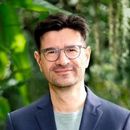
Prof. Dr. Thomas Brinkhoff is Chair of the Institute Board and Chair of Geoinformatics at Oldenburg University of Applied Sciences. He leads the Institute for Applied Photogrammetry and Geoinformatics (IAPG) and contributes to institutions like the Association for the Promotion of Geoinformatics in Northern Germany (GiN e.V.) and the Oldenburg Research and Development Institute for Computer Science (OFFIS e.V.). Education: Diploma in Computer Science (Informatik), Universität Bremen (1990) Doctorate in Computer Science (Dr. rer. nat.), Ludwig Maximilian University of Munich (1994) Brinkhoff's research spans geodatabase systems, spatiotemporal data processing, geosensor analytics, and location-based services. His work addresses Volunteered Geographic Information (VGI), web-based geospatial visualization, and mobile data integration, with applications in traffic management and forensic science. Recent projects include ProSaDi (Digital Provenance and Collection Research) and contributions to the Laboratory for optical 3D metrology . He has served on program committees for ACM SIGSPATIAL (2002-2019), AGILE conferences (2010-2025), and editorial boards of journals like GeoInformatica and TGIS. Notable Lectures: 2024: Forensic applications of tachograph data 2023: Geoinformatics in homicide investigations 2022: Spatiotemporal analysis for sustainability projects 2015: Open geodata standards at FOSSGIS 2014: Mobile sensor data processing
Dimitris N. Metaxas is a Professor in the Department of Computer Science within the School of Arts and Sciences at Rutgers University. His research spans computer vision, medical image analysis, and artificial intelligence, with a particular focus on medical applications including cardiac MRI analysis and foundation models for healthcare. Dr. Metaxas's research interests encompass medical image analysis, computer vision, deep learning, and artificial intelligence. His work demonstrates a strong emphasis on applying advanced machine learning techniques to medical imaging problems, particularly in cardiac analysis. He has made significant contributions to diffusion models, multimodal learning, and efficient AI techniques for medical applications. His research bridges the gap between theoretical computer vision and practical healthcare solutions, with numerous publications in top-tier conferences and journals. His recent publications show a clear trend toward foundation models for medical image analysis, with significant contributions to cardiac MRI segmentation, diffusion models, and multimodal learning. The research spans both theoretical advancements in AI techniques and practical applications in healthcare, particularly focused on improving medical diagnostics through computer vision. His work demonstrates expertise in adapting cutting-edge AI techniques like diffusion models and large language models for specialized medical applications. Dr. Metaxas has mentored numerous students and researchers, as evidenced by his extensive publication record with multiple co-authors across various institutions. His work has received significant attention in the research community, with numerous publications in top venues including CVPR, ICCV, MICCAI, and Medical Image Analysis. His research group focuses on medical image computing, computer vision, and machine learning applications in healthcare. The team works extensively with cardiac MRI data, developing advanced techniques for segmentation, reconstruction, and analysis of 4D cardiac imaging. They are particularly known for their contributions to foundation models in medical imaging and efficient adaptation techniques for specialized medical tasks.
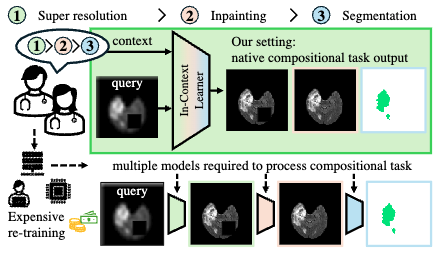
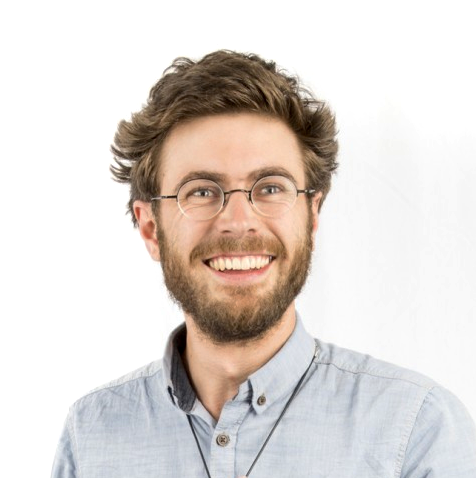
Prof. Dr. Erik Rodner is a faculty member at the University of Applied Sciences Berlin (HTW Berlin), where he serves as a Professor for Machine Learning and Data Science. He also contributes to the School of Engineering Sciences - Technology and Life. His research spans computer vision, machine learning, and biomedical applications, with a focus on learning with limited data, robust visual recognition models, and medical image analysis. He has developed innovative methods for medical diagnostics, industrial classification, and anomaly detection. Recent publications (2025-2016) highlight his expertise in visual in-context learning, semi-weakly segmentation, and active learning frameworks. He has collaborated with institutions such as ZEISS Group, Friedrich Schiller University Jena, and UC Berkeley. Scientific Awards: Award for Excellent Teaching (2023)
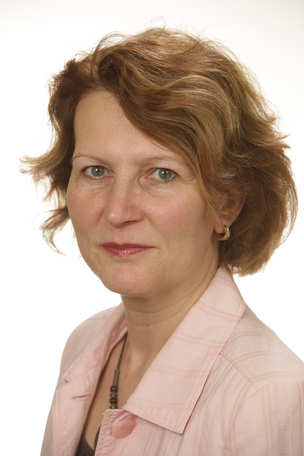
Miguel Mahecha is Professor of Environmental Data Science and Remote Sensing at the University of Leipzig, where he serves as Institute Head of the Institute for Earth System Science and Remote Sensing. He is also affiliated with the Remote Sensing Centre for Earth System Research, a collaboration between Leipzig University and the Helmholtz Centre for Environmental Research (UFZ). Mahecha is a member of the German Centre for Integrative Biodiversity Research (iDiv) and serves as Principal Investigator in the Centre for Scalable Data Analytics and Artificial Intelligence. Additionally, he is a Fellow of the European Laboratory for Learning and Intelligent Systems and co-spokesperson for the National Research Data Infrastructure for Earth System Sciences (NFDI4Earth). Full Professor for Modelling Approaches in Remote Sensing, University of Leipzig (since 03/2020) Research Group Leader: Empirical Inference in the Earth System, Max Planck Institute for Biogeochemistry, Jena (12/2012 - 03/2020) PostDoc, Max Planck Institute for Biogeochemistry, Jena (10/2009 - 11/2012) PhD in Environmental Sciences, ETH Zürich (06/2006 - 09/2009) Diploma in Geoecology, Bayreuth University (10/2000 - 04/2006) Mahecha's research focuses on understanding ecosystem responses to climate extremes and human-environment relationships during these events. He investigates macro-ecological dynamics and ecosystem functioning using data-driven methods and high-dimensional Earth observations. A key contribution is his co-development of the Earth System Data Cube concept, which integrates empirical methods with theoretical understanding to analyze complex Earth system interactions. His work spans biogeography, ecosystem functioning, and advanced data science methodologies for environmental monitoring. His recent publications demonstrate a strong emphasis on analyzing compound climate extremes, particularly heatwaves and droughts, and their impacts on ecosystems. Mahecha has pioneered methods using Earth System Data Cubes to integrate diverse environmental datasets, enabling novel insights into biosphere-atmosphere interactions. His research increasingly incorporates artificial intelligence and machine learning approaches to understand spatiotemporal patterns in ecological systems, with applications in real-time forest monitoring and biodiversity assessment. Fellow of the European Laboratory for Learning and Intelligent Systems Co-spokesperson for NFDI4Earth (National Research Data Infrastructure for Earth System Sciences) Mahecha leads multiple significant research projects including Digital Forest (real-time forest monitoring), NFDI4BioDiversity, and XAIDA (extreme events: AI for Detection and Attribution). His work receives funding from diverse sources including EU, DFG, and Stiftungen Inland. He collaborates extensively with the German Centre for Integrative Biodiversity Research (iDiv) and the Centre for Scalable Data Analytics and Artificial Intelligence. His research group, Earth System Data Science (ESDS), focuses on developing methods to extract valuable information from long-term environmental observations to understand coupled Earth system dynamics. At the Remote Sensing Centre for Earth System Research, Mahecha's ESDS group investigates how ecosystem functions respond to climate extremes, societal vulnerability to environmental hazards, and nonlinear interactions in coupled Earth systems. The group leverages citizen science data, remote sensing observations, and advanced computational methods to address pressing environmental questions.
Ulrich Parlitz is an Adjunct Professor of Physics at Georg-August-University Göttingen and a Scientist leading the Biomedical Physics Group at the Max Planck Institute for Dynamics and Self-Organization. His research focuses on nonlinear dynamics, chaos theory, and biomedical applications, particularly in cardiac dynamics and excitable media. He has held visiting positions at institutions like UC San Diego and the Santa Fe Institute. Education: 1987 PhD in Physics, Georg-August-University Göttingen 1984 Diploma in Physics, Georg-August-University Göttingen Research Interests: Analysis of nonlinear systems (neurons, lasers, oscillators) Bifurcation and chaos phenomena Data-based modeling and synchronization control Wave dynamics in excitable media (e.g., cardiac arrhythmias) Fractal dimension estimation and reservoir computing Labs/Teams: Leads the Biomedical Physics Group at MPI-DS and contributes to the IMPRS Program in Physics of Biological and Complex Systems.
Benjamin Bach is a Lecturer (Assistant Professor) in Design Informatics and Visualization at the University of Edinburgh , affiliated with the School of Informatics and the Centre for Design Informatics . Education : PhD in Computer Science from Université Paris Sud (2014), MSc in Computer Science (Diplom Medieninformatik) from University of Technology Dresden (2010). Research Interests focus on designing interactive visualization interfaces to explore, communicate, and understand complex data. Key areas include: Network Visualization Immersive Analytics (Augmented/Virtual Reality) Data-driven Storytelling Collaborative and Non-digital Visualization Visualization of Spatio-temporal Data Graph Databases and Dynamic Networks His work integrates these themes into tools like networkcube and Vistorian , emphasizing interdisciplinary applications in biology, neuroscience, and history. Current projects explore annotation systems, dynamic network analysis, and geographic network visualization. Scientific Awards : Honorable mention for Best PhD Thesis by IEEE Visualization Committee (2014). Supervision : Mentored 14 graduate students (MSc, MA, B.Hons) and actively seeks PhD/MSc candidates in network visualization, data storytelling, and immersive analytics. Collaboration : Works within the interdisciplinary Centre for Design Informatics , which bridges data science, design, and digital humanities.
Prof. Petra Sauer is a Professor of Computer Science and currently serves as Dean of the Department of Computer Science and Media at BHT Berlin. She leads research in database systems, geospatial technologies, and educational data analytics. Her work bridges academic research with practical applications in facility management, urban logistics, and e-learning platforms. Key projects include DiSEA (education analytics), ExCELL (mobility data integration), and BIM-FM (building lifecycle management). Research interests focus on: Database design & schema evolution Semantic web applications Geodatabase implementations Learning analytics in MOODLE environments Notable awards include the Tiburtius Prize (Gold 2008 for Marc-Florian Wendland's thesis, Bronze 2009 for Marco Blankenburg's thesis). Active supervision spans over 15 advisees across data science, database security, and semantic integration topics. Current courses include 'Database Systems' for Media Informatics students. Key projects: DiSEA: Moodle-based learning analytics framework ExCELL: Real-time traffic forecasting platform mVIZ: Open data visualization guidelines BIM-FM: Semantic integration of building models
Daxin Tian is a prominent professor at Beihang University's School of Transportation Science and Engineering, specializing in intelligent transportation systems and vehicular networks. With over 170 publications spanning from 2006 to 2025, his research has significantly contributed to the advancement of connected and autonomous vehicle technologies. His work appears consistently in top-tier IEEE journals including IEEE Transactions on Intelligent Transportation Systems, IEEE Transactions on Intelligent Vehicles, and IEEE Internet of Things Journal, establishing him as a leading authority in the field. Professor Tian's research interests encompass several critical areas in modern transportation technology: Connected and Autonomous Vehicle Systems Vehicular Networking and Communication Protocols Vehicle Platooning and Cooperative Driving Algorithms Edge Computing Applications for Transportation Computer Vision for Autonomous Driving Perception Traffic Flow Optimization and Prediction Models Resource Allocation in Vehicular Networks His recent publications demonstrate an increasing sophistication in addressing complex multi-vehicle scenarios while maintaining practical considerations like communication reliability, energy efficiency, and safety constraints. The research trajectory shows a clear evolution from foundational networking and control problems toward more integrated AI-driven solutions that combine computer vision, natural language processing, and advanced control theory for next-generation transportation systems. Professor Tian maintains extensive international collaborations, particularly with researchers at Canadian institutions including Victor C. M. Leung's group, while leading a substantial research team at Beihang University. His work frequently bridges theoretical advances with practical transportation challenges, resulting in numerous high-impact publications that address real-world implementation barriers in intelligent transportation systems.
Mitra Baratchi is an Associate Professor at the Leiden Institute of Advanced Computer Science (LIACS) , Leiden University. She leads the Spatio-temporal data Analysis and Reasoning (STAR) research group, co-leads the Automated Design of Algorithms (ADA) group, and founded the Special Interest Group on Spatio-Temporal Data Mining (SIG-SDTM) . PhD from University of Twente (Mobility Data) Master’s/Bachelor’s in Computer Engineering, Iran Research Interests focus on automated pattern extraction from spatio-temporal data across urban, environmental, and industrial domains. Key applications include: Automated Machine Learning (AutoML) for Earth Observations Time-Series Forecasting for public health (e.g., pandemic modeling) Urban Mobility Optimization with ESA, Honda, and municipalities Reliable Vehicular Communication Systems Smart Garments for Health Risk Detection Geocast Protocols for Internet-wide Communication Grant Highlights include €120K NWO-Aspasia, €2.9M Marie Skłodowska-Curie, €350K NWO-KLEIN, and €135K Center for BOLD Cities funding. She has supervised 12 PhD students and 4 current Master’s students since 2011, with notable best paper award at WWIC'16. Teaching includes Machine Learning (2020-present) and Urban Computing (2018-present) at Leiden, plus past courses in Data Visualization, Software Engineering, and Research Methods.
Dr. Sven Sahle is a computational systems biologist at Heidelberg University's BioQuant center , specializing in modeling biological processes and biochemical networks. He works on dynamic time-scale decomposition, sensitivity analysis, and simulation frameworks like COPASI. Research focus: Computational systems biology Key tools: COPASI, SBML extensions, MIASE standards Institutional affiliation: University of Heidelberg His research addresses modeling biological networks, feedback inhibition dynamics, and spatio-temporal chaos patterns. Recent work explores computational frameworks for biochemical analysis and interdisciplinary simulation environments. Scientific contributions include developing modeling standards and decomposition methods. He collaborates with international teams on simulation experiments and network analysis.
Xingcheng Zhou is a Research Assistant at the Technical University of Munich (TUM), affiliated with the Chair of Robotics, Artificial Intelligence and Real-time Systems since 2023. He holds an M.Sc. in Electrical and Computer Engineering from TUM (2021) and previously worked as an Industrial AI Researcher at Siemens. Research Interests: Focus on Large Language Models , Vision Language Models , 3D Environment Perception , and Domain Adaptation in autonomous driving contexts. Publications: Contributions to 3D object detection refinement, sim2real domain adaptation, vision-language models, and dataset development for intelligent transportation systems. Teaching Involvement: Co-supervisor for master's theses and seminars on autonomous agents, perception models, and traffic environment understanding. Advising: Mentoring students on projects including LiDAR-guided monocular detection, world models, and multimodal benchmarks for transportation scenes. Trends in Research: Zhou's work bridges low-light image enhancement with spatial-frequency features, surface-aware frameworks for 3D detection, and weakly-supervised domain adaptation. He contributes to benchmarking spatio-temporal video understanding and evaluating autonomous driving datasets. Supervision and Collaboration: Co-authored key surveys and frameworks with Prof. Alois C. Knoll and peers, focusing on real-time roadside LiDARs, graph-based object relationships, and vision-language integration for traffic analysis.
Pan Pan is a Professor in the Department of Biomedical Engineering at Huazhong University of Science and Technology, with extensive research contributions spanning medical image analysis, computer vision, and underwater wireless communications. Their work demonstrates strong interdisciplinary collaboration between biomedical engineering and computer science, with significant industry partnerships including Alibaba. Research interests focus on medical image analysis (particularly automatic breast ultrasound systems), deep learning applications in healthcare diagnostics, and secure underwater communications . Their work bridges theoretical advances with practical clinical applications, developing innovative segmentation algorithms, tumor detection systems, and secure communication protocols for specialized environments. Analysis of recent publications reveals a strong trend toward integrating multi-modal data fusion techniques with uncertainty-aware deep learning models for medical diagnostics. The research spans both fundamental algorithm development (novel segmentation networks, feature matching optimization) and domain-specific applications (ABUS tumor detection, ICU mortality prediction, underwater sensor networks). Pan Pan maintains active collaborations with major Chinese technology companies and academic institutions, evidenced by the consistent publication record in top-tier conferences including CVPR, ICCV, and NeurIPS. While specific awards aren't documented in the provided materials, the research impact is demonstrated through numerous high-impact publications across computer vision and biomedical engineering venues. The research program shows particular strength in translating computer vision techniques to medical applications, with significant contributions to semi-supervised learning approaches for medical image segmentation where labeled data is scarce. Recent work also demonstrates growing interest in secure communications for specialized environments like underwater sensor networks.
Prof. Dr. Jukka Matthias Krisp is a Professor of Applied Geoinformatics at the Institute of Geography, Faculty of Applied Computer Science, University of Augsburg. He leads the Applied Geoinformatics research team focusing on Location Based Services, Geographic Visualization, Spatial Modeling, and GIS applications in ecological network planning. His research interests span multiple domains within geoinformatics: Location Based Services (LBS) including context modeling, navigation systems, and mobile applications Geographic Visualization and Visual Analytics for complex spatial data representation Spatial Modeling techniques for urban environments and transportation systems Geographic Information Systems applications in ecological network planning and environmental monitoring Indoor navigation systems and 3D spatial representation Prof. Krisp's recent publications demonstrate a strong focus on bicycle routing optimization, spatial analysis of social networks, and the integration of AI technologies like ChatGPT for geospatial data generation. His work often combines traditional GIS methodologies with emerging technologies to address urban mobility challenges, traffic congestion analysis, and sustainable transportation planning. He has made significant contributions to the field of Location Based Services, particularly in context-aware computing and spatial data processing. Among his notable scientific contributions: Development of surface roughness-centric approaches to bicycle routing Innovative methods for estimating night populations using mobile network data Integration of big data and cartographic techniques for understanding urban mobility patterns Application of fuzzy inference systems for traffic congestion analysis Narrative approaches to indoor navigation using 360-degree camera documentation Prof. Krisp actively supervises students and collaborates with researchers internationally. His team includes Pablo Löw, Zulfa Nur'aini Afifah, and former members like Lika Zhvania. He teaches courses such as Advanced Spatial Analysis, Geoinformation Systems and Cartography, and Visual Geodata Mining at the University of Augsburg.
Gotthard Meinel is a Senior Fellow at the Leibniz Institute of Ecological Urban and Regional Development (IOER) since 2023, with a distinguished career spanning over three decades in geoinformatics and spatial analysis. Previously, he served as Head of the Research Department for Spatial Information and Modeling (2009-2022) and held various leadership positions within the institute since joining in 1992. Meinel received his education at the Technical University of Dresden, graduating in Information Technology in 1981. He pursued postgraduate studies in biomathematics and earned a specialist mathematician degree between 1981-1992, culminating in his promotion (PhD equivalent) in 1987. His research focuses on geoinformatics, particularly remote sensing image processing and the automated analysis of large geospatial datasets. Meinel specializes in monitoring land-use developments and building stock through advanced spatial analysis methods. His work encompasses the development of indicators and visualization technologies for understanding settlement patterns and open space dynamics. With expertise spanning computer science, mathematics, and spatial analysis, Meinel has made significant contributions to the field of land use monitoring in Germany. Analysis of Meinel's recent publications reveals a strong focus on land use monitoring systems, spatial data infrastructure, and the integration of survey and geospatial data. His research increasingly emphasizes interdisciplinary approaches, combining urban planning, environmental science, and data science to address complex spatial challenges. Key trends include the development of comprehensive monitoring frameworks, analysis of building stock characteristics, and exploration of sustainable land use practices across Germany. Meinel has led or participated in numerous significant research projects including the Social-Spatial Research Data Infrastructure (SORA), the Research Database for Non-Residential Buildings (ENOB:DataNWG), OpenGeoEdu, and the Competence Center for Scalable Data Services and Solutions (ScaDS). These projects demonstrate his leadership in developing innovative spatial data infrastructures and analytical approaches. As project leader and principal investigator, Meinel has supervised numerous research initiatives and likely mentored students and junior researchers, though specific advisees are not documented in the provided materials. His work has significantly influenced spatial planning practices and land use monitoring methodologies in Germany. Meinel's research is closely associated with the IOER Monitor, a comprehensive spatio-temporal research data infrastructure for settlement and open space development in Germany. His team has developed sophisticated methodologies for analyzing land use change, building stock dynamics, and urban structure through the integration of topographic data, remote sensing, and statistical approaches.
Sabine Fischer is a Professor for Supramolecular and Cellular Simulations at the University of Würzburg’s Center for Computational and Theoretical Biology (CCTB). She holds a PhD in Mathematics from the University of Nottingham (2009) and completed postdoctoral research at the University of Cambridge (2009-2011) and the University of Frankfurt (2011-2017). Her work focuses on mathematical modeling and data-driven simulations of biological processes across subcellular, multicellular, and multi-tissue scales. Key research areas include agent-based modeling of parasite collective behavior (e.g., Project 7 of SPP 2332 PoP), cell-cell interactions, and morphological modeling with Blender. Her group develops tools for image analysis and applies methods ranging from classical statistics to machine learning. Education: Diploma in Mathematics, University of Würzburg PhD in Mathematical Biology, University of Nottingham (2009) Professional Experience: Postdoc, University of Cambridge (2009-2011) Postdoc, University of Frankfurt (2011-2017) Development Engineer, h.a.l.m. Elektronik GmbH (2017-2018) Professor, University of Würzburg (since 2018) Her research integrates experimental data with computational models to study processes like mouse blastocyst differentiation, tissue-level organization, and parasitic locomotion. Current projects emphasize agent-based modeling of Trypanosoma collective behavior and the development of open-source tools like VESNA for 3D vessel analysis.