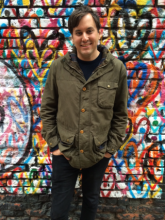
Ian Condry is a Professor of Japanese Culture and Media Studies at MIT, affiliated with the Department of Anthropology. He holds a BA in Government from Harvard (1987) and a PhD in Anthropology from Yale (1999). His research focuses on Japanese popular culture, media globalization, and creative industries. He is best known for his seminal work on hip-hop in Japan and anime production, emphasizing collaborative creativity and cultural hybridity. Condry leads the MIT Spatial Sound Lab, exploring immersive audio technologies, and co-founded the music discovery platform Hearby.com. He hosts the 'Near and Far' Japanese hip-hop radio show on WMBR 88.1FM since 2018 and releases music as Leftroman. Condry’s academic roles include former Head of Global Studies and Languages at MIT and Executive Committee member of the Technology Broadcasting Corporation. His work bridges academic research with creative practice, including organizing the Dissolve Music conference and curating multimedia projects. He has pioneered open-access publishing, making his books available under Creative Commons licenses. His research spans media anthropology, youth culture, and digital media’s societal impact. Key projects include the MIT/Harvard 'Cool Japan' research initiative and studies on post-3/11 cultural recovery. Condry’s interdisciplinary approach integrates ethnographic methods with technological innovation, addressing themes of global cultural flows and participatory media production.
Jim Sykes is an Associate Professor of Music at the University of Pennsylvania's School of Arts & Sciences. His research focuses on ethnomusicology, sound studies, and the cultural histories of the Indian Ocean world. He specializes in examining sonic practices across Afro-Asiatic seascapes, colonial surveillance systems, and postcolonial music theory. His work bridges disciplines like anthropology, history, and cultural studies, emphasizing decolonial methodologies. Recent scholarship explores governmental acoustic surveillance in maritime contexts, the politics of area studies, and the role of music in labor and value systems. He has contributed to rethinking sound studies through global south perspectives, including projects on sonic cartography and indigenous acoustic knowledge systems. Sykes has published extensively on topics such as Sri Lankan post-war musical generosity, Dalit liberation theology through Tamil folk music, and colonial sound regulations in British Ceylon. His interdisciplinary approach addresses intersections between sound, power, and cultural memory in contexts ranging from Southeast Asia to the Indian Ocean trade networks.
Richard M. Stern is a Professor of Electrical and Computer Engineering at Carnegie Mellon University (CMU), holding courtesy appointments in the Language Technologies Institute and Department of Computer Science, and serving as an Artist Lecturer in the School of Music since 2007. His interdisciplinary work bridges engineering and music technology through the School of Music's programs. Education: Ph.D. in Electrical Engineering from Massachusetts Institute of Technology (MIT), 1976 Professor Stern's research spans sound, speech, hearing, and music, with core emphases on robust speech processing in variable acoustic environments, music information retrieval, automated accompaniment, and foundational contributions to binaural perception theory. His work integrates psychoacoustic principles with machine learning to address challenges in speech recognition and human-robot interaction. Recent publications (2022-2025) reveal intensified focus on deep learning for speech enhancement in reverberant/noisy conditions, human-robot interaction scenarios, and music tagging—highlighting innovations in beamforming, source separation, and temporal modulation modeling. Awards and Honors: Fellow of the IEEE Fellow of the Acoustical Society of America Fellow of the International Speech Communication Association (ISCA) ISCA Distinguished Lecturer Allen Newell Award for Research Excellence (1992) Lutron Award for Teaching Excellence (2018) Professor Stern has advised numerous graduate students in speech and audio research, though specific names are unlisted in source materials. His grant portfolio includes significant National Science Foundation and industry-funded projects in speech technology, with leadership roles in initiatives like Interspeech 2006. He actively collaborates with CMU's Language Technologies Institute and Music and Technology program. He maintains strong ties to CMU's interdisciplinary ecosystem through the Language Technologies Institute and School of Music's Music and Technology program, contributing to research that merges acoustic engineering with musical applications.
Professor Emma Moore is a leading sociolinguist at the School of English, University of Sheffield . Specializing in the social dimensions of language, her work integrates methodologies from anthropology and sociology to investigate how linguistic variation constructs identity and social affiliations. Research focus: Sociolinguistic style, dialect contact, youth language, identity negotiation, and community-based fieldwork Key projects: Adolescence and grammar (1999-), Isles of Scilly dialect (2008-), language and inequality (2014-), language perception software (2016-) Educational background : PhD in Sociolinguistics, University of Manchester Stanford University (USA) during PhD research Research trends across her 2021-2025 publications reveal interdisciplinary exploration of: Socio-syntactic variation Clinical linguistics (2025 MDS-UPDRS studies) Digital discourse post-pandemic Indexicality and cognitive representations Dialect contact in insular communities Educational policy implications Scientific recognition : British Academy Mid-Career Fellow (2019-2020) Elected Fellow, Royal Anthropological Institute (2014) AHRC/BA funded research projects (1999-2015) Research group leadership : Mentored 9 PhD students (2004-2024) and supervised 3 undergraduate SURE projects, including analyses of: Gender in rap performance Language style and workplace inequality Oral history digitization Professional contributions : Editorial Board: Language in Society (2015-), Gender and Language (2011-2017) External Examiner: Lancaster University MA in English Language (2013-2017) Collaborative software development for dialect perception testing
Dr James Herbert-Read is an Associate Professor and Whitten Lecturer in Marine Biology at the Department of Zoology, University of Cambridge. He serves as Deputy Head of Department (Postgraduate Education) and leads the Marine Behavioural Ecology Group. His research focuses on understanding how animals, particularly marine organisms, collect and process information from their environments to make behavioral decisions, with emphasis on social interactions, adaptation mechanisms, and ecological constraints. His group employs theoretical frameworks, controlled experiments, and quantitative field studies to investigate behavioral diversity in marine species. Key themes include collective behavior, predator-prey dynamics, camouflage strategies, and the impacts of environmental stressors on animal decision-making. Recent publications highlight work on lionfish vocalization mechanisms, cuttlefish camouflage, citizen science applications in marine research, and behavioral responses to visual and acoustic noise. Scientific awards and affiliations include: Whitten Lecturer in Marine Biology Associate Professor, University of Cambridge He has supervised research projects on topics such as: Social attraction in invasive fish species Evolution of coordinated movement Neurophysiological basis for leadership in shoals Maternal effects on offspring exploration
Edwin van der Heide is a part-time Lecturer and researcher at Leiden University, affiliated with the Leiden Institute of Advanced Computer Science (LIACS) and the Academy for Creative and Performing Arts (ACPA). His work bridges sound, space, and interaction through installations, performances, and environments. Key roles include: Co-head of ArtScience Interfaculty (Royal Conservatoire & Royal Academy of Art, The Hague) until 2016 Edgard Varèse Guest Professor at TU Berlin (2009) Invited artist at Le Fresnoy (France) and HKB Bern University of the Arts (2019) Research Interests: Spatial sound composition, audience interaction, interdisciplinary art, and the intersection of technology with auditory perception. Notable projects include Whispering Wind (permanent installation at Leiden University) and Spiral of Time (MACBA, Barcelona). Recent Articles & Exhibitions (2023–2024): Focus on large-scale installations like Pneumatic Sound Field and Spiral of Time , emphasizing public engagement and spatial acoustics. Awards: Witteveen+Bos Art+Technology Award (2009), Best Paper Award for BAI (摆) (2018). Grants & Labs: Collaborations with institutions like NCCA (Russia), MAXXI (Italy), and involvement in projects like Evolving Spark Network (global sound art initiatives).
Dr. Philip Kirby is a Senior Lecturer in the History of Education at King’s College London’s School of Education, Communication & Society. He joined in 2020 after roles at the University of Oxford, the Sutton Trust, and the University of Exeter. His research focuses on the historical and social dimensions of specific learning difficulties like dyslexia and dyspraxia, alongside children’s culture and education policy. His notable work includes Dyslexia: A History (2022, co-authored with Prof. Margaret J. Snowling) and entries in encyclopedias like Palgrave Encyclopedia of Disability . He also explores geopolitical themes in media, including film scores and video games. Recent projects include Delphi studies on dyslexia assessment and policy reform. His research spans education policy, private tuition dynamics, and the intersection of popular culture with disability ethics. He actively contributes to interdisciplinary initiatives like the Centre for Public Policy Research, addressing social justice in education and policy.
Panpan Yang is a Lecturer in Arts and Visual Cultures of Modern China at the School of Arts, SOAS University of London. She joined SOAS in 2021 after completing her joint PhD at the University of Chicago under the direction of Wu Hung, Tom Gunning, W. J. T. Mitchell, Judith Zeitlin, and Dana Polan. Her interdisciplinary work bridges art history, screen studies, East Asian studies, and digital humanities, with a focus on innovative methodologies in art historical writing. Dr. Yang earned a dual BA from Peking University, double majoring in art and philosophy, followed by an MA from Tisch School of the Arts at NYU, and a PhD from the University of Chicago. During her undergraduate studies, she served as president of the Society of Dream of the Red Chamber Studies, which informed her secondary academic interest in Redology and the visual material world of the novel Hong lou meng. Panpan Yang's research explores how minor discourses can deterritorialize the terrains of both art history and screen studies. Her work demonstrates a multimethodological approach attentive to archival research, material practices, close visual analysis, computer-aided vision, and cross-cultural theorization. She is particularly interested in Chinese animation history, calligraphic imagination in contemporary art, and the intersections between traditional Chinese art forms and new media. Her publications reveal a consistent focus on Chinese visual culture across multiple media forms, with particular attention to animation, film, and calligraphy. Yang's work demonstrates how traditional Chinese art forms engage with contemporary digital media, creating new hybrid forms that challenge disciplinary boundaries. Her research shows a trajectory from historical analysis of Chinese animation to contemporary explorations of calligraphy in digital contexts, revealing the ongoing relevance of traditional Chinese aesthetics in modern media. Dr. Yang has received several prestigious awards for her scholarly and creative work: China's National Young Screenwriter Award Domitor Essay Award Dean's Distinguished Dissertation Award Nomination Honourable Mention from the Association for Chinese Animation Studies As a Principal Investigator, Dr. Yang leads the AHRC-funded research project "Stroke by Stroke: Calligraphic imagination in contemporary Chinese art and emergent media" (2023-25) with Shane McCausland. She was also a collaborating partner on the NEH-funded "Media Ecology Project." Her research has received additional support from the Getty Foundation and the Sino-British Fellowship Trust. At SOAS, she works closely with faculty and graduate students interested in Chinese arts and cultures, art theory, cinematic arts, and digital art history. Dr. Yang is currently developing innovative research at the intersection of traditional Chinese calligraphy and contemporary digital media through her AHRC-funded project. This work explores how calligraphic imagination manifests in contemporary art and emergent media contexts, creating new pathways for understanding Chinese cultural heritage in the digital age.
Robert Likamwa is an Associate Professor at Arizona State University, affiliated with the School of Arts, Media and Engineering and the School of Electrical, Computer and Energy Engineering. His research focuses on the intersection of mobile computing, augmented reality, and sensor design through Meteor Studio. Ph.D., Rice University M.S., Rice University B.S., Rice University His work spans three core research arcs: (i) advanced visual capture systems, (ii) hybrid virtual-physical immersion through sensory augmentation, and (iii) data-driven frameworks for AR/VR storytelling. He explores mobile operating systems, low-power architectures, computational imaging, and holographic computing. Recent publications analyze multi-resolution visual sensing, geospatial cross-virtuality collaboration, planetary data visualization, spatial audio optimization, and multi-sensory virtual environments. His 2013 paper on energy-proportional image sensors received the Best Paper Award at ACM MobiSys. Best Paper Award, ACM MobiSys 2013 LiKamWa advises graduate students through research and thesis courses and leads grants related to mobile vision systems, haptic interfaces, and energy-efficient sensor design. He directs Meteor Studio, a research group focused on immersive technology innovation.
Andrew Gersick is a Lecturer in the Department of Ecology and Evolutionary Biology at Princeton University. His research focuses on animal behavior, particularly in large social species such as spotted hyenas, zebras, and cowbirds. He explores topics including collective behavior, social dynamics, communication systems, and ecological adaptations. His work integrates field studies with technological tools like accelerometers to analyze activity patterns and signaling mechanisms. Notably, he investigates how zebra stripes repel biting flies and how hyenas use vocalizations for individual recognition. Gersick also contributes to conservation efforts, such as the Great Grevy’s Rally in Kenya, and studies social learning in avian species like cowbirds. His recent articles highlight interdisciplinary approaches, combining ecology, physiology, and technology to understand animal behavior in natural and social contexts. While no awards are explicitly listed, his contributions to understanding collective behavior and conservation biology are significant. Advising and grants: No formal advisees or grant details are provided in the text. His work appears to focus on collaborative research and field-based methodologies. Labs/Teams: No specific laboratory or team affiliations are mentioned beyond his departmental role at Princeton.
Jonathan Nangle is a Lecturer in Music Technology and Electro-Acoustic Composition at the Royal Irish Academy of Music. His work spans acoustic/electro-acoustic composition, live electronics, installations, and improvisation. Educated at Trinity College Dublin under Donnacha Dennehy, Rob Canning, and later privately with Kevin Volans, his music has been performed by ensembles like RTÉ National Symphony Orchestra and Crash Ensemble. Research interests include spatial music, interactive installations, and hybrid acoustic/digital forms. Notable works include Pause (Ergodos, 2017), Iridescent Cobalt Glow (2015), and our headlights blew softly... which earned a 2009 Rostrum commendation. Awards include dual Irish Rostrum representations (2009/2011) and the 2007 AIC/Music 21 Prize. Recordings span solo piano works to ensemble commissions, often integrating innovative electronic elements. His work has been broadcast internationally and choreographed for stage/film. Current roles include academic teaching and ongoing creative exploration at the intersection of technology and traditional composition.
David Lindlbauer is an Assistant Professor at Carnegie Mellon University's Human-Computer Interaction Institute (HCII), where he leads the Augmented Perception Lab and co-directs the CMU Extended Reality Technology Center. His research focuses on advancing Mixed Reality (MR) and Extended Reality (XR) interfaces through computational interaction methods that optimize spatial, temporal, and multimodal feedback.
Miguel Nacenta is a Professor in the Department of Computer Science at the University of Victoria (UVic), Canada, and a founding member of the Victoria Interactive eXperiences with Information (VIXI) research group. Previously affiliated with the University of St Andrews (UK), his work bridges Human-Computer Interaction (HCI), Information Visualization, and Cognitive Science. He specializes in designing interactive systems that enhance human cognition, with a focus on Infotypography (using typography to encode data), collaborative problem-solving tools, and perceptual input/output devices. Research Interests: His key areas include cognitive augmentation, visualization techniques for complex tasks, multi-display environments, and tools for constraint problem-solving. Notable projects include the WriteReason tool for essay writing, InfoTypography studies on perceptual typographic parameters, and Solvi for visual constraint modeling. Grants & Collaborations: He collaborates internationally, including with the University of St Andrews on PhD scholarship programs. His work is supported by grants focusing on HCI innovations and accessibility. He actively mentors students (e.g., Adam Binks, Johannes Lang) and supervises postdoctoral researchers. Affiliations: Member of the VIXI group,他曾是St Andrews计算机科学学院的教授, 并参与多个学术服务活动, including conference program committees and journal reviews. Labs & Teams: Leads the VIXI lab at UVic, focusing on interactive technologies for cognitive tasks. Collaborates with industry partners on projects like TypoCartographer for infoTypographic maps and HaptiQ for accessible graph exploration.
Catherine Guastavino is a Professor at McGill University's School of Information Studies (within the Faculty of Arts) and an Associate Member at the Schulich School of Music. She also contributes to the Centre for Interdisciplinary Research in Music Media and Technology (CIRMMT). Her roles include leading research projects and supervising graduate students in music technology and related fields. She holds a PhD in Psychoacoustics from Université Pierre et Marie Curie (Paris VI), an MSc from IRCAM (France), and a BSc in Mathematics from McGill University. Her research focuses on auditory perception, soundscape analysis, human-computer interaction, and urban acoustics. Notable projects include the 'Sounds in the City' partnership addressing urban noise policy and the development of immersive soundscape simulation tools. She leads or co-leads grants from SSHRC, NSERC, and MITACS, emphasizing interdisciplinary approaches to sound in urban environments. Guastavino's work bridges academic research with practical applications, such as designing sound installations for public spaces and improving acoustic environments in transportation and performance venues. She collaborates with city planners, musicians, and engineers, reflecting her commitment to making cities sound better through evidence-based strategies. Key Projects: SSHRC Partnership Grant for urban soundscape management (2018-2023) NSERC Discovery Grant on auditory localization (2019-2024) MITACS projects on Montreal festival soundscapes and noise policy Labs & Partnerships: Multimodal Interaction Laboratory (MIL) Collaborations with Ville de Montréal and Quartier des Spectacles Education: PhD: Psychoacoustics (Paris VI) MSc: Computer Science & Music Technology (IRCAM) BSc: Mathematics (McGill) Her teaching includes courses like Music Information Retrieval, integrating computational methods with artistic and scientific applications.
Kamal Sen is an Associate Professor in the Department of Biomedical Engineering at Boston University, serving as Director of the Natural Sounds and Neural Coding Laboratory and Director of Admissions and Recruitment for Master’s Programs. He holds a PhD and MA in Physics from Brandeis University and a BA in Physics from Bates College. His research focuses on understanding how neurons encode natural sounds, particularly in the auditory cortex. Key areas include neural coding efficiency, hierarchical auditory processing, and the role of learning in shaping receptive fields. He developed the BOSSA algorithm to address sound segregation challenges in noisy environments, with applications for hearing aid technology. Sen’s work integrates electrophysiological techniques with theoretical approaches from signal processing, information theory, and systems theory. His lab explores neural discrimination of behaviorally relevant sounds and models cortical processing dynamics using computational frameworks. Recent studies investigate parvalbumin neuron contributions to temporal coding and cortical noise reduction in complex auditory scenes. His publications span neural circuit modeling, fNIRS applications in BCI, and biomimetic algorithms for auditory scene analysis. Research highlights include exploring schizophrenia-related gene effects on neural circuits and developing 3D neurosphere models for Parkinson’s disease.