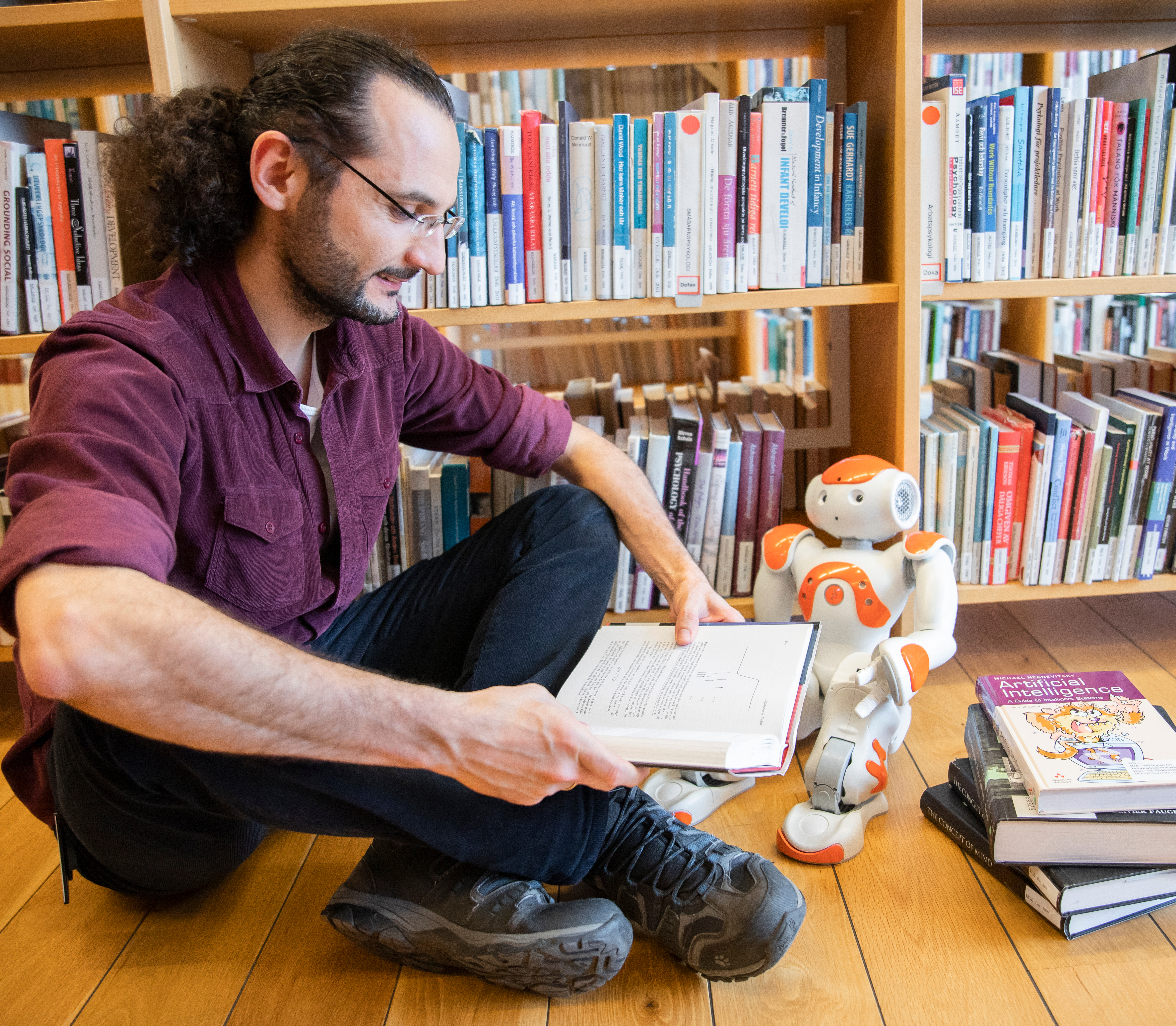
Tinko Velichkov Tinchev is a Professor and Researcher at the Faculty of Mathematics and Informatics (FMI), Sofia University "St. Kliment Ohridski". His research focuses on Modal Logic , Dynamic Logic , and Formal Methods , particularly in applications to spatial reasoning and theoretical computer science. Email: tinko@fmi.uni-sofia.bg Office Hours: Thursday 11-12, Friday 13:30-15:30 His work spans geometric reasoning , equivalence relations , and knowledge representation . Publications include collaborations on region-based theories of space , affine reasoning , and modal operators for logical systems.
Erdal Aksoy is an Associate Professor at Halmstad University 's School of Information Technology , with visiting scholar roles at Volvo Group Trucks Technology and Zenseact AB . His work focuses on semantic scene perception , action semantics , and environment understanding for autonomous systems including robots and unmanned vehicles. Education : PhD from University of Göttingen, postdoctoral research at Karlsruhe Institute of Technology (KIT) and University of Göttingen Research Interests : Semantic scene perception, action semantics, autonomous systems, human-robot interaction, LiDAR processing, and deep learning applications His recent publications demonstrate expertise in LiDAR data processing (SalsaNet, SalsaNext), semantic state estimation for robotic cloth manipulation, and multimodal failure detection systems. He has coordinated the HORIZON Europe ROADVIEW consortium with 15 partners. Scientific recognition includes Best Student Paper Award at IJCAI 2021 AI4AD workshop Best AI Master’s Thesis Award from Swedish AI Society (SAIS) Wimanska Prize for best bachelor thesis Distinguished Service Award as IEEE Robotics and Automation Letters Associate Editor His advising track record shows mentorship of award-winning students across bachelor, master, and PhD levels. Erdal Aksoy maintains active collaborations between academia and industry, particularly with automotive technology companies.
Emre Gönlügür serves as an Assistant Professor in the Department of Interior Architecture and Environmental Design at Izmir University of Economics, where he actively contributes to architectural pedagogy and research. With a robust academic foundation spanning multiple disciplines and institutions, he bridges historical scholarship with contemporary design practice through interdisciplinary collaborations. Education is foundational to his expertise, reflected in his comprehensive academic journey: PhD in Art History, University of Toronto (2014), dissertation on American architectural influence in postwar Turkey Master's in Architectural History, University College London, Bartlett School of Architecture (theatre architecture in 19th-century London) Master's in Urban Design, Middle East Technical University (gated communities in Istanbul) Bachelor's in City and Regional Planning, Middle East Technical University (1998) Research Interests converge at the intersection of emotional history, spatial memory, and architectural culture. His work critically examines Cold War-era architecture, collective memory construction, and Anthropocene-era design imaginaries, with particular focus on 20th-century Turkish urban landscapes. He pioneers methodologies connecting architectural history with emotional geographies, analyzing how spaces become vessels for cultural memory and political contestation through rigorous archival work and cross-disciplinary analysis. Publication Trends reveal a coherent trajectory from historical analysis toward computational and emotional dimensions of space. His recent scholarship (2020-2025) demonstrates increasing methodological diversity, integrating digital humanities approaches with memory studies to examine sites like Izmir's Kültürpark and the Izmir International Fair. Key thematic threads include the emotional navigation of urban modernity, circular design principles, and the therapeutic potential of spatial interventions, reflecting his commitment to socially engaged scholarship that connects historical inquiry with contemporary design challenges.
Alan Wagner is an Assistant Professor in the Department of Aerospace Engineering at Penn State University. His research integrates social psychology, behavioral economics, and artificial intelligence to develop frameworks for human-robot socialization, focusing on trust calibration, deception reasoning, and relationship modeling. Research interests include: Cognitive realism in game-theoretic social behavior models Trust dynamics during emergency evacuations Context-specific norm learning for robots Human-robot collaborative task execution Adaptive turn-taking routines Image encoding for continual learning Project funding highlights: $500K NSF CAREER grant for trust calibration in emergencies $455K AFOSR grant for cognitive realism $698K NSF grant for human-technology frontier construction work $20K NSWC Crane grant for object recognition Scientific recognition: Best Paper Award Finalist (ARSO 2021)
Claudio di Ciccio is an Associate Professor at the Department of Information and Computing Science within the Faculty of Science at Utrecht University, Netherlands. Previously, he worked with the Department of Computer Science of Sapienza University of Rome (Italy) and the Institute for Information Business of the Vienna University of Economics and Business (WU Vienna), Austria. He received his PhD in Computer Science and Engineering in 2013 from Sapienza University. His research interests span across Process Mining, Formal Methods, Automated Reasoning, and Blockchain & Distributed Ledger Technologies. He has developed expertise in Process Modelling and Simulation, Distributed Computing, Logic, and Artificial Intelligence. His work bridges theoretical formal methods with practical applications in business process management and decentralized systems. His recent publications focus on advancing Process Mining techniques while addressing critical challenges in data privacy and security, particularly in decentralized environments. His research explores the intersection of visual analytics and process mining, developing innovative approaches for multi-faceted process information analysis through time and space. He has made significant contributions to formal methods for process specification verification and constraint satisfaction. Member of the Steering Committee of the IEEE Task Force on Process Mining General Chair of the Conference on Process Mining (ICPM) in 2023 PC chair of ICPM in 2021 PC chair of the Conference on Business Process Management (BPM) in 2022 PC chair of the Blockchain Forum at BPM in 2019 and 2024 Di Ciccio has been actively involved in numerous significant research projects related to process mining, blockchain applications, and formal methods. His work demonstrates a consistent focus on developing practical tools and frameworks that address real-world challenges in business process management while maintaining strong theoretical foundations. His research group appears to focus on the intersection of process science with emerging technologies, particularly in secure and decentralized environments.
Alexei (Alyosha) Efros is a Professor in the Department of Electrical Engineering and Computer Sciences at the University of California, Berkeley, where he holds the Howard Friesen Professorship and is a core member of the Berkeley Artificial Intelligence Research Lab (BAIR). Prior to joining UC Berkeley in 2013, he spent a decade as faculty at Carnegie Mellon University and maintained affiliations with École Normale Supérieure/INRIA and the University of Oxford. His educational background includes: PhD in Computer Science, University of California, Berkeley (2003) BS in Computer Science, University of Utah (1997) Efros's research fundamentally explores how machines can understand and recreate the visual world using vast unlabeled data, with pioneering contributions at the intersection of computer vision and computer graphics. He champions data-driven and self-supervised learning approaches, emphasizing slow science principles while advancing applications in computational photography, visual data mining, robotics, and interdisciplinary humanities projects. His work consistently bridges theoretical innovation with practical impact, as evidenced by his prolific publication record and industry collaborations. Analysis of his 2024-2025 publications reveals three dominant trajectories: 1) Generative model interpretability (CLIP analysis, diffusion model auditing), 2) 3D scene understanding through novel representations (Gaussian splatting, persistent state modeling), and 3) Self-supervised techniques for video and multiview consistency. These threads demonstrate his lab's strategic focus on making generative systems more controllable, interpretable, and spatially coherent while maintaining strong connections to human vision principles. His exceptional contributions have been recognized with: ACM Prize in Computing (2016) Five ICCV Helmholtz Test-of-Time Prizes (1999-2017) SIGGRAPH Significant New Researcher Award (2010) NSF CAREER Awards (2006, 2010) Multiple teaching honors including the Jim and Donna Gray Award (2023) As a dedicated mentor, Efros has advised 19 PhD students to completion (including current faculty at CMU, TTIC, and Stanford) and numerous MS/BS researchers, with his trainees consistently securing prestigious fellowships and industry positions. His research has been supported by sustained NSF funding, industry partnerships with Adobe and NVIDIA, and collaborative grants through BAIR's multi-institutional initiatives. The lab maintains active international collaborations with Oxford, École Normale Supérieure, and leading AI institutes worldwide. His research group operates within BAIR's collaborative ecosystem, featuring dedicated computational resources for vision and graphics research. The lab emphasizes interdisciplinary teamwork, regularly partnering with robotics and cognitive science researchers to explore human-AI visual interaction. Current projects focus on foundational challenges in visual representation learning, with increasing emphasis on ethical AI development and societal impact through initiatives like visual data attribution frameworks.
Dr. Kevin J Liang is a Research Scientist at Meta Platforms, Inc. , specializing in Deep Learning , Computer Vision , and 3D Reconstruction . He earned his PhD in Electrical & Computer Engineering from Duke University in 2020, with a dissertation on Deep Automatic Threat Recognition for Airport X-Ray Baggage Screening . His research focuses include: 3D Computer Vision (ICON, Fast3R) Few-Shot Learning (Sylph, HyperMix) Federated Learning (WAFFLe) Object Detection (EgoTracks, Self-Supervised Methods) Recent publications demonstrate his leadership in Egocentric Vision (Ego-Exo4D) and Transformer Applications (GliTr). He has received numerous awards including the E Bayard Halsted Fellowship (2017) and Summa cum laude (2015), and serves on program committees for major conferences like NeurIPS and CVPR . As an educator, he developed and taught tutorials for Duke University's Machine Learning School and Coursera courses, covering TensorFlow, PyTorch, and foundational ML concepts for over 600 students.
Sunita Hirsch is a researcher at the Institute of Educational Science at the University of Stuttgart, specializing in vocational education with a focus on technology didactics. Her work bridges cognitive psychology, virtual reality, and technical skill development. Education: Bachelor in Computer Science (2014) and Diplom in Psychology (2008–2014), both from the University of Tübingen. Research interests revolve around virtual and augmented reality applications in education , mental rotation ability , and technology-based didactic frameworks . She investigates how immersive environments enhance technical knowledge acquisition and spatial reasoning. Recent publications highlight trends in virtual learning arrangements , cognitive assessments in VR , and adaptive training systems . These works emphasize cross-reality integration , human-centered design , and improving technical education in industrial contexts. Collaborations include partnerships with B. Zinn and other experts in vocational education. Her research impacts fields like industrial training , spatial cognition , and interactive technical learning .
Iro Armeni is an Assistant Professor in the Civil and Environmental Engineering Department at Stanford University's School of Engineering. She leads the Gradient Spaces research group, focusing on the intersection of civil engineering, architecture, and machine perception to design and construct data-driven environments across physical and digital space. Her educational background is highly interdisciplinary: PhD in Civil and Environmental Engineering with Minor in Computer Science from Stanford University (2020), Postdoctoral Researcher at ETH Zurich (2023), MSc in Computer Science from Ionian University (2013), MEng in Architectural Engineering from University of Tokyo (2011), and Diploma in Architectural Engineering from National Technical University of Athens (2009). Before academia, she worked as an architect and consultant for both private and public sectors. Dr. Armeni's research focuses on developing quantitative and data-driven methods that learn from real-world visual data to generate, predict, and simulate new or renewed built environments with humans at the center. She is particularly interested in creating gradient spaces that blend 100% physical (real reality) to 100% digital (virtual reality) using Mixed Reality. Her work spans computer vision, 3D scene understanding, semantic mapping, and their applications in the built environment. Her recent publications demonstrate significant contributions across multiple venues including CVPR, ECCV, SIGGRAPH, and ISPRS Journal, with research themes centered around 3D scene understanding, appearance transfer, scene synthesis, SLAM in dynamic environments, and semantic mapping. Her work shows a consistent trajectory toward creating sustainable, inclusive, and adaptive built environments that support current and future physical and digital needs. She has received prestigious awards including the ETH Zurich Postdoctoral Fellowship, Google PhD Fellowship, and MEXT Scholarship. Her teaching includes graduate courses such as Designing for Gradient Spaces (CEE342), Computer Vision for the Built Environment (CEE247C), and AI Applications in AEC (CEE329), reflecting her interdisciplinary approach to integrating machine perception with civil engineering applications.
Gustaf Gredebäck is a Professor at the Department of Psychology , Uppsala University , specializing in Developmental Psychology . His research investigates how infants' and children's cognitive, social, and emotional development is shaped by personal exploration, adverse environments (war, mental health challenges), cultural contexts, and early educational settings. Research Interests: Cognitive development, social cognition, emotional processing, executive functions, and the impact of sociocultural/political contexts on child development Methodologies: Eye tracking, pupillometry, experimental paradigms, and cross-cultural comparisons Key Collaborations: International studies in Bhutan, Syria, and Sweden; partnerships with autism research groups Recent Research Trends: Analysis of urbanization's developmental effects, methodological rigor in infancy research, gaze-following as a social cognition marker, and maternal mental health impacts on refugee children. His 2025 articles explore expertise acquisition through play and cross-cultural gaze stability. Scientific Contributions: Holds a significant grant from the Knut and Alice Wallenberg Foundation (2015) and has developed innovative tools like TimeStudio for behavioral research workflows.
Associate Professor Twan Huybers is affiliated with the School of Business at UNSW Canberra , where he conducts research on decision-making analysis, choice experiments, and modeling applications across diverse contexts. Educated with a Masters in Economics and Business Administration (cum laude) from University of Maastricht and a PhD in Economics from UNSW Current research explores tourist destination choices, household spending behavior, athlete decision-making on doping, university selection, teaching evaluations, and academic integrity Published in Journal of Travel Research , Tourism Management , Journal of Sport Management , and other interdisciplinary journals His recent work analyzes AI support systems in military ethics, contract cheating in education, and research misconduct through choice experiments. Teaching responsibilities include undergraduate and postgraduate economics courses. Selected grants include: 2022-23: The effect of AI enabled support systems on ethical decision making in military contexts 2022: Contract cheating – A choice experiment of Australian university students 2020-21: Research misconduct – A choice experiment of Australian academic researchers
Anne Lucietto is an Associate Professor at Purdue University's Polytechnic Institute with extensive industry experience in mechanical, electrical, and chemical engineering sectors including energy generation, nuclear plant construction, and manufacturing management. She transitioned to academia to support student career development and graduate education. Education: Ph.D. in Engineering Education - Purdue University MBA in Finance - Lewis University BS in Mechanical Engineering - Marquette University Her research focuses on sustainable energy systems and engineering education, particularly investigating learning methodologies for engineering technology students. Key areas include renewable energy integration, materials engineering applications, cross-cultural STEM communication, and gender dynamics in technical fields. She employs mixed-methods approaches to understand problem-solving cognition and industry-academia knowledge transfer. Recent publications (2020-2025) demonstrate strong emphasis on engineering pedagogy, showing recurring themes of diversity in STEM, industry-education collaboration, cognitive approaches in technical learning, and renewable energy innovation. Over 60% of recent works address equity interventions in engineering education. Awards and Honors: Society of Women Engineers: Engaged Advocate Award (2021), Outreach Award (2020), Fellow status Purdue Polytechnic Outstanding Faculty in Learning (2018) Influential Woman in Manufacturing (2018) ASEE-CIEC Best Moderator Award (2018) Multiple teaching excellence awards from Purdue University She maintains active industry engagement through corporate training certifications (Six Sigma, OSHA) and prior leadership roles at Caterpillar, Fermilab, and Exelon. Professional affiliations include senior membership in IEEE, ASME, and ASEE.
HAFSI Meriem is a researcher at CESI Lyon , focusing on Computer Science and Information and Communication Sciences and Technology (STIC) . Her work bridges research and education, contributing to both academic and industrial advancements. Education: Doctoral thesis in STIC (Computer Science) from Savoie Mont Blanc University (2018) Master's in Web Intelligence from Jean Monnet University of Saint-Etienne (2014) Master's in IT project management from Mouloud Mammeri University of Tizi-Ouzou (2013) Research interests span Industry 4.0 , Predictive maintenance , Data analysis , Knowledge representation , and Machine learning . Recent work emphasizes hybrid predictive maintenance frameworks, battery state estimation, and security in cyber-physical systems. Selected publications (2014–2023) highlight applications in aerospace, energy systems, and industrial networks. Common themes include data fusion, ontological modeling, and adaptive processing techniques. Labs/teams: Member of the Engineering and Digital Tools research team at CESI Lyon.
Tünde Berta is a Lecturer at the Department of Pre-school and Elementary Education within the Faculty of Education at J. Selye University in Komárno, Slovakia. She has been employed at the university since 2004 and is currently pursuing her PhD in Pedagogy at J. Selye University (2024-). Her academic background includes a degree in Mathematics-Informatics from Comenius University's Faculty of Mathematics and Physics (1994-2000). Dr. Berta's educational journey began with her university studies in Mathematics-Informatics at Comenius University, followed by her current doctoral studies in Pedagogy at J. Selye University. Her professional development reflects a strong commitment to advancing educational practices, particularly in mathematics instruction and teacher development. Her research interests focus primarily on mathematics teaching methodology, with special emphasis on cooperative techniques and project methods in mathematics education. She has extensively explored continuing teacher education, adult education possibilities, teacher mentoring and its impact on classroom quality, and inclusive education approaches. Her work demonstrates a consistent dedication to improving teaching practices through evidence-based methodologies and innovative approaches that address the diverse needs of students in primary education settings. Analysis of Dr. Berta's publication record reveals a strong focus on practical applications of educational theory in mathematics instruction. Her recent work (2021-2024) shows increasing attention to teacher development, assessment methods, and the integration of technology in education. She frequently collaborates with colleagues like Zuzana Árki and Ladislav Jaruska, indicating active participation in research teams focused on improving mathematics education. Her publications span multiple languages (English, Hungarian, Slovak), reflecting her work within the Hungarian minority educational context in Slovakia. Her publications have received 5 citations according to institutional records 2 citations registered in citation indexes (Web of Science, Scopus) 3 citations in other databases Dr. Berta has been actively involved in developing educational materials and textbooks, including two versions of 'Project Teaching in School' (2022) in both Slovak and Hungarian. Her research often addresses the specific needs of Hungarian-speaking communities in Slovakia, particularly in the context of mathematics education and teacher development. She has participated in numerous international conferences, demonstrating her commitment to sharing knowledge across borders and engaging with the broader educational research community. Her work on cyberbullying during the pandemic period shows responsiveness to contemporary educational challenges.
Dr. Irène Abi-Zeid is a Full Professor at the Department of Operations and Decision Systems within the Faculty of Administrative Sciences at Université Laval , Canada. With a joint doctorate in water sciences and a master's in mathematics, her work bridges multi-criteria decision support (MCDA), optimization , and machine learning to address complex socio-ecological challenges. Research Interests : Multi-criteria decision support systems, socio-ecological modeling, participatory decision-making, and optimization techniques for search and rescue operations. Awards : 2019 Best paper award, Artificial Intelligence and Decision Support Systems track 2019 Best Ph.D. project award (KMIS Conference) 2017 Runner-up: GDN Springer Young Researcher Award Teaching : Probability and statistics for business, ANOVA, stochastic processes, and research methodology. Publications : Over 40 peer-reviewed articles focusing on MCDA applications in water management, urban planning, and emergency response. Her pioneering SARPlan decision support system for search and rescue operations has been adopted by Canadian agencies, while her MCDA-ULaval software advances multi-criteria analysis in environmental and transportation domains.