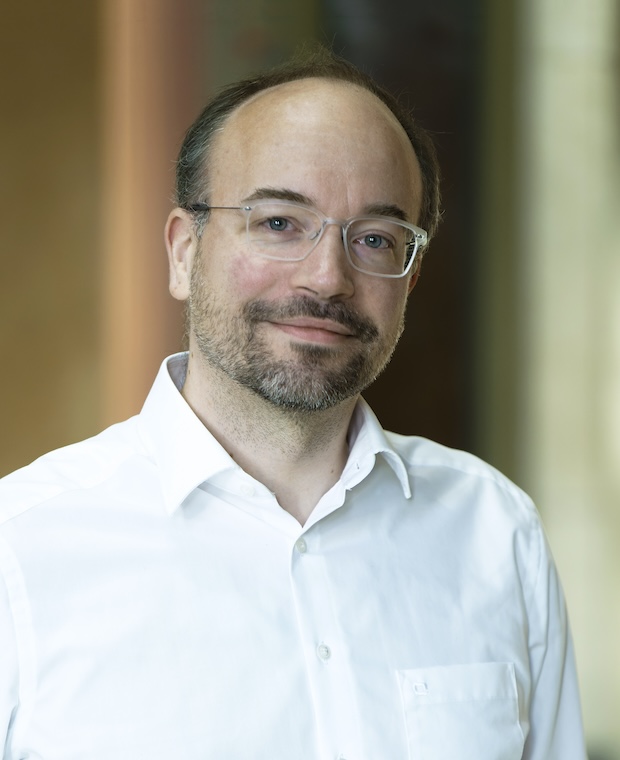
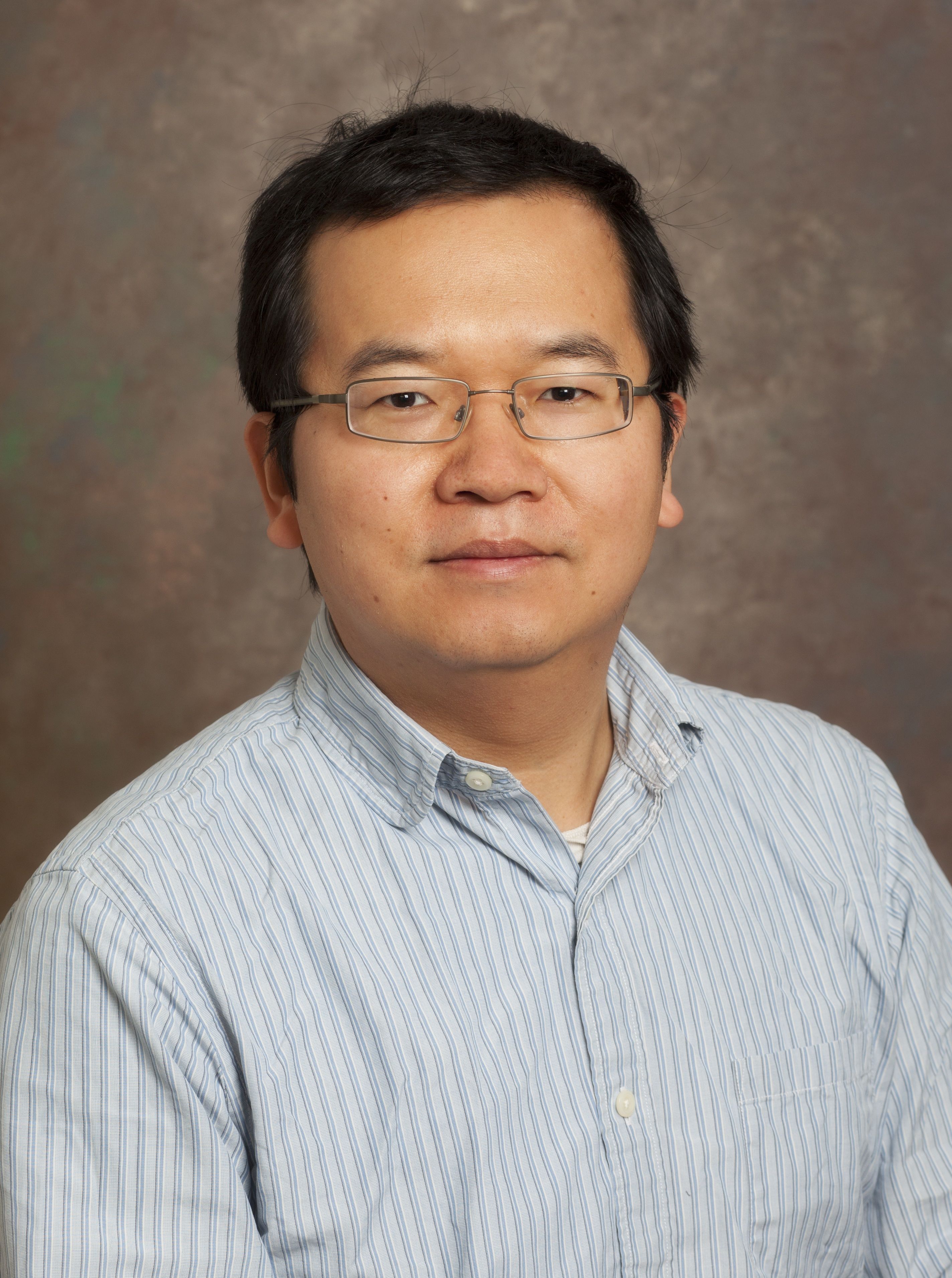
Prof. Dr.-Ing. Ahmad Osman is a Professor at the Saarland University of Applied Sciences (htw saar), specializing in Test Technologies and Test Methods within the Faculty of Engineering. He also holds an Adjunct Professor position at Laval University in Quebec, Canada, in the Department of Electrical Engineering and Computer Science. His research focuses on Artificial Intelligence applications in Signal and Image Processing for Non-destructive Testing (NDT) , with extensive work on Deep Learning , 3D Ultrasound Tomography , and Sensor Data Fusion in industrial contexts. Engineering Artificial Intelligence Signal Processing Image Processing Non-destructive Testing Quality Control Augmented Reality Osman leads the AutomaTiQ research group and serves as Head of the Algorithms/Signal and Data Processing Department at Fraunhofer IZFP . His recent publications (2017–2022) emphasize Deep Learning for defect detection in CFRP , Terahertz Imaging for artwork diagnostics, and Acoustic Sensors for agricultural quality control. He has organized international conferences on Structural Health Monitoring and contributed to Springer books on NDT technologies. His projects include ComforTex-AI (2024) and development of 3D positioners for ultrasound measurements. Collaborations span institutions in Germany, Canada, Italy, and Brazil, with advisory roles in the German Society for NDT and technical committees for conferences in Montreal and Egypt.
Professor Josef Dick serves as a Professor and Deputy Head in the School of Mathematics & Statistics at the University of New South Wales (UNSW). With a distinguished career in computational mathematics, he has established himself as a leading researcher in numerical integration methods and quasi-Monte Carlo theory. His work bridges theoretical mathematics with practical computational applications across various scientific domains. Dr. Dick earned his PhD in Mathematics from UNSW in 2004 and his MSc in Mathematics from the University of Salzburg in 2001. His academic journey reflects a strong foundation in both theoretical and applied mathematics, which has informed his subsequent research contributions. Professor Dick's research primarily focuses on numerical integration and quasi-Monte Carlo rules , employing techniques from number theory , abstract algebra (particularly finite fields), discrepancy theory , wavelet theory , and statistics . His work provides rigorous analysis of practical algorithms for computational problems, with implementations often provided in Matlab to bridge theory and application. His research has successfully addressed point distributions on the unit cube for numerical integration, completely uniformly distributed sequences for Markov chain quasi-Monte Carlo algorithms, and explicit constructions of uniformly distributed points on the sphere. Analysis of his recent publications (2022-2025) reveals a consistent focus on advancing quasi-Monte Carlo methods, with increasing integration of machine learning techniques and applications to complex computational problems. His work demonstrates strong interdisciplinary connections between pure mathematics, computational science, and practical engineering applications, particularly in uncertainty quantification and high-dimensional numerical integration. Discovery project from Australian Research Council (2012-2014): "Mathematics in the round - the challenge of computational analysis on spheres" Queen Elizabeth II Fellowship from Australian Research Council (2010-2014): "Algebraic methods for Markov Chain Monte Carlo and quasi-Monte Carlo" UNSW Vice Chancellor Fellowship (2006-2009) Professor Dick has supervised numerous PhD and Honours students working on topics including Quasi-Monte Carlo methods, Discrepancy Theory, Markov chain Monte Carlo, and Uncertainty Quantification. His research has been supported by significant grants from the Australian Research Council, including serving as Chief Investigator on multiple projects. Beyond his research, he serves as an Editor for the Journal of Complexity and Journal of Approximation Theory, demonstrating his leadership in the mathematical community. He teaches courses in Algebra and Mathematical Computing for Finance at UNSW.
Prof. Dr. Markus Bachmayr is a full professor at the Institute for Geometry and Practical Mathematics, RWTH Aachen University, holding the chair for Applied Mathematics. His research focuses on nonlinear approximation, high-dimensional partial differential equations (PDEs), uncertainty quantification, and numerical methods in quantum chemistry. He leads the ERC Consolidator Grant project Computational Complexity of Highly Nonlinear Approximations (COCOA) and contributes to CRC 1481 Sparsity and Singular Structures, and RTG 2326 Energy, Entropy, and Dissipative Dynamics. His recent work emphasizes adaptive low-rank and sparse approximation techniques for parametric and stochastic PDEs, including applications in radiative transfer and poroviscoelastic flow modeling. He serves as Editor-in-Chief of Foundations of Computational Mathematics and Associate Editor for multiple journals. Scientific Awards: John Todd Award 2013 Borchers Plakette 2014 Erwin Wenzl Preis 2007 He has taught courses such as Numerische Analysis I/II, Numerische Mathematik für Elektrotechniker, and seminars on numerical methods and approximation theory.
Prof. Dr.-Ing. Gerhard Müller is a Full Professor at the Chair of Structural Mechanics within the TUM School of Engineering and Design at Technical University of Munich (TUM). Since 2004, he has held this distinguished position, and since 2014, he has served as Executive Vice President for Academic and Student Affairs at TUM. His research focuses on structural dynamics and vibroacoustics, with specific expertise in dynamic soil-structure interaction, sound radiation analysis, and seismic risk assessment. Professorship: Structural Mechanics University: Technical University of Munich School: TUM School of Engineering and Design Department: Chair of Structural Mechanics in Civil Engineering Prof. Müller's research spans multiple domains, including: Structural Dynamics : Examining building and vehicle vibrations, seismic soil-structure interaction, and advanced model order reduction techniques Vibroacoustics : Investigating sound radiation from vibrating structures and developing acoustic metamaterials for noise control Computational Methods : Pioneering hybrid deterministic-statistical approaches, Wave Based Methods (WBM) for saturated elastodynamic structures, and parametric model order reduction His recent publications demonstrate expertise in: Wave propagation analysis in poroelastic media Bayesian parameter updating for structural models Acoustic metamaterials for vibration control Advanced numerical methods for seismic risk assessment Hybrid ITM-FEM approaches for soil-structure interaction Energy flow analysis in timber structures Awarded the Spindler Prize in 1984 , Prof. Müller also holds significant academic leadership roles: President of European Association for Structural Dynamics (EASD) Chairman of Bavarian-French University Center (BayFrance) Active member of ASIIN accreditation agency and Bavarian Chamber of Engineers Previously served as Dean of Civil Engineering and Surveying at TUM (2010-2014) He leads the Structural Dynamic Lab (formerly Vibroacoustics Lab) and has developed interactive web apps for engineering education. His work bridges theoretical advancements with practical applications in construction acoustics, transportation noise control, and geothermal energy infrastructure analysis.
Venkatesan Guruswami is a Chancellor's Professor in the Department of EECS and a Senior Scientist at the Simons Institute for the Theory of Computing at UC Berkeley . He also holds a Professor position in the Department of Mathematics . His academic journey began with a B.Tech in Computer Science from the Indian Institute of Technology, Madras (1997) , followed by a Ph.D. in Computer Science from the Massachusetts Institute of Technology (2001) . After a Miller Research Fellowship at UC Berkeley (2001–02), he held faculty roles at the University of Washington and Carnegie Mellon University before returning to UC Berkeley in January 2022. Education : B.Tech, IIT Madras (1997) Ph.D., MIT (2001) Professional Affiliations : Chancellor's Professor, UC Berkeley (EECS) Senior Scientist & Interim Director, Simons Institute Professor, UC Berkeley (Mathematics) Guruswami's research spans multiple domains within Theoretical Computer Science , focusing on Error-Correcting Codes , Approximation Algorithms , Randomness in Computing , Probabilistically Checkable Proofs , and Computational Complexity . His groundbreaking work in List Decoding has enabled codes with minimal redundancy for correcting worst-case errors, while recent advancements include Polar Codes , Deletion-Correcting Codes , and Constraint Satisfaction Problems . He has also contributed to Quantum Coding Theory , Locally Recoverable Codes , and Approximation Hardness in various computational contexts. His publications reflect a deep engagement with interdisciplinary topics. Key trends include: Quantum Information Theory : Quantum LDPC codes, transversal gates, and quantum storage. Algebraic Coding : Reed-Solomon codes, AG codes, and polynomial-based constructions. Computational Complexity : Hardness of approximation, CSPs, and parameterized intractability. Data Transmission : Polar codes, deletion channels, and feedback mechanisms. Algorithmic Techniques : Spectral methods, semirandom models, and Lasserre hierarchy applications. Guruswami has received numerous accolades, including the Simons Investigator Award , Presburger Award , Packard Fellowship , Sloan Research Fellowship , ACM Doctoral Dissertation Award , and the IEEE Information Theory Society Paper Award . He is an ACM Fellow (2017) and IEEE Fellow (2019) , with recent honors like the Guggenheim Fellowship (2023) and AMS Fellow (2023) . As an advisor, he has mentored over 25 PhD and postdoctoral researchers , including Atri Rudra , Prasad Raghavendra , and Peter Manohar , whose work has won awards like the Edmund M. Clarke Doctoral Dissertation Award and CRA Outstanding Undergraduate Researcher Award . His research is supported by grants from the National Science Foundation , Packard Foundation , and Sloan Foundation . He also serves as Editor-in-Chief of the Journal of the ACM and holds leadership roles in IEEE and arXiv moderation. Guruswami is actively involved in Simons Institute programs and co-organized workshops on Coded Computation and Information Theory . His work bridges theoretical advancements with practical applications in Cloud Storage , Quantum Computing , and Group Testing , including pandemic-era contributions like AC-DC: Amplification Curve Diagnostics for SARS-CoV-2 .
Daniel B. Szyld is a Professor in the Department of Mathematics at Temple University's College of Science and Technology. He is co-Director of the High-Performance Computing for Scientific Applications Professional Science Master’s program and a member of the Center for Computational Mathematics and Modeling. He holds leadership roles as President of the International Linear Algebra Society (ILAS, 2020–2026) and as a Board of Trustees member at ICERM (2024–2028), and previously served as Vice-President of SIAM (2014–2015). His research interests include Numerical Analysis , Scientific Computing , Numerical Linear Algebra , Iterative Methods , Preconditioning , Domain Decomposition , and High-Performance Computing . His work often focuses on Krylov subspace methods like GMRES, block solvers, and asynchronous algorithms, with applications in large-scale scientific simulations. The 15 most recent publications reflect a strong focus on enhancing the stability, convergence, and performance of iterative solvers, especially GMRES variants and domain decomposition methods. Topics include random sketching, deflation, weighted norms, multisketching in QR factorization, and asynchronous Schwarz methods. These works appear in top journals such as SIAM Journal on Matrix Analysis and Applications , Numerische Mathematik , and Electronic Transactions on Numerical Analysis , often in collaboration with leading researchers in the field. Scientific Awards and Recognitions: Commemorative medal, Charles University of Prague, 1997 Featured in Hall of Fame by Henk van der Vorst, SARA, 2010 Dean's Distinguished Award for Excellence in Research, Temple University, 2011 Fellow, American Mathematical Society, 2017 Fellow, Society for Industrial and Applied Mathematics, 2017 Achievement in Mathematics Award, Temple University, 2018 Faculty Senate Outstanding Service Award, Temple University, 2021 Daniel B. Szyld has served on the editorial boards of numerous prestigious journals, including Mathematics of Computation , Linear Algebra and its Applications , Numerical Linear Algebra with Applications , and was Co-Editor-in-Chief of Electronic Transactions on Numerical Analysis (2005–2013) and Editor-in-Chief of SIAM Journal on Matrix Analysis and Applications (2015–2020). His research has been supported by the National Science Foundation and the Department of Energy. He has advised students and postdocs, though specific names are not listed in the provided text. He is also involved in professional service through societies such as SIAM, AMS, ILAS, and NAM, and advocates for equity and ethical engagement in mathematics. Labs and Research Groups: He is a member of the Center for Computational Mathematics and Modeling at Temple University and co-Director of the High-Performance Computing for Scientific Applications Professional Science Master’s program, indicating active leadership in computational research and training.
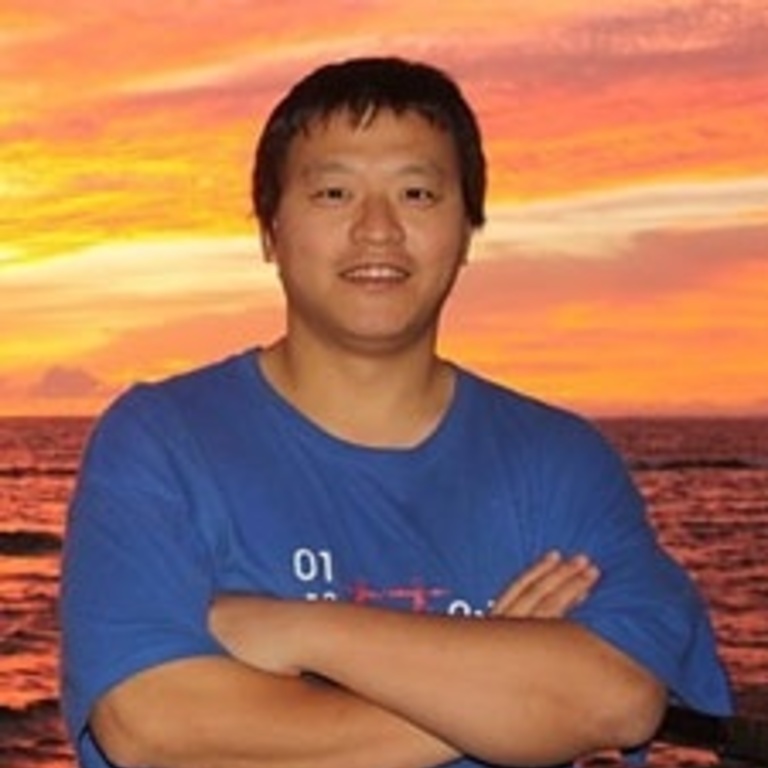
Weiyu Xu is a Professor at the University of Iowa, affiliated with both the Department of Electrical and Computer Engineering and the Department of Applied Mathematical and Computational Sciences. He joined the College of Engineering in 2012 and leads the Intelligent Information Processing Lab (IIPL). Ph.D., Electrical Engineering, California Institute of Technology, 2009 M.S., Electrical Engineering, California Institute of Technology, 2006 M.S., Electronic Engineering, Tsinghua University, 2005 B.E., Information Engineering, Beijing University of Posts and Telecommunications, 2002 His research focuses on compressive sensing, information theory, signal processing, network optimization, and deep learning applications in medical imaging and cybersecurity. He has made significant contributions to adversarial attack robustness, distributed optimization algorithms, and medical imaging techniques for OCT segmentation and brachytherapy. Recent publications highlight trends in Adversarial machine learning Medical imaging algorithms Compressed sensing for diagnostics Optimization in wireless communication He has also contributed to federated learning over tree networks and theoretical guarantees for sparse signal recovery. Weiyu Xu's lab, IIPL, integrates deep learning with classical optimization and signal processing. His work bridges foundational theories (e.g., information-theoretic robustness) with real-world applications in healthcare (e.g., cancer treatment planning) and communication systems (e.g., MIMO channel estimation).
Jose Israel Rodriguez is an Assistant Professor in the Department of Mathematics at the University of Wisconsin-Madison, with additional affiliations in the Department of Electrical & Computer Engineering and the Institute for Foundations of Data Science. He joined UW Madison in Fall 2020 after completing postdoctoral positions at the University of Chicago (with Lek-Heng Lim) and Notre Dame (with Jonathan Hauenstein). Rodriguez earned his PhD in 2014 from UC Berkeley under the supervision of Bernd Sturmfels. His research focuses on applied algebraic geometry and algebraic methods for statistics, with particular interests in nonlinear algebra and nonlinear eigenvalue problems, algebraic statistics and nearest point problems, and applications of monodromy and Galois groups. Rodriguez has made significant contributions to numerical algebraic geometry, particularly in solving polynomial systems, maximum likelihood estimation, and Euclidean distance degree calculations. His work bridges theoretical mathematics with practical computational methods. Rodriguez's recent publications demonstrate a strong trend toward developing numerical methods for solving complex algebraic problems with applications in statistics, optimization, and engineering. His research shows increasing sophistication in handling decomposable systems, multiparameter eigenvalue problems, and braid group computations, often implementing these methods in software tools like Macaulay2. His work connects abstract algebraic geometry with concrete computational approaches. NSF Postdoctoral Fellow Provost's Postdoctoral Scholar Rodriguez currently advises PhD students Julia Lindberg (expected graduation May 2022, joint with B. Lesieutre) and Zinan Wang. He has organized numerous seminars and conferences including SIAM_SAGA, Algebra in Statistics and Computation Seminar, and Applied Algebra Seminar. His research has been supported by various grants that enable his work in numerical algebraic geometry and its applications. Rodriguez is actively involved in the algebraic geometry and statistics communities, organizing several seminars and minisymposia at major conferences. He has developed several software tools including implementations for decomposable sparse polynomial systems, multiregeneration, algebraic optimization, Galois groups, and maximum likelihood obstruction functions. His work connects theoretical mathematics with practical computational applications across various domains.
Ioannis Z. Emiris is a Professor in the Department of Informatics & Telecoms at the National & Kapodistrian University of Athens and concurrently serves as President and General Director of the ATHENA Research Center in Greece. He holds a BSc in Computer Science from Princeton University (1989) and a PhD in Computer Science from UC Berkeley (1994). His research spans computational geometry, algebraic algorithms, robotics, structural bioinformatics, and optimization. He is a leading expert in sparse elimination theory, geometric modeling, and algorithmic algebra. Affiliations: ATHENA Research Center, National & Kapodistrian University of Athens, INRIA Sophia Antipolis (France via joint AROMATH team). Education: BSc (Princeton), PhD (UC Berkeley). Research Interests Emiris's work focuses on geometric algorithms, algebraic systems, and their applications. His contributions include advancements in sparse elimination theory, computational geometry for high-dimensional data, and robotics. He has developed algorithms for polynomial system solving, Voronoi diagrams, and geometric predicates for ellipses. Articles Overview His recent work bridges theoretical advances with practical applications, such as deep learning for protein structure prediction (HydraProt) and geometric algorithms for high-dimensional data analysis. He explores intersections between algebraic geometry and computational methods, with applications ranging from robotics to bioinformatics. Scientific Awards Best Paper Award at ISSAC 2003 and 2010 MSCA Network GRAPES (2019-2023) Advising & Grants Emiris has supervised numerous students and researchers, contributing to interdisciplinary projects. He has secured grants for initiatives like the GRAPES network and has led teams in algorithm design and geometric software development. His work on MARS (Maple/Matlab/C Resultant-Based Solver) exemplifies his focus on practical algorithm implementation. Labs & Teams He directs the Lab of Geometric & Algebraic Algorithms and collaborates with the AROMATH team at INRIA. His research group develops open-source tools for computational geometry and algebraic computations.
Garnet K. Chan is the Bren Professor of Chemistry and Director of the Rudolph A. Marcus Center for Theoretical Chemistry at the California Institute of Technology. He received his B.S. from the University of Cambridge in 1996 and his M.A. and Ph.D. from the University of Cambridge in 2000. Dr. Chan's research lies at the interface of theoretical chemistry, condensed matter physics, and quantum information theory, focusing on quantum many-particle phenomena and the numerical methods to simulate them. His group has developed numerous methodologies including density matrix renormalization and tensor network algorithms, canonical transformation-based down-foldings, local quantum chemistry methods, quantum embeddings, and new quantum Monte Carlo algorithms. His work addresses problems that appear naively exponentially hard but where understanding of physics, particularly entanglement structure, allows for calculations of polynomial cost. Analysis of his recent publications reveals a strong focus on quantum simulation techniques, particularly tensor network methods applied to strongly correlated systems. His research spans fundamental theoretical developments to practical applications in quantum computing, molecular simulation, and materials science, with increasing integration of machine learning techniques and GPU acceleration in computational chemistry frameworks. Dr. Chan leads an active research group at Caltech dedicated to simulating chemical and physical systems at the level of many-particle quantum mechanics. His group has welcomed numerous researchers including Kasra Hejazi, Zuxin Jin, Zhihao Cui, Ke Liao, Henrik Larsson, and Wenyuan Liu. He teaches courses in Physical Chemistry (Ch 21 abc) and Advanced Quantum Chemistry (Ch 225), contributing significantly to theoretical chemistry education at Caltech.
Nicole Wein is an Assistant Professor in the Department of Electrical Engineering and Computer Science at the University of Michigan, where she is a member of the Theory of Computation Lab within the Computer Science and Engineering Division. Her research focuses on theoretical computer science, particularly graph algorithms and lower bounds across various domains including distance-estimation, dynamic, parameterized, distributed, and online algorithms. Education: PhD in Computer Science from MIT, advised by Virginia Vassilevska Williams Master's in Computer Science from Stanford University B.S. in Computer Science/Mathematics from Harvey Mudd College Nicole's research centers on theoretical aspects of graph algorithms and computational complexity. She investigates fundamental questions about how algorithms can efficiently handle changing data, extract information from graphs in linear time, and understand the structure of shortest paths, especially in directed graphs. Her work spans multiple algorithmic paradigms including dynamic algorithms that adapt to changing inputs, parameterized approaches for hard problems, and fine-grained complexity that establishes precise relationships between problem difficulty. Analysis of Nicole's recent publications reveals a strong focus on graph algorithms, particularly shortest path problems, spanners, and hardness results. Her work often bridges theoretical insights with practical implications, developing novel techniques for distance estimation, dynamic graph processing, and approximation algorithms. A significant portion of her research examines the structural properties of graphs that enable or constrain efficient computation, with applications across computer science. Nicole actively mentors students at various levels. She currently advises PhD student Jubayer Nirjhor and has worked with undergraduate researchers including Sam Hiken (now a pre-doc at MIT), Michael Wang, and Tony Zhang. Her teaching includes foundational courses like EECS 376: Foundations of Computer Science and specialized courses such as EECS 598: Graph Algorithms. Nicole contributes to the academic community through service as a program committee member for major conferences including SOSA 2025, FOCS 2025, SODA 2025, and others. She co-organized the June 2023 DIMACS workshop on Modern Techniques in Graph Algorithms and previously organized Algorithms Office Hours at MIT to improve communication between theory and applications of algorithms.
Xiaoming Li is an Associate Professor in the Department of Electrical and Computer Engineering at the University of Delaware , focusing on compiler optimization, GPU computing, and hardware-software interaction. His work bridges machine learning with code generation to enhance program efficiency. B.S. and M.E. from Nanjing University (1998, 2001) Ph.D. in Computer Science from University of Illinois at Urbana-Champaign (2006) Research interests include: Compiler optimizations for static and dynamic code transformation Machine learning-driven code generation techniques FFT algorithms for sparse and hybrid systems Non-traditional compilers for SAT solvers and virtual machines GPU acceleration for large-scale computational problems His publications span 15 years , emphasizing: FFT optimization across GPU/CPU architectures Compiler techniques for heterogeneous systems Adaptive scheduling and error resilience Integration of empirical and model-driven approaches Notable awards: NSF CAREER Award (2008) Best Paper Award at ADAPT Workshop (2013) Advising highlights: Current students: Ryan Taylor, Sha Li, Shuo Chen, Yuanfang Chen, Chao Yang, Chaoyu Chen Graduates: Liang Gu (FFT Libraries), Jakob Siegel (GPGPU Frameworks), Murat Bolat (Context-Aware Compilation)
Anne J. Shiu is a Professor in the Department of Mathematics at Texas A&M University. She holds a Ph.D. in Mathematics (2010) from the University of California Berkeley with advisors Bernd Sturmfels and Lior Pachter. Her career includes postdoctoral positions at Duke University (2010-2011) and the University of Chicago (2011-2014), followed by a faculty role at Texas A&M since 2014. Research Focus: Algebraic, geometric, and combinatorial approaches to mathematical biology, specializing in biochemical dynamical systems, neural coding, parameter identifiability, algebraic statistics, and genomics. Academic Contributions: Over 15 recent publications spanning identifiability in compartmental models, multistationarity in reaction networks, convexity analysis of neural codes, and algebraic robustness in biochemical systems. Scientific Recognition: Association of Former Students Distinguished Achievement College-Level Award in Teaching (2019) Invited speaker for Ethel Ashworth-Tsutsui Memorial Lecture (2018-2019) Current Research: Investigates structural identifiability in biological models, focusing on compartmental systems, reaction networks, and neural codes through algebraic methods and computational tools. Her work bridges abstract algebra with practical biological applications, including parameter estimation and robustness analysis. Grant Support: Recipient of NSF CAREER award (2018-2023), prior NSF grants (2010-2017), and Simons Foundation Collaboration Grant (#521874, 2017-2018). Academic Leadership: Organized multiple international workshops/conferences including SIAM conferences and Banff workshop. Currently an Associate Editor for SIAM Journal on Applied Mathematics and serves on the AIM Scientific Research Board.
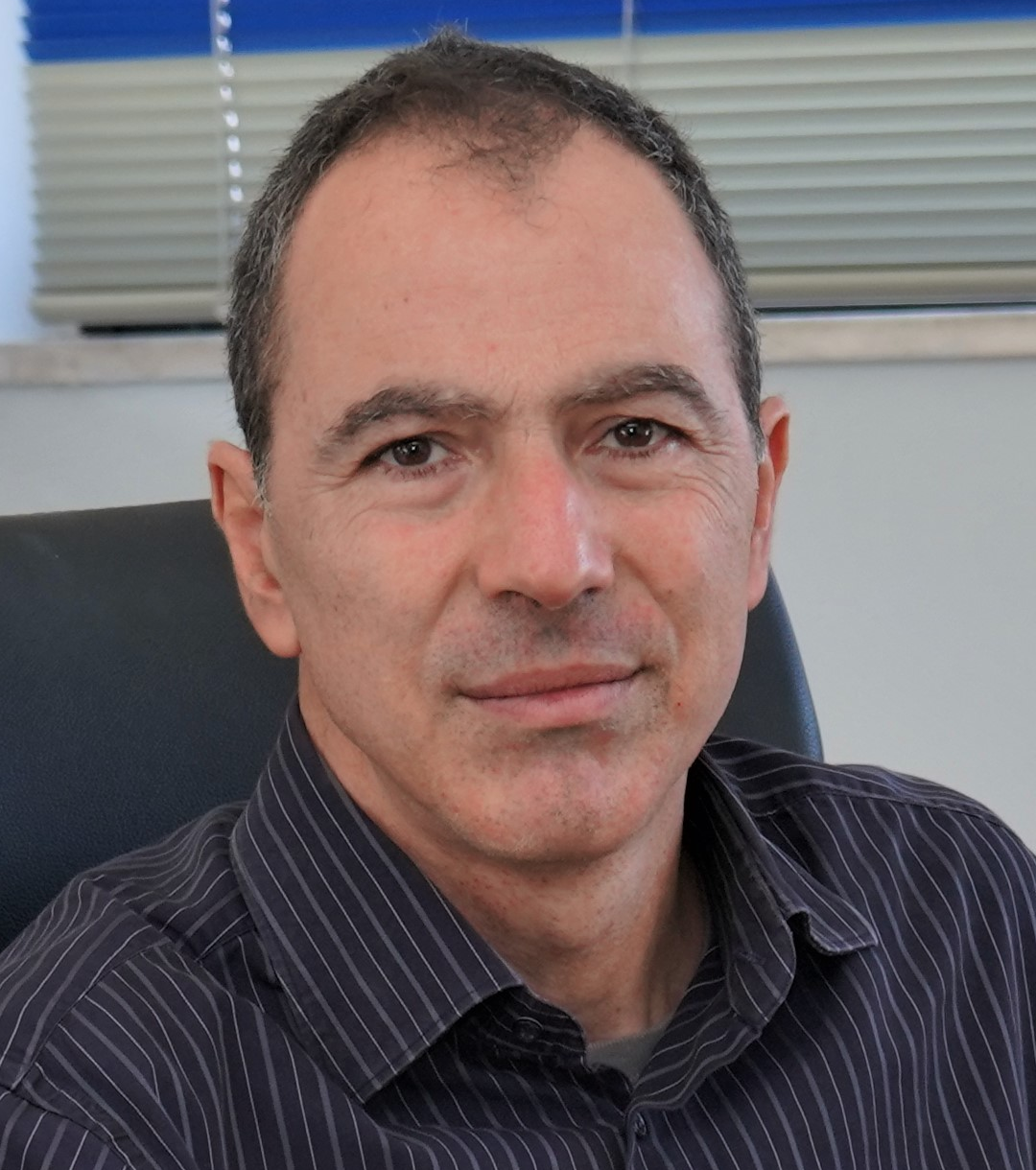
Professor Asaf Shapira is a faculty member in the Department of Theoretical Mathematics at Tel Aviv University's School of Mathematical Sciences. He has been actively contributing to combinatorics and graph theory research for over a decade, with numerous publications in top journals including Journal of the ACM, Advances in Mathematics, and Geometric and Functional Analysis. Professor Shapira's research focuses on extremal combinatorics, graph theory, and property testing. His work explores fundamental questions in Ramsey theory, hypergraph theory, and probabilistic methods in combinatorics. He has made significant contributions to the study of graph regularity, removal lemmas, and extremal problems in dense and sparse graphs. His recent publications demonstrate a consistent focus on theoretical aspects of combinatorics with connections to theoretical computer science. A notable trend is his work on developing polynomial bounds for various combinatorial theorems and exploring connections between combinatorial structures and computational complexity. His research often bridges pure mathematics with theoretical computer science applications. Professor Shapira teaches advanced courses at Tel Aviv University including Extremal Graph Theory, Basic Combinatorics, and seminars on specialized topics in combinatorics. His teaching spans undergraduate and graduate levels, reflecting his commitment to educating the next generation of mathematicians.
Dr. Giang Tran is an Associate Professor in the Department of Applied Mathematics at the University of Waterloo, where she leads research in sparse modeling and computational mathematics. She holds a PhD from UCLA and previously served as a Bing Instructor at the University of Texas at Austin. Her research explores sparse optimization techniques with applications in medical imaging, dynamical systems, and data science. Recent publications focus on developing novel algorithms for sparse random feature expansions and dynamical system identification. She mentors numerous graduate and undergraduate researchers through projects on neural networks, transformers, and epidemic forecasting. Awards include the NSERC Discovery Grant and SIAM Student Paper Prize. Dr. Tran teaches advanced courses in numerical methods and functional analysis, contributing to curriculum development in computational mathematics.