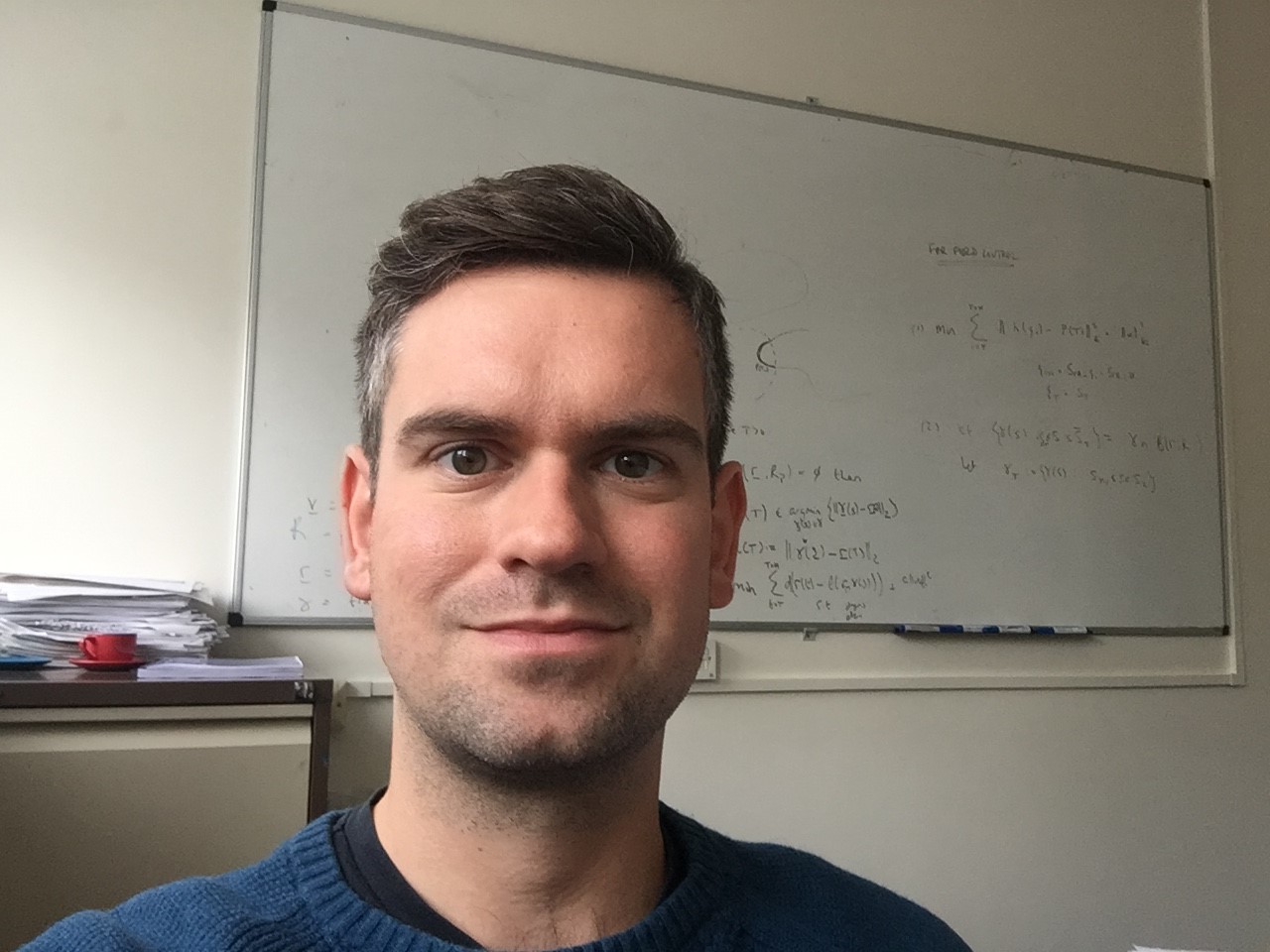
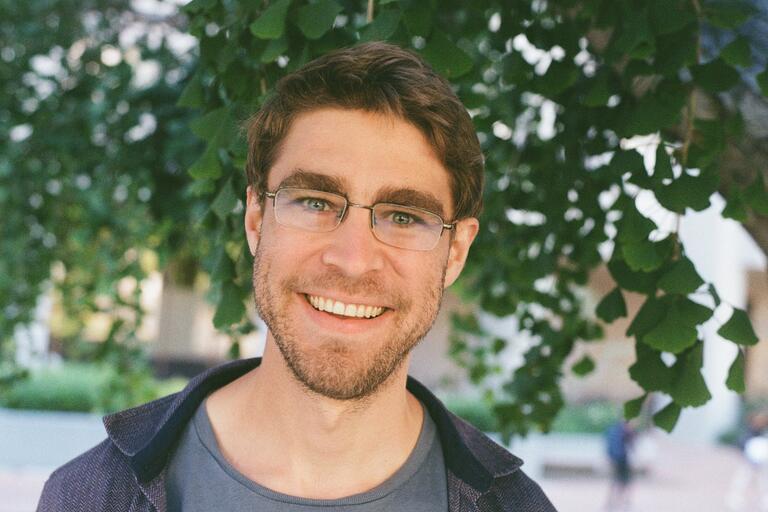
Dr. Richard Veras is an Assistant Professor in the School of Computer Science at the University of Oklahoma . His research focuses on High Performance Computing (HPC), with emphasis on code synthesis, parallel algorithms, and optimizing computational workflows for modern hardware architectures. Education: Ph.D. and M.S. in Electrical and Computer Engineering from Carnegie Mellon University B.S. in Mathematics and Computer Science from The University of Texas at Austin Research Interests: High Performance Computing (HPC) Parallel algorithm design and implementation Computational linear algebra and signal processing Graph analytics and network modeling Compiler optimizations and automated code generation Performance portability across hardware architectures Professional Experience: Research Scientist at Louisiana State University Postdoctoral Researcher at Carnegie Mellon University Labs/Teams: Leads HPC research initiatives at OU, focusing on code synthesis tools and performance optimization frameworks.
Randal Burns is a Professor and the Bill and Lisa Stromberg Head of the Department of Computer Science in the Whiting School of Engineering at Johns Hopkins University. He is also affiliated with the Data Science and AI Institute and co-founder of NeuroData. His research focuses on scalable data systems for scientific applications, spanning storage technologies, cloud infrastructure, and graph/sparse-matrix engines for machine learning. Key themes include data-intensive science, neuroscience imaging analysis, and adaptive performance management. Recent publications highlight trends in edge-parallel graph encoders masked matrix operations for sparsity decentralized foundation model training storage optimization for evolving AI models batch-parallel data structures turbulence data analysis These reflect his work on scalable systems for machine learning and scientific computing. Scientific awards include NSF CAREER Award DOE Early Career Principal Investigator Kavli Fellowship IBM Outstanding Innovation Award Advising: Mentors PhD students in scalable data systems and machine learning. Grants: Supported by NSF, DOE, and DARPA initiatives. Labs: Core member of the Johns Hopkins Turbulence Database Group and NeuroData team, developing open platforms for neuroscience and turbulence research.
Galen Reeves is an Assistant Professor at Duke University with a joint appointment in the Department of Electrical and Computer Engineering and Department of Statistical Science since Fall 2013, reflecting his interdisciplinary expertise bridging engineering and mathematical sciences. His research establishes rigorous theoretical frameworks at the intersection of information theory, machine learning, and statistical signal processing, focusing on fundamental limits in high-dimensional inference problems. His academic background features elite training across top institutions: PhD in Electrical Engineering and Computer Sciences, University of California, Berkeley (2011) MS in Electrical Engineering, University of California, Berkeley (2007) BS in Electrical and Computer Engineering, Cornell University (2005) Reeves' research centers on mathematical foundations of data science, with seminal contributions to compressed sensing, tensor estimation, and coding theory. He investigates information-theoretic bounds for estimation problems, develops efficient algorithms like approximate message passing, and analyzes generative AI model behavior under recursive training conditions. His work demonstrates how statistical physics approaches solve complex problems in communication theory and high-dimensional statistics. Analysis of his 2021-2025 publications reveals three dominant trends: breakthroughs in channel capacity using Reed-Muller codes, theoretical analysis of generative models and diffusion sampling, and fundamental limits in tensor/matrix estimation. These works consistently integrate information theory with machine learning, emphasizing scalability challenges in high dimensions and algorithmic robustness under heteroskedasticity. His scientific recognition includes: NSF VIGRE fellowship supporting postdoctoral research at Stanford University (2011-2013) NSF CAREER award (2018) for Theoretical Foundations for Probabilistic Models with Dense Random Matrices While no specific students are documented in the source text, his faculty position entails graduate mentorship in both ECE and Statistical Science departments. Research funding primarily stems from the NSF CAREER grant advancing probabilistic modeling, complemented by earlier fellowship support. His collaborations span Stanford University, EPFL, TU Delft, and Microsoft Research. Though no dedicated lab is mentioned, his joint appointment fosters cross-departmental research at Duke, particularly in projects like 'Modeling Traffic with Self Driving Cars' which applies statistical learning to autonomous systems. His work maintains strong ties to industry through past Microsoft Research internships and ongoing computational applications in communications and AI.
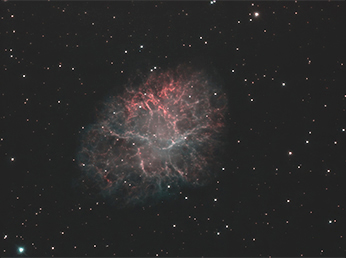
Robert J. Vanderbei is a full Professor in the Department of Operations Research and Financial Engineering (ORFE) at Princeton University. He also holds courtesy appointments in Mathematics, Astrophysics, Computer Science, Mechanical and Aerospace Engineering, and Applied Mathematics, and is a member of the Bendheim Center for Finance. He served as department chair from 2005 to 2011. Education: BS in Chemistry and MS in Operations Research and Statistics from Rensselaer Polytechnic Institute (1976) PhD in Applied Mathematics from Cornell University (1981) Vanderbei's research spans optimization, applied mathematics, and astrophysics. He is a pioneer in linear and semidefinite programming, having co-developed the influential HKM algorithm and contributed to robust optimization. His work at Bell Labs led to patented algorithmic enhancements. He has also made significant contributions to space telescope design for exoplanet detection and is an accomplished astrophotographer. His interdisciplinary work bridges theoretical research and real-world applications in finance, engineering, and astronomy. His recent publications reflect a strong trend in interdisciplinary research, combining mathematical optimization with astrophysical applications, data visualization, and educational outreach. Key themes include interior-point methods, robust optimization, space imaging, and 3D astronomical visualization. His work continues to influence both theoretical and applied domains. Author of a widely adopted textbook on Linear Programming Developer of the LOQO nonlinear optimization software Co-author of popular science books: Sizing Up The Universe and Welcome To The Universe in 3D Creator of the 'Purple America' election visualization Vanderbei has been actively involved in academic leadership and public engagement. His research has been supported by various grants, particularly in optimization and space science. He has mentored students and collaborated widely across disciplines, though specific advisees are not listed. He led the ORFE department for six years and continues to contribute to curriculum development and interdisciplinary initiatives. He maintains a strong presence in scientific and public communities through his astrophotography gallery and educational outreach. His Fitzrandolph Observatory supports both personal and educational imaging projects. He was formerly a glider pilot and flight instructor, demonstrating a lifelong passion for aerospace and observational science.
Zhiru Zhang is a Professor at Cornell University in the School of Electrical and Computer Engineering , leading research at the Computer Systems Laboratory . His work focuses on algorithms, methodologies, and design automation tools for heterogeneous computing systems. Recent publications emphasize high-level synthesis (HLS), hardware specialization for machine learning, and programming models for software-defined FPGAs. Education: Ph.D. in Computer Science, UCLA B.S. in Computer Science, Peking University M.S. in Computer Science, UCLA Research Interests: Heterogeneous computing systems High-level synthesis (HLS) optimization FPGA-based hardware acceleration Sparse data format compilers Machine learning for electronic design automation Scientific Awards: IEEE Fellow Intel Outstanding Researcher Award NSF CAREER Award DARPA Young Faculty Award Multiple Best Paper Awards at ASPLOS, ISPD, FPGA, AutoML, FCCM Research Group: Mentors 12 current students including Jordan Dotzel, Jie Liu, and Grace Dinh, with 14 alumni now at institutions like AWS AI, NVIDIA, Google DeepMind, and Microsoft. His lab develops tools like UniSparse for sparse format customization, presented at OOPSLA'24 and IEEE CAL.
Lexing Ying is a Professor of Mathematics at Stanford University. His research focuses on applied mathematics, computational science, and interdisciplinary areas such as quantum computing, machine learning, and numerical analysis. He has made significant contributions to high-dimensional problems, inverse problems, and the development of efficient algorithms for complex systems. His work spans theoretical advancements and practical applications, including quantum signal processing, tensor-based numerical methods, and probabilistic modeling. Key themes in his research include the analysis of diffusion models, stochastic systems, and optimization algorithms. Recent publications highlight innovations in solving high-dimensional PDEs, improving sampling techniques, and advancing quantum algorithms. Notably, Ying has developed methods for operator learning, functional hierarchical tensors, and robust phase estimation. His research often bridges mathematical theory and computational practice, addressing challenges in areas like statistical inference and numerical simulation.
Lixin Shen is a Professor in the Department of Mathematics at Syracuse University, part of the College of Arts and Sciences. His research focuses on applied and computational harmonic analysis, optimization, imaging science, and information processing. Shen holds a Ph.D. in Mathematics from Sun Yat-Sen University (1996), an M.Sc. from Peking University (1990), and a B.Sc. from Peking University (1987). Education: Ph.D., Mathematics, Sun Yat-Sen University, 1996 M.Sc., Mathematics, Peking University, 1990 B.Sc., Mathematics, Peking University, 1987 Research Interests: Shen’s work emphasizes sparse optimization, image and signal processing, computational mathematics, and their applications. Notable areas include wavelet analysis, tensor decomposition, and robust algorithms for noise removal and high-resolution imaging. Grants & Awards: NSF Grant: Collaborative Research: Sparse Machine Learning and Sparse Optimization (2022–2025) Excellence in Graduate Education Faculty Recognition Award, Syracuse University (2024) Air Force Summer Faculty Fellowship (2024, 2023, 2021, 2020) Service & Leadership: Chair of Graduate Committee, Mathematics Department (2024–2025) Editor, Frontiers in Applied Mathematics and Statistics Organizer, SIAM Conferences on Optimization and Imaging (2023–2020) Teaching: Recent courses include Numerical Linear Algebra, Numerical Methods with Programming, Sparse Optimization, and Partial Differential Equations.
Maciej Besta is a leading researcher at ETH Zurich's Institute for Computing Platforms, where he heads research initiatives at the Scalable Parallel Computing Lab (SPCL) and contributes to the ETH Future Computing Laboratory (EFCL). Working under the mentorship of Professor Torsten Hoefler, he has established himself as a prominent figure in high-performance computing, graph processing, and large language models. Position: Researcher at Institute for Computing Platforms, ETH Zurich Research Leadership: Head of Sparse Graph Computations and Large Language Models Research at SPCL Collaboration: Leads project management for SPCL's contributions to ETH Future Computing Laboratory Besta's research spans multiple abstraction levels, from hardware and network topologies to middleware, algorithms, and programming models. His primary focus areas include graph-enhanced language models, graph neural networks, graph databases, and sparse models, with applications across various computational settings. He approaches these problems through rigorous performance modeling and formal reasoning, emphasizing both scalability and practical implementation. His recent publications reveal a clear trend toward integrating graph structures with language models and AI systems. Besta has pioneered work on graph databases, knowledge graphs of thoughts, and higher-order graph neural networks, while maintaining his strong foundation in high-performance computing and network topology design. His research bridges traditional HPC with cutting-edge AI, creating novel approaches for efficient large-scale computation. IEEE TCSC Award for Excellence in Scalable Computing (Early Career, 2023) Multiple Best Paper Awards at Supercomputing conferences (2022, 2023) ACM SIGHPC Doctoral Dissertation Award (2022) ETH Medal for outstanding doctoral thesis (2021) Fellow of The Explorers Club (2022) Besta actively mentors ETH Zurich students through semester projects, Bachelor's, and Master's theses, focusing on graph processing and related computer science challenges. His mentorship extends beyond technical guidance, incorporating lessons from his extensive polar and mountaineering expeditions that emphasize mental resilience, efficient risk management, and leadership. He has supervised numerous student projects that have resulted in high-impact publications at top-tier conferences. As a core member of the Scalable Parallel Computing Lab, Besta collaborates with researchers across ETH Zurich and international institutions. His unique approach integrates insights from extreme environment expeditions into research methodology, creating a distinctive framework for tackling complex computational problems. The lab's work under his leadership spans theoretical modeling, practical implementation, and real-world deployment of high-performance systems.
P. Sadayappan is a Professor at the School of Computing, University of Utah, specializing in high performance computing, compiler optimization, and scalable machine learning. His research focuses on developing efficient computational methods for scientific applications, particularly in the areas of sparse/dense matrix and tensor computations. His research interests include: Compiler Optimization for High Performance Computing Optimization of Sparse/Dense Matrix/Tensor Computations Scalable Machine Learning Algorithm-Architecture Co-Design Optimization Sadayappan's recent publications demonstrate a strong focus on tensor computations, GPU acceleration, and compiler optimizations for machine learning workloads. His work spans from fundamental compiler theory to practical implementations that improve performance across various architectures. A significant trend in his recent work involves the development of frameworks for efficient tensor operations, sparse matrix computations, and domain-specific code generation, with particular emphasis on performance portability across heterogeneous computing platforms. His notable scientific achievement includes receiving the ACM SIGPLAN Most Influential PLDI Paper Award in 2018 for his work on polyhedral compilation. Sadayappan has been principal investigator or co-investigator on numerous significant research grants, including: NSF award #2217154 (2022-2027): A Comprehensive Framework for Efficient, Scalable, and Performance-Portable Tensor Applications NSF award #2112606 (2021-2026): AI Institute for Intelligent CyberInfrastructure with Computational Learning in the Environment (ICICLE) NIH SBIR-Phase 2 (2023-2025): Enabling next generation machine learning for large scale image analysis NSF award #2009007 (2020-2024): Data Locality Optimization for Sparse Matrix/Tensor Computations DARPA SBIR-Phase 2 (2017-2022): Performance Portable Framework for Developing Graph Applications He teaches CS 4230/6230 (Parallel and High-Performance Computing) at the University of Utah and collaborates extensively with researchers across multiple institutions on projects involving computational chemistry, physics simulations, graph analytics, and machine learning.
Zheng Zhang is a Professor in the Department of Electrical and Computer Engineering at the University of California, Santa Barbara. His research focuses on neural networks, quantum computing, uncertainty quantification, and optimization, with particular emphasis on tensor networks, low-rank compression methods, and hardware-efficient machine learning systems. He leads efforts in developing memory-efficient training algorithms for large language models (LLMs), tensorized optical networks, and physics-informed neural PDE solvers. Key contributions include FLAT-LLM for LLM compression, FETTA hardware accelerators, and DeepOHeat for thermal simulation in 3D-IC design. His work spans cross-disciplinary areas such as quantum-inspired algorithms, stochastic control, and yield-aware optimization of photonic ICs. He holds a faculty position in the College of Engineering and is affiliated with the ECE department. Research trends in his 2025 publications emphasize scalable training techniques for transformers, zeroth-order optimization methods, and optical computing integration. His work consistently addresses computational efficiency, memory constraints, and hardware acceleration across domains like AI, quantum computing, and electronic design automation. Notable grants and lab affiliations include projects on FPGA-based neural training, quantum circuit simulation, and tensor-compressed PDE solvers. He advises on edge computing, neuromorphic systems, and uncertainty-aware design tools for integrated circuits.
Dr. Andrew Wynn is an Associate Professor in the Department of Aeronautics at Imperial College London, Faculty of Engineering. His research focuses on developing computational optimization methods to improve fluid mechanical systems, including active flow control, data-driven modelling, aeroservoelasticity, and semi-algebraic optimization techniques. He leads a research group addressing challenges in fluid-structure interactions, turbulence, and control systems. Wynn's affiliations include the Flow Control Research Group and the Aeroelastics Group. His work intersects interdisciplinary fields such as mechanical engineering, applied mathematics, and aerospace engineering. Key research topics include bluff body drag reduction, scaling laws for fluid flows, and estimator design for high-dimensional systems. Publications highlight contributions to fluid mechanics, optimization algorithms, and control theory. His group employs methods like semidefinite programming and dynamic mode decomposition to analyze and control complex flows. Ongoing projects involve wind farm optimization, global stability of viscoelastic fluids, and Bayesian optimization for experimental fluid dynamics. Education: Not explicitly stated in the provided text. Grants & Awards: Affiliated with Imperial College Research Fellowships (ICRF) and President's PhD Scholarships programs. Labs/Teams: Leads the Wynn Research Group, collaborating with the Flow Control and Aeroelastics Groups.
Dustin Richmond is an Assistant Professor in the Department of Computer Science and Engineering at the Baskin School of Engineering, University of California, Santa Cruz. His work focuses on secure, usable hardware systems with applications in FPGA acceleration, RISC-V architectures, and side-channel analysis. Email: drichmond@ucsc Office: Engineering 2, Room 221 Research Interests: Secure hardware systems FPGA-based computing Manycore processors High-level synthesis Side-channel vulnerabilities Notable Article Trends: Recent publications emphasize cloud FPGA security, manycore design optimization, and hardware security. Earlier works focus on RISC-V acceleration, OpenCL compiler enhancements, and heterogeneous computing systems. GitHub Contributions: Maintains open-source projects like RISC-V-On-PYNQ and PYNQ-HLS, addressing FPGA programming challenges and RISC-V integration. Active in resolving community issues related to toolchain compatibility and hardware-software interfaces.
Peter Münch is a postdoctoral researcher at the Chair of Numerical Methods for Partial Differential Equations within the Institute of Mathematics at Technical University of Berlin (TU Berlin), Faculty II - Mathematics and Natural Sciences. He has held research positions at Uppsala University, University of Augsburg, Helmholtz-Zentrum Hereon, and Technical University of Munich. Dr. Münch's research focuses on high-performance scientific computing with expertise in matrix-free computations, dynamic sparse communication patterns, node-level optimization, iterative solvers including multigrid and block preconditioners, and efficient algorithms for high-dimensional partial differential equations. His work spans discontinuous Galerkin methods, computational fluid dynamics, and simulation of additive manufacturing processes including solid-state sintering and melt-pool modeling. He is one of the principal developers of the deal.II finite-element library, which won the SIAM/ACM Prize in Computational Science and Engineering in 2025. His recent publications demonstrate significant contributions to matrix-free finite element methods, multigrid solvers, and applications in computational fluid dynamics and materials science. The research shows a strong trend toward high-performance implementations of numerical methods for extreme-scale computing, with particular emphasis on matrix-free approaches that avoid explicit storage of large sparse matrices. SIAM/ACM Prize in Computational Science and Engineering 2025 (for deal.II) Dr. Münch has supervised numerous student projects including Master's theses, Bachelor's theses, and term papers on topics ranging from immersed boundary methods to high-order discontinuous Galerkin methods. His teaching activities include courses on Numerical Methods for ODEs, PDEs, and High-Performance Parallel Computing. He has contributed to multiple deal.II tutorial programs (steps 19, 68, 75, 76, 87) demonstrating advanced finite element techniques. As a principal developer of the deal.II finite element library, Dr. Münch is actively involved in the open-source scientific computing community, contributing to one of the most widely used finite element frameworks in computational science and engineering. His GitHub profile shows consistent contributions to deal.II and related projects, with significant activity in 2025.
Michael J. Lindsey is an Assistant Professor in the Department of Mathematics at the University of California, Berkeley, and a Faculty Scientist at Lawrence Berkeley National Laboratory. His research focuses on computational methods driven by Numerical Linear Algebra , Optimization , and Randomization , particularly for High-Dimensional Scientific Computing in quantum many-body problems and applied probability. University : UC Berkeley (Assistant Professor since 2022) Lab Affiliation : Mathematics Group at Lawrence Berkeley National Laboratory Email : lindsey@berkeley.edu His work includes Semidefinite Relaxation for quantum and classical problems, Monte Carlo Sampling techniques, and Tensor Networks for high-dimensional functions. He has pioneered Variational Embedding theory with guaranteed energy bounds and scalable solvers for quantum systems. Recent publications span Quantum Chemistry , Machine Learning , and High-Dimensional Probability , with applications to Electronic Structure , Molecular Dynamics , and Optimal Transport . He received the 2024 Hellman Fellowship and the 2019 SIAM Student Paper Prize . Teaching includes graduate and undergraduate courses in numerical analysis and applied mathematics at UC Berkeley and New York University. He also organizes the HDSC Seminar on high-dimensional scientific computing.