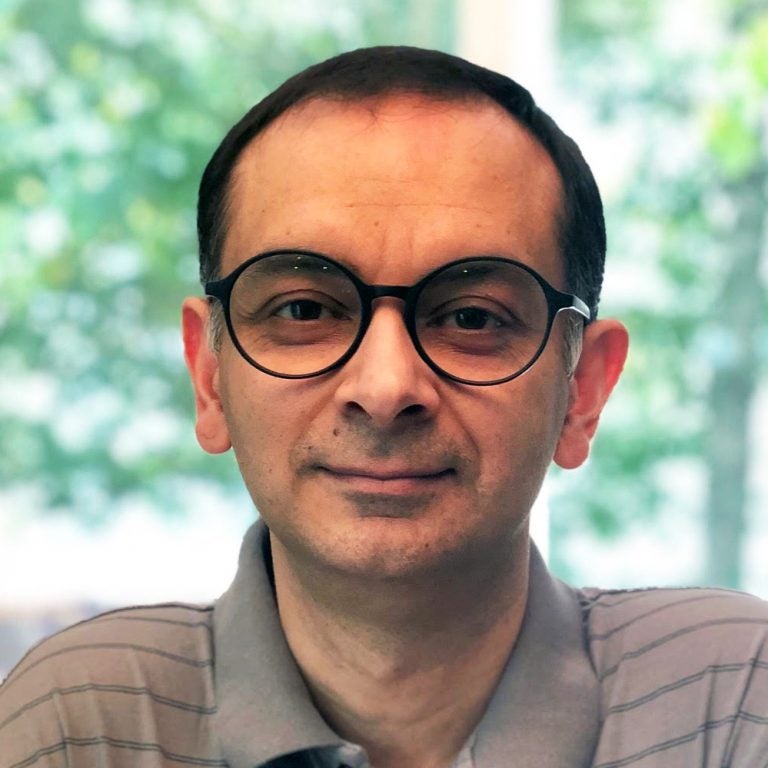
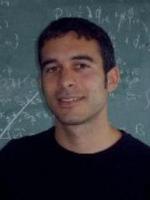
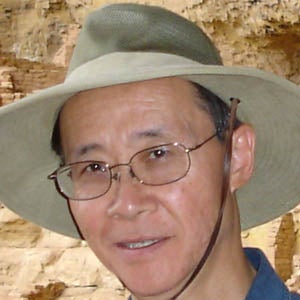
Jonathan Winghong Luk is a Professor in the Department of Mathematics at Stanford University. His research focuses on nonlinear partial differential equations, general relativity, and mathematical physics, with a particular emphasis on gravitational wave dynamics, shock formation, and high-frequency spacetime solutions. Contact: Email: jluk@stanford.edu Office: 382-Z, Building 380, Stanford, CA 94305 Research Trends: His recent publications examine nonlinear wave equations on dynamic spacetimes, gravitational phase mixing, impulsive gravitational wave interactions, and stability of black hole interiors. He frequently collaborates with experts like C. Huneau, S.-J. Oh, and J. Speck. Academic Activities: Luk organizes the Analysis and PDE seminar at Stanford with Eugenia Malinnikova and Ryan Unger. He has developed lecture notes on nonlinear wave equations and Fourier analysis, complemented by example sheets.
Harvey Reall is a Professor of Theoretical Physics at the University of Cambridge , affiliated with the Department of Applied Mathematics and Theoretical Physics (DAMTP) and a Fellow of Trinity College . His research focuses on General Relativity and Effective Field Theory , particularly in the context of black hole mechanics , higher-dimensional gravity , and cosmic censorship . He has held prestigious positions including a Royal Society University Research Fellowship from 2005 to 2013. Education: PhD from DAMTP, University of Cambridge. Previous Appointments: Lecturer at the University of Nottingham (2005-2007); Postdoctoral positions at the Kavli Institute (2003-2005), Queen Mary University of London (2000-2003), and University of California, Santa Barbara (2003-2005). Reall's work explores the uniqueness and stability of black holes , causality in gravitational theories , and effective field theory approaches to gravity . His recent publications address nonperturbative second law formulations , event horizon dynamics , and axisymmetry theorems in extended theories of gravity. He has supervised numerous researchers including Aidan McSharry (2025-) , Maxime Gadioux (2022-) , and Iain Davies (2020-24) , contributing to the training of the next generation of physicists. Scientific Awards: Royal Society University Research Fellow (2005-2013)
Christoph Kehle is an Assistant Professor in the Department of Mathematics at the Massachusetts Institute of Technology (MIT) since 2024. He works at the intersection of General Relativity, Partial Differential Equations, and Mathematical Physics, focusing on black hole stability, cosmic censorship, and gravitational collapse phenomena. Education: PhD in Mathematics (2020) from the University of Cambridge under Mihalis Dafermos, MASt (2015) at Cambridge, and BS/MS (2016) from LMU Munich. Research: His work addresses fundamental questions about black hole interiors, extremal black hole formation, and nonlinear wave dynamics on curved spacetimes. He investigates connections between Diophantine approximation and spacetime stability, as well as turbulence in AdS black hole systems. Scientific Awards: Recipient of the Research Scholar at Trinity College (Cambridge), EPSRC PhD Scholarship, Senior Scholarship Exam Prize, and scholarships from the German Academic Foundation and Max Weber-Program. Publications: 15 most recent articles span nonlinear stability of extremal black holes, critical collapse phenomena, and geometric PDEs. Collaborators include Y. Angelopoulos, R. Unger, A. Figalli, and M. Van de Moortel.
Yakov Shlapentokh-Rothman is an Assistant Professor jointly appointed in the Department of Mathematics at the University of Toronto St. George and the Department of Mathematical and Computational Sciences at the University of Toronto Mississauga. His research focuses on the intersection of partial differential equations, general relativity, and geometric analysis, with particular emphasis on black hole physics and the Einstein field equations. Education: PhD: Massachusetts Institute of Technology (2015) BS with Honors: Stanford University (2010) Research Interests: Shlapentokh-Rothman's work explores fundamental problems in mathematical relativity, including black hole stability, singularity formation, wave propagation in curved spacetimes, and the asymptotic behavior of solutions to Einstein's equations. His research combines rigorous PDE analysis with deep geometric insights. Publications focus on: black hole dynamics, scattering theory in curved spacetimes, stability analysis of Kerr and Reissner-Nordström solutions, cosmic censorship conjectures, and self-similar solutions to Einstein's equations. Recent work examines the structure of naked singularities and decay properties of fields in black hole backgrounds. Awards and Recognition: Alfred P. Sloan Fellowship in Mathematics Advising and Grants: Currently advising PhD student: Avyay Venkat Viswanath Research supported by NSERC Discovery Grants (RGPIN-2021-02562, DGECR-2021-00093)
Professor Oscar Dias is a faculty member in the Department of Mathematical Sciences at the University of Southampton. His research focuses on Einstein's gravity, black holes, holographic dualities, and gravitational aspects of string theory. He actively supervises PhD students in mathematical sciences and holds grants from the Science and Technology Facilities Council (STFC), including projects like 'New Frontiers in Particle Physics, Cosmology and Gravity.' His work explores topics such as cosmic censorship, black hole dynamics, and numerical general relativity, with recent contributions published in journals like Physical Review Letters and Journal of High Energy Physics . Key research interests include the study of black hole binaries in de Sitter space, the stability of charged black holes, and the interplay between holographic dualities and quantum field theories. His projects often involve collaborations with leading institutions, addressing foundational questions in theoretical physics and cosmology. Professor Dias is a member of the Southampton Theory Astrophysics and Gravity (STAG) Research Centre and the String Theory and Holography group. His articles highlight advancements in understanding gravitational wave phenomena, quasinormal modes, and the behavior of black holes under various physical conditions. He currently accepts PhD applications and can be contacted via O.J.Campos-Dias@soton.ac.uk.
Gaurav Khanna is a Professor in the Department of Physics at the University of Rhode Island (URI) and serves as the Director of Research Computing at URI. He is a key member of the UMass-URI Gravity Research Consortium (U²GRC), a collaborative effort between the gravity research groups at URI and the University of Massachusetts Dartmouth focused on gravitational physics research. Dr. Khanna earned his Ph.D. in Physics from Pennsylvania State University in 2000 and his B.Tech. in Electrical Engineering from the Indian Institute of Technology Kanpur, India in 1995. His academic journey reflects a strong foundation in both theoretical physics and engineering principles that inform his current research. His primary research focuses on theoretical and computational aspects of gravitational physics, particularly the coalescence of binary black hole systems using perturbation theory and estimation of emitted gravitational radiation properties. This work is directly relevant to the NSF LIGO laboratory and upcoming space-borne gravitational wave detection missions. His research spans black holes, gravitational waves, quantum gravity, and high-performance scientific computing. Dr. Khanna has developed advanced computational techniques for modeling extreme mass ratio inspirals and has made significant contributions to understanding black hole singularities in both classical and quantum gravity frameworks. Dr. Khanna has published nearly 100 research papers in top international journals and secured over $2 million in research funding. His work has been featured in prominent media outlets including Nature Magazine, Quanta Magazine, and Physics World. He has advised numerous graduate students, with Tousif Islam (Ph.D. '24) receiving an honorable mention in the GWIC-Braccini Thesis Prize, and Som Bishoyi earning UMass Dartmouth's Research in the Media Award. American Physical Society Fellow As Director of Research Computing, Dr. Khanna oversees high-performance computing resources and provides expertise in parallel and scientific computing. His work with the U²GRC involves collaboration with major research groups including the Simulating Extreme Spacetimes (SXS) Collaboration, Kavli Institute for Astrophysics at MIT, Black Hole Initiative at Harvard, and the Max Planck Institute for Gravitational Physics in Germany. The consortium's research is funded through multiple National Science Foundation grants, NASA, and private foundations.
Professor Maciej Dunajski is a University Professor of Mathematical Physics at the Faculty of Mathematics, University of Cambridge, and a Senior Lecturer at Clare College Cambridge. His career spans institutions including Oxford and Cambridge, with roles ranging from Tutorial Fellow to Senior Research Associate. He holds a DPhil from the Mathematical Institute, Oxford, and was awarded the title of Professor by the President of Poland in 2011. University Professor of Mathematical Physics, Faculty of Mathematics, University of Cambridge (2021–present) University Reader in Mathematical Physics, University of Cambridge (2020–2021) Fellow at Clare College Cambridge (2003–present) Author of Solitons, Instantons & Twistors (Oxford University Press, 2009) His research focuses on Twistor Theory , Integrable Systems , and Differential Geometry , with significant contributions to self-dual gravity, Einstein-Weyl structures, and geometric solutions to nonlinear equations. His work bridges mathematics and theoretical physics, including applications to quantum gravity and black hole thermodynamics. Dunajski's recent publications highlight advancements in conformal geometry, null Kähler structures, and higher-dimensional relativity. His collaborations span researchers like K. P. Tod, R. Penrose, and L. Mason. He is based in Room B2.14 at DAMTP, Cambridge, and maintains an active research group in high-energy physics.
Prof. Dr. Gerhard Huisken is a Professor at Eberhard Karls University of Tübingen and Director of the Mathematical Research Institute Oberwolfach. His research focuses on geometric analysis, differential geometry, and mathematical relativity, with significant contributions to mean curvature flow, Ricci flow, and geometric evolution equations. He has authored numerous influential papers on topics such as curvature flows, singularity analysis, and applications to general relativity. Key positions include leadership at Oberwolfach and teaching roles in advanced courses like 'Mathematical Relativity' and 'Introduction to Ricci Flow'. His work bridges geometric analysis with physics, contributing to the Poincaré conjecture through Ricci flow studies. Collaborations include projects with S. Brendle and C. Sinestrari on convex solutions and flow surgeries. Research highlights include the Riemannian Penrose inequality, inverse mean curvature flow, and long-term behavior of geometric flows. His academic contributions are documented in top journals like Inventiones mathematicae and Journal of Differential Geometry .
Karen Crowther is Associate Professor in the Department of Philosophy, Classics, History of Art and Ideas at the University of Oslo, where she specializes in the philosophy of science and philosophy of physics. Previously, she held postdoctoral positions at the University of Geneva (2016-2019) and the University of Pittsburgh (2014-2015). Her research focuses on the foundations of physics, particularly quantum gravity and the emergence of spacetime, and she is an active contributor to the international philosophy of physics community. Dr. Crowther's educational background includes: PhD in Philosophy, University of Sydney, 2015 BA (Hons) in Philosophy, Monash University, 2009 BSc (Hons) in Physics, Monash University, 2008 Her primary research interests span the philosophy of science and philosophy of physics, with additional focus on metaphysics and epistemology. Dr. Crowther investigates scientific methodology, non-empirical approaches to theory development, inter-theory relations in physics (including reduction, correspondence, and emergence), fundamentality, space and time, and quantum gravity. Her work examines how fundamental physical theories relate to one another and how spacetime might emerge from more basic quantum structures. Dr. Crowther's publication record demonstrates a consistent focus on quantum gravity and the philosophical foundations of physics. Her recent work explores the motivations for seeking quantum gravity, levels of fundamentality, and the role of principles in theoretical physics. She has developed nuanced analyses of spacetime emergence, distinguishing between synchronic and diachronic conceptions, and has critically examined reduction in physics. Her research bridges conceptual analysis with technical understanding of physical theories, particularly effective field theory approaches to quantum gravity. Dr. Crowther is actively involved in several research communities: Centre for Philosophy and the Sciences (CPS) at the University of Oslo Nordic Network for Philosophy of Physics Geneva Symmetry Group Foundational Questions Institute (FQXi) John Bell Institute for the Foundations of Physics Editorial board for Studies in History and Philosophy of Science She has taught courses including Metaphysics/Philosophy of Consciousness, Philosophical Method and Practice, Epistemology/Philosophy of Science, Cognitive Theory, and Specializations in Philosophy of Science and Metaphysics. Dr. Crowther frequently presents her research at international conferences and has organized special journal issues on spacetime functionalism and principles of quantum gravity.
John D. Norton is a Distinguished Professor in the Department of History and Philosophy of Science (HPS) at the University of Pittsburgh, where he has been a faculty member since 1983. He served as Chair of the department from 2000 to 2005 and as Director of the Center for Philosophy of Science from 2005 to 2016. His work bridges the history and philosophy of physics, with deep engagement in Einstein’s relativity, quantum theory, statistical mechanics, and foundational issues in scientific reasoning. His educational background includes a PhD in the School of History and Philosophy of Science from the University of New South Wales (1982) and a Bachelor of Engineering in Chemical Engineering from the same institution (1974). Before transitioning to philosophy, he worked as a technologist at the Shell Oil Refinery in Sydney. Norton is renowned for his development of the material theory of induction , which challenges formalist approaches by asserting that inductive inferences are warranted by domain-specific facts rather than universal logical rules. He has also made significant contributions to the philosophy of spacetime, particularly through his analysis of the hole argument , and has published extensively on thought experiments, causation, and the thermodynamics of computation. His recent publications (2021–2025) reflect a sustained focus on induction, spacetime ontology, and the limits of thermodynamic reversibility and information processing. Key themes include the critique of Bayesianism, the historical development of thermodynamics, and the philosophical implications of time travel models in general relativity. His two major books— The Material Theory of Induction (2021) and its sequel The Large-Scale Structure of Inductive Inference (2024)—form a comprehensive philosophical framework for understanding scientific reasoning beyond formal logic. Co-Founder and Executive Committee Member, philsci-archive.pitt.edu Editor for Philosophy of Physics (Space and Time, General Physics), Stanford Encyclopedia of Philosophy Contributing Editor, Archive for History of Exact Science (1996–present) Associate/Co-Editor, Studies in History and Philosophy of Modern Physics Contributing Editor, Collected Papers of Albert Einstein , Volumes 3 and 4 Norton has advised numerous graduate students and has been instrumental in shaping the academic landscape of philosophy of science through editorial leadership and archival initiatives. His teaching includes graduate seminars on confirmation theory and the popular undergraduate course Einstein for Everyone , for which he maintains a freely available online textbook.
Alexander D Maloney serves as the Kathy and Stan Walters Endowed Professor of Quantum Science and Director of the Institute for Quantum and Information Science at Syracuse University's College of Arts and Sciences, Department of Physics. His leadership bridges theoretical physics and quantum information science through institutional and research initiatives. His academic foundation includes a Ph.D. in Physics from Harvard University (2003) with dissertation "Time-Dependent Backgrounds of String Theory," complemented by dual B.Sc. and M.Sc. degrees in Physics and Mathematics from Stanford University (1998). Maloney's research centers on quantum gravity and information theory, exploring black hole physics through string theory frameworks. His work connects quantum field theory, cosmology, and information paradox resolution, with particular focus on wormhole geometries, resurgence phenomena, and holographic dualities. This interdisciplinary approach examines how quantum information principles shape spacetime structure. Recent publications reveal evolving emphasis on Narain ensemble statistics, modular invariance applications, and quantum cosmology in reduced dimensions. His 2020-2025 output demonstrates methodological progression from semiclassical gravity to non-perturbative quantum gravity techniques, increasingly integrating machine learning concepts with theoretical frameworks. His scientific recognition includes: James McGill Professor at McGill University (2023) Sir William Macdonald Chair in Physics at McGill University (2020) Maloney secures major research funding including NSERC Discovery Grants (2015-2020, 2020-2025) and Simons Foundation's "It from Qubit" collaboration (2015-2022). He actively shapes academic discourse through search committee leadership, journal reviewing (Journal of High Energy Physics since 2007), and international conference organization at Aspen Center for Physics and Institute for Advanced Study. As Director of Syracuse's Institute for Quantum and Information Science, he cultivates collaborative research environments exploring quantum gravity applications to quantum computing and cosmological modeling.
Mihalis Dafermos is the Lowndean Professor of Astronomy and Geometry at the Department of Pure Mathematics and Mathematical Statistics (DPMMS) within the Faculty of Mathematics at the University of Cambridge. He is a leading researcher in mathematical general relativity and partial differential equations, with particular expertise in black hole physics. His research expertise spans: Partial Differential Equations General Relativity Black Hole Stability and Dynamics Mathematical Analysis of Spacetime Singularities Wave Equations on Curved Spacetimes Cosmic Censorship Conjectures Dafermos's publications reveal a systematic progression from foundational work on Schwarzschild and Reissner-Nordström black holes to sophisticated analyses of Kerr black holes across various parameter regimes. His research consistently focuses on mathematical rigor in addressing fundamental questions about black hole stability, interior structure, and the behavior of fields in strong gravitational environments. A significant portion of his work investigates the Cauchy horizon stability, blue-shift instabilities, and cosmic censorship, contributing substantially to the mathematical foundations of general relativity. He is an active member of the Relativity and Gravitation research group at Cambridge, collaborating with prominent researchers including Igor Rodnianski, Georgios Holzegel, and others. His work has been published in the most prestigious mathematical physics journals including Acta Mathematica, Annals of Mathematics, and Communications in Mathematical Physics.
Associate Professor Thomas Leistner holds a position in Pure Mathematics at the University of Adelaide, within the School of Computer and Mathematical Sciences under the Faculty of Sciences, Engineering and Technology. He earned his PhD from Humboldt-University Berlin, followed by postdoctoral roles at Berlin and Adelaide before becoming an Assistant Professor at the University of Hamburg. His research focuses on differential geometry, particularly Lorentzian and conformal geometries, holonomy groups, and their applications in mathematical physics, general relativity, and string theory. His work explores curved spaces and spacetimes, their geometric properties, symmetries, and connections to differential equations. Notable areas include conformal transformations, holonomy classifications, and geometric structures like Walker metrics and Cahen-Wallach spaces. Recent publications emphasize Lorentzian homogeneous spaces, conformal Killing tensors, and completeness properties of compact manifolds. Leistner is eligible to supervise Masters and PhD students in Pure Mathematics, specializing in geometry and related fields. Though no specific grants or awards are listed, his research maintains an active focus on foundational geometric problems with interdisciplinary relevance.
Edison P. Liang is the Andrew Hays Buchanan Professor of Astrophysics at Rice University, where he has served since 1991. Previously, he held positions at Stanford University, Michigan State University, and Lawrence Livermore National Laboratory (LLNL), where he led research groups in plasma physics and astrophysics. His research focuses on relativistic plasma physics, high-energy density physics, laser-plasma interactions, and high-energy astrophysical phenomena. He earned his BA (1967) and PhD (1971) in Physics from UC Berkeley, supported by the UC Science Fellowship and Anthony Scholarship. Key professional milestones include: Recipient of the British SRC Senior Visiting Scientist Fellowship (1974) Co-founder of the High Energy Density Laboratory Astrophysics (HEDLA) conference series Contributor to major NAS and SAUUL reports on High Energy Density Physics Organized over a dozen international astrophysics conferences Current research emphasizes computational modeling of relativistic plasmas, laboratory astrophysics, and antimatter creation using intense lasers. His group collaborates on both theoretical and experimental projects, with active involvement in HEDP applications to fusion, gamma-ray generation, and medical physics. Recent studies include relativistic jet dynamics, magnetic reconnection mechanisms, and shock-driven particle acceleration processes. Awarded over 300 peer-reviewed publications and conference proceedings, Liang is a Fellow of the American Physical Society and holds honorary memberships in Sigma Xi and Phi Beta Kappa. His group advises current graduate students Kyle Perez and Brandon Cage, with notable alumni including Guy Hilburn and Yingchao Lu. Research infrastructure includes advanced computational simulations and collaborations with national labs like LLNL.
Professor Malcolm John Perry is affiliated with the Department of Applied Mathematics and Theoretical Physics (DAMTP) at the University of Cambridge , where he has held the position of Professor of Theoretical Physics since 2007. His work is centered in the Relativity and Gravitation research group within the Faculty of Mathematics . Email: mjp1@cam.ac.uk Location: Room B1.26, Centre for Mathematical Sciences Research Group: High Energy Physics, Relativity & Gravitation Perry’s research spans key areas of theoretical physics, including quantum gravity , black hole thermodynamics , supersymmetry , and string theory . His work on soft hair and supertranslation charges has advanced understanding of black hole entropy and the information paradox. Recent publications explore Chern-Simons theory on black hole horizons and dual gravitational charges . His publications (2012–2025) reveal a focus on quantum aspects of gravity , cosmological models , and mathematical structures in high-energy physics. Collaborations with prominent physicists like Stephen Hawking and Andrew Strominger highlight his role in foundational studies of gravitational theories and quantum field theory. Perry is part of the DAMTP group that operates the COSMOS supercomputer , a critical resource for theoretical cosmology and gravitational wave research. His work intersects with the Stephen Hawking Centre for Theoretical Cosmology (CTC) , supporting conferences and collaborative research in cosmology and black holes.