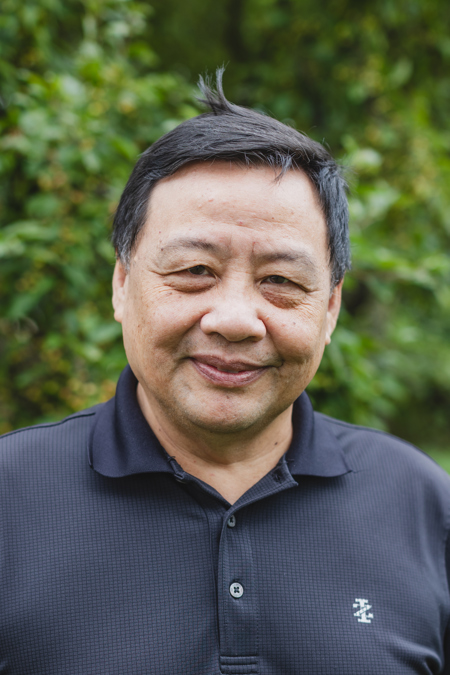
Dr. Akash Jain is affiliated with the Faculty of Science at the University of Amsterdam , associated with the Institute for Theoretical Physics (ITF). His research focuses on theoretical physics, particularly in hydrodynamics, effective field theory, and symmetry principles in non-relativistic systems. Key Research Areas: Hydrodynamics, Effective Field Theory, Fracton Theory, Holography, Superfluidity, and Symmetry in Condensed Matter Physics. Publications: His recent work explores higher-form symmetries, fractonic solids, superfluid dynamics, and causal relativistic hydrodynamics, highlighting interdisciplinary connections between particle physics, gravity, and condensed matter. Contact: Email: a.jain2@uva.nl .
Zhengfang Zhou is a Professor of Mathematics at Michigan State University (MSU), affiliated with the Department of Mathematics within the College of Natural Science. He holds a Ph.D. in Mathematics from New York University's Courant Institute (1986) under Louis Nirenberg, preceded by an M.Sc. from the same institute and a B.Sc. from Jilin University, China. His research focuses on Partial Differential Equations, Nonlinear Heat Transfer, Nonlinear Waves, and Mathematical Physics, with notable contributions to blow-up analysis, wave equations, and quantum field theory. Zhou's work spans academic roles at MIT (1988–1998 as Assistant Professor and C.L.E. Moore Instructor) before joining MSU in 1993. His research interests include acoustic intensity-based methods for aeroacoustics, scattering theory, and nonlinear phenomena. He has co-authored works on fusion frame constructions, photonic crystals, and quantum electrodynamics in curved spacetime. His academic contributions extend to service roles at MSU since 2000, including committee work and mentorship of Ph.D. students. Notable publications address chemotaxis systems, magnetic induction tomography, and the redshift-distance law in cosmological contexts. His research bridges theoretical mathematics with applications in physics and engineering, emphasizing rigorous analysis and interdisciplinary problem-solving.
Anton Kapustin is the Earle C. Anthony Professor of Theoretical Physics and Mathematics at the California Institute of Technology (Caltech). His research bridges theoretical physics and mathematics, with a focus on topological phases of matter, quantum field theory, and symmetry principles. He explores topics such as higher symmetries, anomalies in quantum systems, and the interplay between geometry and physics. His work often integrates advanced mathematical concepts, including homotopy theory and topological invariants, to understand phenomena in condensed matter and high-energy physics. Recent studies include investigations into quantum lattice systems, non-equilibrium steady states, and the classification of topological phases. His research also addresses foundational questions in quantum mechanics and gravity, such as non-relativistic geometry and the equivalence principle. Publications span topics like topological insulators, gauge theories, and symmetry-protected topological (SPT) phases. Kapustin collaborates across disciplines, connecting abstract mathematics with experimental physics insights. He maintains an active research group and contributes to both theoretical advancements and interdisciplinary dialogues in physics.
Emil Mottola is an Adjunct Professor in the Department of Physics and Astronomy at The University of New Mexico (UNM) . His research focuses on theoretical high energy physics, with particular emphasis on quantum gravity, cosmology, and black hole alternatives such as gravitational vacuum condensate stars (gravastars). He holds a PhD from Columbia University (1979). Key research interests include the conformal anomaly, dark energy dynamics, and the interplay between quantum field theory and spacetime structure. He has contributed to understanding de Sitter vacuum instability, gravitational wave phenomena, and cosmic frontier challenges like cosmological tensions in observational data. Selected recent work spans gravastar models, axion physics in condensed matter systems, and quantum information applications in nuclear physics. His publications address fundamental questions in cosmology, particle physics, and the validity of semiclassical gravity approximations. No specific advising or grant information is provided in the source materials. His work connects theoretical physics with observational cosmology and condensed matter analogues, reflecting a multi-disciplinary approach to fundamental physics challenges.
Sarah Lambart is an Associate Professor in the Department of Geology and Geophysics at the University of Utah, where she leads the MagMaX Lab. Her research focuses on igneous processes, mantle heterogeneity, and magma genesis using experimental and analytical techniques. Education: PhD in Petrology, Blaise Pascal University, France (2010) MS in Earth Sciences, Blaise Pascal University (2006) BS in Earth Sciences, Blaise Pascal University, France (2004) Research Interests: Sarah Lambart's research explores the composition and dynamics of Earth's mantle, particularly how heterogeneities influence basalt genesis. Her work integrates high-pressure experiments, geochemical modeling (e.g., Melt-PX), and isotopic analyses to understand magma formation and transport. She investigates pyroxenite melting, melt-rock interactions, and the geochemical signatures of recycled materials in the mantle. Her recent projects involve IODP Expeditions 396 and 402, focusing on magmatism during continental breakup and its climate implications. Publication Trends: Her recent articles (2021–2025) span planetary science (Mercury's mantle), deep Earth processes (mantle heterogeneity), and paleoclimate (PETM). They emphasize isotope geochemistry (B, Fe, U-series), experimental petrology, and numerical modeling. Key themes include recycled volatiles in the mantle, crustal anatexis during rifting, and melt transport dynamics. Scientific Awards and Funding: NSF MRI Grant (co-PI) NSF MG&G Grant NSF EAR Grant Geology and Geophysics Faculty Research Award (2024) University of Utah Graduate Research Fellowship (mentor) Multiple student fellowships and travel grants (WAGS, MSA, GSA, Chapman) Advising and Grants: She mentors numerous graduate and undergraduate students, many of whom have received prestigious awards. She has secured significant external funding, including from NSF and internal university programs, supporting lab development (e.g., Neoma MC-ICP-MS) and student research. She actively promotes student participation in conferences and field expeditions. Labs and Collaborations: She directs the MagMaX Lab at the University of Utah, which collaborates internationally with institutions such as Cardiff University, VU Amsterdam, CRPG (France), and UNIL (Switzerland). She is involved in major projects like IODP Expeditions and serves as a handling editor for Advances in Geochemistry and Cosmochemistry .
Luigi Martina is an Associate Professor of Theoretical Physics at the Department of Mathematics and Physics "Ennio De Giorgi" at the University of Salento (UniSalento). His research focuses on mathematical methods in theoretical physics, with particular emphasis on nonlinear systems, integrable models, and symmetry analysis. He maintains a dual affiliation with both UniSalento (luigi.martina@unisalento.it) and INFN (martina@le.infn.it), reflecting his strong connection to Italy's National Institute for Nuclear Physics. Prof. Martina earned his degree in Physics from the University of Lecce on September 28, 1978, with highest honors (110/110 cum Laude). He began his academic career as a Confirmed Researcher in Theoretical Physics (B02A) on September 28, 1985, and was appointed Associate Professor of Theoretical Physics (FIS/02) at UniSalento on January 10, 2001, a position he continues to hold. His academic journey spans over three decades of continuous research and teaching in theoretical physics. His research spans a wide spectrum of theoretical physics topics. Prof. Martina's work primarily focuses on nonlinear partial differential equations, integrable systems, and symmetry analysis. He has made significant contributions to the understanding of solitons, vortices, and topological structures in various physical contexts including liquid crystals and quantum systems. His research also extends to noncommutative geometry, quantum computation, and applications of mathematical physics to image processing. He has explored connections between exotic Galilean symmetry, Berry phases, and noncommutative geometry, with applications to condensed matter physics and quantum Hall effects. His recent work includes Skyrmion models in 2 and 3 dimensions, modular forms in conformal theories, and asymptotic groups in general relativity. Prof. Martina's publication record, with 153 publications and 2,175 citations (excluding self-citations) as of September 30, 2021, demonstrates his sustained contributions to mathematical physics. His work shows a clear evolution from classical studies of integrable systems and symmetry analysis toward more contemporary topics involving topological structures, quantum information, and applications to condensed matter physics. His research demonstrates consistent methodological rigor with a focus on symmetry preservation across different mathematical frameworks. Prof. Martina has held significant research responsibilities, serving as National Coordinator for the INFN-CSN4 Specific Initiative: MMNLP (2017-2019) and as local responsible for the MIUR-PRIN 2017 grant 2017KC8WMB on UV imaging systems in liquid argon detectors. He has coordinated multiple international research projects including a NATO-CR Grant (960717/1996/99) and joint initiatives with the Russian Foundation for Basic Researches (2006-2010) focusing on "Vortices, Solitone Topologies and their excitations". Throughout his career, Prof. Martina has advised numerous students, including 3 Doctorate students, 4 "vecchio ordinamento" Physics students, 18 bachelor's level Physics students, 12 Physics Master's students, and 1 Mathematics Master's student. His teaching portfolio is extensive, covering courses such as Theoretical Physics, Quantum Mechanics, Mathematical Methods, and specialized topics like Quantum Computing and Geometrical Methods in Physics. He has also contributed to educational outreach through the Organization of the Summer School of Physics for High School Students and Physics Italian Olympics. Prof. Martina has been actively involved in organizing international conferences, including multiple editions of "Physics and mathematics of nonlinear phenomena" (2011, 2013, 2015, 2017) and the "Geometric Structures in Integrable Systems" conference in 2018. He serves as a referee for prestigious journals including Journal of Physics A, European Journal of Physics Plus, and Physics Letters A, demonstrating his standing within the international physics community.