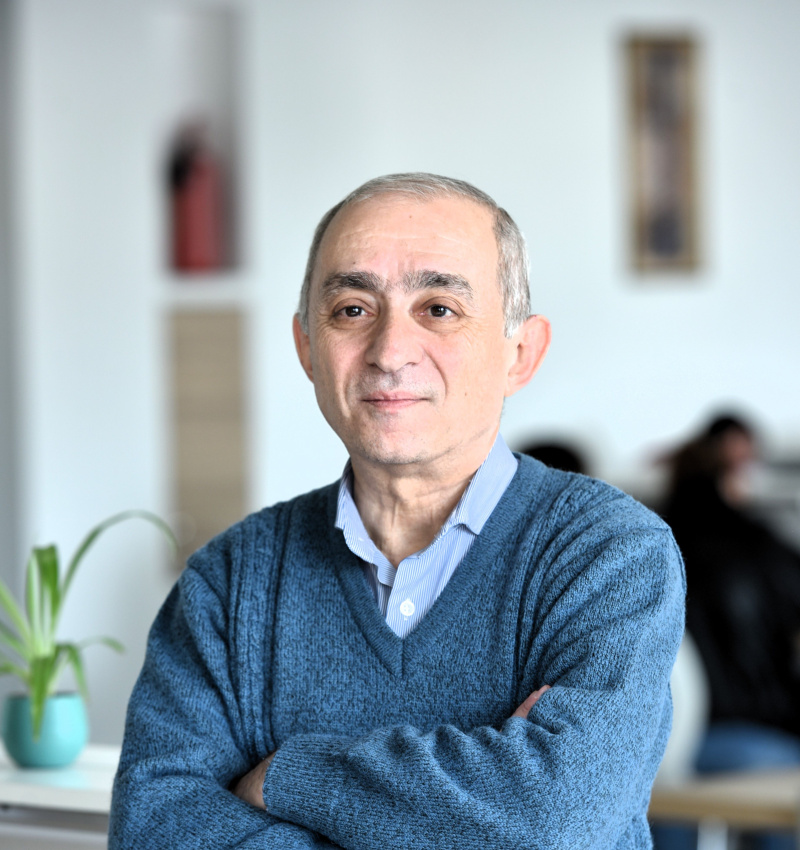
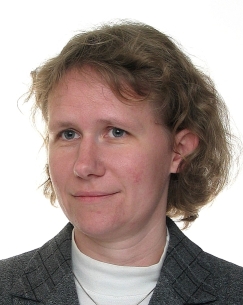
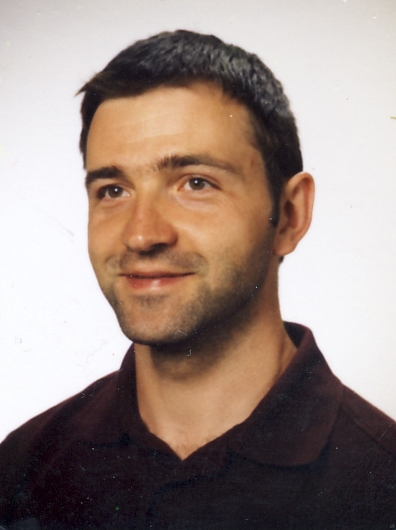
Karen Martini Ghambaryan is a Professor at Yerevan State University's Institute of Physics, Department of Semiconductor Physics and Microelectronics, where she has served as Head of Department since 2019. Her work focuses on semiconductor nanostructures, quantum dots, and energy conversion technologies. Bachelor of Science - Yerevan State University (1976-1981) Doctor of Science - Yerevan State University (2013) Professor - Yerevan State University (2015) Her research spans semiconductor physics, nanotechnology, and infrared engineering, with emphasis on quantum dot systems for optoelectronic applications. Recent work explores energy level alignment in asymmetric quantum dots and thermophotovoltaic converters. Karen's publications demonstrate expertise in quantum dot nucleation , semiconductor material systems , and infrared device engineering . She has presented at major conferences including the World Renewable Energy Congress and European Advanced Materials Congress. 2023 - Global Renewable Energy Network Pioneer Award 2017 - IAAM Gold Medal 2019 - Yerevan State University Gold Medal She participates in international networks like the World Renewable Energy Network and Council (WREN/WREC) and leads research in semiconductor materials science.
Marcus Giglmaier is a researcher at the Chair of Aerodynamics and Fluid Mechanics within the Department of Aerospace and Geodesy at the Technical University of Munich (TUM). He holds a Dr.-Ing. degree and is actively involved in both teaching and research activities at TUM's Garching campus. His work is primarily focused on fluid dynamics phenomena with applications in aerospace engineering and materials processing. Dr. Giglmaier's research interests span multiple areas of fluid mechanics including droplet dynamics, shock wave interactions, multiphase flows, and nanoparticle synthesis. His work often combines experimental approaches with computational modeling to investigate complex fluid phenomena. He has made significant contributions to understanding droplet breakup mechanisms, bubble dynamics in various media, and gas-particle interactions in industrial processes. His publication record shows consistent research output from 2009 through 2025, with recent work focusing on liquid metal aerodynamics, metal powder production, and nanoparticle synthesis. The research demonstrates a clear progression from fundamental fluid dynamics investigations toward more applied industrial processes, particularly in materials manufacturing. Dr. Giglmaier teaches Applied CFD and Fluid Mechanics courses at TUM, contributing to the education of mechanical and aerospace engineering students. His teaching responsibilities include both lectures and central exercise sessions for core fluid mechanics courses.
Yuri A. Lawryshyn serves as Professor and Joseph C. Paradi Chair in Information Engineering at the University of Toronto's Faculty of Applied Science and Engineering, where he directs the Centre for Management of Technology and Entrepreneurship (CMTE). His interdisciplinary work applies analytical and numerical methods to solve complex industry problems through academic-industry collaboration. His educational background includes: Diploma in Financial Engineering (2007), Schulich School of Business, York University MBA (2002), Richard Ivey School of Business, University of Western Ontario Ph.D. in Chemical Engineering and Applied Chemistry (1997), University of Toronto M.A.Sc. in Mechanical Engineering (1993), University of Toronto B.A.Sc. in Mechanical Engineering (1989), University of Toronto Professor Lawryshyn's research integrates financial engineering and computational fluid dynamics, with dual foci on real options valuation for investment decisions and UV disinfection modeling for wastewater treatment. His work emphasizes practical applications through industry partnerships, developing simplified theoretical frameworks accessible to practitioners while advancing technical solutions for environmental challenges. Recent publications (2011-2012) demonstrate consistent output across finance and environmental engineering domains. Financial research includes portfolio optimization using stochastic dominance and credit card fraud detection via meta-classification, while environmental work covers wastewater flotation dynamics and UV reactor validation. His publications consistently bridge theoretical modeling with industrial applications through collaborations with financial institutions and environmental technology firms. No specific scientific awards were mentioned in source materials. Through the CMTE, Professor Lawryshyn supervises 7-8 undergraduate thesis projects annually alongside graduate research, maintaining strong industry ties with Bank of Montreal (BMO), Canadian Imperial Bank of Commerce (CIBC), and Toronto Dominion (TD). His advising spans: Business Applications: HR systems, IT operations, market risk modeling, and trading strategies Quantitative Research: Project valuation, financial risk analysis, and stochastic modeling The Centre for Management of Technology and Entrepreneurship operates as an interdisciplinary hub connecting engineering and business disciplines, facilitating research partnerships that address real-world challenges in financial services and environmental technology sectors through applied projects and student engagement.
Aigbavboa Ohis Clinton is a Professor at the University of Johannesburg 's Faculty of Engineering and the Built Environment. With over 684 publications and 3,546 citations, he leads the DSI/NRF Research Chair in Sustainable Construction Management and Leadership (SARChi). His work bridges academic excellence with practical solutions for the construction sector. Key affiliations: University of Rwanda, Cape Coast Technical University, University of Auckland Research locations: South Africa, Nigeria, Ghana, Zambia, Benin, Eswatini Clinton's research focuses on: Sustainable construction practices Advanced technology integration Waste management systems Policy-driven urban development Publications since 2014 demonstrate technical rigor and regional impact, particularly in developing nations. His work combines machine learning applications with traditional construction economics. Scientific Recognition : National Research Foundation (NRF) awardee European Commission sponsored research High-impact publications in leading journals
Prof. Dr.-Ing. Tobias Morck serves as Professor and Head of Urban Water Engineering at the Institute of Water, Waste and Environment within the Faculty of Civil and Environmental Engineering at the University of Kassel. His research drives innovation in sustainable water infrastructure with focus on advanced treatment technologies and resource recovery systems. Research interests span wastewater treatment optimization, micropollutant removal mechanisms, and climate-resilient infrastructure design. Key specialties include powdered activated carbon systems, membrane bioreactor innovations, ozonation processes, and digital monitoring solutions. Morck actively develops tools for climate neutrality assessment (KlicK-Webtool) and explores wastewater heat recovery potential alongside biorefinery concepts for nutrient and energy valorization. Analysis of recent publications (2023-2025) reveals concentrated efforts on trace contaminant elimination through adsorption and oxidation technologies. His group pioneers rotating membrane systems for energy efficiency and implements intelligent control centers for resource optimization. Emerging work focuses on digital twins for real-time process management and circular economy integration in municipal treatment plants. No scientific awards were documented in available sources. Details regarding specific advisees and grant funding remain undisclosed in current materials. As head of the Urban Water Engineering group, Morck leads research initiatives addressing critical challenges in water security and sustainability at the University of Kassel's engineering faculty.
Dr. hab. inż. Katarzyna Bielicka-Daszkiewicz is an Associate Professor at the Department of Organic and Bioorganic Chemistry, Faculty of Chemical Technology, Poznań University of Technology. With habilitation in Chemical Sciences (2013), her career spans over 25 years of interdisciplinary research bridging analytical chemistry, environmental engineering, and pharmaceutical applications. Master of Science in Engineering (1995, PUT) PhD in Chemical Sciences (2001, PUT) Habilitation in Chemical Sciences (2013, Gdańsk Tech) Her research focuses on chromatographic techniques and solid-phase extraction for environmental and pharmaceutical applications. Key contributions include: Development of Monolithic In-Needle Extraction devices Application of Hansen solubility parameters in extraction system optimization Analysis of dental material releases and food contact material safety Design of polymer inclusion membranes for contaminant removal Recent work (2022-2025) emphasizes chemoinformatics tools for drug development and tau protein inhibitors from fungal metabolites. She has contributed to 29 scientific articles (2001-2025) with impact factors up to 6.215.
Prof. Dr. hab. inż. Marek Ochowiak is a Professor at the Poznań University of Technology, Faculty of Chemical Technology, where he works at the Institute of Chemical Technology and Engineering. He serves as Head of the Department of Chemical Engineering and Equipment and is an active researcher with numerous publications in chemical engineering fields. His academic career spans over two decades with significant contributions to fluid dynamics and separation processes. Prof. Ochowiak completed his academic journey with a Master of Science in Engineering in 1998 from the Faculty of Chemical Technology at Poznań University of Technology, specializing in Chemical Power Sources. He earned his Doctor of Technical Sciences in chemical technology in 2002 from the same institution, followed by his habilitation in technical sciences in Chemical Engineering in 2014 from the Faculty of Chemistry at the Silesian University of Technology. His primary research interests focus on three key areas: liquid atomization processes using various nebulizers, solid-liquid separation in vortex settling tanks, and air/gas cleaning processes. His work on atomization involves designing nebulizers with consideration of multiple dimensions and operating parameters to achieve desired spray characteristics. In separation processes, he investigates vortex settling tanks that utilize vortex motion for efficient water purification, developing modifications that demonstrate higher purification efficiency compared to standard designs. His third research area examines dust removal processes and methods for eliminating pollutants from air and flue gases using physical mechanisms, with particular attention to modifying conventional chamber filters through the application of vortex motion phenomena. Prof. Ochowiak's publication record shows a strong focus on fluid dynamics, separation processes, and chemical engineering applications. His recent work increasingly incorporates computational methods like CFD analysis and artificial neural networks for process optimization. The trend shows consistent contributions to atomization technology, vortex-based separation systems, and process engineering applications, with publications appearing in reputable journals such as Energies, Polish Journal of Chemical Technology, and International Journal of Pharmaceutics. As an academic leader, Prof. Ochowiak serves as Head of the Department of Chemical Engineering and Equipment, and is a Member of the University Disciplinary Committee for Academic Teachers. He is also an Expert of the Polish Accreditation Committee for chemical engineering and environmental engineering disciplines, and a Member of the Polish Society of Technical Rheology. Prof. Ochowiak supervises doctoral students and has guided several PhD candidates to completion, including Małgorzata Markowska, Andżelika Krupińska, and Anna Kasperkowiak. His teaching responsibilities include Elements of Automation and Measurements in Chemical Technology, Industrial Automation and Measurement, Environmental Protection Process Engineering, Cleaning Processes, Engineering Graphics, and AutoCad. His research involves extensive collaboration with numerous institutions including Sumy State University (Ukraine), Technical University of Kosice (Slovakia), Warsaw University of Technology, Opole University of Technology, Adam Mickiewicz University in Poznań, and several industry partners including ADOB S.A., Haba RL, Poltech Trading, Terravita, and Volkswagen Poznań.
Dr. Eng. Piotr Wesołowski is a faculty member at the Institute of Chemical Technology and Engineering , Faculty of Chemical Technology , Poznań University of Technology . He can be contacted at piotr.wesolowski@put.poznan.pl or by phone at +48 61 665 37 58. Academic titles include Doctor of Technical Sciences (1992) with dissertation on aerated liquid mixing Member of Polish Academy of Sciences subsections (1995–2016) Court expert in chemical equipment safety Research focuses on mechanical mixing processes in multiphase systems , including: Energy input assessment Mixer design with mechanical agitators CFD modeling of mixing processes Industrial process optimization Recent publications (2001–2013) examine: Agitator geometry effects on suspension stability Power consumption in cereal-coffee systems Turbine impeller performance Baffle-free mixing solutions Scientific distinctions: 2010: Medal of the National Education Commission 2006: 'Exemplary Academic Lecturer' diploma 2006: Rector's Award for achievements Mentored 93 diploma theses (33 master's, 60 engineering) and reviewed 43 theses. Coordinated industry-university collaboration (2009–2013).
Václav Janiš is a Senior Scientist at the Theory Group of the Department of Dielectrics, Institute of Physics, Czech Academy of Sciences, and a Professor of Theoretical Physics at the Faculty of Mathematics and Physics, Charles University in Prague. His research bridges condensed matter theory, quantum coherence, and spin glasses. Research Interests: Strongly correlated electrons (Hubbard/Anderson models) Quantum phase transitions in itinerant systems Anderson localization and transport in disordered systems Spin-glass theory with real replicas Field-theoretic and diagrammatic methods Superconducting nanostructures Publications Overview: His work spans 1986-2011, focusing on parquet equations for two-particle vertices, renormalized perturbation theories, Kondo effects, and replica-symmetry breaking in spin glasses. Key themes include quantum criticality, non-Fermi liquid behavior, and thermodynamic homogeneity in glassy phases. Contact: janis@fzu.cz | Phone: +420 26605 2771
Prof. Dr. Alf Mews is a full Professor of Physical Chemistry at the University of Hamburg, where he leads the Research Group Mews within the Institute of Physical Chemistry, Department of Chemistry. His research focuses on the synthesis, characterization, and application of nanoscopic structures, particularly semiconductor nanocrystals, nanowires, and nanosheets. Alf Mews studied chemical engineering in Aachen (Diploma in 1988) and Chemistry in Siegen (Diploma in 1992). He received his PhD in 1994 from the Hahn-Meitner-Institute in Berlin under Prof. Horst Weller, focusing on semiconductor nanocrystals. After a DFG fellowship with Prof. Paul Alivisatos at UC Berkeley (1995), he worked with Prof. Christian Bräuchle in Munich (1996) and completed his Habilitation in 2003 at Johannes Gutenberg University Mainz under Prof. Thomas Basché. He was appointed to a full professorship at the University of Siegen in 2004 and moved to the University of Hamburg in 2008. Prof. Mews' research interests span multiple areas of nanoscience and nanotechnology. His group investigates the nucleation and growth processes of colloidal nanoparticles, structure determination of nanoscopic systems using X-ray diffraction, and atomic modeling based on high-resolution electron microscopy. They also study the attachment and uptake mechanisms of nanoparticles in biological cells, synthesis of semiconductor nanostructures (nanorods, nanowires, nanoplatelets), development of surface-modified gold clusters, and biofunctionalization of nanoparticles for medical diagnostics. A key aspect of their work involves determining structure-property relationships by combining different microscopy methods. The research group has published extensively on semiconductor nanowires, particularly focusing on CdS, CdSe, and CdTe systems. Their publications reveal a strong emphasis on understanding the fundamental optical, structural, and electronic properties of nanoscopic model structures. The group employs sophisticated microscopic techniques to investigate individual nanostructures, with significant contributions in areas like cation exchange reactions, quantum confinement effects, and nanowire-based device fabrication. Their research often bridges fundamental science with potential applications in optoelectronics and nanomedicine. Scientific recognition includes: DFG fellowship (1995) to work with Prof. Paul Alivisatos at UC Berkeley Prof. Mews has advised numerous PhD students throughout his career, with a substantial list of former group members who have completed their doctorates under his supervision. His research group maintains active collaborations and participates in various research networks at the University of Hamburg, including those focused on nanochemistry and materials science. The group operates specialized laboratory facilities for nanomaterial synthesis and characterization, including equipment for electrical measurements, optical spectroscopy, and surface potential analysis. The Research Group Mews operates within the Institute of Physical Chemistry at the University of Hamburg, with laboratory and office space at Grindelallee 117. The group maintains strong connections with other research groups within the Department of Chemistry and participates in interdisciplinary research initiatives focused on nanoscience and nanotechnology.
Klarissa Niedermeier is a Research Fellow at the Karlsruhe Institute of Technology (KIT) in Germany. She earned a PhD (Dr.-Ing.) in process engineering and specializes in high-temperature thermal energy storage systems using liquid metals as heat transfer fluids. Since 2023, she has led a junior research group focused on these technologies. Education: Doctoral degree in Chemical Engineering and Process Technology from KIT (2008–2014) Prior Positions: Project Manager at KIT (2019–2021), Fraunhofer Institute for Solar Energy Systems (2019) Her research explores thermal energy storage materials , packed bed systems , and liquid metal applications in concentrated solar power (CSP) and industrial process heat. She has developed experimental test rigs like LIMELIGHT for component testing and contributed to studies on lead-bismuth eutectic and moltensodium systems. Klarissa’s publications highlight advancements in high-temperature storage , thermocline systems , and entropy generation minimization for improved thermal efficiency. Her work addresses challenges in renewable energy integration, decarbonization, and practical implementation of liquid metal technologies. She collaborates with institutions like the German Aerospace Center (DLR) and Fraunhofer ISE , focusing on concentrating solar power , liquid metal heat transfer , and renewable industrial heat solutions . Klarissa is also involved in mentoring programs and advocates for sustainable energy systems.
Bethany Caulkins serves as an Assistant Professor in the Chemistry Department at Scripps College, where she leads research at the intersection of physical chemistry and structural biology. Her work leverages advanced nuclear magnetic resonance (NMR) methodologies to investigate fundamental biochemical processes, with particular emphasis on enzyme mechanisms and protein dynamics. Her primary research domains include NMR Spectroscopy , Enzyme Mechanisms , and Protein Dynamics , with specialized focus on tryptophan synthase catalysis, metabolomics, and neurodegenerative disease models. She employs cutting-edge techniques such as NMR crystallography, dynamic nuclear polarization, and solution-state NMR to characterize enzyme active sites, protein folding intermediates, and molecular recognition events in lipid environments. Analysis of her publication trajectory (2015-2025) reveals sustained investigation into tryptophan synthase intermediates using multi-technique approaches, with recent expansion into metabolomics and rodent model systems. Her work consistently bridges structural characterization and functional mechanism studies, demonstrating expertise in both solid-state and solution NMR methodologies applied to complex biological systems.
Patrice Chartrand is a Full Professor in the Department of Chemical Engineering at Polytechnique Montréal, specializing in thermodynamic modeling and high-temperature materials. He co-directs the Center for Research in Thermochemical Computing (CRCT) and holds the Philanthropic Chair in Materials Engineering on Waste Recycling. His work focuses on primary aluminum production (Hall-Héroult, inert anodes), baked carbons, molten salts (including nuclear reactors), light metals (Al, Mg), recycling, and complex fertilizers (NPK). B.Eng., M.Sc.A., Ph.D. from Polytechnique Montréal His research interests include: Thermochemical modeling (FactSage, CALPHAD method) High-temperature physicochemical properties Phase equilibria in industrial systems Coal tar pitch carbonization Molten salt thermal conductivity Lithium battery materials Recent publications highlight trends in: Extending quasi-chemical models for multicomponent systems Thermal transport in molten salts Solid-state battery safety High-temperature oxidation kinetics Environmental applications (arsenic standards, hazardous waste) Scientific awards: 2013 - Prix Synergie pour l'innovation (NSERC Canada) 2007 - Grand Prix Alcan (French Academy of Sciences) He has supervised 8 doctoral and 12 master’s students, including research on aluminum metallurgy, lithium batteries, and molten salt systems. His work involves collaborations with industry and government, particularly on the Horne Foundry’s arsenic emissions.
Jean-Philippe Harvey is an Associate Professor in the Department of Chemical Engineering at Polytechnique Montréal . His research focuses on computational thermochemistry, multiscale thermodynamics, and optimization of high-temperature metallurgical processes. Education: PhD and MSc in Metallurgical Engineering from Polytechnique Montréal Affiliation: Thermochemical Computing Research Center (CRCT) Research areas include atomistic simulations of metallic systems, green metallurgy for decarbonization, life cycle analysis of industrial processes, and development of thermodynamic databases for alloy design. His 2025 work emphasizes microwave-assisted reactors for syngas production and green hydrogen integration in pyrometallurgy. Awards: Philanthropic Chair in Materials Engineering (2023) Canada Foundation for Innovation (CFI) grant (2019) Harvey has supervised 14 graduate students since 2018, including 3 PhD candidates and 11 Master’s students. His publications span journals like Acta Materialia , Calphad , and Physical Chemistry Chemical Physics , covering topics from high-entropy alloys to plasma-based metal recycling.
Arijit Raychowdhury is a Professor and the Steve W. Chaddick School Chair at Georgia Tech's School of Electrical and Computer Engineering (ECE). He leads the Center for the Co-Design of Cognitive Systems (CoCoSys) and directs the DoD-sponsored SCALE Workforce Development Program in SoC Design. Current affiliations: Georgia Tech (ECE), Integrated Circuits and Systems Research Lab Prior affiliations: Intel Corporation (6 years), Texas Instruments (1.5 years) Research interests focus on low-power circuits, compute-in-memory (CIM) systems, cryogenic electronics, and neuro-symbolic AI. His work bridges circuit design with emerging device technologies and machine learning applications. Scientific contributions include: Over 250 publications and 27 patents Leadership in top conferences (ISSCC, VLSI Symposium, DAC, CICC) Pioneering 3D Gaussian Splatting acceleration, adaptive echo-cancellation networks, and CIM architectures Advancing GaN-based power converters and cryogenic CMOS Awards : IEEE Fellow (2022) SRC Technical Excellence Award (2021) Qualcomm Faculty Award (2021, 2020) IEEE/ACM Innovator under 40 (2018) Intel Young Faculty Award (2015) Dimitris N. Chorafas Award (2007) Leadership : • Director of CoCoSys Center • Site Director for SCALE Program • Distinguished Lecturer, IEEE Solid-State Circuits Society