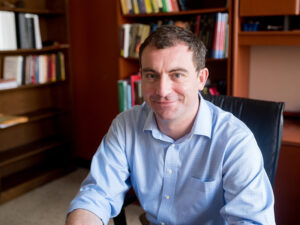
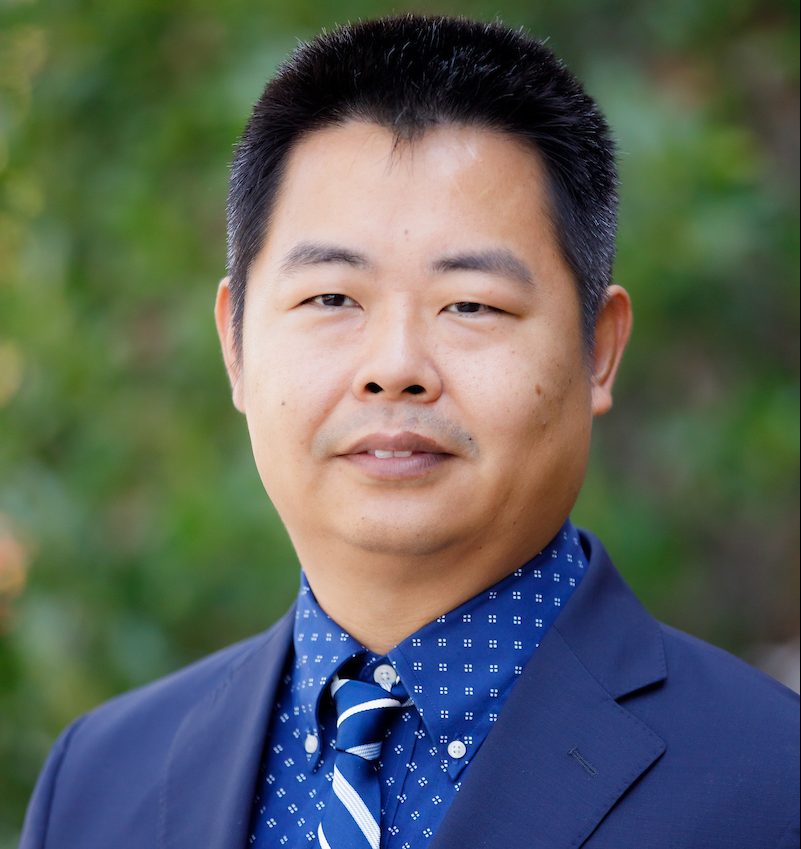
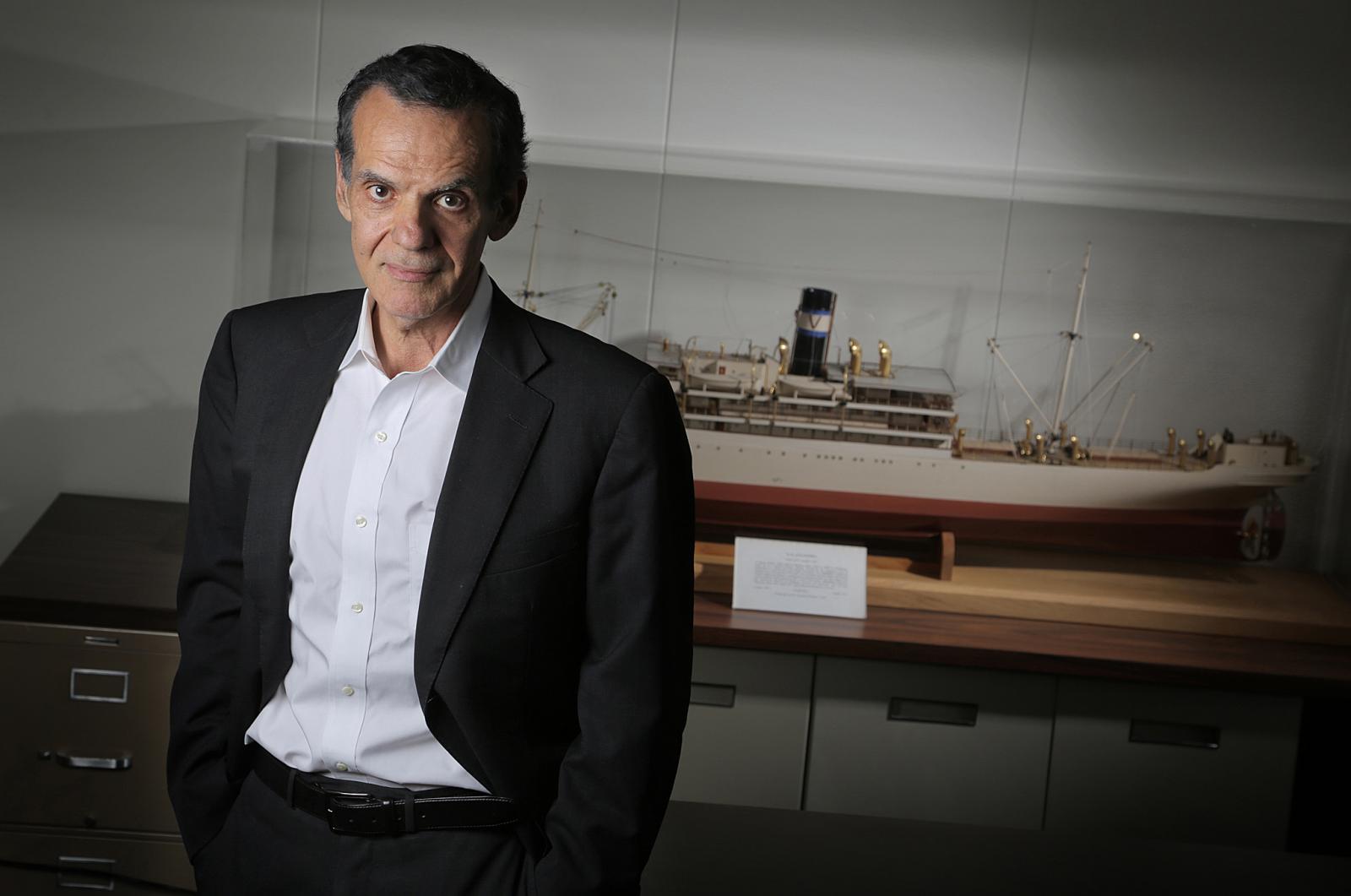
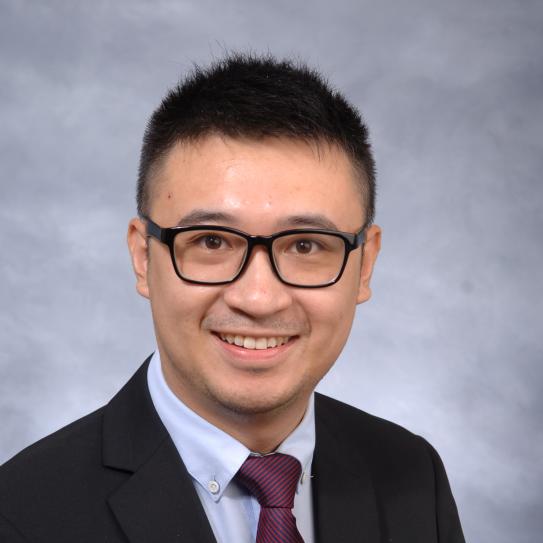
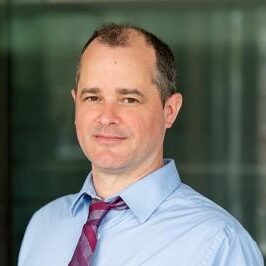
Ram Rajagopal is an Associate Professor of Civil and Environmental Engineering and Electrical Engineering at Stanford University, and a Senior Fellow at the Precourt Institute for Energy. He leads the Stanford Sustainable Systems Lab (S3L), focusing on large-scale monitoring, data analytics, and stochastic control for infrastructure networks, particularly power systems. His research emphasizes renewable energy integration, smart distribution systems, and demand-side data analytics. Education: PhD in Electrical Engineering and Computer Sciences & MA in Statistics (UC Berkeley), MS in Electrical and Computer Engineering (UT Austin), and BEng in Electrical Engineering (Federal University of Rio de Janeiro). Research interests include power grid optimization, renewable energy systems, and data-driven approaches to infrastructure challenges. He has pioneered work in grid flexibility, distributed energy resources, and machine learning applications for energy systems. His lab develops technologies like Smart Dim Fuses and the EV-EcoSim platform for EV charging infrastructure optimization. Received NSF CAREER Award, Powell Foundation Fellowship, and Berkeley Regents Fellowship Over 30 patents and best paper awards Advises/founded companies in sensor networks, power systems, and data analytics Labs/Teams: Stanford Sustainable Systems Lab (S3L), Powernet Project. His work spans grid resilience, energy equity, and scalable energy solutions.
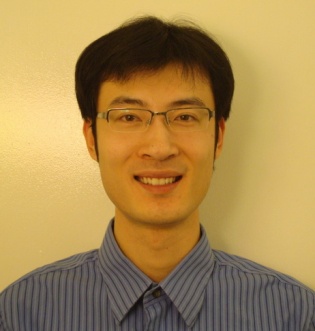
Dr. K. Max Zhang is a Professor in the Sibley School of Mechanical and Aerospace Engineering at Cornell University. He is the director of the Energy and the Environment Research Laboratory (EERL) and a fellow at the Atkinson Center for a Sustainable Future. His research is deeply interdisciplinary, focusing on sustainable energy systems, air quality, and environmental justice, with significant impacts on policy and community development in New York and beyond. Ph.D., Mechanical Engineering, University of California-Davis, 2004 B.S., Thermal Engineering, Tianjin University, 1998 B.A., English Language, Tianjin University, 1998 Dr. Zhang’s research centers on the integration of energy and environmental systems. He investigates air pollution dynamics using advanced numerical models like CTAG, with applications in near-source pollution, indoor air quality, and environmental justice. His work on renewable energy systems includes designing sustainable solar farms and managing distributed energy resources such as heat pumps to enhance grid flexibility. He also leads a pioneering initiative to create the first statewide public IoT network in the U.S., enabling hyperlocal weather forecasting and microclimate monitoring. His recent publications reflect a strong trend toward agrivoltaics, peer-to-peer energy markets, and IoT-based environmental monitoring. These works demonstrate a consistent focus on data-driven modeling, community-scale energy solutions, and the integration of social considerations into technical systems. The keywords across his articles highlight expertise in sustainability, machine learning, air quality, and energy transition. Cornell Town-Gown Achievement Award (2022) Engaged Scholar Prize, Cornell University (2017) People's Choice Sign of Sustainability Award, Sustainable Tompkins (2016) Scientific and Technological Achievement Award, Environmental Protection Agency (2015) Fellow of the American Society of Mechanical Engineers Dr. Zhang is actively involved in mentoring students and securing research grants from agencies such as the National Science Foundation (NSF) and the New York State Energy Research and Development Authority (NYSERDA). His projects often involve interdisciplinary collaboration across eight Cornell colleges and 16 academic departments. He has led initiatives such as the Cornell Atkinson Academic Venture Fund projects and the development of a county-level energy roadmap for Tompkins County. He also teaches courses in engineering thermodynamics, future energy systems, and air quality, emphasizing experiential and community-based learning. Dr. Zhang leads the Energy and the Environment Research Laboratory (EERL) and collaborates with the Atkinson Center for a Sustainable Future. His lab functions as a hub for innovation in sustainable communities, combining advanced modeling with real-world applications. Through partnerships with community organizations, government agencies, and industry, his team develops science-driven solutions to urban and rural sustainability challenges.
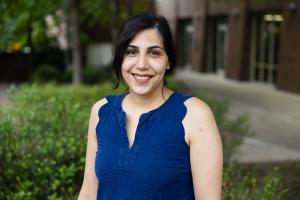
Michael Baldea is an Associate Professor in the Department of Chemical Engineering at the University of Texas at Austin . He holds a Ph.D. in Chemical Engineering from the University of Minnesota (2006), with prior degrees from 'Babeş-Bolyai' University in Romania (M.Sc. 2001, Diploma 2000). His research group develops theoretical and computational methods for Process and Energy Systems Engineering , focusing on integrated decision-making, performance optimization, and process intensification with industrial validation. Education: Ph.D., Chemical Engineering, University of Minnesota (2006) M.Sc., Interface Process Engineering, 'Babeş-Bolyai' University (2001) Diploma, Chemical Engineering, 'Babeş-Bolyai' University (2000) Research Thrusts: Integrated decision-making in chemical/energy supply chains Process performance monitoring and optimization Process integration and intensification Key applications include grid-responsive chemical plants, intensified distillation/column designs, and renewable energy integration for building systems. Scientific Awards: Frank A. Liddell, Jr. Fellowship NSF CAREER Award (2015-2020) Moncrief Grand Challenges Faculty Award (2014) AIChE Outstanding Young Researcher Award (2017) Implementation : His group has translated research into commercial tools through partnerships with industrial test beds and is working to integrate methods into commercial simulators. They explore predictive approaches for building energy management and strategic capital investment analysis in next-generation energy systems.
Bri-Mathias Hodge is an Associate Professor at the University of Colorado Boulder's Department of Electrical, Computer, and Energy Engineering, while also serving as Chief Scientist at NREL's Grid Planning and Analysis Center and Associate Director of the Renewable and Sustainable Energy Institute. His career spans academic and industry roles in power systems analysis and renewables integration. Bachelor's, Master's, and PhD in Chemical Engineering from Carnegie Mellon, Åbo Akademi, and Purdue respectively His research focuses on Renewables integration , Net-zero energy systems , and Wind and solar power forecasting . Recent publications explore energy storage dispatch modeling, electric vehicle wireless charging impacts, and AI-driven grid foundation models. His 299+ research outputs (2011-2025) emphasize Renewable energy grid integration Power system forecasting AI applications in energy systems EV infrastructure impacts Carbon capture technologies Scientific recognition includes Fulbright Fellowship (2016) Five IEEE Power and Energy Society Best Paper Awards (2015-2018) Active in professional networks as Member of IEEE Transactions on Sustainable Energy Member of multiple IEEE working groups Contributor to Journal of Renewable and Sustainable Energy
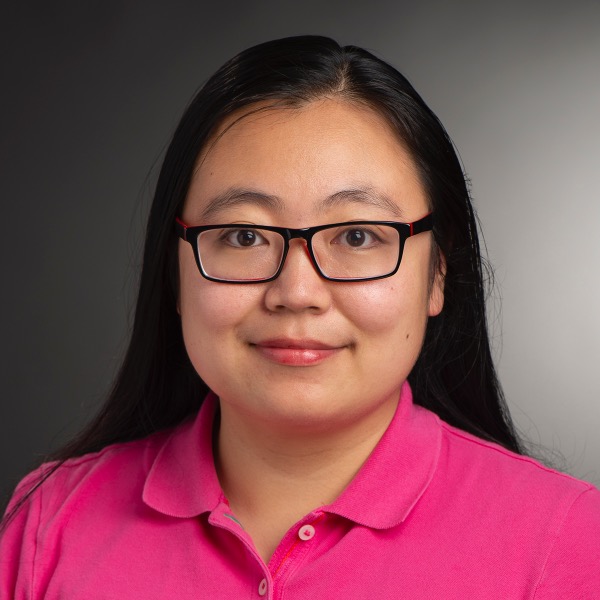
Dr. Jiaqi Gong serves as Associate Professor in Computer Science and Adjunct Associate Professor in Mechanical Engineering at The University of Alabama's College of Engineering, while directing the Alabama Center for the Advancement of Artificial Intelligence. His academic foundation includes: B.S. in Engineering, China University of Geoscience (2004) Ph.D. in Engineering, Huazhong University of Science and Technology (2010) Dr. Gong's research pioneers human-AI convergence through cyber-physical systems and smart health technologies, developing mobile/wearable platforms to enhance human perceptual, cognitive, and physical capabilities. His work spans artificial intelligence, machine learning, computer vision, and IoT with applications in healthcare, environmental monitoring, and education. The Sensor-Accelerated Intelligent Learning (SAIL) laboratory he founded drives innovation in behavior change interventions, human movement modeling, and educational data mining. Recent publications reveal strong interdisciplinary trends: healthcare AI dominates with medication adherence prediction and surgical classification systems, while environmental applications feature flood-risk communication and drought analysis. His work increasingly integrates generative AI and LLMs across domains, demonstrating methodological innovation in federated learning, knowledge graphs, and explainable storytelling frameworks. Notable recognitions include: Best Student Paper Award, IEEE/ACM Connected Health Conference (2022) Best Student Paper Award, Body Sensor Networks Conference (2019) Data Challenge Win, IEEE Biomedical Health Informatics (2018) Best Paper Award, Body Area Networks Conference (2014) Best Demonstration Award, IEEE Wireless Health Conference (2014) Dr. Gong leads significant funded projects including a $2M CDC/NIOSH grant for first responder safety and $3M NSF funding for hydrologic research. As SAIL laboratory director, he mentors students in developing clinically deployed technologies for multiple sclerosis, dementia, and mental health. Future work focuses on scaling AI applications in chronic disease management and climate resilience through the Alabama AI Center. The SAIL laboratory (founded 2017) operates as a multidisciplinary hub developing wearable/mobile systems for health applications, with active collaborations across medical clinics and engineering departments for real-world deployment of behavior change interventions and movement analysis tools.
Massachusetts Institute of TechnologyUnited States
Professor Paul D. Sclavounos is a faculty member in the Department of Mechanical Engineering at the Massachusetts Institute of Technology (MIT). He earned his B.Sc. from the National Technical University of Athens in 1977 and Ph.D. from MIT in 1981. Research Interests : Marine hydrodynamics, stochastic control, offshore wind/wave/tidal/solar energy, machine learning applications, magnetohydrodynamic propulsion systems. Notable Contributions : Development of computational tools like SWAN and SML software suites; analysis of nonlinear wave dynamics; integration of AI/ML in marine hydrodynamics. Scientific Recognition : First Prize in National Mathematics Competition (1972), Georg Weinblum Memorial Lecturer (2010-2011), Best Paper Award at OMAE 2019, AEOLOS Scientific Award (2024). Leadership : Director of the Laboratory for Ship and Platform Flows since 1985; advisory roles for US Navy, US Department of Energy, and Det Norske Veritas (DNV). Teaching : Courses in Hydrodynamics (2.016), Advanced Fluid Mechanics (2.25), and Naval Architecture (2.701).
Dr. Yuzhang Lin is an Assistant Professor in the Department of Electrical and Computer Engineering at NYU Tandon School of Engineering. Previously, he held an Assistant Professor position at the University of Massachusetts Lowell (2018–2023). He earned his Ph.D. from Northeastern University and B.Eng./M.S. from Tsinghua University. His research focuses on smart grids, renewable energy systems, cyber-physical resilience, and machine learning applications. He leads editorial roles for IEEE Transactions on Power Systems and chairs IEEE PES Task Forces on standard test cases and distribution system operations. Dr. Lin’s research has been funded by NSF, DOE, ONR, and others. He is a recipient of the NSF CAREER Award and Northeastern’s Graduate Student Outstanding Research Award. His work emphasizes data-driven solutions for grid resilience, including state estimation, cyber-physical defense, and distributed energy integration. The Lin Group actively seeks PhD candidates interested in advancing smart grid technologies. Education: Ph.D. (Northeastern University), B.Eng./M.S. (Tsinghua University) Grants: NSF, DOE OE/EECE/CESER, ONR, NYSERDA, MassCEC Service Roles: IEEE PES Task Force Co-chair (Standard Test Cases), Secretary (Distribution System Operations Subcommittee) Publications span top journals/conferences, focusing on state estimation, inverter-based resource control, and machine learning for grid systems. His lab develops cutting-edge tools for power system resilience and renewable energy integration.
Dustin Tingley is a Professor of Government at Harvard University and holds a joint appointment at the Harvard Kennedy School of Public Policy . He serves as Interim Vice Provost for Advances in Learning and directs the Data Science and Technology Group and the Harvard Initiative on Learning and Teaching . He earned a PhD in Politics from Princeton and a BA in political science and math from the University of Rochester. Key Roles : Deputy Vice Provost (past), Chair of Harvard's Standing Committee on Climate Education Research Focus : Climate change politics, data science, causal inference, and international political economy His recent work explores the political economy of climate transitions , public opinion on carbon policies , and machine learning applications in social sciences . He co-founded ABLConnect , a repository for active learning pedagogy, and organized conferences on causal mechanisms , teaching with AI , and equitable classrooms . Awards : Gladys M. Kammerer Award (2015) for co-authored book Sailing the Water’s Edge Notable Publications : Uncertain Futures: How to Unlock the Climate Impasse (2023, with Alex Gazmararian) The Political Economy of the Clean Energy Transition (2025)
Dr. King Man Siu is an Assistant Professor in the Department of Electrical Engineering at the University of North Texas, College of Engineering. He established the Power Electronics and Renewable Energy (PERE) Lab in February 2022, focusing on power electronics technologies for renewable energy, smart grids, and electric vehicle applications. University: University of North Texas School: College of Engineering Department: Electrical Engineering Research Interests: Dr. Siu specializes in power electronics, renewable energy systems, and smart grid technologies. His work addresses challenges in: Efficient energy conversion for solar and battery systems Grid integration of electric vehicles and renewable sources Advanced inverter design for residential and industrial applications Reduction of magnetic components in power converters Reactive power management and circuit breaker development Modular solutions for DC distribution and rural electrification Publication Trends: His research emphasizes optimizing power electronics through innovative topologies (e.g., Manitoba inverters, interleaved totem-pole converters) and materials (e.g., SiC MOSFETs). Key areas include energy efficiency in photovoltaic systems, smart grid stability, and DC microgrid interconnection strategies. Contact: Email: Kingman.Siu@unt.edu Office: Discovery Park B233
Lei Wu is a Professor and Anson Wood Burchard Chair Professor in the Department of Electrical and Computer Engineering at Stevens Institute of Technology. He holds a B.S. (2001) and M.S. (2004) in Electrical Engineering from Xi'an Jiaotong University, and a Ph.D. (2008) in Electrical Engineering from Illinois Institute of Technology. His research focuses on power system optimization, renewable energy integration, microgrid control, and cyber-physical systems resilience. Education: B.S. Electrical Engineering, Xi'an Jiaotong University (2001) M.S. Systems Engineering, Xi'an Jiaotong University (2004) Ph.D. Electrical Engineering, Illinois Institute of Technology (2008) Research Interests: Dr. Wu's work addresses challenges in power system operations, including optimization of renewable energy integration, electricity market design, and resilient microgrid control. He develops advanced algorithms for unit commitment, stochastic modeling of renewable resources, and cyber-physical security. His research emphasizes practical applications in grid resilience, demand response, and multi-energy system coordination. Awards: Fellow of IEEE (2022) NSF CAREER Award (2013) IBM Smarter Planet Faculty Innovation Award (2011) Grants & Professional Service: He leads grants on smart grid optimization, including projects from NSF, DOE, and industry partners. He serves as Editor for IEEE Transactions on Smart Grid and other journals, and has advised numerous students on energy-related research. His work on microgrid control and cyber-physical security has been widely recognized in industry and academia. Labs & Teams: Leads the Stevens Energy Systems Lab, focusing on advanced grid technologies and interdisciplinary collaborations between power systems, AI, and cybersecurity.
Benjamin F. Hobbs serves as the Theodore M. and Kay W. Schad Professor of Environmental Management at Johns Hopkins University, holding a primary appointment in the Department of Environmental Health and Engineering and a joint appointment in the Department of Applied Mathematics and Statistics. He is co-director of the USEPA Yale-JHU SEARCH Center and director of the NSF-funded Electric Power Innovation for a Carbon-free Society (EPICS) Center, focusing on interdisciplinary research at the intersection of energy systems, environmental management, and public health. Hobbs' educational background includes a BS from South Dakota State University (1976), an MS in Resources Management and Policy from SUNY-Syracuse (1978), and a PhD in Environmental Systems Engineering from Cornell University (1983). Prior to joining Johns Hopkins in 1995, he worked at Brookhaven and Oak Ridge National Laboratories and served as a professor at Case Western Reserve University, with additional visiting appointments at institutions including Cambridge University. His research integrates systems analysis, economics, and optimization to address critical challenges in electric utility planning, renewable energy integration, and environmental resource management. Key focus areas include solar forecasting using AI, green infrastructure for urban water management, health impacts of energy transitions, and grid reliability under high renewable penetration. His work emphasizes practical applications through engineering-economic modeling with rich technological and environmental detail. Analysis of his recent publications reveals a strong trend toward addressing grid reliability in decarbonizing systems, with increasing emphasis on market design innovations, resource adequacy under uncertainty, and storage-transmission tradeoffs. His research consistently bridges theoretical optimization with real-world policy implementation, particularly evident in his leadership of the EPICS Center's 100% renewable grid initiatives. Lifetime Achievement Award by Energy Systems Integration Group (ESIG), 2024 Fellow of the Institute of Electrical and Electronics Engineers (IEEE) Fellow of the Institute for Operations Research and Management Science (INFORMS) Hobbs advises graduate students through Johns Hopkins' interdisciplinary programs, with alumni employed as energy consultants, policy analysts, and researchers. His current grants include leadership of the NSF Global Center EPICS and co-direction of the USEPA SEARCH Center, focusing on energy-air-climate-health interactions. He chairs the Market Surveillance Committee for the California Independent System Operator and serves on editorial boards for Energy Economics and other leading energy journals. He leads the Hobbs Energy & Environment Decisions Research Group, which collaborates with institutions including IBM, National Renewable Energy Laboratory, and University of Texas at Dallas. The group participates in the Global Power Systems Transformation Consortium and Columbia-JHU Future Power Markets Forum, conducting fieldwork initially in California and the central United States.
Hua Cai is the Thomas and Jane Schmidt Rising Star Associate Professor at Purdue University's Edwardson School of Industrial Engineering with a joint appointment in Environmental & Ecological Engineering. She holds a PhD in Environmental Engineering & Natural Resources from the University of Michigan, an MS in Environmental Engineering from Penn State, and a BS from Tsinghua University. Her research integrates operations research and production systems to address sustainability challenges, with focus areas including: Environmental implications of emerging technologies Urban sustainability modeling and infrastructure resilience Industrial ecology and complex adaptive systems Sustainable transportation and mobility systems Recent publications demonstrate strong focus on sustainable transportation systems, with extensive analysis of shared mobility patterns (bike/e-scooter systems), autonomous vehicle impacts, and microgrid resilience. Her work consistently applies advanced computational methods including reinforcement learning, agent-based modeling, and spatiotemporal analysis to urban sustainability challenges. Dr. Cai has received recognition including the Thomas and Jane Schmidt Rising Star Professorship for her contributions to sustainable systems engineering. She leads research on renewable energy integration in transportation infrastructure and advises projects on climate-resilient urban systems.
Yue Zhao is an Associate Professor in the Department of Electrical and Computer Engineering at Stony Brook University, with an affiliated appointment in Applied Mathematics and Statistics. Prior to this, she held postdoctoral positions at Stanford University and Princeton University. She earned her Ph.D. from UCLA in 2011 and B.E. from Tsinghua University in 2006. Her research focuses on smart grid systems, renewable energy integration, machine learning applications in power systems, and game-theoretic approaches to electricity markets. Key areas include transportation electrification, demand response mechanisms, and cyber-physical security of grid infrastructure. She teaches courses on digital signal processing, convex optimization, and communication systems. Her work spans over 50 publications in top journals and conferences like IEEE Transactions on Power Systems and ACM e-Energy. Notable contributions include dynamic state estimation frameworks for inverter-based resources, incentive-compatible market mechanisms for renewable aggregation, and cyber attack detection methodologies. Dr. Zhao advises a research group focused on interdisciplinary challenges in energy systems. Current openings exist for Ph.D. students with strong analytical backgrounds. Sponsors include NSF, DOE, and industry collaborators.
Negin Alemazkoor is an Assistant Professor at the University of Virginia's School of Engineering and Applied Science, specializing in interdisciplinary research on infrastructure resilience. Her work focuses on developing AI-driven methodologies for analyzing interconnected systems like power grids, urban flood models, and transportation networks under uncertainty. Key areas include enhancing grid reliability through multi-fidelity modeling, hurricane evacuation equity analysis, and precision-compression techniques for large-scale data. She co-leads a NSF-funded initiative to democratize AI education in high schools. Her research integrates graph neural networks, physics-informed models, and machine learning to address challenges in energy systems, environmental monitoring, and disaster response. Notable projects include hurricane-induced power outage risk analysis under climate change and precision guarantees for smart-meter data analytics. She emphasizes computational efficiency and multi-fidelity approaches to balance accuracy with resource constraints. Recent contributions span AI applications in flood forecasting, renewable energy integration, and infrastructure cybersecurity. Her NSF grant aims to create inclusive AI curricula, reflecting her commitment to education and societal impact. She is affiliated with UVA Engineering’s research initiatives on resilient systems and data-driven decision-making.
Rochester Institute of Technology (RIT)United States
Bing Yan is an Assistant Professor in the Department of Electrical and Microelectronic Engineering at Rochester Institute of Technology (RIT), affiliated with the Kate Gleason College of Engineering. She holds a B.S. in Information Management from Renmin University of China (2010), and M.S. and Ph.D. degrees in Electrical Engineering and Statistics from the University of Connecticut (2012–2017). Prior to RIT, she was an Assistant Research Professor at the University of Connecticut. Dr. Yan’s research focuses on power system optimization , including grid integration of renewables (wind/solar), microgrid operations, distributed energy systems, and manufacturing scheduling. She has published over 30 peer-reviewed articles and secured grants from the National Science Foundation (including a CAREER Award), Department of Energy, and industry partners like Brookhaven National Laboratory and ABB. Her work emphasizes mixed-integer linear programming and machine learning applications in energy systems. Notable contributions include stochastic unit commitment models for wind farms, voltage control via deep reinforcement learning, and multi-layer weather models for PV prediction. She advises on projects involving grid resilience, smart manufacturing, and data-driven optimization. Awards: National Science Foundation Faculty Early Career Development (CAREER) Award Multiple NSF grants, DOE grants, and industry contracts Teaching: Courses include Circuits I , Electric Power Transmission & Distribution , and Advanced Power Systems . She also mentors students through co-op programs and independent studies. Labs/Teams: Leads the Intelligent Lab of Power and Manufacturing (ILPM), focusing on multidisciplinary solutions for energy and manufacturing systems. The lab emphasizes hands-on training and innovation in smart grid technologies and sustainable energy systems.