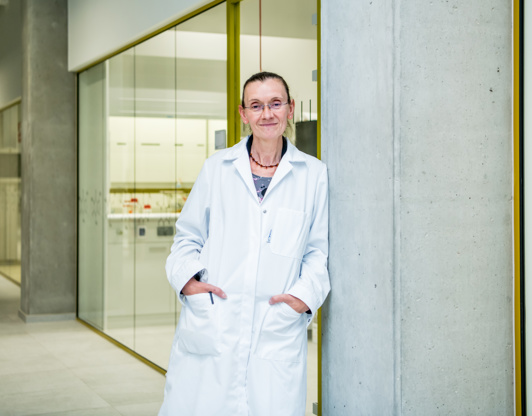
Marika Edoff is a Professor in Solid State Electronics specializing in solar cells at Uppsala University. She leads the Thin Film Solar Cell group at the Ångström Solar Center and has held a 50% pro-dean appointment (2014-2018). Her research focuses on Cu(In,Ga)Se2 (CIGS)-based thin film solar cells, including physical deposition methods, alkali-metal doping, and nanostructured passivation strategies. Education : PhD in Solid State Electronics (KTH 1997), Master in Electrical Engineering (KTH 1990) Professional Experience : Full Professor (2012-), Senior Lecturer (2006-2012), Spin-off company founder (Solibro AB) Recent publications highlight her work on rear contact passivation , light management architectures , and wide-gap CIGS solar cells with efficiency breakthroughs (23.6%). Collaborations span institutions in Belgium, Portugal, France, and Slovenia. Scientific Awards : Member, Swedish Research Council Board (2019-2024) Project Leader, EU Horizon Projects (ARCIGS-M, SITA) Coordinator, Ångström Thin Film Solar Center She supervises PhD students including Dorothea Ledinek and Olivier Donzel-Gargand , and has contributed to thermally integrated PV-water splitting and industrial-scale CIGS module development .
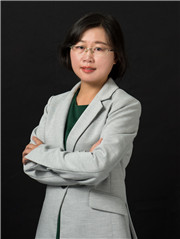
Associate Professor Hu Yunfei is affiliated with the School of New Materials and New Energy at Shenzhen University of Technology , where she leads the New Energy Systems and Smart Microgrids Laboratory . She is a member of the China Renewable Energy Society and Guangdong Solar Energy Association . PhD in Materials Processing Engineering (2005), South China University of Technology Bachelor of Engineering (2000), South China University of Technology Her research focuses on new energy systems , solar-storage direct-flexible systems , and high-efficiency photovoltaic devices , including perovskite solar cells , tandem solar cells , and transparent conductive oxides . Her work spans fundamental materials science and applied energy systems. The 15 most recent publications highlight her expertise in polycrystalline silicon thin films , transparent conductive oxides , perovskite solar cells , and optoelectronic materials . These works reflect trends in improving solar cell efficiency, stability, and manufacturing scalability. She has led projects such as the development of consumer solar power optimizers , optical performance testing for bifacial solar panels , and industrial collaborations on silicon ribbon substrates . Her projects are funded by institutions like the Norwegian Science Foundation and National Natural Science Foundation of China . At Shenzhen University of Technology, she oversees the New Energy Systems and Smart Microgrids Laboratory , integrating advanced materials and system design for renewable energy applications.
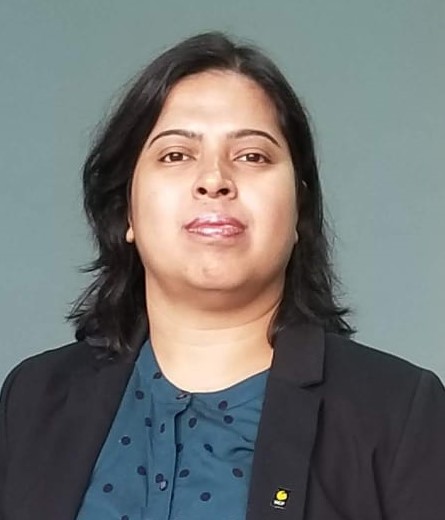
Sonali Das is a Lecturer in the Department of Electrical and Computer Engineering at the University of Central Florida. She earned her Ph.D. in Electrical Engineering from the Indian Institute of Engineering Science and Technology, India, in 2017. Research Interests: Her work focuses on device electronics, RF and microwave MEMS, solar cells, phototransistors, optoelectronic synaptic and neuromorphic devices, and emerging micro-nano fabrication technologies. She investigates light-trapping mechanisms in solar cells, develops biomimetic photovoltaic structures, and explores 2D material-based memristors for neuromorphic computing. Professional Activities: Das has served as a technical reviewer for the UCF Seed Funding Program (2019), instructor for Camp Connect I and II lab tours (2017–2019), and mentor for Camp Connect III programs at UCF (2019). She is an IEEE member. Scientific Awards: GAP Award, UCF Research Foundation and UCF Office of Technology Transfer (2019) Fulbright Bhaskara Advanced Solar Energy (BASE) Fellowship (2015) Teaching: She teaches courses including Semiconductor Devices (EEE 3350), Electronics I and II (EEE 3307/4309), Linear Circuits II (EEL 3123), Electromagnetic Fields (EEL 3470), Signal Analysis & Analog Communication (EEL 3552), Linear Control Systems (EEL 3657), and Digital Systems (EEE 3342).
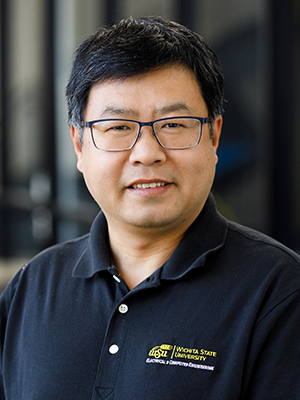
Chengzong Pang is an Associate Professor and MSECE Graduate Coordinator at the Department of Electrical and Computer Engineering, College of Engineering, Wichita State University. His work focuses on power systems, electrical engineering innovations, and renewable energy integration. He specializes in transient stability analysis, control systems, and smart grid technologies. Research Interests: Dr. Pang's expertise includes advanced control strategies for power electronics (e.g., PMSM, UPQC), machine learning applications for grid stability (LSTM/SVM), and energy storage solutions for renewable integration. His research also addresses challenges in microgrid operation, subsynchronous oscillation mitigation, and battery storage systems. Key Trends in Publications: Over 20 years of publications (2002–2022) emphasize: (1) Machine learning for power system analysis, (2) Control system design for renewable integration, (3) Grid stability enhancement via advanced algorithms, and (4) Smart grid infrastructure optimization. Recent works (2021–2022) highlight transient stability prediction and ANFIS-based power quality solutions. Labs/Teams: Active in energy systems research groups focusing on renewable integration and grid modernization, though specific lab names are not explicitly stated in the provided texts.
Pooya Davari is a Professor and Head of the Section for Applied Power Electronic Systems at Aalborg University , Denmark. He leads the EMI/EMC in Power Electronics Research Group and serves as Vice Chair of the Energy Efficiency Mission. His research focuses on electromagnetic interference (EMI) and harmonic mitigation in power electronic systems, with over 200 publications and significant contributions to renewable energy integration. Education: B.Sc. and M.Sc. in Electronic Engineering (2004, 2008), Ph.D. in Power Electronics from Queensland University of Technology (2013) Prior Roles: Lecturer at QUT (2013–2014), Postdoc at AAU (2014) Research Interests: Harmonic and EMI analysis in grid-tied converters High power density converter design Signal processing for converter modeling Reliability of power electronic systems Article Trends: Recent work emphasizes EMI/EMC in renewable energy systems, wide bandgap semiconductors (SiC/GaN), and reliability modeling for EVs and hydrogen production via electrolysis. Sub-fields include converter topologies, grid integration challenges, and AI-driven diagnostics. Scientific Awards: Equinor 2022 Prize (Denmark’s oldest engineering award) IEEE EMC Society Young Professional Award (2020) World’s Top 2% Highly Cited Scientist (Stanford, 2021–2025) Multiple best paper awards (IEEE, Applied Sciences, etc.) Grants & Editorial Roles: Recipient of grants from Innovation Fund Denmark (Supra-EMC project), Horizon Europe (SOLARIS), and industry partnerships. Serves as Area Editor for IEEE Transactions on Transportation Electrification , Associate Editor for IEEE Transactions on Power Electronics , and Editor-in-Chief of Circuit World Journal (2020–2025). Labs & Standards: Coordinator of the EMC Laboratory at Aalborg University. Member of IEC standardization Working Groups 6 and 8 (TC77A), focusing on EMC strategies for power grids.
Laura Bruckman is a Climo Associate Professor in the Department of Materials Science and Engineering at Case Western Reserve University's Case School of Engineering. Her research focuses on predictive lifetime modeling for materials degradation, quantitative spectroscopic characterization of materials, and applying statistical analytics and data science to solve challenges in photovoltaic systems and long-lived engineering materials. Her work emphasizes understanding degradation mechanisms in photovoltaic materials (e.g., backsheets, encapsulants, and silicon cells) under environmental stressors, with applications in improving reliability and service life through advanced data-driven approaches. Dr. Bruckman has contributed to the development of machine learning methods for material characterization (e.g., ToF-SIMS analysis) and spatiotemporal models for predicting degradation patterns in field-deployed PV systems. Her research also extends to curriculum design for applied data science, emphasizing industry-relevant training in statistical modeling and interdisciplinary problem-solving. Her expertise bridges materials science, data science, and energy systems, with over 50 peer-reviewed publications and a patent in classification using multivariate optical computing. Key technical contributions include analyzing environmental impacts on solar module performance, quantifying crack propagation in polymers, and developing predictive frameworks for material aging. Her work has been supported by collaborations with industry partners and federal research initiatives.
Dr. Jennifer Bauman is an Associate Professor in the Department of Electrical & Computer Engineering at McMaster University. Her research focuses on the electrification of transportation, power electronic converters, vehicle design and control, and smart-grid integration of electric vehicles (EVs). She holds a B.Sc. and Ph.D. from the University of Waterloo and has 8 years of industry experience as Director of Research at CrossChasm Technologies. Her work spans three levels: low-level power electronics optimization, mid-level vehicle system design, and high-level EV-grid interaction analysis. Education: B.A.Sc. and Ph.D. in Engineering from the University of Waterloo (2004, 2008). Professional registration: P.Eng. (Professional Engineer). Teaching: Instructors for ECE 724/MECHENG 721 on Modeling, Control, and Design of Electrified Vehicles. Research Interests: Development of efficient power electronic converters (e.g., using wide-bandgap devices), optimization of hybrid/electric powertrains, and analyzing EV impacts on smart grids. Notable contributions include a 65kW boost converter for fuel cell vehicles and studies on solar-charged EV architectures. Grants & Awards: Received $1.9M in CFI infrastructure funding (2017) as part of a team. Lab: Located in ITB A220, focusing on advanced vehicle electrification and grid-integrated systems.
Jao van de Lagemaat is a Center Director II-Technical at the Chemistry and Nanoscience Center of the National Renewable Energy Laboratory (NREL) , with affiliations as a Lecturer in the Department of Physics at the University of Colorado at Boulder . He holds dual fellowships at the Renewable and Sustainable Energy Institute and the Materials Science and Engineering Program at CU Boulder. Education: PhD in Physical Chemistry , Utrecht University (1998) Research Interests focus on semiconductor physics , quantum dots , and plasmonic-enhanced energy systems . His work bridges nanoscale charge transport in solar cells and molecular-level electrochemical processes for renewable fuels. Current projects include two-dimensional material engineering and perovskite stability analysis . Publication Trends show expertise in transition metal dichalcogenides , quantum tunneling in nanoparticles, and photovoltaic material degradation . His recent studies emphasize Molybdenum disulfide scalability and nitrogen fixation catalysts . Scientific Awards Fellow, Renewable and Sustainable Energy Institute (2020–present) Fellow, Materials Science and Engineering Program, University of Colorado at Boulder (2020–present) Advising & Collaboration includes mentorship of co-authors like Eric Miller and Joseph Berry , with interdisciplinary partnerships across materials modeling , organic-inorganic interfaces , and advanced microscopy techniques.
Jef Poortmans is a Visiting Professor at KU Leuven, Belgium, specializing in photovoltaic technologies and solar energy systems. His research spans multiple applications including conventional solar installations, agrivoltaics, vehicle-integrated photovoltaics, and tandem solar cell configurations. Affiliated with the Electa department at KU Leuven, he maintains an active research profile with numerous publications extending into 2025. His research interests focus on advancing photovoltaic technology across multiple dimensions. Poortmans investigates thermal modeling to improve energy yield predictions, develops lightweight PV modules for vehicle integration, explores agrivoltaic systems that combine agriculture with solar energy production, and works on next-generation perovskite and tandem solar cell technologies. His work often addresses practical implementation challenges including reliability under various environmental conditions, mechanical integration requirements, and performance optimization for specific applications. Analysis of his recent publications reveals a strong emphasis on practical implementation challenges of photovoltaic systems. His work spans fundamental materials science (particularly for perovskite and thin-film technologies), system integration challenges (especially for vehicle applications), and innovative approaches to land use optimization through agrivoltaics. A recurring theme is addressing reliability and performance issues under real-world operating conditions rather than ideal laboratory settings. Poortmans frequently collaborates with researchers across multiple institutions, indicating strong industry and academic connections within the photovoltaics community. His work appears in high-impact journals including Solar Energy Materials and Solar Cells, Scientific Reports, and Advanced Functional Materials, demonstrating recognition within the field. While specific grant information isn't detailed in the provided materials, his extensive publication record across diverse photovoltaic applications suggests successful funding acquisition for multiple research projects. His involvement in PhD theses supervision indicates active mentorship of next-generation researchers in the photovoltaics field. His research group appears to focus on bridging fundamental photovoltaic science with practical engineering applications, particularly addressing the reliability and integration challenges that prevent wider adoption of solar technologies in non-traditional applications like vehicles and agricultural settings.
Rune Strandberg is an Associate Professor at the Department of Engineering Sciences, University of Agder. He holds a PhD in solar cell physics from NTNU and specializes in photovoltaic materials, solar cell physics, and energy conversion. His research focuses on advanced solar cell concepts including tandem cells, intermediate band solar cells, and thermoradiative energy harvesters. Education: Master of Technology (2005) and PhD (2010) in solar cell physics from NTNU. Pedagogical training includes Uniped courses (2014-2015) and PhD supervision qualification. Current teaching: Renewable Energy, Solar Energy Systems, Electromagnetism, Advanced Photovoltaics Prior roles: PhD student at NTNU (2005-2009), Senior Researcher at Teknova AS (2010-2013) Research areas: New photovoltaic concepts, characterization of photovoltaic cells, solar cell physics, emissive energy harvesters His recent publications analyze band gap optimization, radiative coupling in multi-junction cells, temperature sensitivity, and theoretical efficiency limits across multiple high-impact journals. Collaborators include Anne Gerd Imenes, Alfredo Sanchez Garcia, and Sissel Tind Kristensen. Key contributions include development of analytical models for solar cell performance, field testing of PV modules in Norway, and studies on temperature effects in multicrystalline silicon wafers.
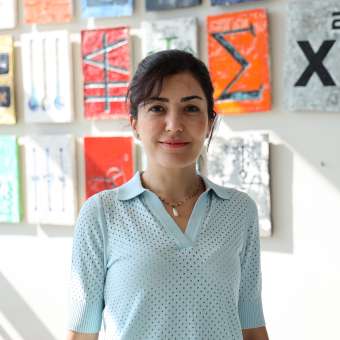
Dr. Sueda Saylan is an Assistant Professor at the Faculty of Engineering, Özyeğin University, since 2024. Her academic journey includes a Ph.D. in Interdisciplinary Engineering (2016) from Masdar Institute (now Khalifa University), postdoctoral research at Khalifa University (2016-2022), and an MSCA Postdoctoral Fellowship at Bilkent University (2022-2024). She has also held visiting researcher positions at MIT (2014) and the University of Tokyo (2016). Education Doctorate: Interdisciplinary Engineering, Masdar Institute of Science and Technology (2016) Master's: Microelectronic Manufacturing Engineering, Rochester Institute of Technology (2004) Bachelor's: Mechanical Engineering, Middle East Technical University (2002) Dr. Saylan's research focuses on memristive devices , photovoltaics , and light-matter interactions at micro/nanoscale . Her work bridges materials science and electronic engineering, with recent publications on memristor-based sensors, spectral filtering in silicon, and machine learning integration for biomedical diagnostics. Key trends from her 15 most recent articles (2013-2025) include: Advancing memristor technology for radiation sensing and vacuum monitoring Optimizing photovoltaic efficiency through light management and antireflection coatings Developing compact, low-power diagnostic devices for pathogen detection Exploring nanoscale electrode materials and switching mechanisms Applying Fourier transforms and interferometry in optical systems Scientific Awards Marie Skłodowska-Curie Actions (MSCA) Postdoctoral Fellowship (2022-2024) Dr. Saylan has received research support from prestigious programs and has contributed to interdisciplinary projects involving semiconductor physics, optical engineering, and biomedical diagnostics. Her collaborations span institutions like Khalifa University, MIT, and the University of Tokyo.
Dr. Laurence Lutsen is a Strategic Research Manager at IMEC-IMOMEC and Project Manager at UHasselt-MATCHEM, affiliated with Hasselt University in Diepenbeek, Belgium. She holds a PhD in Chemistry from the University of Montpellier II (1994) and has over 200 peer-reviewed publications with an H-index of 56 and over 10,900 citations. Her research focuses on designing and synthesizing novel semiconductors for organic and hybrid electronic devices, including solar cells, transistors, sensors, and light-emitting diodes. **Education:** PhD in Chemistry, University of Montpellier II (1994) Postdoctoral research at the University of Kent (1995) Joined Limburgs Universitair Centrum (now UHasselt) in 1997 **Research Interests:** Her work emphasizes organic and hybrid semiconductor materials, particularly layered hybrid perovskites, organic electrochemical transistors (OECTs), and photovoltaic technologies. Key areas include optimizing material stability, charge transport, and device performance in applications like solar cells and biosensors. She explores advanced synthesis techniques and defect engineering to enhance material reliability. **Labs & Teams:** Lutsen leads research initiatives at IMOMEC and MATCHEM, collaborating on interdisciplinary projects involving materials chemistry, nanotechnology, and device fabrication. Her contributions bridge fundamental material science and applied optoelectronics.
Panagiotis Christofides is a Distinguished Professor in the Department of Chemical and Biomolecular Engineering at the University of California, Los Angeles (UCLA), with a secondary affiliation in Electrical and Computer Engineering. He serves as Department Chair and holds the William D. Van Vorst Chair in Chemical Engineering Education. Education: Diploma in Chemical Engineering (1992), University of Patras M.S. in Electrical Engineering (1995), University of Minnesota M.S. in Mathematics (1996), University of Minnesota Ph.D. in Chemical Engineering (1996), University of Minnesota Research Focus: Christofides specializes in control systems engineering for complex industrial processes, including nonlinear/hybrid systems, economic model predictive control, fault-tolerant control, and multiscale modeling. His work bridges chemical engineering with advanced computational methods, particularly in water/energy systems and solar-cell technologies. Scientific Leadership: He has authored over a dozen influential books and special issues on control theory and its industrial applications. Awards include AIChE Fellow, IEEE/IFAC/AAAS Fellowships, the Donald P. Eckman Award, and multiple Schuck Best Paper Awards. His research has been recognized through the NSF CAREER Award and ONR Young Investigator Award.
Dr. Carl Ho (Ngai Man) is a Full Professor and Canada Research Chair in Efficient Utilization of Electric Power at the University of Manitoba's Price Faculty of Engineering, Department of Electrical and Computer Engineering. Appointed Associate Head (Electrical Engineering) in July 2021, he leads the Renewable-energy Interface and Grid Automation (RIGA) Lab established with CFI funding in 2014. His educational background includes: PhD in Electronic Engineering (2007), City University of Hong Kong MEng in Electronic Engineering (2002), City University of Hong Kong BEng in Electronic Engineering (2002), City University of Hong Kong Dr. Ho's research focuses on power electronics applications for sustainable energy systems, with particular expertise in power conversion technologies for electric vehicles, renewable integration, and smart grid infrastructure. His work bridges industrial application and academic innovation, evidenced by over 40 IEEE journal publications, 80 conference papers, and 20+ patents. Current research emphasizes wide-bandgap semiconductor applications, power hardware-in-loop validation, and DC microgrid architectures for remote communities. Analysis of his recent publications reveals a strong trend toward practical implementation of power electronics solutions, with increasing focus on GaN/SiC devices, grid-forming converters, and modular architectures for microgrids. His work consistently addresses real-world challenges in efficiency, reliability, and cost-effectiveness across renewable integration, electric transportation, and power quality domains. Notable awards include: Second Place Winner for 2018 IEEE Transactions on Power Electronics Prize Paper Multiple IEEE JESTPE Star Associate Editor Awards (2022-2023) IEEE TPEL AE Excellence Award (2023) Best Student Team Regional Award in IEEE Empower a Billion Lives 2019 As an active mentor, Dr. Ho supervises numerous graduate students across multiple cohorts and leads significant research initiatives including NSERC Discovery Grants, MITACS collaborations with Power Integrations Inc., Research Manitoba Innovation Proof-of-Concept Grants, and Natural Resources Canada projects on zero-emission heavy vehicles. His RIGA Lab serves as a hub for industry-academic collaboration with Manitoba Hydro and transportation sector partners. The RIGA Lab, completed in 2016 and renovated in 2019, houses specialized equipment for power electronics prototyping, real-time simulation, and hardware-in-loop testing. Current projects include advanced wireless EV charging, GaN-based controller development, and DC microgrid solutions for remote communities, with recent recognition including a visit from Prime Minister Justin Trudeau in April 2023.
Khalifa Aguir is a Professor at Aix-Marseille University, affiliated with the Department of Detection, Radiation and Reliability (DETECT) and the Microsensor Instrumentation (MCI) Team. His research focuses on gas sensing technologies , particularly metal oxide semiconductors , nanomaterials , and thin films for environmental and biomedical applications.