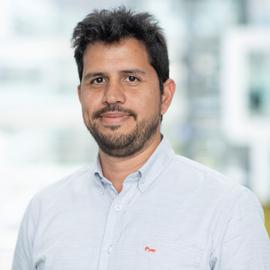
Emil Boye KromannView profile
Associate Professor
Emil Boye Kromann is an Associate Professor at the Department of Health Technology, Technical University of Denmark (DTU), leading the Optical Sensing and Imaging Systems group within the Bio-observatory. His research focuses on developing optical microscopes for high-throughput imaging of artificial organs, particularly organ-on-chip systems, to advance biomedical research and personalized medicine. He has held academic positions at DTU since 2017, including Assistant Professor in the Department of Electrical Engineering (2017-2018) and Associate Professor in Health Technology (2018-present). A graduate of Yale University with a PhD in Biomedical Engineering (2012-2017) under mentor J. Bewersdorf, Kromann integrates interdisciplinary approaches in hardware/software development for micro/nano-scale imaging. Current Position: Associate Professor, Department of Health Technology, DTU Past Position: Assistant Professor, Department of Electrical Engineering, DTU Education: PhD in Biomedical Engineering, Yale University His research portfolio emphasizes optical imaging technologies, including single-pixel imaging, lattice light sheet microscopy, and 3D-printed tissue models. Collaborations with DTU teams and involvement in BSc/MSc student supervision through the Biomedical Prototyping course in DTU Skylab highlight his commitment to training and translational science. Publications and patents reflect innovations in imaging systems, organ-on-chip actuation, and biomaterial integration. Current projects center on light scatter-based imaging and spatial frequency-sequential probing for complex living samples. Key research trends include the development of adaptive optical systems for organ-on-chip visualization, interference pattern analysis, and dual-material scaffolds for intestinal modeling. These works intersect biomedical engineering, optical physics, and tissue engineering, with applications in drug screening and personalized diagnostics. Despite no explicit scientific awards listed, his leadership in multidisciplinary projects and patent contributions underscores significant academic impact.