David H. Rogers is a Researcher affiliated with Los Alamos National Laboratory , specializing in Scientific Visualization and Data Analysis . His work focuses on Exascale Computing , Color Mapping , and In Situ Visualization to enhance large-scale scientific data workflows. His research explores methods for Lossy Data Reduction , 3D Streamline Visualization , and Perceptual Uniformity in Color Sequences . He has contributed to frameworks like VTK-m and CinemaScience , enabling efficient data exploration and domain-specific visualization. David collaborates extensively with institutions such as University of Utah , Oak Ridge National Laboratory , and University of Oregon , addressing challenges in High-Performance Computing and Visual Analytics . His publications highlight interdisciplinary efforts in Computer Graphics , Flow Dynamics , and Scientific Data Management .
Professor Ralf Brüggemann is a full-time faculty member at the University of Konstanz , holding the Chair of Statistics and Econometrics since October 2007. He completed his Habilitation in Time Series Econometrics at Humboldt-Universität zu Berlin in 2007 and received his Ph.D. in Economics in 2003 for work on VAR model reduction techniques. Education : Habilitation: "Topics in Time Series Econometrics", Humboldt University Berlin (2007) Ph.D.: Economics, Humboldt University Berlin (2003) Diplom: Economics, Humboldt University Berlin (1999) His research spans Time Series Econometrics with focus on Cointegrated VAR Models , Structural VAR/VECM , Forecasting Methods , and Empirical Macroeconomics . Key contributions include methodological work on structural identification, variable selection in high-dimensional VAR, and monetary policy analysis using microeconomic data. Recent publications address External instruments in SVAR identification (2022) Directed graphs for VAR variable selection (2022) Stochastic aggregation weights in forecasting (2023) Asymmetric impulse responses in European financial markets (2014) with methodological innovations in heteroskedasticity-robust inference and stochastic aggregation weights. Scientific Awards : Jean Monnet Fellow, European University Institute (2003-2004) He leads research on monetary policy transmission mechanisms and macroeconomic risk through collaborative projects with institutions like the German Research Foundation Collaborative Research Center 649 (2005-present) and serves as editor for the Journal of Economics and Statistics special issue on Economic Forecasts (2011).
Dr. Lakshmi Prayaga is an Associate Professor in the Department of Cybersecurity and Information Technology at the University of West Florida, part of the Hal Marcus College of Science and Engineering. She is based in Building 4, Room 437, and can be reached at lprayaga@uwf.edu . Education: Ed.D. in Instructional Technology, University of West Florida M.S. in Software Engineering, University of West Florida MBA, Alabama A&M University M.A. in Philosophy, Bangalore University, India B.A. in Liberal Arts, Osmania University, India Dr. Prayaga's research focuses on the integration of advanced technologies—such as robotics, augmented reality, 3D printing, data visualization, game programming, and computer-mediated simulations—into educational and workforce training contexts. Her work aims to enhance comprehension, develop cognitive skills, and make technology accessible through innovative platforms like tele-robotics. She emphasizes practical, hands-on learning experiences that bridge theory and application in instructional and applied technologies. Her recent publications reflect a strong trend in using interactive and immersive technologies to transform education and training. Topics include game-based learning, web development pedagogy, data visualization in social media, and the use of 3D printing and robotics in curricula. These works span disciplines such as computer science education, cognitive development, workforce technology, and instructional design, demonstrating a multidisciplinary approach to educational innovation. Scientific Awards: No awards listed in the provided text. Dr. Prayaga is actively involved in curriculum development and teaching graduate-level courses such as Information Engineering Technology, Exploring the Internet, Web Server Technologies, and Game Programming 2 (3D Game Studio), most of which she designed. She has co-authored books on robotics, Android app development, game programming, and web technologies. While specific grant funding and advisees are not mentioned, her extensive publication record and course leadership indicate a strong commitment to academic mentorship and research leadership. She contributes to advancing accessible and inclusive educational technologies, particularly through her tele-robotics platform, which reduces infrastructure costs and broadens access to robotics education. Her interdisciplinary work connects computer science, education, and cognitive science, positioning her as a key contributor to technology-enhanced learning environments.
Sandro Luigi Fiore is an Associate Professor in the Department of Information Engineering and Computer Science at the University of Trento, Italy. He has held academic positions at the University of Salento and visiting scientist roles at the University of Chicago and Lawrence Livermore National Laboratory. His research integrates data science, big data, and high-performance computing with climate informatics and open science. Education: Ph.D. in Innovative Materials and Technologies, University of Lecce, 2004 Master of Science in Computer Engineering (with honors), University of Lecce, 2001 His research interests span Data Science, Big Data, Scientific Data Management, Artificial Intelligence, and Distributed/Cloud/Parallel Computing , with a strong application focus on Climate Change and Open Science . He develops FAIR-enabled data analytics solutions and contributes to large-scale data infrastructures such as ESGF, EOSC-hub, and INDIGO-DataCloud. His work emphasizes provenance, reproducibility, and interoperability in scientific computing. The articles reflect a consistent trajectory in large-scale scientific data systems , evolving from Grid-DBMS and parallel computing to modern applications in climate informatics, AI, and FAIR data. Key themes include distributed data management, middleware, exascale software, and reproducible workflows in HPC environments. Scientific Awards: Earth System Grid Federation Team Award (2017) UNIDATA Community Equipment Award (2011) Best Student Paper Award, ITCC2003 Fiore has advised on and led multiple national and European projects including EOSC-hub, IS-ENES, and BARRACUDA (RDA-Europe3). He actively supports the adoption of FAIR data principles in scientific repositories, advising on data policies, architecture, provenance, and interoperability. He is a member of the FAIR Champions group and serves on the Advisory Board of FAIRsFAIR. He is involved in key research teams and projects such as the Earth System Grid Federation (ESGF) , Globus Lab (University of Chicago) , and PCMDI/LLNL . His work contributes to climate model intercomparison (CMIP5/6) and the development of next-generation data infrastructure for open science.
Dr. Franck Patrick Vidal is an Honorary Professor at Bangor University's School of Computing and Engineering, with additional affiliations at the Science and Technology Facilities Council. He holds a PhD in Computer Science and has extensive experience in medical imaging, visualization, and simulation. His research focuses on X-ray imaging, computed tomography (CT), and high-performance computing applications in medical physics. He has contributed to developing open-source tools like gVirtualXray for real-time X-ray simulations and has been involved in projects addressing large-scale emergency response visualization (RAMPVIS). Education includes a PhD from Bangor University (2008), a Master's from Teesside University (2002), and a Postgraduate Certificate in Higher Education (2016). He has held roles such as Senior Lecturer and Postdoctoral Research Fellow at institutions like Inria and CEA Saclay. His research interests span medical imaging technologies, optimization algorithms, and the application of artificial intelligence to healthcare. Notable awards include the 'Best Poster Presentation' and the 'David Duce Prize'.
Dr. Daniel Gillis is an Associate Professor in the School of Computer Science at the University of Guelph. He specializes in transdisciplinary research addressing ecological and public health challenges, community-engaged software design, and educational pedagogy. His work emphasizes collaboration across disciplines and communities, notably through projects like Farm to Fork (food security), ICON (transdisciplinary classroom), and the Wireless Mobile Mesh Network initiative to bridge Canada’s digital divide. Gillis holds a PhD in Statistics from the University of Guelph (2010) and has been recognized with awards including the Ontario Confederation of University Faculty Associations Teaching Award (2019) and a $2.13M MITACS grant (2018). Education & Employment: PhD in Statistics, University of Guelph (2010) Joined University of Guelph School of Computer Science in 2011 Research Themes: Agent-based modeling for ecological risk assessment Community-led tech solutions in Indigenous communities Transdisciplinary education frameworks (e.g., ICON program) Climate change adaptation via integrated monitoring systems (eNuk program) Grants & Awards: MITACS Accelerate Grant ($2.13M, 2018) Science Borealis 100 Voices recognition (2016) Teaching Excellence Award (2019) Advising & Partnerships: Collaborations with Public Health Agency of Canada, Statistics Canada, Inuit communities in Labrador Advisor for undergraduate and graduate research projects (e.g., phishing detection, land observation tools) Labs & Teams: ICON Transdisciplinary Classroom Wireless Mobile Mesh Network Research Group Rigolet Inuit Community Monitoring Initiative
Lt Col Wayne Chris Henry is an Assistant Professor in the Department of Electrical and Computer Engineering at the Air Force Institute of Technology (AFIT), part of Air University. He is actively engaged in teaching, research, and leadership in cybersecurity, particularly in space systems and offensive cyber operations. Education: Ph.D., Electrical Engineering, Air Force Institute of Technology, 2020 M.S., Computer Engineering, Air Force Institute of Technology, 2011 B.S., Computer Engineering, Pennsylvania State University, 2004 His research focuses on cutting-edge cybersecurity challenges, including software reverse engineering, vulnerability analysis, IoT/embedded security, and human-machine teaming. He emphasizes practical applications in military and space contexts, aiming to strengthen cyber resilience in critical infrastructure. The most recent articles show a strong trend in space system cybersecurity, secure data distribution (DDS-Cerberus), satellite intrusion detection, and offensive cyber techniques like ROP attacks and script smuggling. His work bridges theoretical analysis with operational defense strategies. Scientific Awards: 2023 Field Grade Officer of the Year - Air University 2023 Graduate School of Engineering Management Dean's Distinguished Professor Award 2022 Field Grade Officer of the Quarter - AFIT 2019 Inducted into Tau Beta Pi (Top 20% students) 2019 Inducted into Eta Kappa Nu (Top 33% students) He mentors numerous students and researchers, particularly through collaborative publications and leadership in AFIT's first Capture the Flag team. While specific grants are not listed, his extensive publication record in defense and cybersecurity suggests active involvement in funded research projects. He is also deeply involved in cybersecurity education and curriculum development for military professionals. Dr. Henry leads and contributes to research teams focused on space cybersecurity, software analysis, and cyber education. His lab work includes developing testbeds for satellite security, designing intrusion detection scenarios, and analyzing cyber threats in RF SATCOM and embedded environments.
Luís Henrique Ramilo Mota is an Assistant Professor in the Department of Information Science and Technology (ISTA) at ISCTE – Instituto Universitário de Lisboa. His research lies at the intersection of robotics, multi-agent systems, and artificial intelligence, with a strong focus on cooperative robotics and robotic soccer applications. His primary research interests include: Multi-Robot Coordination Setplays-based Planning Ontology Engineering for Agent Systems Semantic Web Technologies RoboCup Simulation and Mixed Reality Distributed Autonomous Systems Mota’s recent scholarly work centers on developing flexible coordination mechanisms for robotic teams, particularly through the Setplays framework, enabling robust and dynamic behavior in competitive environments like RoboCup. His publications span high-impact journals such as Data and Knowledge Engineering and Mechatronics , as well as top-tier conferences including AAMAS and IEEE RAM. His research integrates software architecture, communication protocols, and AI planning to solve real-world coordination challenges in autonomous systems. Scientific Contributions: Developed the Setplay framework for multi-robot coordination Contributed to ontology modeling for multi-agent systems (O3F) Authored multiple RoboCup team description papers for FC Portugal Pioneered work on open, fault-tolerant robotic architectures Advising and Collaborative Research: While no formal students are listed, Mota has collaborated extensively with researchers such as Luís Paulo Reis, Nuno Lau, and Fernando Almeida on robotic soccer and semantic web projects. His work often involves team-based research initiatives, particularly within the RoboCup community, where he contributes to both simulation and physical visualization leagues. Laboratories and Research Teams: Mota is actively involved with the FC Portugal RoboCup team, contributing to both the 2D simulation and mixed reality competitions. His work supports the development of cooperative strategies and communication frameworks in multi-agent robotic systems.
Dr. Popirlan Claudiu Ionut is a Lecturer in the Computer Science Department at the Faculty of Exact Sciences, University of Craiova, Romania. He has been actively involved in academic and research activities since 2004, progressing from Assistant Lecturer to Assistant Professor and currently serving as a Lecturer. He holds a Ph.D. in Computer Science from the University of Pitesti and has extensive teaching experience in advanced programming, databases, GIS, and software engineering. His educational background includes: Ph.D. in Computer Science, University of Pitesti (2005–2009) Master in Artificial Intelligence, University of Craiova (2003–2004) B.Sc. in Computer Science, University of Craiova (1999–2003) Secondary Education, Fratii Buzesti National College (1995–1999) Dr. Popirlan's research is centered on Artificial Intelligence, with a strong emphasis on Mobile Agents and Multiagent Systems. His work explores knowledge representation, processing, and management using agent-based architectures, with applications in robotics, contact centers, and virtual organizations. He has also contributed to web-based 3D visualization and modeling in mechanical engineering. His technical expertise spans Java technologies, databases, and software engineering. The analysis of his recent publications reveals a consistent focus on mobile agents for knowledge processing, distributed systems, and intelligent control. Themes include agent architectures, knowledge base management, pathfinding algorithms, and simulation systems, indicating a deep and sustained research trajectory in autonomous and intelligent software systems. He has received research grants such as TD CNCSIS and CNCSIS IDEI, where he served as director and team member respectively, focusing on mobile agents and knowledge management. His editorial roles include Scientific Referent for INFO-PRACTIC and Editorial Secretary for the Annals of the University of Craiova. Dr. Popirlan is an active member of the academic community, affiliated with IEEE, IEEE Computer Society, ACM, IBM Academic Initiative, Microsoft Faculty Connection, and the Romanian Mathematical Society. He is also part of the Research Center of Artificial Intelligence in Craiova.
Noah Rhodes is a CNLS Postdoctoral Associate at Los Alamos National Laboratory's Center for Nonlinear Studies (CNLS), working within the Theoretical Division (T-Division). His research focuses on mathematical optimization applications for power grid challenges, particularly infrastructure flexibility and wildfire risk mitigation. Office contact: TA-3, Building 1690, Room 123; email: nrhodes@lanl.gov. Educational background includes: B.S. in Electrical Engineering, University of Wisconsin-Madison (2019) Ph.D. Minor in Energy Analysis and Policy, University of Wisconsin-Madison (2022) Ph.D. in Electrical Engineering, University of Wisconsin-Madison (2024) Rhodes' research centers on enhancing power grid resilience through optimization techniques, with emphasis on reducing infrastructure needs and managing wildfire-related outages. His work bridges theoretical mathematics with practical energy security challenges, developing frameworks for public safety power shutoffs and grid restoration under extreme conditions. His 2021-2025 publications reveal a trajectory from foundational grid restoration algorithms toward integrated environmental considerations. Recent work combines carbon intensity analysis with grid operations while advancing open-source tools (PowerModelsRestoration.jl, ElectricityEmissions.jl) for academic and utility applications. Key trends include stochastic optimization for emergency response and topology-aware power flow formulations. No scientific awards are listed in the provided materials. No student advisement or grant information is documented in the source text. Rhodes operates within CNLS—a hub for nonlinear science research at LANL—which fosters interdisciplinary collaboration on complex systems. His work interfaces with T-Division's theoretical frameworks while addressing real-world energy infrastructure vulnerabilities through computational modeling and optimization.
Franz Christopher Kunze is a Researcher at the Department of Automation Technology, Faculty of Electrical Engineering and Information Technology, Ruhr-Universität Bochum. His work focuses on developing advanced alarm management systems for industrial processes using causal directed graphs and machine learning techniques. He collaborates with TU Munich on the DFG-funded CausAlITI project, aiming to improve root-cause analysis during industrial alarm floods. Research interests include causal analysis of alarm patterns, adaptive system modeling, and operator-centric visualization. He teaches courses like Process Automation and Programming for ETIT/ITE students, and supervises bachelor's theses in alarm system development. His publications (2023–2025) address alarm flood dynamics, causal graph applications, and automated model generation using LLMs. Current work emphasizes real-time alarm processing and uncertainty management in industrial systems.
Prof. Yavuz Akpınar at Boğaziçi University is a leading academic in Educational Technology and Interactive Learning Environments . His career spans over two decades of research and development in technology-enhanced education. Ph.D. : Design and Validation of Interactive Learning Environments (University of Leeds, UK) M.A. : Graphical Environments for Understanding School Science (University of Leeds, UK) B.S. : Measurement and Evaluation in Education (Hacettepe University, Türkiye) His research focuses on serious games , computer-based learning , and multimedia pedagogy , with particular emphasis on self-regulated learning and programming education in K-12 contexts. Recent publications highlight a consistent focus on serious game design , flipped classroom modalities , and argumentation-based learning tools . His work bridges STEM education and educational technology validation . Professor Akpınar's email address is akpinar@bogazici.edu.tr .
Ilkka Nissilä, Ph.D., is a Staff Scientist at the Department of Neuroscience and Biomedical Engineering , Aalto University. With a career spanning over two decades, his work focuses on diffuse optical tomography , near-infrared spectroscopy , and neonatal brain imaging . He served as a Principal Investigator for the Academy of Finland-funded project Multimodal neuroimaging of children (2016–2018) and has collaborated internationally through visiting researcher appointments. Education : Doctoral Degree in Engineering, Helsinki University of Technology (2004) Master's Degree in Engineering, Helsinki University of Technology (1998) Research Themes : Biomedical optics and optical tomography for brain imaging Neurovascular coupling and hemodynamic responses Developmental neuroscience in infants/children Emotional and sensory processing in early life Algorithm development for image reconstruction Integration of NIRS with TMS/MEG/EEG Article Trends : Recent work combines deep learning with diffuse optical tomography for improved brain imaging Studies maternal mental health impacts on child brain development Advances frequency-domain data utilization and 3D anatomical modeling in neonatal studies Activities : Visiting Researcher (2001–2008) at multiple foreign institutions Conference Presentations Media Impact : 2023: AI-Mind General Assembly participation 2022: Co-developed a skin-stroking device for alcohol cravings 2019: Maternal anxiety effects on infant brain covered in Finnish media Collaborations : International partnerships in biomedical optics Interdisciplinary work with pediatric and psychiatric researchers
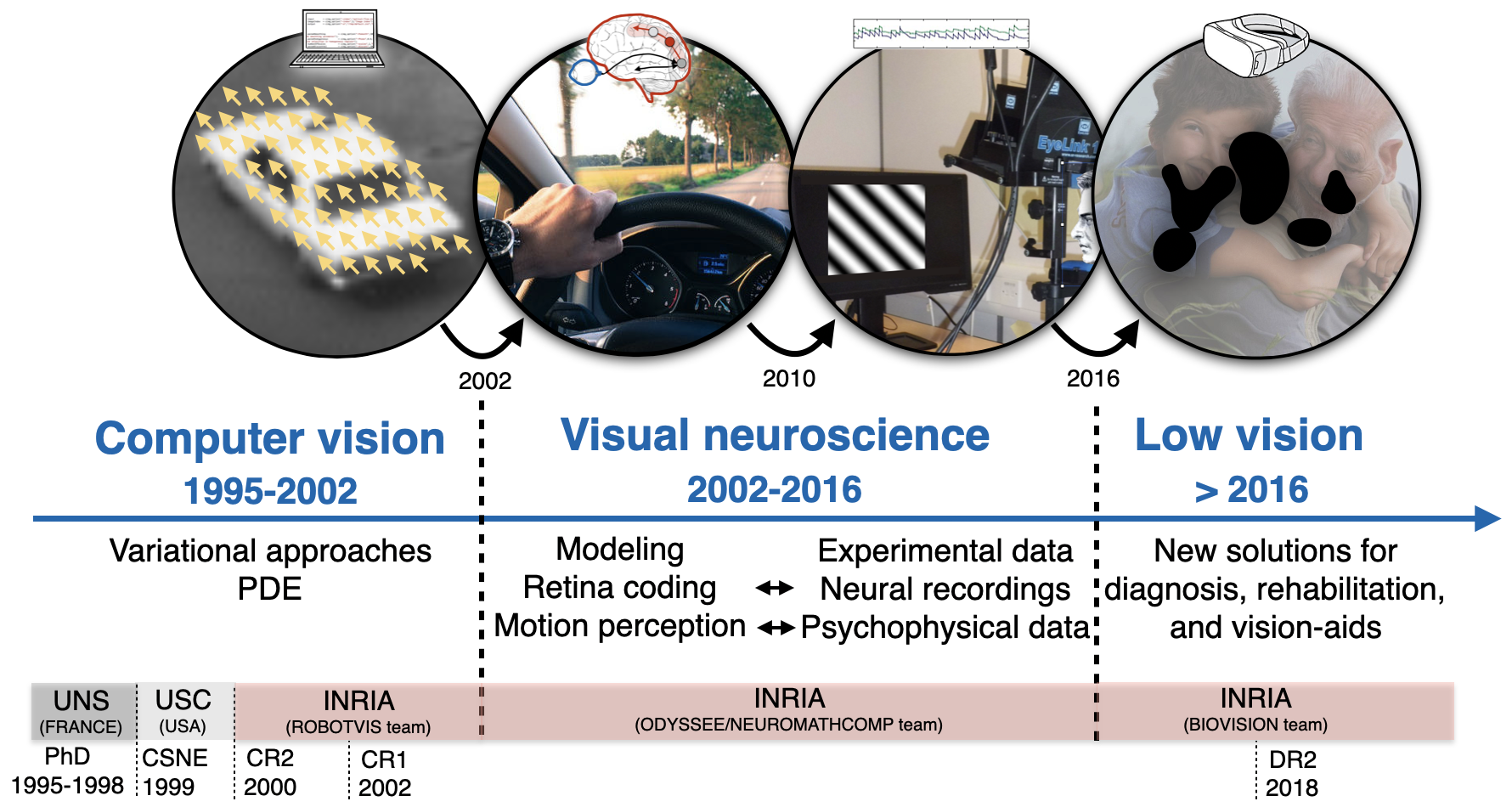
Pierre Kornprobst is a Senior Research Scientist ( Directeur de Recherche ) at Inria Sophia Antipolis – Méditerranée, France. Specializing in vision science and computational neuroscience, he focuses on understanding visual perception mechanisms in visually impaired individuals and developing innovative solutions using virtual reality (VR) and augmented reality (AR). His work bridges biological vision systems with artificial computer vision, emphasizing bio-inspired models. Ph.D. in Mathematics (1998), Nice-Sophia Antipolis University Co-author of a textbook with over 2,000 citations Advisor to 8 Ph.D. and 20+ M.S. students Research interests span bio-inspired computer vision , VR/AR for accessibility , computational neuroscience , and visual perception modeling . Recent publications highlight VR-based assistive technologies, constrained text generation for vision screening, and Python toolboxes for reproducible experiments. His work has been recognized with inclusion in the 21st Annual Best of Computing . He has contributed to five European projects (FACETS, SEARISE, BRAINSCALES, MATHEMACS, RENVISION) and leads work packages in ANR DEVISE (2021–2024).
Andrzej Skalski serves as a Professor and Deputy Head of the Department of Metrology and Electronics within the Faculty of Electrical Engineering, Automatics, Computer Science and Biomedical Engineering at AGH University of Science and Technology in Kraków. He actively participates in the Biomedical Engineering Discipline Council and maintains his primary workplace in Building B-1, Room 206, with contact via skalski@agh.edu.pl. His research spans Medical Imaging, Computer Vision, and Mixed Reality applications in healthcare, with concentrated expertise in medical image segmentation, surgical navigation systems, and 3D visualization techniques. Recent work demonstrates innovative integration of deep learning for vascular structure analysis, development of cloud-based diagnostic platforms like DECODE, and implementation of extended reality solutions for surgical precision and anatomy education. His scholarship bridges engineering principles with clinical practice to solve complex biomedical challenges. Analysis of his 2024-2026 publications reveals dominant trends in markerless surgical navigation, noninvasive vascular disease management, and educational technology for anatomy instruction. Key thematic clusters include: (1) Deep learning-driven segmentation of vascular and fracture structures in CT/X-ray data, (2) Mixed reality frameworks for surgical guidance and biopsy procedures, and (3) Systematic evaluations of digital versus traditional methods in medical education. These works consistently emphasize clinical applicability and technological innovation. Dr. Skalski leads collaborative initiatives including the DECODE platform for peripheral artery disease management and the PENGWIN 2024 Challenge for pelvic fracture segmentation benchmarking. His leadership in the Biomedical Engineering Discipline Council underscores institutional influence, while his extensive publication record indicates active supervision of graduate researchers despite no explicit student listings in available records. Current projects focus on WebGL-based medical visualization and mixed reality surgical navigation systems.