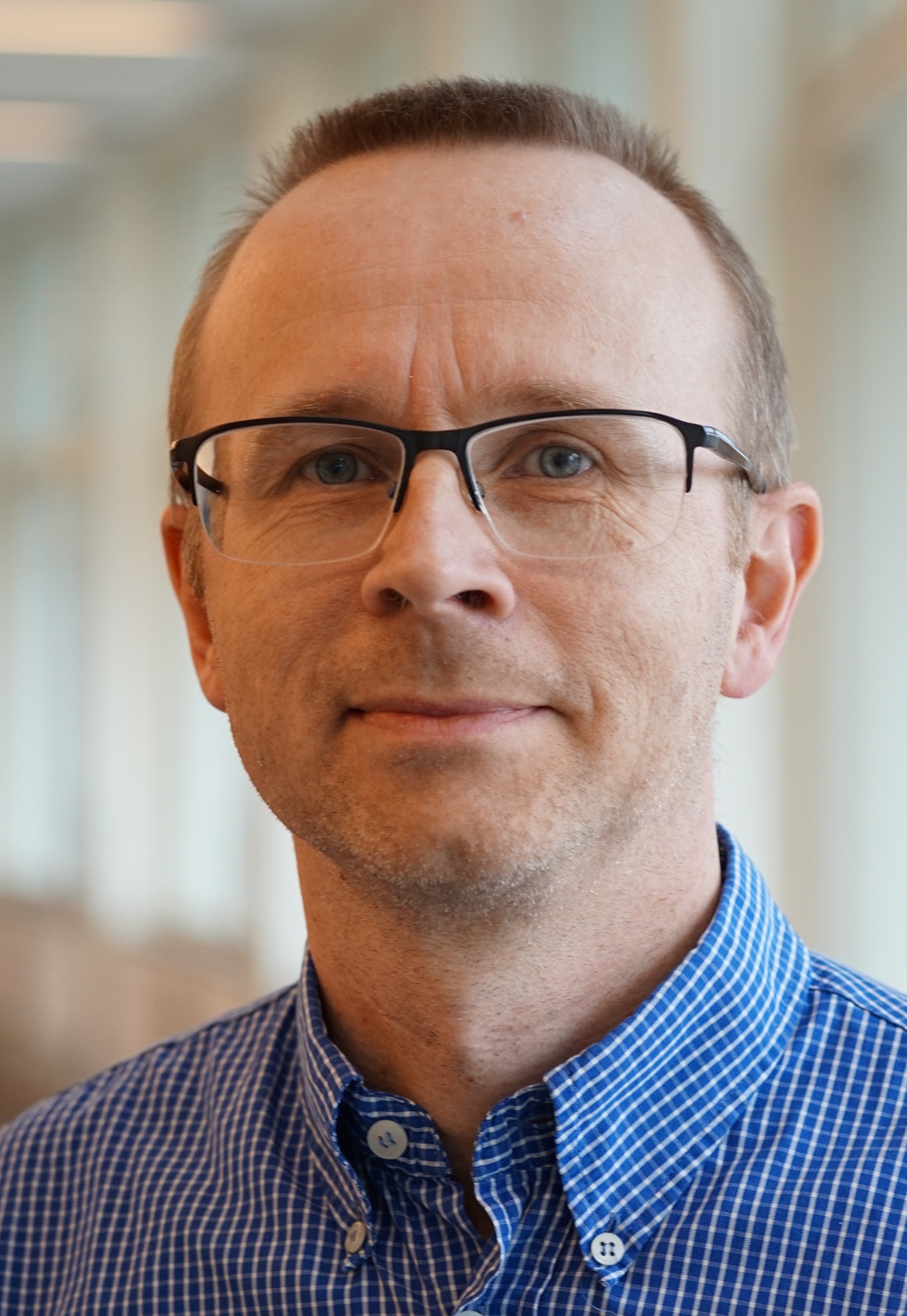
Niclas Jansson is a researcher at the PDC Center for High Performance Computing at KTH Royal Institute of Technology. He holds an M.S. in Computer Science (2008) and a Ph.D. in Numerical Analysis (2013) from KTH. His career spans roles such as postdoctoral researcher at RIKEN Advanced Institute for Computational Science (2013-2016) and visiting scientist at RIKEN (2018-2021), where he contributed to the Japanese exascale program Flagship 2020. A core focus of his research involves extreme-scale computing and numerical method development. He is a key developer of RIKEN's multiphysics framework CUBE , the HPC branch of FEniCS , and the spectral element flow solver Neko . His work is currently supported by a Swedish Research Council Starting Grant aimed at enhancing high-order spectral element methods for exascale fluid simulations. Niclas has published extensively on topics such as GPU acceleration , adaptive finite element methods , in situ visualization , and extreme-scale turbulence modeling . He also teaches Computational Fluid Dynamics (SG2212) at KTH.
Siegfried Rouvrais is an Associate Professor and Research Scientist at IMT Atlantique, part of the Institute Mines-Télécom, and a CNRS research fellow at Lab-STICC. He specializes in engineering education and software systems research, focusing on curriculum design, decision-making skills in VUCA contexts, and enterprise architecture. His affiliations include IMT Atlantique (Brest, France), CNRS, and international collaborations like the CDIO initiative. Education: PhD in Software Architecture and Distributed Systems Modeling from University of Rennes/IRISA (2002) Research Interests: Engineering Education Systems (curriculum transformation, accreditation frameworks, project-based learning) and Software Systems (non-functional properties, service composition, model-driven engineering). His work integrates educational and technical domains to enhance program quality and student readiness for volatile environments. Recent Articles Highlight: Analysis of curriculum resilience in VUCA contexts, design of expedition learning models, and frameworks for higher education systems. His publications emphasize interdisciplinary methods, quality assurance, and global educational collaboration. Awards: Best Paper Award (MOPAS 2011), Emerging Innovative Course Prize (2021). Grants & Projects: Coordinator of DECART (€400k), HOOD (ongoing), DAHOY (€395k), and others. Advised over 50 student projects, with roles in program evaluations (e.g., French Engineering Accreditation Commission). Labs/Teams: Member of Lab-STICC’s P4S team (Safe & Secure Systems) and former leadership in PASS and ACS2 research groups.
Saad Mubeen is a Full Professor of Computer Science at Mälardalen University, Sweden, affiliated with the School of Innovation, Design and Engineering and the Division of Networked and Embedded Systems. He holds a Master's in Electrical Engineering (Embedded Systems) and a PhD in Computer Science and Engineering from Mälardalen University (2014), with a Docent title (2018) focused on vehicular embedded systems. His research emphasizes predictable embedded systems, timing analysis for real-time communication, and component-based software design. Key areas include model-driven development for automotive systems, integration of TSN/5G networks, and fault-tolerant industrial architectures. He has led projects on end-to-end timing analysis in distributed systems, ROS 2 verification, and cognitive edge-cloud scheduling. Publications span 2021–2025, focusing on real-time systems, network protocols (TSN, AVB, 5G), and industrial automation. Notable work includes frameworks for TSN configuration, fault diagnosis tools using NETCONF, and scheduling algorithms for heterogeneous edge-cloud environments. His contributions address critical challenges in timing predictability, security, and resource optimization for cyber-physical systems. Education contributions include problem-based learning modules for vehicular software engineering. He is actively involved in bridging academia and industry through collaborative research on next-generation automotive and industrial systems.
Takeshi Shirabe is an Associate Professor in the Division of Geoinformatics at KTH Royal Institute of Technology, Sweden. He holds positions in the Department of Urban Planning and Environment, School of Architecture and the Built Environment (ABE), and is part of the Digital Futures cross-disciplinary research center. His research focuses on spatial optimization, geographic information science (GIS), and geodesign, with particular emphasis on raster-based models for spatial decision support and route improvisation. He has taught numerous courses including GIS Architecture and Algorithms, Computational Methods in GIS, and Spatial Planning with GIS. Shirabe's academic journey includes a PhD from the University of Pennsylvania (USA), a Master’s in City and Regional Planning from the same institution, and a Bachelor of Engineering from the University of Tokyo. Before joining KTH in 2010, he served as an Assistant Professor at Vienna University of Technology, Austria, where he earned his Habilitation in Geoinformation. His research interests span combinatorial optimization in geography, spatial decision support systems, and GeoDesign. Notable projects include the Space Time Alarm Clock (STAC), an Android app for pedestrian route improvisation, developed with Adrian C. Prelipcean and Falko Schmid. This tool uses real-time spatial-temporal analysis to guide users toward destinations efficiently. Shirabe has contributed to over 30 peer-reviewed publications since 2002, focusing on raster-based GIS methods for corridor design, least-cost path analysis, and spatial allocation modeling. His work bridges theoretical computational geometry with practical urban planning applications. Courses he oversees emphasize algorithmic and computational foundations of geospatial technologies.
Bestoun S. Ahmed Al-Beywanee is a Professor in AI and Software Engineering at the Department of Mathematics and Computer Science, Karlstad University, Sweden. He joined the university as a Senior Lecturer in 2019, was promoted to Associate Professor in 2020, and to Professor in 2023. His roles include teaching advanced courses such as AI Engineering, Automated Software Engineering, and Software Testing Fundamentals. His research focuses on software quality assurance, trustworthy AI systems, and MLOps, with a strong emphasis on combinatorial testing, IoT systems, and applied optimization techniques. Education: BSc (Electrical and Electronic Engineering, University of Salahaddin-Erbil, 2004); MSc (University Putra Malaysia, 2009); PhD (Software Engineering, University Sains Malaysia, 2012). Postdoctoral research at the Swiss AI Lab IDSIA (2015) and positions at Salahaddin University and Czech Technical University further enriched his expertise. Research interests span Quality Assurance of machine learning systems, software testing methodologies, trustworthy AI, IoT system reliability, and optimization algorithms. He has pioneered frameworks like PatrIoT for IoT testing and contributed to MLOps robustness. His work integrates machine learning with anomaly detection, adaptive systems, and industrial applications. Recent articles highlight advancements in data-driven heat pump management, MLOps robustness, and edge-cloud AR/VR optimization. Collaborations include projects on digital twins, smart manufacturing, and industrial IoT. His contributions bridge theoretical research with practical industrial solutions, emphasizing system reliability and AI ethics.
Lars-Henrik Eriksson is a Senior Lecturer in the Department of Computer Science at Uppsala University, part of the Department of Information Technology. He holds a PhD and is recognized as an Excellent Teacher and educational mentor. He currently serves as the program director for the Master's program in Computer Science and has previously held leadership roles, including Head of the Department of Computer Science from 2004 to 2018. PhD in Computer Science Excellent Teacher Award Pedagogical Mentor at Uppsala University His research focuses on the applications of logic in computer science, particularly formal methods for software development. His work spans formal specification, verification, and synthesis, with strong emphasis on logic programming, interactive theorem proving, and logical frameworks. He has made significant contributions to the use of formal methods in safety-critical domains such as railway signaling. His current research includes modeling application domains within formal methods and formalizing concurrency theory using the Isabelle proof assistant. The recent publications reflect a sustained focus on modal logics for nominal transition systems, formal verification tools (e.g., GTO), and domain-specific applications of formal methods. These works demonstrate deep integration of theoretical logic and practical software engineering, especially in distributed and safety-critical systems. The recurring themes include concurrency, verification, and the use of domain models to enhance formal reasoning. Scientific Awards and Recognitions: Excellent Teacher Pedagogical Mentor Lars-Henrik Eriksson has advised numerous students through project supervision, thesis reviews, and course mentorship, though no formal list of advisees is provided. He has been involved in significant research management, including leading the department and directing a master’s program. He has also collaborated with industry, particularly in railway signaling, contributing to safety analysis and formal verification projects with Trafikverket and through companies he co-founded. He is a board member of Formal Methods Europe and served as program committee chair for the FME Symposium 2002 (part of FLoC’02). His work bridges academia and industry, especially in the application of formal methods to real-world engineering challenges.
Dominik Fay is a Researcher at the Division of Decision and Control Systems within Kungliga Tekniska Högskolan (KTH). His work focuses on federated machine learning, data privacy, and their applications in healthcare. He is supported by the Wallenberg AI, Autonomous Systems and Software Program (WASP) through their industrial PhD program in collaboration with Elekta, a healthcare technology company. Education: MSc in Computer Science from KTH (2019) BSc in Applied Computer Science from Heidelberg University (2017) His research primarily addresses privacy challenges in distributed machine learning environments. Key contributions include methods for locally differentially private federated learning, dynamic privacy allocation, and privacy amplification techniques tailored for healthcare applications. His work also explores the intersection of machine learning and medical imaging, particularly in segmentation tasks requiring stringent privacy guarantees. Dominik's publications reflect a strong emphasis on data privacy, federated learning, and healthcare applications. Recent articles focus on correlated noise in federated learning, privacy allocation for composite objectives, and privacy-preserving medical image segmentation. Earlier works extend into smart grid privacy, metabolomics data analysis, and scalable privacy-preserving algorithms. Grants and Collaborations: Supported by WASP Industrial PhD Program Collaboration with Elekta, a leader in healthcare technology He is part of Mikael Johansson's research group, which specializes in decision and control systems, and his work aligns with broader efforts in privacy-preserving AI and machine learning for sensitive healthcare data.
Paolo Monti is a Professor and Head of the Optical Networks Unit at Chalmers University of Technology's Department of Communications, Antennas and Optical Networks. With extensive expertise in optical communication infrastructures, he leads research focusing on energy efficiency, network resiliency, programmability, automation, and techno-economics of optical networks. His work spans multiple international collaborations with funding from major research bodies across EU, USA, and Asia. Professor Monti's research interests center around next-generation optical networking technologies. His work explores the integration of artificial intelligence and machine learning with optical networks, quantum-classical network convergence, 6G infrastructure development, and network automation. His research addresses critical challenges in network energy consumption, reliability under failure conditions, and cost-effective deployment strategies for emerging communication technologies. The research group under his leadership develops frameworks for optical network monitoring, security, and resource optimization using advanced computational techniques. Analysis of his recent publications reveals a strong trend toward AI/ML integration with optical networking, with significant focus on quality of transmission estimation, network automation, and 6G readiness. His work increasingly combines quantum technologies with classical optical networks while addressing practical implementation challenges in multi-band elastic optical networks. The publications demonstrate a progression from theoretical network design to practical implementations with real-world validation. Professor Monti has received recognition as a Senior Member of IEEE, highlighting his contributions to the field of communications and networking. As an academic leader, Professor Monti has been involved as Principal Investigator, co-PI, and main technical leader in numerous national and international projects. His educational contributions include teaching courses at undergraduate, Master's, and PhD levels, as well as developing ICT-focused education programs. His research has been supported by major funding bodies including the European Commission, VINNOVA, and Wallenberg Centre for Quantum Technology. The Optical Networks Unit under Professor Monti's leadership operates as a vibrant research environment focusing on both theoretical and experimental aspects of next-generation optical communications. The unit maintains strong collaborations with industry partners and academic institutions worldwide, participating in multiple EU-funded projects and national initiatives focused on quantum communications and 6G infrastructure.
Bengt Jonsson is a Professor at the Division of Computer Systems, Department of Information Technology, Uppsala University. His research focuses on formal methods, real-time and distributed systems, semantics and verification of concurrent systems, and IoT security. Current Projects: UPMARC (Software Technology for Multicore Programming), aSSIsT (Secure Software for IoT), and Designed for UPDATE (Safe Embedded Software Updates) Past Projects: CoDeR-MP (Multicore Real-Time Applications), ProFun (Wireless Sensor Networks), CONNECT (Networked Component Synthesis) His work includes automated verification, model checking, and symbolic execution for concurrent systems. Recent publications address dynamic partial order reduction, IoT protocol testing, and lock-free data structures. Scientific Awards : CAV Award 2017 He advises PhD students and teaches courses like Model-Based Development of Embedded Systems and graduate-level symbolic execution. Personal interests include piano playing and orienteering.
Christoph Egger is an Assistant Professor at Chalmers University of Technology in the Department of Computer Science and Engineering, where he works with the Security & Privacy Lab and the Crypto Team. Prior to this position, he was a Marie-Curie Fellow at Institut de Recherche en Informatique Fondamentale (IRIF) from fall 2022 to 2024, researching connections between cryptography and complexity theory. His educational background includes: PhD: "On Abstraction and Modularization in Protocol Analysis" Master's: "An implementation of global caching for the alternation-free coalgebraic μ-calculus" Bachelor's: "Analysing and attacking the I2P Network Database" Dr. Egger's research focuses on cryptography and its connections to computational complexity, statistical privacy, and formal methods. His work spans multiple areas including cryptographic foundations (random oracles, key agreement protocols), privacy-enhancing technologies (ring signatures, information flow techniques), and practical applications in genomic data security. He develops both theoretical frameworks and practical tools like CryptoZoo for cryptographic proof visualization, bridging the gap between theoretical cryptography and real-world security challenges. His recent publications demonstrate a strong focus on cryptographic foundations and privacy technologies, with significant contributions to ring signatures, key agreement protocols, and genomic data security. His work bridges theoretical cryptography with practical applications in blockchain, anonymous communications, and healthcare data management, showing consistent productivity across multiple high-impact venues in security and privacy. Dr. Egger has served on program committees for prestigious conferences including IEEE Computer Security Foundations Symposium (CSF), Proceedings on Privacy Enhancing Technologies (PETS), and Conference on Applied Cryptography and Network Security (ACNS). He currently advises PhD students Lucia Lavagnino at Chalmers and Kirthivaasan Puniamurthy at Aalto University. Previously, he advised Master's students including Julian Brost and Kirthivaasan Puniamurthy. His Marie-Curie Fellowship was cofunded by EU H2020 Marie Sklodowska-Curie Action and FSMP Comunity Service. Dr. Egger is an active member of the Security & Privacy Lab and Crypto Team at Chalmers. He is also a founding member of the FAUST CTF team and has been a Debian Developer for over a decade, contributing to various Free Software projects including the Linux kernel and Git version control system, demonstrating his commitment to both academic research and practical software security.
Christoph Kessler is a Professor and Head of the Software and Systems (SAS) division at the Department of Computer and Information Science (IDA), Linköping University, Sweden. He leads the Programming Environment Laboratory’s research group focusing on compiler technology, parallel computing, and heterogeneous systems. His work includes the development of tools like OPTIMIST, PARAMAT, and SkePU, and he has contributed over 100 publications in journals and conferences. He holds a PhD from the University of Saarbrücken and a Habilitation from the University of Trier. Research interests span parallel programming, compiler optimization, and energy-efficient scheduling for heterogeneous systems. He has secured a 30M SEK grant from SSF for the ASTECC project, advancing adaptive software for edge-cloud computing. Notable contributions include frameworks for GPU-based systems and methodologies for optimizing resource allocation on many-core architectures. His team’s work emphasizes practical applications in high-performance computing, including tools for course management (StASy) and energy-aware scheduling algorithms. The SAS division, under his leadership, focuses on software engineering and computer systems research with strong industry collaboration.
Dr. Jesper Andersson is a Professor of Computer Science and Dean of the Faculty of Technology at Linnaeus University. He holds a PhD from Linköping University (2007) and has extensive leadership experience, serving as Department Chair from 2013–2020. His research focuses on self-adaptive software systems, software reuse, and cyber-physical systems. He has published widely in top venues like ACM Transactions on Autonomous and Adaptive Systems and Computing , and actively contributes to organizing international conferences. Education: Responsible for advanced courses in software design and development processes. Engaged with industry through technical advising for global companies. Completed major projects include developing a master’s program in computer science and the PROSSES project on self-protecting systems. Current research projects include Digital Twin of Organizations (DTO), DIACCESS for sustainable cities, and Aladino for adaptable architectures. His work emphasizes resilience frameworks, decentralized control, and industrial adaptation practices. Key collaborations include leading the AdaptWise research group and co-chairing SEAMS 2023. His articles span self-adaptive patterns, trust-aware systems, and IoT applications, reflecting a strong focus on both theoretical and applied software engineering challenges.
Federico Ciccozzi is an Associate Professor in Computer Science at Mälardalen University's School of Innovation, Design and Engineering, where he leads the ASSO research group and the VR ORPHEUS project. He also serves as Head of Research Education in Computer Science and Electronics at the university. His academic journey includes a M.Sc. in Global Software Engineering (via the GSEEM program) and a Ph.D. in Computer Science and Engineering from Mälardalen University (2014), followed by promotion to Docent (Associate Professor) in 2017. Education: M.Sc. in Global Software Engineering (GSEEM program, joint between Mälardalen, L'Aquila, and Amsterdam) Ph.D. in Computer Science and Engineering (Mälardalen University, 2014) Docent (Associate Professor) in Computer Science (Mälardalen University, 2017) His research focuses on model-driven engineering, robotics software engineering, and software architecture. He has pioneered work in blended modeling approaches, EAST-ADL extensions, and formal verification of complex systems, particularly in robotics and automotive domains. Recent projects emphasize industrial collaborations, such as optimizing ROS2 multi-robot systems and enhancing safety-critical software through model-based methodologies. Research Contributions: Developed frameworks for transforming surface languages into augmented EAST-ADL models Advanced blended modeling techniques across JetBrains MPS and Eclipse tools Examined consistency management in industrial model-driven development Edited special issues on model-driven engineering and low-code development His work bridges academic innovation and industrial practice, with notable projects like the Rubus Component Model for vehicular systems. He actively organizes workshops (e.g., RoSE, ASYDE) and contributes to standardization efforts like the Portable Test and Stimulus Standard. Labs/Teams: Leads the ASSO research group, focusing on advanced software engineering methodologies and robotics systems development.
Lars Arvestad is a Senior Lecturer at Stockholm University's Department of Mathematics, Faculty of Science. His research focuses on computational biology problems in evolution and comparative genomics, with significant contributions to bioinformatics tool development for genome assembly and phylogenetic analysis. He teaches courses in programming techniques for mathematicians, database technology, and software engineering. Academic Appointments: Senior Lecturer in Mathematics (2013-present) Research Focus: Computational modeling of biological systems, particularly in evolutionary genomics and genome assembly challenges His work includes creating BESST for efficient genome scaffolding, VMCMC for Bayesian phylogeny analysis, and Fastphylo for accelerated phylogenetic tree construction. Key technical innovations involve handling PE-contamination in mate-pair libraries and developing automated burn-in estimation for MCMC methods. Recent publications demonstrate expertise in integrating mathematical modeling with biological data analysis, particularly in solving practical challenges in next-generation sequencing data processing. The research group Computational Mathematics at Stockholm University develops methods applicable across molecular to planetary scale systems.
Marcus Schmidt Birgersson is a Lecturer at the Division of Network and Systems Engineering , KTH Royal Institute of Technology , Stockholm, Sweden. His roles include teaching and research in cybersecurity, particularly focused on Internet of Things (IoT) systems. Research Interests : Cybersecurity for IoT and cloud environments Secure system architecture design Trusted execution environments and privacy-preserving computing Publications : Recent work explores secure cloud analytics using trusted execution environments (2024) Research on multi-user security architectures for IoT systems (2021) Involvement : Course assistant and teacher for subjects including Applied Cryptography, Computer Networks, and Computer Systems Examiner and course responsible for Computing Systems Engineering