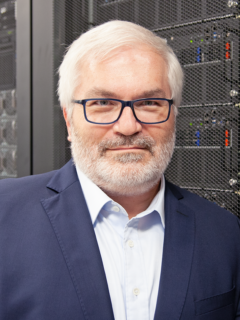
Wenguang Chen is a researcher affiliated with Tsinghua University and Pengcheng Laboratory , specializing in computer science and high-performance computing . His work bridges theoretical advancements with practical applications in domain-specific languages , parallel programming , and machine learning . Research Interests include: Development of modular DSLs for numerical methods (e.g., Mat2Stencil) Performance optimization in distributed and parallel systems Compiler frameworks for privacy-preserving AI (e.g., FHE-based neural network inference) Graph algorithms scaling to trillion-edge datasets Applications of Rust in memory-safe pointer analysis Recent Publications span 2014–2025, focusing on: Parallelization strategies for supercomputing Compiler automation tools Extreme-scale data processing Performance variance diagnosis in production environments
Dr. Sandra Diaz Pier is a Scientific Lead at the Jülich Supercomputing Centre (JSC) within the Jülich Research Centre , Germany. Specializing in computational neuroscience , high performance computing (HPC) , and machine learning , she bridges neuroscience and advanced computational methods through her research. Education: B.Sc. in Electronic Systems Engineering, Mexico M.Sc. in Computer Science (focus: machine learning, quantum computing), Mexico Second M.Sc. in Electrical Engineering, Ontario, Canada Ph.D. in Computer Science, Germany (2021) Her research focuses on modeling and simulating brain dynamics and plasticity at multiple scales, leveraging HPC to accelerate large-scale neural network simulations. She actively contributes to EU projects like the Human Brain Project (HBP) , Virtual Brain Cloud , and EBRAINS 2.0 , emphasizing infrastructure development and educational training. Her work includes open-source tools such as the NEST simulator , The Virtual Brain , and L2L , enabling efficient parameter exploration and multiscale co-simulation frameworks. The 15 most recent publications highlight her interdisciplinary approach, spanning topics from quantum computing in biomolecular simulations to neural plasticity algorithms and cloud-based brain modeling . These articles reflect her expertise in integrating machine learning , multi-scale simulation , and HPC infrastructure for neuroscience challenges, including seizure propagation, Parkinson’s disease progression, and swarm intelligence in spiking networks. She leads technical coordination in projects like EBRAINS and serves as a task leader in the HBP infrastructure work package , while also organizing workshops and hackathons for open-source tools. Her role involves supporting domain scientists through methodological research and workflow optimization for brain simulations.
Sarah Neuwirth is a tenured Professor for Computer Science at Johannes Gutenberg University Mainz (JGU) and a Visiting Researcher at the Jülich Supercomputing Centre. She manages JGU's High Performance Computing (HPC) division, coordinates regional/national HPC activities, and represents JGU in NHR, Gauss-Allianz, and HPC committees. Education : PhD (Dr. rer. nat.) in Computer Science (2018), Heidelberg University Diplom in Computer Science (2012), University of Mannheim Bachelor of Science in Computer Science (2010), University of Mannheim Research Interests : Parallel File and Storage Systems Modular Supercomputing (resource disaggregation/virtualization) Performance Engineering High Performance Computing Networking Reproducible Benchmarking Parallel I/O Publications Trends : Her work focuses on HPC performance modeling, parallel I/O optimization, modular supercomputing, network characterization, and reproducible benchmarks. Key themes include resource disaggregation, automated workflows, and data-intensive distributed applications. Scientific Awards : 2023 PRACE Ada Lovelace Award for HPC ZONTA Science Award 2019 Grants & Leadership : She leads the High Performance Computing division at JGU, participated in European DEEP projects, and serves on SC conference committees.
Prof. Dr. Alexander Pretschner is a leading academic in software and systems engineering at the Technical University of Munich, with additional roles as Chair of the bidt Board of Directors, Member of the Executive Committee, and Chair of the Scientific Directorate at fortiss (Bavarian Research Institute for Software-Intensive Systems). His expertise spans software engineering, information security, and ethical deliberation in agile processes. Professor for Software & Systems Engineering, TUM Founding Director and Chairman of bidt Chair of Scientific Directorate at fortiss Research interests focus on software engineering with emphasis on testing and information security , alongside pioneering work in AI ethics , digital sustainability , and data privacy . Key projects include EDAP (Ethical Deliberation for Agile Processes), DetDat (Determinants of Data Disclosure), and AIffectiveness in Education. Publications and lectures address critical issues like "What makes Munich attractive for Open AI?" , "How generative AI transforms creative work" , and "Balancing benefits and risks of AI assistants in workplaces" . Collaborations include prominent researchers like Julian Nida-Rümelin and Niina Zuber.
Professor Dr. Marianne von Schwerin is affiliated with Ulm University of Applied Sciences (THU) and serves as a member of the Faculty of Electrical Engineering and Information Technology . She is actively involved in the Institute of Computer Science and the Institute of Communication Technology , while also contributing to the State of Baden-Württemberg's BW-CAR Doctoral Center . Vice-Rector for Research, Transfer, and International Affairs (2015–2023) Chair of the Doctoral Committee in Research Unit III Deputy Chair of the State's Digital Research Infrastructure Steering Committee (2020–2023) Her research focuses on Embedded Systems , Model-based Software Development , and the integration of Machine Learning and Artificial Intelligence in Internet of Things applications. She teaches programming in C/C++ , Data Analysis , and Advanced Software Engineering . Currently, she co-leads the AICOSS Special AI Program with South Korean universities, offering intensive AI training for students at THU. Her work emphasizes cross-university collaboration and digitalization in research .
Anne Fischer, M.Sc., is a researcher at the Chair of Material Handling, Material Flow, and Logistics at the Technical University of Munich (TUM). Her work focuses on digital twins, construction automation, and resource scheduling in heavy civil engineering. She is based in Garching near Munich and collaborates with institutions like UC Berkeley and Stanford University. Research Interests: Digital Twin frameworks, simulation-based optimization, BIM integration, activity recognition in construction, and sustainable logistics systems. Collaboration: Serves as a contact person for international exchanges with U.S. institutions. Publication Trends: Her recent articles (2024–2021) address construction automation, digital twin applications, and variability management in civil engineering projects. Key Projects: Engaged in initiatives like Bauen 4.0 , MiProcess2Twin , and SiteRoute , which focus on digitalization and automation in construction. Location: Boltzmannstraße 15, Garching bei München (Room: 5505.EG.501).
Ermeson Carneiro de Andrade is a Professor at the Department of Systems and Computer Engineering within the Center of Informatics at the Federal University of Pernambuco (UFPE) in Brazil. His research focuses on dependability engineering, performability analysis, and fault tolerance in distributed and embedded systems. Over his career spanning more than 15 years, he has established himself as a prominent researcher in the field of system reliability through numerous publications in top-tier journals and conferences. Dr. Andrade's research interests primarily center on the analysis and modeling of system dependability, with particular expertise in UAV-based monitoring systems, cloud computing environments, and IoT architectures. His work bridges theoretical modeling with practical applications, particularly in environmental monitoring, disaster recovery solutions, and mission-critical systems. He has made significant contributions to understanding software aging phenomena in various computing environments and developing performability-aware solutions for real-time systems. The analysis of his recent publications reveals a strong focus on UAV systems for environmental monitoring, particularly deforestation detection, with increasing attention to weather impacts and vehicle density-aware traffic monitoring. His research demonstrates a consistent pattern of applying stochastic modeling techniques to solve practical problems in distributed systems, with recent work expanding into NoSQL database performance, satellite constellation dependability, and the performance-interpretability trade-offs in machine learning models. This evolution shows his ability to adapt to emerging technologies while maintaining core expertise in system reliability. Dr. Andrade has been actively involved in mentoring students and collaborating with researchers across Brazil and internationally. His work often involves interdisciplinary teams addressing complex system challenges. While specific awards aren't detailed in the available publication records, his consistent output in high-impact venues demonstrates recognition within the dependability engineering community. His laboratory work appears to focus on system modeling and analysis, with particular emphasis on experimental validation through simulation and real-world testing. Current projects suggest involvement in UAV-based monitoring systems for environmental applications, with strong connections to public sector institutions in Pernambuco state.
Floriment Klinaku is a Researcher and Doctoral Researcher at the University of Stuttgart , affiliated with the Software Quality and Architecture Group . His work focuses on elasticity modeling , cloud-native systems , and performance optimization for modern software architectures. He contributes to projects like the Slingshot Simulator , which addresses autoscaling and resource management challenges in containerized environments. Research Interests include: Autoscaling mechanisms for cloud applications Elasticity and resilience in microservices Data stream processing in cloud environments Performance prototyping for containerized systems DevOps practices for automotive software His publications emphasize architectural solutions for scalability, resilience, and explainability in cloud-native ecosystems. Current trends in his work involve model-driven engineering approaches to coordinate autoscaling policies and quantify impact of design decisions on system behavior. No scientific awards are explicitly listed, and no advising/grant information is provided. He is part of the Software Quality and Architecture Group , contributing to research on cloud performance and elastic systems.
Reza Salkhordeh is a Lecturer and Postdoctoral Researcher at Johannes Gutenberg University Mainz, Germany, where he leads the Efficient Computing and Storage Group. He holds a Ph.D. in Computer Engineering from Sharif University of Technology (2018) and has been affiliated with Ferdowsi University of Mashhad and Sharif University of Technology. His research focuses on operating systems, storage systems, and non-volatile memory technologies, with a particular emphasis on high-performance computing and I/O optimization. He has taught courses such as Storage Systems and Advanced Topics in Operating Systems since 2020. His academic journey includes a B.Sc. from Ferdowsi University (2011), M.Sc. and Ph.D. from Sharif University (2013, 2018). He has held roles such as Technical Lead for the High-Performance Data Storage System (HPDS) project in Tehran, Iran, and has mentored 4 M.Sc. and 6 B.Sc. students. His work spans patented technologies like Reconfigurable Cache Architectures and Load Balancers for I/O caching systems. Research interests include heterogeneous memory management, storage system design, and optimizing I/O performance in distributed environments. His recent publications address challenges in NVMM utilization, garbage collection in SSDs, and I/O tracing for HPC systems. He is actively involved in conference committees (e.g., FAST, ARCS, SC) and has reviewed for top journals like IEEE TPDS and ACM Transactions on Storage. Notable recognitions include membership in Iran’s National Elites Foundation (2012–2015) and top rankings in national exams (3rd in PhD, 35th in MSc). His contributions to storage systems have advanced enterprise-grade architectures and decentralized file systems, with a focus on practical implementations for modern computing challenges.
Professor Harald Kosch serves as Vice President for Academic Infrastructure and IT at the University of Passau. Since 2006, he holds the Chair of Distributed Information Systems within the Faculty of Computer Science and Mathematics. He co-leads the tri-national IRIXYS research center (University of Passau, INSA Lyon, Università di Milano) and directs the German-French DFH/UFA Doctoral College. Current academic leadership roles Specialization in distributed systems and big data International research networks in digital innovation Recipient of French academic distinction His team develops tools for distributed information processing in multimedia and data-intensive applications, with applications in eHumanities and emergency logistics. Research emphasizes cross-border collaboration and technology transfer between academia and industry. Scientific distinctions include: Chevalier de l'Ordre des Palmes Académiques 2022 DFH Dissertation Prize (for Dr. Benjamin Planche) Active in EU digital strategy, Bavarian sustainability initiatives, and Franco-Bavarian AI competitions.
Dr. Jonas Biehler is a Research Fellow at the Chair of Numerical Mechanics within the Institute for Computational Mechanics at the Technical University of Munich (TUM). His work focuses on computational methods for biomechanical systems, with expertise in uncertainty quantification, high-performance computing, and machine learning applications in respiratory and cardiovascular modeling. Education: PhD in Mechanical Engineering, Technical University of Munich, 2016 His primary research spans Computational Biomechanics, Computational Solid Mechanics, and Experimental Biomechanics, with specialization in Inverse Problems and Uncertainty Quantification. He integrates High-performance parallel computing with Machine Learning and Bayesian Optimization to advance Respiratory Mechanics and Semantic Segmentation of medical images. His methodologies address complex challenges in patient-specific modeling where experimental validation is constrained. Analysis of his 2021-2025 publications reveals dominant themes in respiratory system modeling (35%), uncertainty quantification frameworks (30%), and cardiovascular biomechanics (25%). Key trends include the development of open-source tools like QUEENS for solver-independent analyses, physics-informed machine learning for drug delivery optimization, and multi-fidelity approaches that reduce computational costs by 40-60% in large-scale simulations. His work increasingly bridges computational models with clinical applications in ARDS and pulmonary fibrosis. No scientific awards were documented in the provided materials. Dr. Biehler has supervised 15+ student projects with emphasis on methodological innovation and experimental validation: Deep Neural Networks as Surrogate Models for Uncertainty Quantification Multi-Level Monte Carlo Schemes for Uncertainty Quantification Experimental and Numerical Analysis of Nonlinear Anisotropic Polymer Membranes Uncertainty Quantification for Human Respiratory System Models Biaxial Measurement of Porcine Aorta Mechanical Properties He operates within the LNM (Lehrstuhl für Numerische Mechanik) research ecosystem at TUM, which maintains high-performance computing clusters and biomechanics testing facilities. The group collaborates extensively with clinical partners at Klinikum rechts der Isar on translational projects involving abdominal aortic aneurysms and respiratory mechanics, with current efforts focused on integrating real-time patient data into computational frameworks.
Peter G. Kropf is a Professor in the Department of Computer Science at the University of Neuchâtel, Switzerland, with a distinguished research career spanning over three decades. His academic journey reflects significant contributions to distributed systems, peer-to-peer networks, and cloud computing, with recent focus on IoT analytics and scientific computing applications. Dr. Kropf's research interests center on Distributed Systems , Peer-to-Peer Networks , Cloud Computing , Wireless Mesh Networks , and Scientific Workflows . His work demonstrates a clear evolution from foundational distributed systems research to practical applications in environmental monitoring, IoT analytics, and large-scale scientific computing. He has maintained consistent research productivity throughout his career, with publications appearing regularly from 1990 through 2024. Analysis of his recent publications reveals a strong trend toward real-time data processing for environmental applications, IoT analytics , and cloud-based scientific workflows . His work often bridges theoretical distributed systems concepts with practical implementations, particularly in environmental monitoring and resource management contexts. The interdisciplinary nature of his research connects computer science with environmental science and hydrology. Dr. Kropf has established long-term collaborations with researchers including Gilbert Babin (15 joint publications), Pascal Felber (14 publications), and Sabina Serbu (7 publications), forming a productive research network focused on distributed systems challenges. His work has appeared in prestigious venues including IEEE Internet Computing, Future Generation Computer Systems, and Middleware conference proceedings.
Dr. Nour Ali serves as a Professor and Vice-Dean of Education in the College of Engineering, Design and Physical Sciences at Brunel University London, where she co-heads the Brunel Software Engineering Lab. With a PhD in Software Engineering from Universidad Politecnica de Valencia and a Computer Science degree from Bir-Zeit University, she brings extensive international experience from previous positions at University of Brighton, Lero (Irish Software Engineering Research Centre), and Politecnico di Milano. PhD in Software Engineering, Universidad Politecnica de Valencia, Spain Major in Computer Science, Bir-Zeit University, Palestine PG Certificate in Teaching and Learning in Higher Education, University of Brighton Fellow of the Higher Education Academy (HEA) Her research focuses on developing software architecture techniques for distributed, mobile, and adaptive systems, with particular expertise in microservice architecture recovery and visualization. With over 70 publications spanning two decades, her work bridges theoretical architecture principles with practical implementation challenges. Recent research demonstrates a strong focus on microservice architecture recovery tools like MiSAR and analysis of service granularity adaptation. Dr. Ali has made significant contributions to the software engineering community through editorial roles including Deputy Editor in Chief of IET Software, committee memberships for major conferences like ICSE and ASE, and reviewer positions for EPSRC and other funding bodies. Her publications reveal consistent contributions across architecture consistency, microservice systems, and adaptive requirements engineering, with recent work increasingly focusing on practical tool development for architecture recovery. External Examiner, York St John University (2021-2025) Deputy Editor in Chief, IET Software Committee member for ICSE, ASE, EASE, ICSA, MOBILESoft conferences EPSRC Full College Member (2018-present) Reviewer for Dutch Research Council (NWO), UK UNESCO Newton Prize As an educator, Dr. Ali leads CS3100 Software Project Management and contributes to multiple undergraduate and postgraduate courses. Her teaching philosophy integrates research insights with practical software engineering skills, supported by her PG Certificate in Teaching and Learning and HEA Fellowship. She actively supervises PhD students and contributes to curriculum development as Vice-Dean of Education for her college.
Michael Philippsen is a Professor at the Department of Computer Science at Friedrich-Alexander-Universität Erlangen-Nürnberg (FAU), where he leads the Chair of Programming Systems (Lehrstuhl für Informatik 2). His research spans software engineering, programming languages, high-performance computing, and machine learning applications. He has directed multiple significant research projects including Holoware (software visualization in VR/AR), ORKA (OpenMP for FPGAs), and CS4MINTS (computer science education initiatives). Prof. Philippsen's research focuses on improving software quality and developer productivity through innovative approaches. His work in software testing includes novel methods for detecting flaky tests using version history and test execution data. In compiler research, he has pioneered automated testing techniques and optimization methods, particularly for FPGA acceleration using OpenMP extensions. His Holoware project revolutionized software visualization by applying city metaphors in virtual reality to enhance program comprehension. Additionally, he has made significant contributions to machine learning applications in software engineering, including few-shot out-of-domain detection in natural language processing systems. His publication record demonstrates a strong trend toward interdisciplinary research bridging traditional software engineering with emerging technologies. A significant portion of his recent work focuses on optimizing compiler techniques for heterogeneous architectures, particularly FPGA acceleration through OpenMP extensions. His research in software visualization has produced award-winning work on layered software city metaphors that significantly improve program comprehension compared to traditional visualization techniques. The consistent theme across his work is applying practical, measurable solutions to real-world software engineering challenges. Best Paper Award for 'Multipurpose Cacheing to Accelerate OpenMP Target Regions on FPGAs' (2023) Best Paper Award for 'A Layered Software City for Dependency Visualization' (2020) Prof. Philippsen has secured substantial research funding from the German Federal Ministry for Economic Affairs and Energy (BMWE), the Bavarian State Ministry of Science and the Arts (StMWK), and the Fraunhofer Society. His projects often involve industry collaboration to ensure practical applicability. He has supervised numerous student theses contributing to his research in compiler testing and software visualization. His research group maintains specialized laboratories for VR/AR software visualization, FPGA acceleration, and educational tool development as part of the CS4MINTS project.
Dr. Georg Hager is Head of Research at the Erlangen National High Performance Computing Center (NHR@FAU), Friedrich-Alexander-Universität Erlangen-Nürnberg, and an associate lecturer at the Institute of Physics, University of Greifswald. His work focuses on performance engineering, node-level optimization, and analytic modeling in high performance computing. Research Interests: High Performance Computing (HPC) Performance Engineering and Modeling Architecture-Specific Optimization Energy Efficiency in Computing Scientific Code Optimization Execution-Cache-Memory (ECM) Model Development Computer Architecture for HPC His recent publications and tutorials emphasize performance modeling, node-level engineering, hybrid programming (MPI+OpenMP), and benchmarking on modern architectures such as Ice Lake, Sapphire Rapids, and A64FX. He has contributed to the development of the LIKWID tool suite and promotes best practices in HPC education. Scientific Awards: ISC Gauss Award (2018) Informatics Europe Curriculum Best Practices Award (2011) Georg Hager has been instrumental in developing and teaching international tutorials on performance engineering and hybrid programming, often in collaboration with HLRS Stuttgart and TU Wien. He is the co-author of the widely used textbook Introduction to High Performance Computing for Scientists and Engineers . His work bridges theoretical modeling and practical application, aiming to improve time-to-solution and resource efficiency in large-scale scientific computing.