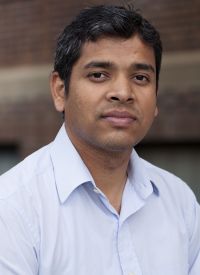
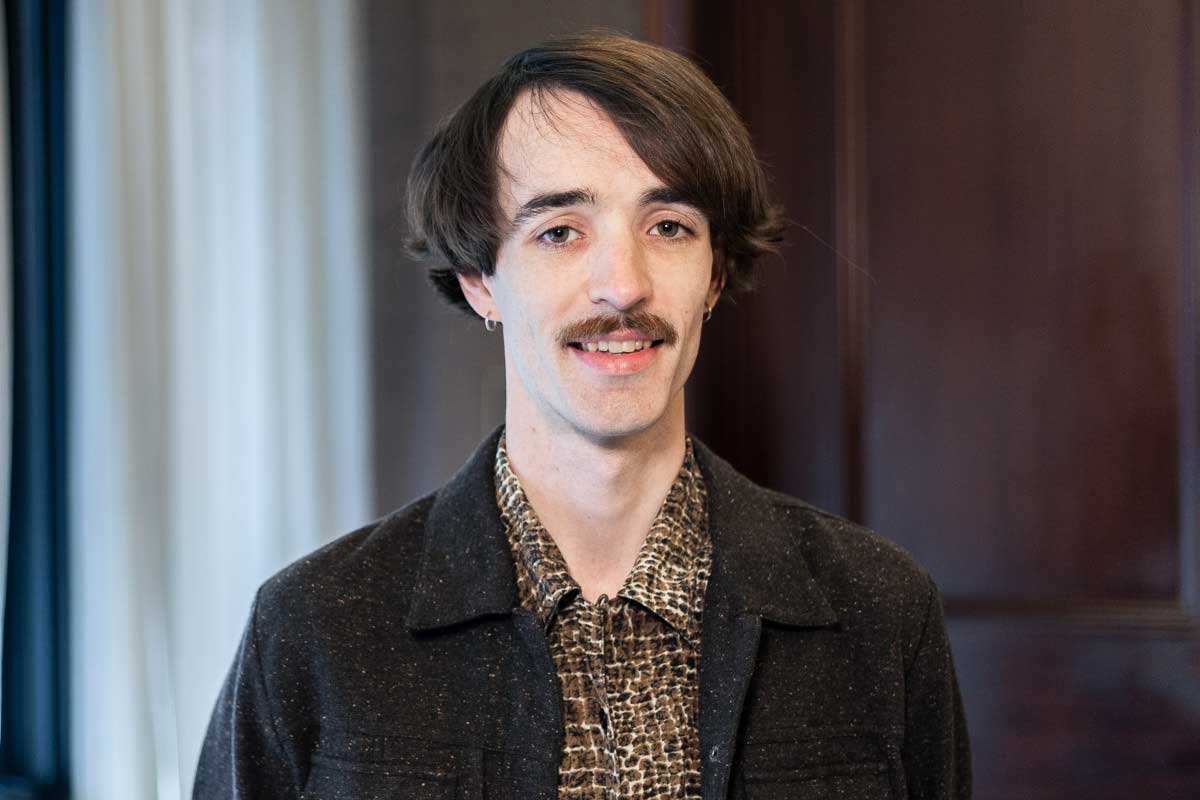
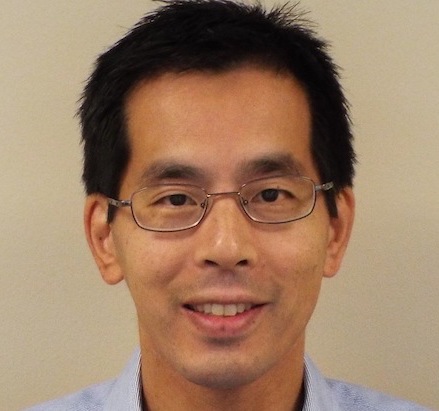
Dr. Brian Floyd is the Alton and Mildred Lancaster Professor in the Department of Electrical and Computer Engineering at NC State University. His research focuses on RF and millimeter-wave circuits for wireless communication, radar, and imaging applications. He has extensive industry experience, including roles at IBM Research and leadership in the IEEE RFIC Symposium. His work includes pioneering contributions to 60-GHz transceivers and silicon phased arrays. Education: Ph.D., M.S., and B.S. in Electrical Engineering from the University of Florida. Leadership: IEEE Solid-State Circuits Society AdCom Secretary and IEEE RFIC Symposium Executive Committee. Research Interests : RF and millimeter-wave integrated circuits Phased arrays and beamforming Low-cost radar and imaging systems 6G/5G communication systems Recent publications emphasize phased-array calibration, mmWave platforms, and Gallium Nitride-based transmitters. His awards include the NC State Innovator of the Year (2023) and multiple teaching accolades. He leads advanced wireless research initiatives like AERPAW and 6GNC, focusing on 6G technologies and autonomous spectrum management.
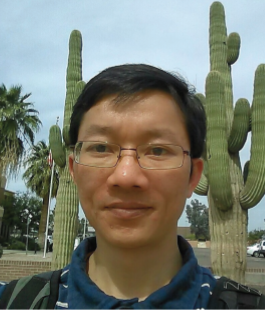
Tan Le is an Assistant Professor in Electrical and Computer Engineering at Hampton University, Virginia, USA. He previously held a Research Assistant Professor position at Virginia Modeling, Analysis and Simulation Center (VMASC), Old Dominion University. He received his Ph.D. from the University of Quebec (2015), M.Eng. and B.Eng. from Ho Chi Minh City University of Technology (2004 and 2002 respectively). His research focuses on AI/ML applications in cybersecurity, IoT, 5G networks, smart healthcare, and edge computing. Key contributions include secure mobility management in vehicular networks, privacy-preserving data sharing, and AI-driven edge caching frameworks. Education Path: Ph.D. Electrical and Computer Engineering, University of Quebec, 2015 M.Eng., Ho Chi Minh City University of Technology, 2004 B.Eng., Ho Chi Minh City University of Technology, 2002 Research Interests: AI/ML for Cybersecurity and Privacy 5G and Beyond Networks Vehicular Networks and Edge Computing Smart Healthcare Systems Blockchain and Distributed Computing His recent publications emphasize AI-aided resource management (e.g., multi-timescale actor-critic learning), privacy-preserving IoT communication, and mobility-aware edge caching in vehicular networks. Collaborations with ODU focus on 5G and IoT infrastructure for DoD mission-support systems. Lab/Team Affiliations: Research involves VMASC and cross-university partnerships, particularly with Old Dominion University teams advancing cybersecurity and next-generation network solutions.
Torsten Hoefler is a Professor affiliated with ETH Zurich, leading research in parallel computing, distributed systems, and high-performance computing (HPC). His work bridges theoretical foundations and practical implementations, focusing on optimizing algorithms, network topologies, and hardware-software co-design. Research Interests: His primary areas include parallel algorithms, distributed systems, machine learning infrastructure, and network architectures. He emphasizes scalable solutions for large-scale applications, particularly in data-centric computing and serverless environments. Publications: Recent work highlights include innovations in network topologies (e.g., HammingMesh), serverless benchmarking frameworks (SeBS), and optimizations for large language models (LLMs). His publications often address performance bottlenecks and energy efficiency in HPC and cloud systems. Awards & Grants: While no specific awards are listed here, his prolific publication record and leadership in HPC indicates significant recognition in the field. Active in grant-funded projects related to exascale computing and AI infrastructure. Labs & Teams: Leads the Communication Systems Lab at ETH Zurich, collaborating with industry partners like NVIDIA and IBM on hardware-accelerated computing and cloud-native systems.
Dr. Deepak Tosh is an Associate Professor at the University of Texas at El Paso in the Department of Computer Science. He specializes in cybersecurity , blockchain , and cyber-physical systems , with a focus on decentralized solutions for critical infrastructure security. Ph.D. in Computer Science and Engineering, University of Nevada, Reno M.S. in Computer Science, University of Hyderabad, India Postdoctoral Researcher, Tennessee State University Former Cybersecurity Researcher, Norfolk State University His research bridges cybersecurity information sharing (CYBEX) , data provenance in cloud/edge environments , and game-theoretic models for cyber-investment and cyber-insurance. Recent work explores federated learning for anomaly detection , blockchain for industrial IoT , and cyber deception frameworks . Key publication trends include: Federated learning applications in industrial cyber-physical systems Game theory and SDN for battlefield communication security Blockchain for provenance in energy systems and medical IoT Graph machine learning for automotive network threats Cyber deception via Monte-Carlo planning Scientific recognitions include: NSF CAREER award for critical infrastructure resiliency NSF grant for cyber security network development At UTEP, Dr. Tosh teaches CS 5352: Computer Security and leads the TRUCYBER Lab , which focuses on decentralized trust frameworks, blockchain security, and cyber situational awareness. The lab has produced notable alumni like Adeel Malik (Ph.D.) and Abel Gomez (Ph.D.) , with projects published in IEEE MILCOM, SecureComm, and CCGrid.
A. Kevin Tang is a Professor of Electrical and Computer Engineering (ECE) at Cornell University, affiliated with the School of ECE. His research focuses on computer networks, control systems, optimization, and information theory. He teaches advanced courses such as ECE 5800 (Control and Optimization of Information Networks) and ECE 6960 (Interplay between Economics and Systems). His work bridges theoretical foundations and practical network applications, including network coding, distributed control, and protocol design. Recent contributions address privacy-preserving data sharing, network routing stability, and optimization techniques for heterogeneous systems. Tang’s publications span top venues like NeurIPS, ICML, NSDI, and IEEE Transactions. His research group explores cutting-edge topics in networked systems, with applications to distributed storage, software-defined networking, and multipath communication protocols. He advises on interdisciplinary projects combining control theory, optimization, and networking. His lab collaborates closely with industry partners to translate theoretical insights into real-world network solutions.
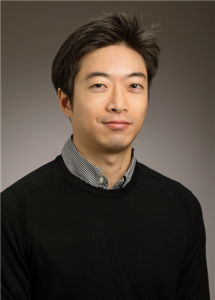
Thomas Moon is a Teaching Assistant Professor in the Department of Electrical & Computer Engineering at the University of Illinois at Urbana-Champaign (UIUC), holding this position since 2019. He previously served as a postdoctoral researcher at UIUC (2017–2019) and a Principle Test Development Engineer at IBM/Globalfoundries (2015–2017). His academic journey includes a Ph.D. in ECE from Georgia Institute of Technology (2015) and a B.S. in EEE from POSTECH, South Korea (2008). Research Interests: Current research focuses on Radar Tracking via Bayesian Estimators , Radar Security , and Wireless Sensing using mmWave and Phase-Arrays . Previous work includes mmWave Phased Array Test Systems , Sub-Nyquist Rate Sampling for Wideband Signals , and High-Speed Signal Testing Methodologies . His work bridges theoretical signal processing with practical hardware implementations, emphasizing cost-effective solutions and real-time applications. Recent Contributions: Recent articles emphasize radar security (e.g., BlueFMCW interference mitigation), mmWave phased array calibration, and embedded DSP education. His 2015 work on sparse signal characterization earned the JETTA-TTTC Best Paper Award. Teaching & Advising: Teaches courses like ECE 398MA (Modern Communication with Python/SDR) and ECE 420 (Embedded DSP Lab). He mentors undergraduate students in senior projects focusing on remote sensing, signal processing, and wireless communication. Labs & Infrastructure: Engages with mmWave radar systems and software-defined radio platforms, leveraging FPGA-based testing modules and Android-based DSP implementations.
Gábor Molnár, PhD, is an Associate Professor of Applied Sciences at Wittenborg University and holds adjunct roles as Associate Professor at the University of Colorado Boulder's ATLAS Institute and Fellow at Silicon Flatirons. He also serves as an Evangelist of Video Technology and Science at Divitel and advises e-Conomics, a telecom policy consultancy. Dr. Molnár's expertise spans high-tech innovations, AI-driven digital transformation, and data policy, with over 20 years in the high-tech industry. His research emphasizes bridging human and machine collaboration, AI ethics, and the socio-economic impacts of broadband infrastructure. He holds degrees from Corvinus University of Budapest (BSc Economics), Budapest University of Technology and Economics (MSc Electrical Engineering), and the University of Colorado Boulder (MSc/PhD Telecommunications). Education: BSc Economics (Corvinus), MSc Electrical Engineering (Budapest University of Technology), MSc/PhD Telecommunications (CU Boulder) His research focuses on human-centric AI, digital transformation strategies, and telecom policy. Recent work explores HRM's role in AI adoption, algorithm factories, and broadband accessibility's socio-economic effects. He has contributed to journals like Journal of Industrial Economics and Discover Artificial Intelligence . As a consultant, he advises Fortune 500 firms, SMEs, and governments on digital transformation and high-tech strategies. His articles highlight trends in algorithmic video delivery, 5G network sharing, and spectrum policy, reflecting his dual academic and industry perspectives.
Wouter Tavernier is an Associate Professor at Ghent University and a Postdoctoral researcher at IMEC, affiliated with the Faculty of Engineering and Architecture's Department of Information Technology (EA05). He leads research at the Internet Technology and Data Science Lab, focusing on networking innovations for future communication systems. His research explores: Network architectures for 5G/6G, HPC, and deterministic systems SDN/NFV orchestration for cloud/edge services Optical networking including programmable photonics and routing optimization Network resilience through fault-tolerant protocols and traffic engineering Publications (2020–2025) emphasize: Deterministic networking for real-time systems and industrial IoT Resource optimization in HPC/cloud networks Convergence of optical/wireless technologies in 6G Decentralized edge intelligence via programmable swarm solutions He advises doctoral researchers on projects including: QoS Optimization in 6G Networks (Jakob Miserez) Control Strategies for Network-Cloud Services (Abhinaba Chakraborty) Software-Based Networking for 6G (Mohammadreza Heydarian) and secured grants such as Network optimization for HPC workloads (Special Research Fund). At the Internet Technology and Data Science Lab, he collaborates on EU-US initiatives like the Next Generation Internet program, advancing open internet architectures.
Peter Alexander is a Lecturer at the School of Informatics and Cybersecurity within TU Dublin, where he has taught since 2016 after 11 years as a Cisco technical solutions specialist in industry. A graduate of TU Dublin himself, he holds both bachelor's and master's degrees from the institution and emphasizes "giving back" through education while mentoring students in technical disciplines. His educational background includes: M.Sc. in Computing (Advanced Software Development) - 2:1 Honours, TU Dublin (City Centre Campus) Honours Bachelor of Computer Engineering - First Class Honours, TU Dublin (Blanchardstown Campus) Cisco Certified Network Associate (CCNA) Cisco Networking Academy Certified Instructor – CCNA1, CCNA2, CCNA3, CCNA Security, IT Essentials Specializing in networking, network security, and virtualisation, his research spans cloud computing, Internet of Things (IoT), Software-Defined Networking (SDN), and data visualisation. He has taught diverse courses including databases, web development, and computer systems while supervising multiple master's projects in cyber security, reflecting his industry-academic bridge approach to technical education. No scientific awards were documented in the provided materials. He has supervised several master's projects in cyber security but no research grants or external funding sources were referenced. His teaching philosophy emphasizes student engagement with academic challenges as foundational to professional growth in technology fields.
Dr. Wencong Su is a Professor and Chair of the Department of Electrical and Computer Engineering at the University of Michigan-Dearborn , where he leads research in power systems, transportation electrification, and cyber-physical systems. He earned his B.S. (2008) from Clarkson University, M.S. (2009) from Virginia Tech, and Ph.D. (2013) from North Carolina State University. Research Interests: Power and energy systems, renewable integration, electric vehicles, machine learning, and smart grid technologies. Editorial Roles: Associate Editor for IEEE Transactions on Smart Grid , IEEE Access , and IEEE DataPort . His research focuses on optimizing power electronics, enhancing grid stability with distributed energy resources, and applying AI to energy systems. Recent work includes surrogate modeling for converter design, safe reinforcement learning in power grids, and cyber-physical solutions for digital substations. Publications span topics like second-life battery applications, high-frequency AC microgrids, and AI-driven energy management. His articles emphasize machine learning, optimization, and robust control in renewable integration and transportation electrification. Awards include IEEE Fellowships, Top 2% Scientist recognition (Stanford), and multiple IEEE best paper awards. He has secured grants from NSF, DoE, Ford, Toyota, and DTE Energy. Labs operate in the Institute for Advanced Vehicle Systems (IAVS-2060, IAVS-1060, ELB-1026, ELB-1042), focusing on power electronics, smart grid validation, and electrified transportation.
Radu Vintan is a Doctoral Assistant and PhD student at École polytechnique fédérale de Lausanne (EPFL) in the School of Computer and Communication Sciences, affiliated with the Institute of Computer Science and the Theory of Computation Laboratory 2 (THL2). He is part of the Doctoral Program in Computer and Communication Sciences (EDIC). Education: Bachelor's and Master's in Computer Science, Technical University of Munich (TUM), Germany PhD in Computer Science, École polytechnique fédérale de Lausanne (EPFL), Switzerland (ongoing) His primary research interests lie in theoretical computer science , particularly online algorithms and approximation algorithms . He also has experience in machine learning and software engineering . His work often involves algorithmic design and analysis for graph and network problems. The recent publications reflect a strong focus on online edge coloring and network update algorithms , with contributions to top-tier conferences such as FOCS, STOC, SODA, and INFOCOM. These works explore both theoretical limits and practical algorithmic solutions, often bridging deterministic and randomized approaches. Scientific Awards: No awards mentioned. Advising and Grants: Radu Vintan is advised by Professor Ola Svensson. There is no mention of him advising students or receiving independent grants. His research is conducted within the Theory group at EPFL, supported through his Doctoral Assistant position. Laboratories and Teams: He is an active member of the Theory of Computation Laboratory 2 (THL2) at EPFL, contributing to foundational algorithmic research in collaboration with leading experts in theoretical computer science.
Jun Luo is an Associate Professor in the School of Computer Science and Engineering at Nanyang Technological University (NTU), Singapore. He earned his PhD in Computer Science from EPFL under the supervision of Prof. Jean-Pierre Hubaux and completed postdoctoral research at the University of Waterloo. He joined NTU in 2008 as an Assistant Professor and was promoted to Associate Professor in 2014. He served as Deputy Director of the Centre for Multimedia and Network Technology from 2010 to 2013. Education: PhD in Computer Science, Swiss Federal Institute of Technology in Lausanne (EPFL), 2006 MS in Electrical Engineering, Tsinghua University, 2000 BS in Electrical Engineering, Tsinghua University, 1997 Research Interests: Jun Luo's research focuses on mobile and pervasive computing, wireless networking, machine learning, and applied operations research. His primary research thrusts include: Contact-free Sensing Driven by Deep Learning : Leveraging RF, acoustic, and visible light signals for human activity recognition, respiration monitoring, and localization without wearable devices. Visible Light Communication and Sensing : Exploring LED-camera systems for data transmission, occupancy inference, and indoor broadcasting. Indoor and Outdoor Localization and Tracking : Developing systems using WiFi, geomagnetism, and crowdsourced data for precise positioning. Machine Learning for Mobile Networking : Applying deep learning and optimization to improve wireless network performance, mobile crowdsensing, and resource allocation. Publication Trends: His recent publications (2021–2023) demonstrate a strong focus on deep learning-enhanced sensing using RF and acoustic signals, particularly for health monitoring (e.g., respiration, heartbeat), multi-person tracking, and privacy-preserving techniques. He frequently collaborates with researchers in signal processing, computer vision, and networking, publishing in top venues like IEEE Transactions on Mobile Computing, MobiCom, and INFOCOM. His work emphasizes practical deployment on commodity devices and integration of sensing with communication systems. Scientific Recognition: IEEE Fellow Advising and Grants: Dr. Luo has advised numerous PhD and Master's students, as evidenced by the extensive list of student co-authors across his publications. He has led significant research projects in wireless sensor networks, mobile computing, and IoT systems, likely supported by competitive grants from Singaporean and international funding agencies. His role as Deputy Director of a research center indicates leadership in managing research teams and collaborative efforts. Labs and Teams: He leads a research group focused on mobile and distributed computing, deep learning, and computer vision. His team actively publishes in top-tier conferences and journals, working on projects involving RF sensing, acoustic platforms, visible light communication, and privacy-aware systems. The group collaborates with researchers both within NTU and internationally, particularly in Canada and China.
Dr. Vicky Liu is a Senior Lecturer in the School of Computer Science at Queensland University of Technology (QUT), Faculty of Science. Her work spans network security, IoT ecosystems, smart grid security, and network performance optimization. She leads research projects in secure energy markets, IoT for power industry optimization, and precise positioning systems. PhD, Queensland University of Technology Master of IT (Research), Queensland University of Technology Bachelor of Business (Computing), Queensland University of Technology Her research interests focus on network security and performance in emerging technologies. Key areas include IoT security (especially MUD, LoRa, Wi-Fi HaLow), smart city architectures, software-defined networking, and cybersecurity for smart grids and national energy markets. She investigates how to balance security with performance in resource-constrained environments. The recent publications highlight a strong trend in IoT and smart grid security , with extensive work on LoRa and Wi-Fi HaLow for energy and urban applications. Her research integrates experimental validation, architectural design, and compliance frameworks. Topics include DoS/DDoS detection, authentication schemes, energy modeling, and secure trading systems. Vice-Chancellor's Performance Award (International Collaboration), 2008 Dr. Liu actively supervises HDR students at Honours, Masters, and PhD levels, with completed theses on IoT smart grids, secure energy trading, DTN routing, and VANET security. She has secured competitive grants including from IMCRC and Geoscience Australia. She led a Capital Equipment Grant to establish a state-of-the-art network laboratory at QUT for hands-on teaching and research. Her work bridges academia and industry, particularly in energy and telecommunications. She leads and contributes to research teams focused on IoT security and smart infrastructure. Her lab supports practical experimentation with real-world networking equipment and protocols. Current and future work includes enhancing IoT profiling assurance, optimizing Wi-Fi HaLow under variable conditions, and strengthening legal compliance in critical communication systems.
Ryan Doenges is a Distinguished Postdoctoral Fellow at Northeastern University in Boston, working with Amal Ahmed. He holds a PhD from Cornell University under Nate Foster and completed undergraduate studies with Zach Tatlock. His educational background includes: PhD in Computer Science, Cornell University Bachelor's degree, institution unspecified Doenges' research focuses on enhancing programming safety through type systems and verification, specializing in program logics for effects/resources like concurrency and memory. His doctoral work established formal semantics and verification frameworks for the P4 network programming language, ensuring termination and correctness. His publications (2017-2025) show consistent advancement from distributed systems verification to network programming (P4) and foundational program logics, culminating in categorical semantics for separation logic. Key themes include certified equivalence, stateful packet processing, and fibrational weakest preconditions. No scientific awards are documented in available sources. He formally supervised Tia Vu's Master's thesis (Cornell MS, now MIT PhD) and informally mentored eight students including Rudy Peterson (ETH Zürich PhD) and Amanda Xu (UW Madison PhD). No grant details are provided. Doenges collaborates with Amal Ahmed's group at Northeastern and previously worked in Nate Foster's Cornell research team focused on network programming languages.
Jason P. Jue is a Professor of Computer Science at the University of Texas at Dallas and director of the Advanced Networks Research Lab. He holds a Ph.D. in Computer Engineering from UC Davis (1999) following M.S. and B.S. degrees in Electrical Engineering from UCLA (1991) and UC Berkeley (1990). Research Interests: His work focuses on next-generation optical network architectures and protocols, including control and management in optical networks, multi-domain optical network protocols, and survivability methods. He has pioneered research in network slicing, software-defined networking, and AI-driven network optimization. Scientific Contributions: Recipient of the prestigious NSF CAREER Award (2002) Recognized for Ph.D. Education & Research (2005) at UTD's Erik Jonsson School Co-authored 3 IEEE Best Paper Awards (Globecom 2005, ONDM 2010, ICC 2011) Leadership Roles: Currently serves on editorial boards of IEEE Communications Surveys and Tutorials and Springer Photonic Network Communications . Former Associate Editor (2009-2012) for IEEE/OSA Journal of Optical Communications and Networking . Organized key conferences as Technical Program Chair of OptiComm 2000 and Co-Chair of multiple IEEE symposia. Lab & Team: Leads the Advanced Networks Research Lab at UT Dallas, mentoring students and collaborating with researchers like Genya Ishigaki, Riti Gour, and Ashkan Yousefpour. The lab focuses on fog computing, optical network survivability, and AI-driven network resource allocation.