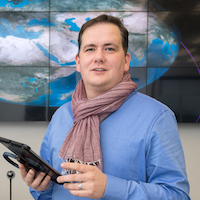
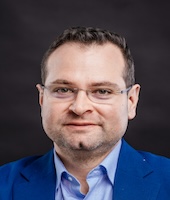
Vlad Popescu is an Associate Professor at the Department of Electronics and Computers, Faculty of Electrical Engineering and Computer Science, Technical University of Brasov. His research focuses on telecommunications, IoT, cognitive radio systems, and multimedia applications. He has authored numerous publications in top journals and conferences, including work on 6G-enabled smart cities, edge-cloud orchestration, and QoE-driven smart home systems. His research explores cutting-edge topics such as immersive multi-sensory experiences, real-time object detection, and energy-efficient architectures for Android TV integration. Popescu has contributed to open-source satellite simulators and pioneered studies on blockchain-based TV advertising systems. His work bridges theoretical advancements with practical implementations in smart home environments, IoT gateways, and next-generation wireless networks. Award-winning research includes innovations in SDR-based satellite gateways and hardware-software partitioning for embedded systems. His collaborative projects address challenges in distributed video applications, D2D communications, and social IoT frameworks for smart tourism management.
Eugen Borcoci serves as a Full Professor in the Department of Telecommunications at the National University of Science and Technology Politehnica Bucharest. With an extensive publication record spanning networking technologies, he has established himself as a significant contributor to the field of telecommunications research. His work bridges theoretical networking concepts with practical implementations, particularly in next-generation network architectures. Professor Borcoci's research interests focus on advanced networking paradigms including Software Defined Networking (SDN), Network Function Virtualization (NFV), and 5G/6G network architectures. He has pioneered work in network slicing technologies, particularly for vehicular communications and Internet of Vehicles applications. His research demonstrates a consistent emphasis on practical implementations and validation of theoretical networking concepts through experimental frameworks and open-source platforms. His recent publication trajectory (2021-2025) reveals a strong focus on Open Source MANO for network automation, SDN controller optimization across different network topologies, and specialized applications of network slicing for electric vehicle infrastructure and vehicular communications. This work demonstrates a clear progression from theoretical networking concepts to practical deployment scenarios with industry relevance. Professor Borcoci actively collaborates with international researchers, particularly with Marius Vochin, Frank Y. Li, and Andra Ciobanu, indicating strong international research connections. His work appears primarily in networking conferences and journals focused on telecommunications infrastructure and next-generation network architectures.
Dr. Dimitrios Efstathiou serves as a Professor at the Department of Informatics, Computer and Telecommunications Engineering of the International Hellenic University (Serres Campus), bringing over 25 years of expertise in telecommunications systems with emphasis on baseband/intermediate frequency design. His industrial tenure includes critical roles at Nokia Mobile Phones and Analog Devices where he pioneered satellite receiver and base station technologies. His educational foundation includes a B.E. in Electrical Engineering from the University of Patras (1989), M.Sc. in Digital Electronics (1991), and Ph.D. in Digital Communication Systems (1996), all from King's College London. Efstathiou's research spans digital telecommunications theory, 4G/5G/6G systems, software-defined radio, IoT security, and physical layer countermeasures against jamming. His work addresses fundamental challenges in signal integrity, network efficiency, and wireless security through innovative algorithm design for timing circuits and digital PLLs. Recent publications demonstrate sustained leadership in WBAN standards and OFDM security enhancement. His 50+ publications reveal evolving expertise from early software radio implementations to contemporary physical layer security frameworks, with consistent focus on practical baseband solutions for multi-carrier systems across 3G to 6G generations. He has supervised 71 bachelor theses and numerous graduate projects while maintaining active industry collaboration. His IEEE leadership includes Chairing the Vehicular Technology and Aerospace Electronic Systems Joint Greece Chapter (2012-2020) and serving as Senior Member since 2006.
Cornel Balint is a researcher affiliated with the West University of Timișoara, employed since 1990. He held roles as an assistant (1990–2000) and Works Manager (2000–present), serving on the Department Council from 2016 to 2020. His doctoral degree (awarded in 2005) was supervised by Prof. Miranda Naforniță. Balint specializes in telecommunications, HF spectrum analysis, and wireless networks, with notable contributions to 5G systems and Markov modeling. Research interests include HF spectrum occupancy, 5G performance evaluation, and signal processing. He introduced courses like 'Resource Management in Wireless Networks' (2010) and contributed to patents for sapphire-based devices (1997). His work involves projects such as SDR sensor networks for emergency support and automotive electromagnetic environment characterization. Recent publications focus on NTN agents, 5G throughput analysis, and HF noise studies. Balint has advised graduates like Ionel Petruț and Alexandru Bobaru and remains active in grants and interdisciplinary teams.
Marian ALEXANDRU is an Associate Professor in the Department of Electronic and Computers at the Faculty of Electrical Engineering and Computer Science, Transilvania University of Brașov. His research focuses on mobile communications, IoT systems, microwave technologies, and cybersecurity. He has developed remote laboratory platforms and contributed to SDR-based solutions for satellite and IoT applications. His work emphasizes practical experimentation, with notable contributions in secure access control systems and embedded multitasking frameworks. Research Interests: Mobile Communication Evolution (3G/4G/5G) IoT Gateway Architectures Software-Defined Radio (SDR) Applications Cybersecurity for Wireless Networks Remote Laboratory Systems Key Projects: Developed an SDR-based satellite gateway for IoT applications Designed an antidrone wireless personal shield Created experiment-supported mobile apps for activity monitoring using neural networks Dr. Alexandru has authored multiple textbooks including Communications, RF and Microwave Fundamentals and Mobile Communications and Mobile Computing: Evolution from 3G to 4G . His work bridges theoretical concepts with hands-on remote experimentation, emphasizing practical education in telecommunications engineering.
Florica Moldoveanu is a Professor at the Faculty of Automatic Control and Computers, University Politehnica of Bucharest. Their research focuses on Virtual Reality (VR), Medical Informatics, and Human-Computer Interaction with a strong emphasis on healthcare applications, assistive technologies, and educational technology. Developed VR systems for phobia treatment and neuromotor rehabilitation (TRAVEE) Pioneered sensory substitution interfaces for visually impaired individuals Advanced GPU-accelerated medical imaging and 3D reconstruction techniques Contributed to SDN networking and healthcare interoperability standards Research spans VR therapy systems, machine learning for emotion/fear detection, and inclusive gaming for accessibility. Collaborations include projects on real-time medical image processing and augmented reality applications in education and healthcare. Publications emphasize interdisciplinary work combining computer science with medicine/education, with over 100+ peer-reviewed articles across journals like Sensors, IEEE Access, and Symmetry. Active in conferences such as IEEE VR, HCII, and CHI.
Dr. Victor Asavei is a Lecturer in the Faculty of Automatic Control and Computers at the Politehnica University of Bucharest. His research spans interdisciplinary areas including virtual reality, medical imaging, and high-performance computing. He is affiliated with the 3DUPB Lab, focusing on 3D virtual environments and GPU optimizations for massive multiplayer online systems. His work integrates computer graphics, signal processing, and network engineering, with notable contributions to 3D Smith chart theory, medical image processing for orthopedic applications, and real-time 3D reconstruction techniques. Collaborations include projects on augmented reality in surgery, distributed file systems, and immersive virtual rehabilitation systems. Key research directions include: Virtual Reality (VR) and Augmented Reality (AR) applications in healthcare and education GPU-accelerated algorithms for medical imaging and deferred rendering RF/microwave engineering with focus on nonlinear circuits and impedance analysis Software-Defined Networking (SDN) architectures for data centers Notable publications highlight advancements in 3D Smith chart visualization, real-time depth map processing on mobile devices, and scalable server architectures for 3D virtual spaces. He actively contributes to conferences such as IEEE Microwave Symposium and RoEduNet. Research infrastructure includes collaborations with medical institutions for computer-aided surgery tools and partnerships with industry on nearshore software development methodologies.
Dominik Knoll is an Assistant Professor at the Faculty of Mathematics and Computer Science, Babeș-Bolyai University in Cluj-Napoca, Romania, teaching undergraduate computer science courses since March 2023. His instructional portfolio includes Formal Languages and Compilers (Autumn 2020-2022), Object-Oriented Programming in C++ (Spring 2021-2023), and Computer Architecture (Autumn 2021-2022), delivered primarily in German language to international students. His academic credentials comprise: PhD in Engineering Systems (2014-2019) from Skoltech with thesis Model-based Processes and Tools for concurrent conceptual design of space systems MSc in Applied Computer Science (2004-2007) from University of Salzburg, passed with distinction BSc in Applied Computer Science (2000-2003) from University of Salzburg Knoll's research centers on Model-Based Systems Engineering (MBSE) and concurrent design methodologies, with specialization in aerospace applications. He pioneered the open-source CEDESK tool for collaborative design and has extensive experience in adapting MBSE frameworks to industrial contexts. His work bridges theoretical systems engineering with practical software tool development, emphasizing traceability across engineering lifecycles and cross-disciplinary data integration. Analysis of his 15 most recent publications (2007-2024) reveals an evolving research trajectory from robotics and communications engineering toward comprehensive MBSE frameworks. Recent works (2021-2024) focus on digital thread implementation, PLM-MBSE integration, and traceability in mechatronic systems, while earlier aerospace publications document high-altitude balloon experiments and concurrent design tool development. The corpus demonstrates consistent emphasis on solving data exchange challenges in multi-domain engineering environments. His scientific recognition includes: Stanford Global Balloon Challenge (2015) for inter-balloon communications experiments As an academic advisor, Knoll mentors bachelor students through structured thesis projects in privacy-by-design applications, distributed systems, and academic publication tools. His industrial engagement includes managing a 15-month research project for a major European aerospace company on technology roadmapping adaptation. He maintains active industry collaboration seeking solutions to complex engineering challenges. Knoll established Skoltech's concurrent design facility infrastructure and operations during his doctoral studies. Beyond academia, he co-founded the NGO New Humanity and contributes to the United World Project, promoting intercultural dialogue through initiatives like language exchange programs and community gardening. His technical proficiency spans Java, C++, Python, and web technologies with professional multilingual capabilities (German, English, Italian, Russian, Romanian).
Răzvan BOCU is an Associate Professor at the Department of Mathematics and Computer Science, Faculty of Mathematics and Computer Science, Technical University of Civil Engineering Bucharest. His research focuses on software systems engineering, cloud infrastructures, bioinformatics, and machine learning applications. He is affiliated with the university's address at Iuliu Maniu nr. 50, Brașov, Romania, and can be reached via razvan.bocu@unitbv.ro. Research interests include developing secure systems for healthcare data management using homomorphic encryption, advancing autonomous driving through sensor data fusion, and exploring software-defined networking for containerized environments. His work bridges theoretical software modeling (e.g., interface-oriented systems) with practical applications in distributed and secure computing. Notable publications span from foundational software design principles to applied machine learning and networking solutions. While no awards are explicitly listed, his active publication record reflects sustained contributions to interdisciplinary computational research. No formal student advisement or grant details are provided in the text. He is part of the university's technical faculty without part-time status.
Csaba Zoltán KERTÉSZ is a Lecturer at the Department of Electronic and Computers, Faculty of Electrical Engineering and Computer Science, Technical University of Brașov. His research focuses on embedded systems, microcontroller applications, graphical user interfaces, digital signal processing, and real-time operating systems. He has contributed to IoT/M2M communication, wireless sensor networks, and SDR platforms. He has also explored the use of GitHub in collaborative learning and automotive industry-supported curriculum design. Key research interests include: Embedded GUI development frameworks IoT gateway systems using SDR Real-time monitoring and control systems HbbTV architecture performance analysis His recent work (2021-2024) emphasizes: AI-driven programming assessment tools SIMD extension optimization Wireless sensor networks for water distribution Reconfigurable IoT infrastructure Publications span over 15 years, showing sustained contributions in embedded systems, telecommunications, and educational technology. No specific awards mentioned. Labs/Teams: Actively involved in the University's embedded systems and IoT research groups.
Gheorghe Asachi Technical University of IasiRomania
Radu Gabriel Bozomitu is an Assistant Professor at the Department of Electronics and Telecommunications, Faculty of Electronics, Telecommunications and Information Technology, Technical University of Iasi. His research focuses on advanced circuit design, signal processing, biomedical engineering, and assistive technologies. Key areas include VLSI design of active filters, pupil detection algorithms for eye-tracking systems, and medical sensor integration with cloud-based platforms. He has contributed to software-defined radio systems, FM transmission frameworks, and embedded hardware for telemedicine applications. Education details are not explicitly stated, but his publications indicate expertise in analog circuits, biomedical signal processing, and assistive communication systems for disabled patients. His work spans from theoretical circuit optimization (e.g., ring oscillators for ADCs) to practical implementations like gyro-mice and real-time pupil detection systems. Research highlights include developing high-accuracy neural network-based pupil detection systems, robust radiocommunication frameworks, and medical monitoring devices. His algorithms for eye-tracking and FM-based driver warning systems reflect interdisciplinary collaboration between electronics and healthcare. While no awards are listed, his extensive publication record demonstrates significant academic contributions. Bozomitu collaborates on hardware-software integration projects, such as wireless sensor networks for bioimpedance monitoring and cloud-integrated medical systems. His work bridges theoretical advancements in RF engineering with practical applications in assistive technologies and telemedicine.
Titus BĂLAN serves as a Professor in the Department of Electronic and Computers at the Faculty of Electrical Engineering and Computer Science, Transilvania University of Brașov. His office is located in Building K, room KB11 at 56 Nicolae Bălcescu, Brașov, Romania, and he can be contacted via telephone at +40 268 478705 or email at titus.balan@unitbv.ro. Professor BĂLAN's research spans several critical areas in modern computing: Cybersecurity and cyber-resilience frameworks for organizational protection Advanced communication technologies including computer networks, telecommunications, and IoT systems Cloud Computing infrastructure and virtualization techniques Artificial Intelligence applications in security and network management His scholarly work demonstrates significant contributions to practical security solutions, particularly for resource-constrained organizations. The publication record shows consistent output from 2017 through 2023, with recent work focusing on cyber-resilience for SMEs, signals intelligence systems using software-defined radio, and proactive digital forensics methodologies. His research bridges theoretical frameworks with real-world implementation challenges across multiple computing domains. Professor BĂLAN's work shows particular strength in developing practical security solutions that address the unique challenges faced by smaller organizations, as well as innovative approaches to digital forensics that anticipate attacker behavior rather than merely responding after breaches occur. His research in IoT networking and agricultural sensor platforms demonstrates cross-disciplinary application of computing technologies.
Dr. Galina Hryhorivna Kyrychek is an Associate Professor in the Department of Computer Systems and Networks at Zaporizhzhia National Technical University. With over 25 years of academic service since 1995, her work bridges theoretical and applied computer science, focusing on network infrastructure and wireless systems. Ph.D. in Computer Science Ukrainian and Russian language proficiency Active in international research collaborations Education : Dnipropetrovsk State University (1988) - Physics, Physicist-Teacher Zaporizhzhia National Technical University (2002) - Computer Systems Engineering Research Interests : Her work emphasizes decentralized networks , wireless data transmission , and cloud infrastructure . She explores IoT security , mesh networking , and educational technology , often integrating simulation modeling and optimization techniques. Publication Trends : Recent articles focus on AI-driven network optimization , decentralized mesh networks , and secure remote access . Her work addresses sustainable urban infrastructure and distance learning systems , reflecting interdisciplinary applications of computer science. Technical Expertise : She actively teaches and develops curricula in computer networks , wireless technologies , and network design , maintaining a strong connection between academic instruction and research innovation.
Stepan Yuriyovych Skrupsky is an Associate Professor at the Department of Computer Systems and Networks, Faculty of Computer Science and Technology, Zaporizhzhya National Technical University (ZNTU). He graduated with honors in 2010 as a Master in Computer Systems and Networks and defended his PhD thesis on "Models and methods of video information compression in distributed computer systems" in 2013 at the Institute of Modeling Problems in Energy. His research focuses on parallel and distributed computing , neural networks , video compression , and artificial intelligence systems . He teaches disciplines such as Computer Architecture, Mobile Application Architecture, and Cloud Technologies. Education : Master in Computer Systems and Networks, ZNTU (2010) PhD Thesis : "Models and methods of video information compression in distributed computer systems" (2013) His scientific works explore parallel computing architectures for AI applications, including neuro-fuzzy models , Internet of Things infrastructure , and rule extraction methods . Publications span topics like big data reduction , medical diagnostics , and software-defined networks . He uses computational intelligence and stochastic optimization for distributed system design. Key trends in his research include parallelization of AI algorithms , resource-efficient distributed systems , and cross-domain applications from medicine to IoT. His articles appear in venues such as Radio Electronics, Computer Science, Control and Automatic Control and Computer Sciences .
Simona Halunga is a Full Professor at the National University of Science and Technology Politehnica Bucharest, Faculty of Electronics, Telecommunications and Information Technology. She leads research in the Wireless Networks and Internet of Things Laboratory, focusing on cutting-edge communication technologies and security aspects. Her research interests span a wide spectrum of modern communication technologies. She specializes in Wireless Networks, Internet of Things, 5G/6G technologies, Signal Processing, and Network Security. Her work particularly focuses on practical implementations of communication systems in challenging environments, including UAV communications, LoRaWAN networks, and secure data transmission. She has made significant contributions to understanding electromagnetic vulnerabilities, TEMPEST security, and the development of secure communication protocols for IoT applications. Her publication record shows consistent focus on emerging communication technologies, with recent work examining the integration of AI and machine learning in network management, optimization of wireless resources, and addressing security challenges in distributed systems. Her research often bridges theoretical concepts with practical implementations, as evidenced by numerous experimental studies and real-world testing campaigns. 212 publications with 44,818 reads 2,233 citations Professor Halunga has been actively involved in numerous research projects, including the EREMI project funded under ERASMUS+ KA203, which focuses on developing advanced interdisciplinary higher education curriculum for resource efficiency in manufacturing. She collaborates extensively with researchers both within her institution and internationally. Her laboratory work encompasses both theoretical research and practical implementation, with significant contributions to understanding electromagnetic vulnerabilities of various devices, development of secure communication protocols, and optimization of wireless network performance in diverse scenarios.