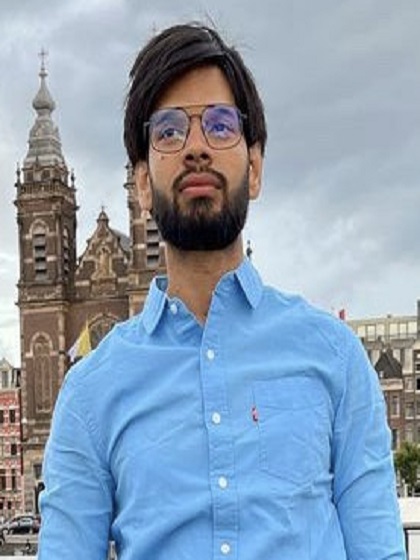
Sushant Pandey serves as an Assistant Professor in the Department of Software Engineering at the Faculty of Science and Engineering, University of Groningen, conducting cutting-edge research at the intersection of software engineering and automotive systems. His core research domains include: Design Pattern Detection using machine learning Software Defect Count Estimation techniques Data Leakage Detection in perception systems Large Language Model applications for code analysis Recent publications demonstrate a cohesive focus on empirical validation of novel methodologies, particularly applying computational experiments to software quality challenges in both traditional and automotive contexts with emphasis on practical tool development.
Sushant Kumar Pandey is an Assistant Professor at the Bernoulli Institute for Mathematics, Computer Science and Artificial Intelligence, Faculty of Science and Engineering, University of Groningen. His research focuses on AI-driven software engineering, including software testing, autonomous systems, and data leak detection in computer vision. Previously, he held postdoctoral roles at Chalmers University of Technology and IIT (BHU), Varanasi. Education: PhD in Computer Science (2017–2021) from IIT (BHU), Varanasi, India. Thesis: 'Observations on Software Defect Prediction.' M.Tech in Information Technology (2014) from NIT Patna, India. Thesis: 'Intrusion Detection System using Anomaly Detection in Wireless Sensor Networks.' B.Tech in Information Technology (2008–2012) from United College of Engineering and Research, Greater Noida, India. Research Interests: AI applications in software engineering, defect prediction, deep learning architectures, and industrial collaborations with companies like Volvo Cars. His work bridges theoretical advancements and practical solutions, such as cross-project defect prediction and data handling for autonomous systems. Key Contributions: Over 15 peer-reviewed publications in journals like Knowledge-Based Systems and Expert Systems with Applications, focusing on machine learning techniques for software defect prediction and testing. His recent work explores design pattern recognition using programming language models and input prioritization for deep learning systems. Awards/Grants: Multiple course certifications in machine learning from Coursera and an ethical hacking certification. No specific grants mentioned, but active collaborations with industry partners like Volvo Cars. Labs/Teams: Leads the Software Engineering and Architecture (SEARCH) research group at Groningen under Prof. Paris Avgeriou. Collaborates with teams at Chalmers University and IIT (BHU).
Dario Di Nucci is a Researcher at Joint Academic Data Science (JADS), focusing on Data Analytics and Data Governance . His work intersects Computer Science , Software Engineering , and Machine Learning , with key contributions to DevOps, Infrastructure-as-Code, and Smart Contracts. Recent Publications include a 2025 review on Data Mesh architecture in ACM Computing Surveys , 2024 studies on vulnerability fix mapping in open-source repositories (ACM Transactions) and automated smart contract testing (Science of Computer Programming), and 2022 empirical analyses of linguistic inconsistencies in infrastructure-as-code (Empirical Software Engineering) and defect prediction via process metrics (IEEE Transactions on Software Engineering). These works collectively advance methodologies in code quality, security, and natural language processing. Collaborations span institutions like Vrije Universiteit Brussel and Tilburg University , with media coverage in 2023 highlighting his research in machine learning and cloud computing. He has supervised at least one PhD student (Supervised Work section) and contributed datasets like Detecting Code Smells Using Machine Learning Techniques (2018, Figshare).
Mariëlle I.A. Stoelinga is a Full Professor at Radboud University Nijmegen, affiliated with the Digital Society Institute and the Formal Methods and Tools group. Her work focuses on formal methods, cybersecurity, and safety-critical systems, contributing to UN Sustainable Development Goals related to infrastructure resilience and innovation. Education: Prior academic qualifications include doctoral studies leading to her Prof.dr. title. Her research integrates theoretical foundations of fault and attack trees, model checking, and stochastic modeling, with applications in railways, manufacturing, and smart infrastructure. Research interests include: Fault Tree Analysis (FTA), Attack Tree Modeling, Risk Management, Formal Verification of Cyber-Physical Systems, Railway Industry Standards, and Anomaly Detection in Manufacturing. She has a strong focus on practical applications, such as data-driven maintenance strategies and security protocols for critical infrastructure. Recent work emphasizes modular criticality analysis for dynamic systems, fuzzy logic in cybersecurity, and statistical model checking for reliability-centered maintenance. Her publications reflect interdisciplinary collaboration across computer science, engineering, and legal domains. Scientific Awards: Notable recognitions include the Alice & Eve Award (2024), Best Paper Awards at SEFM (2023) and FORTE (2022), and the Concur Test-of-Time Award (2022). These highlight her contributions to formal methods and security research. Advising & Grants: Supervised 12 students and led projects on topics like railway controller testing and additive manufacturing defect analysis. Active in research networks and conferences, she also engages in public outreach through podcasts on data-driven maintenance innovations. Labs/Teams: Part of the Formal Methods and Tools group at Radboud University, collaborating on projects involving digital society challenges, safety-critical systems, and cyber-physical security.
Dr. Kwabena Bennin is an Assistant Professor in the Information Technology Group at Wageningen University & Research. His expertise spans software engineering, machine learning, and software quality assurance. He holds a PhD in Computer Science from City University of Hong Kong and a BA (Hons) in Computer Science and Statistics from the University of Ghana. His research focuses on applying AI to software engineering tasks, including defect prediction, automated testing, and software analytics. He has conducted extensive studies on machine learning applications in agriculture, such as plant disease detection using deep learning. Bennin also explores recommender systems for sustainable online food choices and has experience in distributed software development methodologies. He has over 40 international publications and has worked as a Postdoctoral researcher at Blekinge Institute of Technology and a Data Science Consultant at Ericsson. His current projects include developing socio-technical decision support systems for healthy and sustainable food choices in online shopping platforms. Key Skills: Software Architecture, Empirical Software Engineering, Precision Agriculture Analytics Education: PhD in Computer Science, City University of Hong Kong BA (Hons) in Computer Science and Statistics, University of Ghana His work integrates technical innovation with real-world applications, addressing challenges in both software systems and agricultural technology domains.
Önder Babur is an Assistant Professor in the Department of Information Technology at Eindhoven University of Technology. His research focuses on software engineering, machine learning applications, precision agriculture, and digital twin technologies. He has contributed to projects involving business process modeling, drone analytics, and energy market methodologies. Babur collaborates with institutions like Wageningen University & Research and has supervised PhD candidates in generative AI approaches and digital twin systems. His research interests span model analytics, clone detection, API usage analysis, and low-code platforms. Notable projects include an empirical study of business process models on GitHub and foundational work in digital twins for energy markets. Babur has co-developed datasets for drone imagery analysis and systematic reviews of food recommender systems. His work bridges theoretical software engineering advancements with practical applications in agriculture and energy systems. Advising PhD candidates include Gürkan Soykan (digital twins in energy markets) and Jeroen Doornbos (generative AI in drone analytics). Projects emphasize collaborative frameworks like SAMOS for model management and Apache Spark-based distributed analytics. Babur’s contributions span 45+ peer-reviewed publications and two active PhD supervisions.