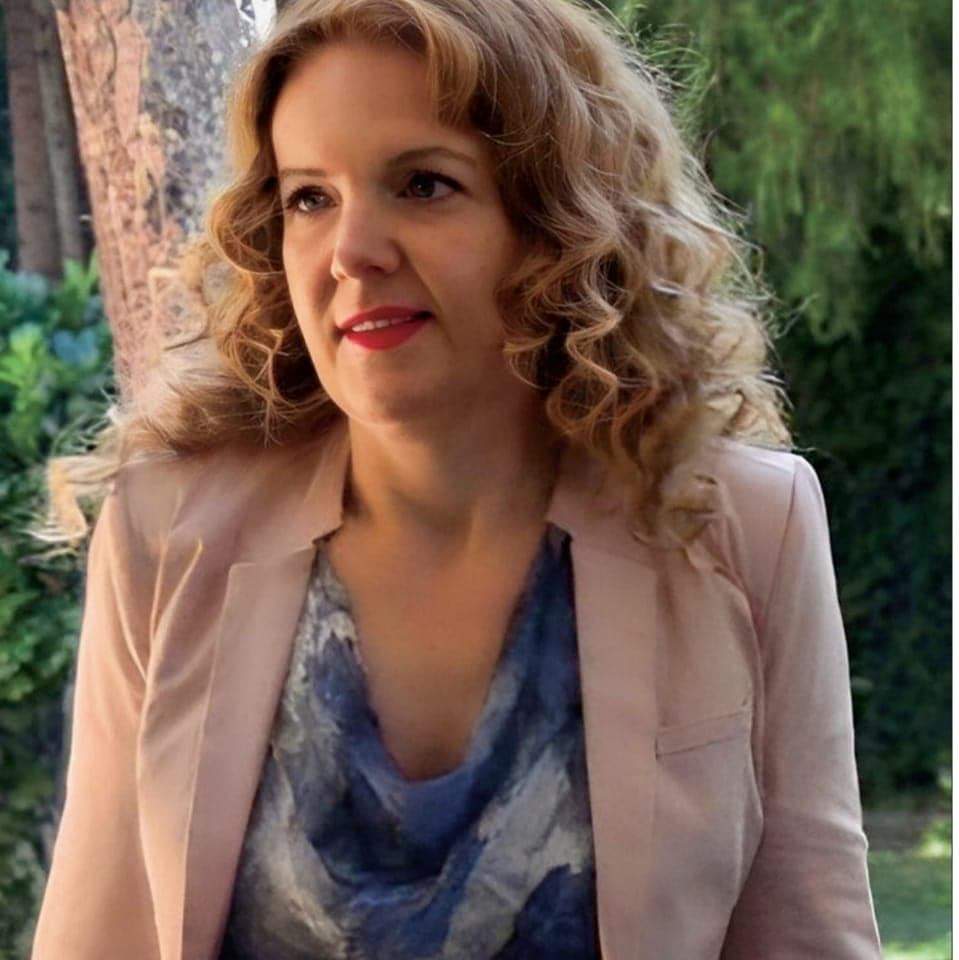
Besa Kadriu is an Associate Professor at the Contemporary Social Sciences Faculty of South East European University in Tetovo, North Macedonia. With a Doctor of Sciences in Public Governance and Administration (2015-2019), her work focuses on policymaking in multiethnic states, public administration reforms, and governance challenges. Native Albanian, C2 Macedonian, C1 English, and A2 German speaker Her research interests span public governance frameworks, integration challenges in Western Balkans, pension system sustainability, and youth migration dynamics. She has published extensively on policy implementation in post-conflict societies and institutional development. Recent publications demonstrate expertise in multiethnic governance (2016-2021), educational reforms (2015), and social inclusion policies (2019). Her work combines theoretical analysis with practical case studies from North Macedonia's political and administrative landscape.
Marija Todorovska is a Full Professor at the Institute of Philosophy, Faculty of Philosophy, Ss. Cyril and Methodius University in Skopje. She teaches undergraduate courses (Introduction to Philosophy, Philosophical Terminology, Ontology, Theories of Religion, Philosophy of Religion) and graduate courses (History of the Notion of God, Theories of the Existence of God). She also co-teaches doctoral electives. Education: BA in Philosophy (2008) MA in Philosophy of Religion (2010) PhD on 'The Diabolical Nature of the Sacred' (2013) Advanced Certificate in Research Ethics (2013) Her research explores: The concepts of divinity across ancient and medieval traditions. Apophatic theology in Hellenistic, Gnostic, and early Christian texts. Ambivalence of the sacred in Mesopotamian, Egyptian, and Byzantine demonology. Philosophy education and curriculum development. Her publications emphasize: Negative theology in Philo of Alexandria and early Church Fathers. Sacred-profane dynamics in contemporary society. Cross-cultural analysis of evil in ancient religions. She serves on editorial boards for Filozofska tribina (Macedonia), Synthesis philosophica (Croatia), and Filozofija (international). As coordinator of the CEEPUS network 'Philosophy and Interdisciplinarity,' she fosters academic collaboration across Europe. No awards or specific grants are noted.
Renata Deskoska is a Full-Time Professor at the Faculty of Law ‘Justinian First’ in Skopje , part of the Ss. Cyril and Methodius University in Skopje . She holds a position in the Department of Constitutional Law and Political System and teaches courses such as Constitutional Law, Human Rights, and Rights of National Minorities across undergraduate, master’s, and doctoral programs. Her research focuses on constitutionalism, human rights, and the interplay between political systems and legal frameworks in North Macedonia and beyond. Her work examines themes like populist transformations of constitutional law, sustainability in governance, and legal responses to crises such as the pandemic. She has contributed to debates on judicial independence, parliamentary dynamics, and the role of constitutional courts. Her recent publications emphasize contemporary legal challenges, including the balance between executive power and democratic legitimacy. Deskoska has been actively involved in academic and policy initiatives related to European integration, language policies, and minority rights. Her research often bridges theoretical constitutional concepts with practical legal reforms, reflecting her commitment to fostering democratic institutions and human rights protection in transitional contexts. She is based at Office 64, reachable via email at renata@pf.ukim.edu.mk , and holds office hours Tuesdays/Thursdays 12-14.
Tanja Karakamisheva Jovanovska is a Full Professor at the Faculty of Law 'Justinian First' in Skopje, affiliated with the University 'Goce Delčev' Štip. She holds a prominent position in constitutional law and European integration studies, teaching courses on constitutional law, EU legal frameworks, political systems, and electoral systems at undergraduate, graduate, and doctoral levels. Her work focuses on the interplay between constitutional identity, EU integration processes, and the protection of fundamental rights through transnational judicial mechanisms. Her research explores complex issues such as judicial dialogue between European courts, constitutional reform dynamics in post-socialist states, and the challenges of maintaining national sovereignty amid EU conditionality. Notable areas of interest include the legal ramifications of international agreements like the Prespa and Bulgarian treaties, privatization processes, and the role of constitutional courts in mediating political conflicts. Her publications consistently address contemporary constitutional dilemmas, including the EU's constitutional culture gaps, federalism debates, and the impact of cultural heritage disputes on state identity. She has contributed significantly to understanding Macedonia's unique position within the Western Balkans' integration trajectory and the evolving relationship between European legal standards and national constitutional frameworks. Education: Advanced qualifications in constitutional law and European studies (inferred from academic position). Grants/Advising: No explicit information provided in text. Labs/Teams: Affiliated with the Institute of Legal and Political Sciences, leading research on constitutional governance and EU law.
Dr. Irena Avirovic Bundalevska is an Associate Professor at the Institute of Family Studies, Faculty of Philosophy, Ss. Cyril and Methodius University in Skopje. She holds a PhD in Historical Sciences (2013) from the same university, specializing in Balkan migration histories. Her academic career includes roles at the Institute of National History as an assistant researcher and teaching positions at the American College in Skopje. Key qualifications include a Master's in International Relations from the University of Bologna (2009) and a Philology degree from the Faculty of Philology (2006). She serves as National Coordinator for the European Family Network (COST Action 18123) and speaks English, Italian, Spanish, with proficiency in German and Russian. Research Focus Cultural shifts in Balkan societies during the 20th century Ethnic minorities' migration patterns Family dynamics influenced by religious institutions Impact of multicultural policies on family structures Her work explores historical migration (e.g., Macedonian emigration to the U.S.), contemporary cohabitation trends, and institutional frameworks affecting family welfare. Recent publications analyze disability-inclusive family policies and UN family initiatives, reflecting her interdisciplinary approach bridging history, sociology, and policy studies. Awards & Grants No specific awards or grants mentioned in current records. Professional Networks Active participant in international conferences on social change and family studies. Collaborations include University Goce Delcev (Stip) and Macedonian Association of Marketing.
Prof. Dr. Antoanela Petkovska is a Full Professor at the Institute of Sociology, Faculty of Philosophy, Ss. Cyril and Methodius University (UKIM). Born in 1958, she holds a PhD in Sociology from the University of Belgrade. Her career spans over four decades, including roles as assistant professor (1994) and associate professor (1999). She specializes in sociology of culture, art, youth, and intercultural communication. She has conducted study stays in the USA (civic education) and France (brain drain). Educations: BA (1980) and MA (1985) from UKIM, PhD (1993) from University of Belgrade. Her research focuses on cultural policy, art sociology, gender studies, and European integration. She has published over 20 books and chapters, including Есеи од социологијата на културата (2009) and Иновацијата низ хуманистички и општествени науки (2020). She has coordinated major projects like EVS European Values Study (2008/2018) and studies on creative industries (2008). Teaching spans undergraduate, graduate, and doctoral programs with courses like Sociology of Visual Culture , Intercultural Communication , and European Civilization . She led professional associations including the Macedonian Center for Culture and Arts (President) and served as President of the Association of Sociologists of Macedonia (2008–2011). Her work addresses societal security through cultural exclusion analysis, youth values, and transnational identity dynamics. Research collaborations include Bulgarian universities and international organizations like DCAF Geneva.
Prof. Violeta Petroska-Beška is a Full Professor of Psychology at the Institute of Psychology, Faculty of Philosophy, Ss. Cyril and Methodius University of Skopje (UKIM). She has been employed since 1980 and holds academic positions in Methodology/Psychometrics and Peace Psychology. She holds a PhD from Belgrade University (1989) and advanced conflict resolution training from Columbia University. Prof. Petroska-Beška is licensed psychologist and member of Macedonia's Psychological Testing Board. Her research focuses on psychological test development, ethnic identity dynamics, multicultural education, and program evaluation. She has authored/co-authored influential works on interethnic relations, including analyses of Macedonian textbook biases (2018), refugee prejudice reduction (2018), and policy transfer in social cohesion (2018). She led Macedonia's 2010 Millennium Development Goal report on universal education and co-created the bilingual "Mosaic" kindergarten initiative. Prof. Petroska-Beška serves as Editor-in-Chief of Psychology - Science and Practice (since 2019) and leads the Citizens' Association Center for Human Rights and Conflict Resolution. She has collaborated with UNDP, UNICEF, and international institutions on education reforms, conflict resolution programs, and refugee integration projects. Her work includes over 200 academic publications and 30 authored/co-authored books. Key Awards: Distinguished Alumni Award (Columbia Teachers College, 2011) Professional Roles: Senior Fellow at USIP (2000-2001), UNESCO consultant, international lecturer at 10+ universities
Hasan Jashari is a Full Professor (part-time) at the Faculty of Contemporary Social Sciences, South East European University. His academic journey includes a PhD in Sociology of Education and Family from Saint Cirillius and Methodius University (1999-2001), building on earlier degrees in Sociological Sciences and Sociology. His research focuses on: Political pluralism in post-communist societies Sociology of education systems Interethnic relations in the Balkans Methodologies in doctoral research Publications over the past decade demonstrate consistent focus on social transformation in Macedonia, with recurring themes of educational reform, political transitions, and research methodology. His most recent work examines data collection techniques in doctoral studies. No awards, students, or grants information was available in the source material.
Saint Clement of Ohrid University of BitolaMacedonia
Prof. Dr. Kosta Sotiroski is a Full Professor at the Faculty of Economics - Prilep, University 'St. Kliment Ohridski' - Bitola. He holds a PhD in Economics from the same institution (1998), with research focused on statistical modeling and production optimization. His academic roles include mentoring doctoral students in Marketing, Management, and Business Informatics, and serving as Secretary of the Doctoral Studies Committee. Education: Bachelor's in Mathematical-Statistical-Cybernetics (1986) Master's in Monte Carlo Simulation in Economic Management (1993) PhD in 'Modeling Optimal Organization of Production Processes' (1998) Research Interests: Business Informatics, ERP Systems, Big Data Technologies, Econometrics, E-Banking Services, and Statistical Process Control. His work emphasizes data-driven decision-making in economics and healthcare. Publications: Over 112 publications in areas like arterial stiffness in dialysis patients, e-learning adoption, and SME innovation. Recent trends focus on healthcare analytics and cloud computing in education. Awards & Grants: Involved in EU-funded projects such as TEMPUS and CARDS initiatives. Recognized as a top-ranked scientist in Macedonia for contributions to economics and management science. Labs/Teams: Leads research in Business Informatics and Data Analytics. Active in editorial roles for journals like Strategic Management and International Journal of Economics, Politics, Humanities & Social Sciences.
Dr. Makedonka Radulovic is an Associate Professor at the Institute of Family Studies, Faculty of Philosophy, Ss. Cyril and Methodius University in Skopje. She holds a PhD in European Integration Studies (2011) and has extensive experience in teaching and research related to family dynamics, health policy, and human rights. Her research explores intersections between European Union policies and Macedonian societal structures, with a focus on family education, health equity, and cultural values. Education: Bachelor's in Journalism (2004), Faculty of Law, Ss. Cyril and Methodius University Master's in European Studies (2009), Institute of Sociology PhD in European Integration Studies (2011), Institute of Sociology Research Interests: European social policy, family structures, healthcare rights, marital education, globalization impacts, and human rights compliance. She actively participates in international conferences and serves as National Coordinator for COST Action 18123 (European Family Network) and Vice President of the European Movement of Macedonia. Teaching Roles: "Contemporary Challenges of Families in Europe" "The Family in EU Strategies" "Family Health and Healthcare" "Tradition in European and Macedonian Families" "Family, Marital Education, and Communication" Labs/Teams: Leads research initiatives at the Institute of Family Studies, collaborating with EU networks and local policymakers to advance family policy frameworks.
Prof. Dr. Огнен Спасовски is a Full Professor at the Institute of Psychology, Faculty of Philosophy, Ss. Cyril and Methodius University in Skopje (UKIM). He obtained his PhD in 2009 on 'Subjective Well-Being, Basic Psychological Needs, and Life Goals'. He held a Fulbright post-doctoral fellowship at the University of Pennsylvania (2011-2012), working under Martin Seligman. His academic career includes roles as lecturer (2009), associate professor (2014), and full professor (2019). Education: Bachelor's in Psychology (1996, UKIM) Master's in Psychology (2004, UKIM) PhD in Psychology (2009, UKIM) Research Interests: Focuses on evolutionary mechanisms influencing human behavior, emotion-cognition interactions, and inclusive education quality. Key topics include subjective well-being determinants, positive psychology applications, and Roma community education challenges. International Engagement: Collaborated with EU Directorate-General Education, Council of Europe, UNICEF, USAID, and others on projects like citizenship education guidelines (2018) and Roma education analysis (2011). Served on COST Agency review panel (2016-2018). Teaching: Offers courses in Evolutionary Psychology, Psychology of Special Educational Needs, Emotions & Cognition, and Positive Psychology across undergraduate, master's, and doctoral programs. Labs/Teams: Leads research groups studying subjective well-being and evolutionary psychology mechanisms. Active in Macedonia Psychological Association since its foundation.
Prof. Dr. Mitko Kotovchevski is a Full Professor at the Institute for Security, Defence and Peace , part of the Faculty of Philosophy at Ss. Cyril and Methodius University in Skopje. He has been Head of the Institute for Security, Defence and Peace since 2009 and was re-elected in 2013. His academic career spans over three decades, with teaching roles in courses such as Polemology , National Security , Intelligence , and Security Assessments at both undergraduate and postgraduate levels. Education: Graduated Faculty of Philosophy, Skopje (1975/76), completed postgraduate studies at Faculty of Defense, Belgrade (1981/82), and earned his Doctorate in Science with a dissertation on Demographic characteristics of the Republic of Macedonia (1991). His research focuses on polemology (war theory), national and integral security, intelligence systems, mobilization models, and non-military aspects of security. He has pioneered theoretical frameworks for Macedonia's national security system and conducted extensive analyses on terrorism, organized crime, and geostrategic challenges in the Balkans and beyond. His work includes collaborations with international scholars and contributions to regional security policy. Professor Kotovchevski has led three major national security research projects and authored over 200 expert analyses in publications like Denes , Nova Makedonija , and Defence magazine. He also co-authored articles with global security experts and contributed to forecasting conflicts in Kosovo and Macedonia alongside Johan Galtung. Leadership and Institutions: Founder of the Crisis Management Center (2001) in Macedonia. Deputy Head and Coordinator of Peace Strategies and Non-Military Aspects of Security at the Balkan Peace Center. Member of the Global Strategic Research Initiative at the Macedonian Academy of Sciences and Arts. Contributor to the MANU project on national security threats. Publications and Languages: Authored 22 books and monographs, including Defendology , National Security , and Counterterrorism Handbooks . Fluent in French, Bulgarian, English, Russian, and Turkish .
Prof. Dr. Zoran Matevski is a Full Professor at the Institute of Sociology, Faculty of Philosophy, Ss. Cyril and Methodius University (UKIM) in Skopje. He holds leadership roles including Head of the Center for Intercultural Studies and Research and Head of the Teaching Commission of the Faculty of Philosophy. His career spans over three decades with roles as Department Head (2009–2017) and involvement in national and international academic governance bodies. Education: Earned a PhD in Sociological Sciences (1998) and has taught at all academic cycles. His research focuses on sociology of religion, religious conflict/peace dynamics, intercultural dialogue, and post-communist societies. He has authored/co-authored 9 books and over 60 scientific papers. Research highlights include projects on religious tolerance, interculturalism, and refugee crises. He founded the 'Religious Dialogue and Cooperation' journal and organizes biennial European conferences on religious dialogue. His work addresses global issues like religious extremism, educational policy, and cultural heritage management. International engagements include visiting professorships at Jagiellonian University (Poland), and active membership in global sociological associations (IIS, ISA, ISSR). Proficient in English, he has led national initiatives like Macedonia's intercultural strategy development and EU integration projects.
Агрон Рустеми е редовен професор на South East European University (Tetovo, North Macedonia) и вицe-декан на Факултетот за современи општествени науки од 2014 година. Тој има докторат по Социјална политика од Филозофскиот факултет на Универзитетот „Св. Кирил и Методиј“ во Скопје, со теза на тема споредба на моделите на државата на благосостојба во Велика Британија и Германија. PhD in Social Politics (2012), Faculty: Philosophical Faculty, Ss. Cyril and Methodius University, Skopje MSc in Social Politics (2008), Faculty: Philosophical Faculty, Ss. Cyril and Methodius University, Skopje BSc in Social Work (2003), Faculty: Philosophical Faculty, Skopje Неговите истражувачки интереси вклучуваат социјални политики , многукултурност , вклучување на жените во политиката , управување со ризик , и конфликтна чувствителност . Тој објави повеќе од 15 научни трудови во периодот 2016-2024, фокусирајќи се на теми како управување со ризик од поплави, државни системи на благосостојба, и влијанието на социјални норми врз женината активност во демократските процеси.
Demush Bajrami serves as a full-time Associate Professor at the Faculty of Languages, Cultures and Communication, South East European University (SEEU) in Tetovo, North Macedonia. Holding a PhD in Social Sciences from the University of Tirana (2011-2016) with a dissertation on social media's role in politics, he maintains active academic engagement across media studies, political communication, and educational leadership domains within the Balkan context. Academic Background: PhD in Social Sciences, University of Tirana, Albania (2011-2016) Professor Bajrami's research critically examines political communication dynamics through digital platforms, disinformation ecosystems in transitional democracies, and cross-cultural language interactions between English and Albanian speakers. His work bridges theoretical frameworks with practical applications in media literacy education , educational leadership , and digital citizenship development , particularly focusing on Generation Z communication patterns and institutional resilience against misinformation campaigns. His publications demonstrate consistent regional relevance to North Macedonia and the Western Balkans. Analysis of his 15 most recent publications (2021-2025) reveals three dominant thematic trajectories: (1) Disinformation countermeasures and media literacy frameworks in post-conflict societies, (2) Social media's transformative impact on political leadership and cross-cultural relationships, and (3) Educational leadership challenges in multilingual institutional environments. His methodological approach combines qualitative discourse analysis with empirical studies of communication preferences and institutional practices. While no formal scientific awards are documented in available materials, his collaborative publications with SEEU colleagues indicate active participation in institutional research initiatives addressing regional media literacy gaps and educational policy development. Professor Bajrami's academic supervision focuses on media studies and political communication theses, though specific student names aren't publicly cataloged. His research integrates grant-funded projects examining disinformation vulnerabilities and digital citizenship education within SEEU's institutional framework, contributing to the university's strategic positioning in Balkan media studies.