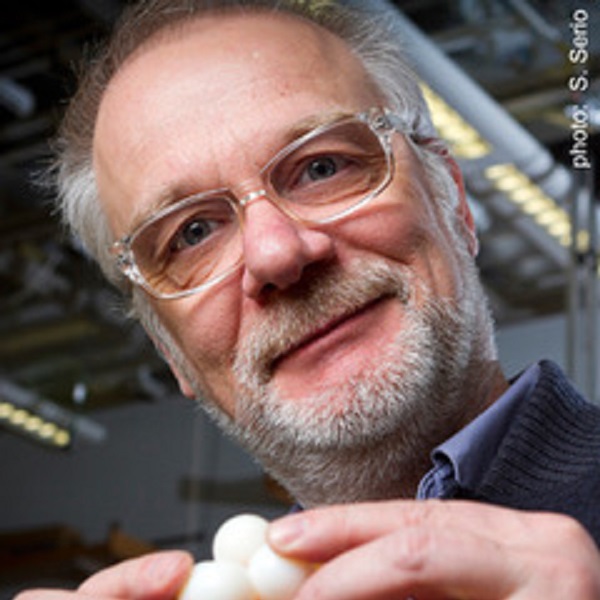
Ionut ENCULESCUView profile
Professor
Dr. Ionut ENCULESCU serves as the General Director of the Laboratory of Functional Nanostructures at the National Institute of Materials Physics (INFIM) in Romania. His research spans nanomaterials, biosensors, and flexible electronics, with numerous publications demonstrating his leadership in the field of functional nanostructures and their applications. His research interests focus on nanomaterials engineering with particular emphasis on electrospun fibers, metal oxide nanostructures, graphene applications, and their integration into functional devices. Dr. ENCULESCU's work bridges fundamental materials science with practical applications in medical diagnostics, wearable sensors, and soft robotics. His laboratory develops innovative approaches to fabricate and characterize nanostructured materials for biosensing, energy conversion, and actuation applications. The publication trends show a consistent focus on electrospun nanofibers and their applications, with recent work emphasizing flexible biosensors for medical diagnostics, artificial muscles for soft robotics, and hybrid nanomaterials for optoelectronic applications. His research demonstrates a progression from fundamental materials synthesis toward increasingly complex functional devices with real-world applications in healthcare and wearable technology. Dr. ENCULESCU leads multiple research projects including biomimetic sensors based on nanowire channel field effect transistors (IDEI project 2017-2019), spin and charge control in nanowire field effect transistors (IDEI project 2013-2016), and high efficiency electrospinning (2012-2015). His work has resulted in numerous publications in high-impact journals covering topics from biosensors to artificial muscles. The laboratory under his direction develops advanced materials for applications ranging from medical diagnostics to soft robotics. Their work on electrospun fiber networks, metal oxide nanostructures, and graphene-based materials has led to innovations in flexible electronics, wearable sensors, and biomimetic actuators. Current research directions include developing self-powered sensing systems , multi-functional biomaterials , and integrated flexible electronic platforms for healthcare applications.