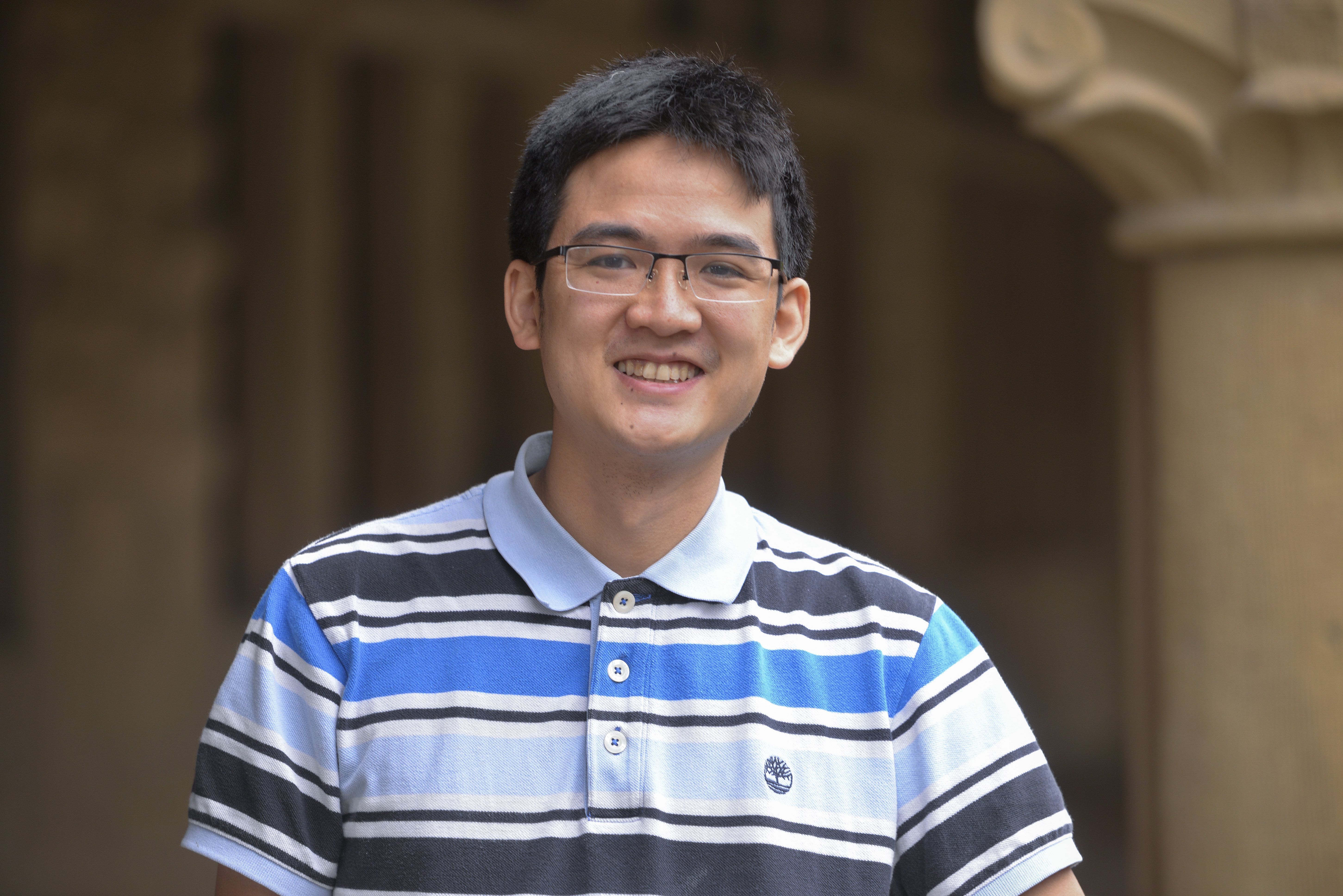
Jonathan Winghong Luk is a Professor in the Department of Mathematics at Stanford University. His research focuses on nonlinear partial differential equations, general relativity, and mathematical physics, with a particular emphasis on gravitational wave dynamics, shock formation, and high-frequency spacetime solutions. Contact: Email: jluk@stanford.edu Office: 382-Z, Building 380, Stanford, CA 94305 Research Trends: His recent publications examine nonlinear wave equations on dynamic spacetimes, gravitational phase mixing, impulsive gravitational wave interactions, and stability of black hole interiors. He frequently collaborates with experts like C. Huneau, S.-J. Oh, and J. Speck. Academic Activities: Luk organizes the Analysis and PDE seminar at Stanford with Eugenia Malinnikova and Ryan Unger. He has developed lecture notes on nonlinear wave equations and Fourier analysis, complemented by example sheets.
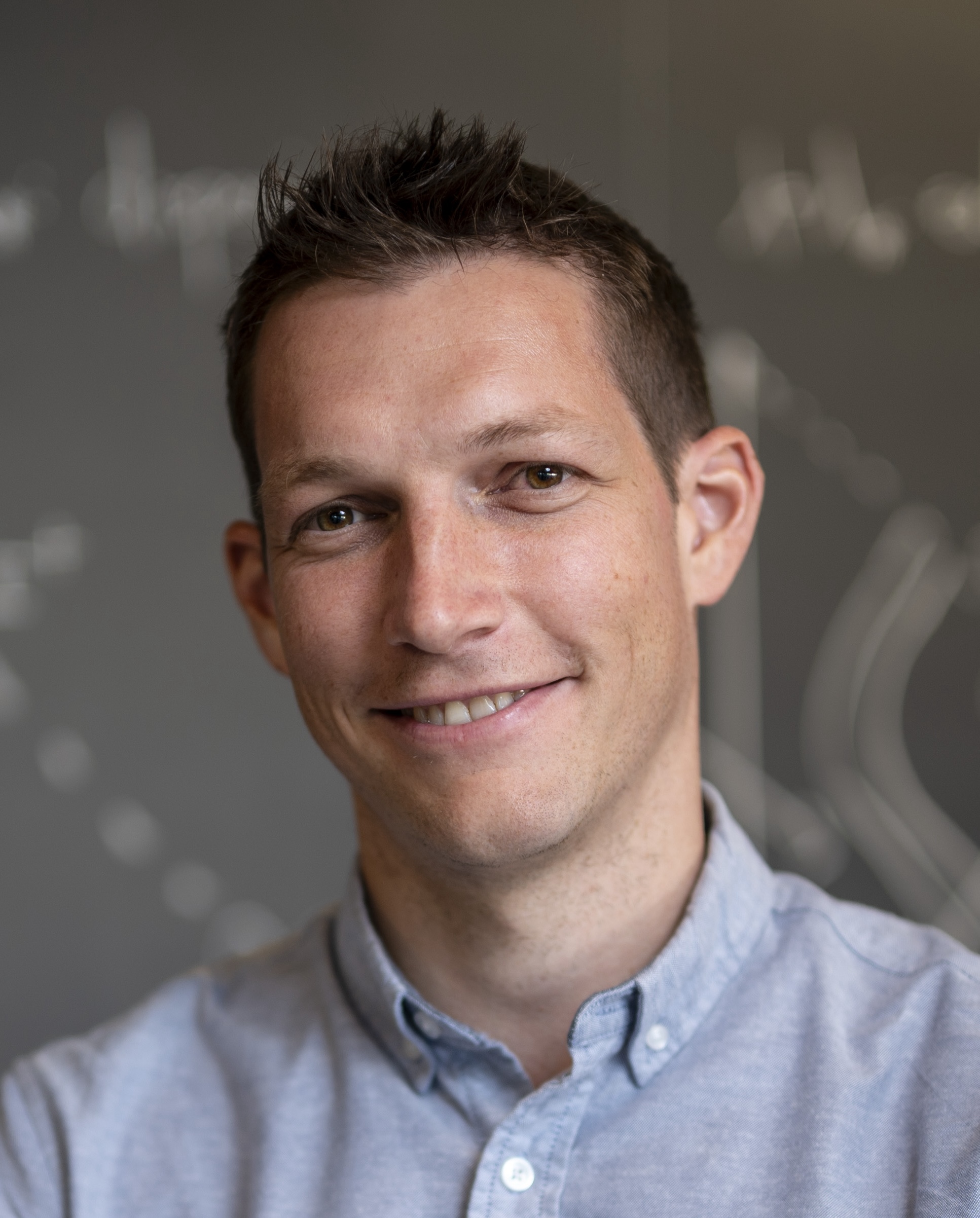
Professor Jasper van Wezel is a distinguished academic in the field of Condensed Matter Theory at the University of Amsterdam's Faculty of Science, where he serves as Professor in the Institute for Theoretical Physics (ITFA) within the Institute of Physics. With a career spanning over two decades, he has progressed from Assistant Professor (2014-2016) to Associate Professor (2016-2024) and currently holds the position of Professor since 2024. His academic journey began with a PhD in theoretical condensed matter physics from Leiden University in 2007, followed by prestigious fellowships at Argonne National Laboratory and Homerton College, Cambridge. PhD in theoretical condensed matter physics (cum laude), Leiden University, 2007 Master's diploma in theoretical condensed matter physics (cum laude), Leiden University, 2003 Dutch VWO Diploma (cum laude), Dalton Scholengemeenschap, Den Haag, 1997 US High School Diploma (cum laude), Sanford High School, Maine, USA, 1998 Professor van Wezel's research focuses on several interconnected areas within Condensed Matter Theory. His work explores competing instabilities in Charge Density Wave materials, including Superconductivity and Charge Order, Combined Charge and Orbital Order, and Transition-metal dichalcogenides. He has made significant contributions to Topology in Condensed Matter, particularly examining the Role of crystal symmetries and Topology in non-Hermitian systems. A major theme in his research involves investigating the Connections between Quantum and Classical behaviour, with special emphasis on Spontaneous Symmetry Breaking both in equilibrium (The role of the Thin Spectrum) and dynamically (Spontaneous loss of Unitarity). Analysis of Professor van Wezel's recent publications reveals a strong focus on quantum phenomena in condensed matter systems, with particular attention to topological aspects, symmetry breaking, and connections to fundamental physics concepts like black hole thermodynamics. His work often bridges theoretical concepts with potential experimental realizations, as evidenced by studies on electron patterns in materials like TaS2 and theoretical frameworks for understanding quantum phase transitions. Bristol Physics Teaching Award (2014) Students' Award for Outstanding Teaching (2014) Fellow of the Higher Education Academy (2014) Aneesur Rahman Fellowship at Argonne National Laboratory (2010-2012) Junior Research Fellowship at Homerton College, Cambridge (2007-2010) Physics 'Discovery of the year' by Leiden University Physics department (2005) 'Onderwijsprijs Natuurkunde' teaching award (2004/2005) Professor van Wezel has secured numerous research grants including an ENW-M grant (2023), an ENW-Groot project with Leiden University (2021), and a prestigious VIDI personal grant from NWO (2014). He has supervised over 50 students at various levels, including PhD candidates, MSc students, and BSc students, fostering the next generation of physicists. His leadership extends to organizing conferences, serving on PhD committees, and holding administrative roles such as chair of the educational committee for the Dutch Research School in Theoretical Physics. His research group at the University of Amsterdam's Institute for Theoretical Physics maintains active collaborations with institutions worldwide, including Leiden University, University of Cambridge, University of Bristol, and research centers in France, Germany, and Poland. The group's work combines analytical theoretical approaches with computational methods to tackle fundamental questions in quantum condensed matter physics.
Manuel Del Pino is Professor at the University of Bath's Department of Mathematical Sciences and Royal Society Professor specializing in nonlinear partial differential equations. His research focuses on singularity formation, geometric evolution equations, and asymptotic analysis in fluid dynamics and mathematical physics. His investigations encompass blow-up phenomena in heat equations, vortex dynamics in Euler flows, and minimal surface theory. Current projects examine infinite-time singularity formation in parabolic equations and asymptotic properties of vortex configurations. Del Pino has received the Royal Society Professorship and leads multiple grants including 'Asymptotic patterns in nonlinear evolution problems' (EPSRC). He maintains collaborations with researchers globally through projects on singularity formation in PDEs.
Dr. Matthias Winter is a Senior Lecturer in the Department of Mathematics at Brunel University's College of Engineering, Design and Physical Sciences. He has been affiliated with Brunel since 2005, following academic positions at the University of Stuttgart (1996-2005) and postdoctoral fellowships at the Institute for Advanced Study in Princeton (1993-94) and Heriot-Watt University in Edinburgh (1994-96). His educational background includes a PhD from Stuttgart University in 1993 and a Habilitation from the same institution in 2003. Dr. Winter's research focuses on mathematical biology, particularly pattern formation in biological systems through reaction-diffusion equations. His work examines spike solutions, pattern formation mechanisms, and the mathematical analysis of biological phenomena. He has made significant contributions to understanding stable spike clusters in various contexts including the Gierer-Meinhardt system. His research spans Mathematical Biology, Pattern Formation, Reaction-Diffusion Systems, Nonlinear Partial Differential Equations, and several related mathematical disciplines. His recent publications (2023-2025) demonstrate continued activity across diverse applications including cancer modeling, ecological systems, climate modeling, and fundamental mathematical analysis of reaction-diffusion phenomena, showing his ability to apply sophisticated mathematical techniques to real-world biological problems. Editorial Board, ISRN Mathematical Analysis, since 2010 Academic Appeals Committee, since 2013 Level One Coordinator for Mathematics, since 2013 Course Director MSc Programme Computational Mathematics with Modelling Mathematics, 2008-2010 Dr. Winter teaches various mathematics courses including Mathematics and Statistics for Economists, Vector Calculus, and Group Projects in Mathematics, with a teaching portfolio spanning from foundational courses to specialized topics related to his research interests.
Mihalis Dafermos is a Professor of Mathematics at Princeton University, with affiliations in the Department of Physics and the Princeton Gravity Initiative. He holds dual roles as a researcher and educator in mathematical physics and partial differential equations. Education: B.A. in Mathematics (Harvard, 1997), Ph.D. in Mathematics (Princeton, 2001 under Demetrios Christodoulou). Professional History: Previous positions include Lowndean Professor of Astronomy and Geometry at the University of Cambridge (2015–present), and roles at MIT (2001–2004) and other institutions. Research: Focuses on general relativity, black hole stability, gravitational collapse, and singularities. His work combines geometric analysis with PDEs, addressing foundational questions like cosmic censorship and the formation/stability of black holes. Awards: Adams Prize (2004) Bodossaki Prize (2008) Whitehead Prize (2009) IAMP Early Career Award (2009) Fellow of the AMS (2016) Advising & Grants: Advisor to 16 Ph.D. students. Secured grants from NSF, ERC, and others, including NSF DMS-2005464 (2020–2024) and EPSRC Programme Grant (with A. Neves et al., 2013–2019). Labs/Teams: Member of the Princeton Gravity Initiative and editorial boards of journals like Annales Henri Poincaré and Classical and Quantum Gravity .
Vladimir Kazeev is an Assistant Professor at the Faculty of Mathematics, University of Vienna , where he has held a faculty position since 2019. He also held previous academic appointments as a Szegő Assistant Professor at Stanford University (2017–2019), a postdoctoral researcher at the University of Geneva (2015–2017), and research positions at ETH Zurich (2011–2015), Russian Academy of Sciences (2008–2011), and Moscow Institute of Physics and Technology (2009). His research focuses on adaptive, data-driven numerical methods for differential equations, nonlinear low-parametric approximation, and numerical linear algebra. His work intersects computational mathematics, tensor methods, and high-dimensional problem-solving, particularly in the context of partial differential equations (PDEs) and stochastic modeling. The 15 most recent publications reveal a strong emphasis on quantized tensor-structured methods for PDEs, low-rank approximations, and high-dimensional numerical analysis. His research spans theoretical advancements in tensor decomposition, practical applications in chemical reaction networks, and novel discretization techniques for multiscale and degenerate diffusion problems. Scientific awards include the prestigious ETH Medal for outstanding doctoral theses (2016) Russian Academy of Sciences Medal for outstanding student works in mathematics (2011) Advising and teaching activities include supervising Jason Zhu (Stanford, 2019) and Simon Etter (ETH Zurich, 2014), as well as teaching advanced courses in tensor methods, numerical analysis, and PDEs at the University of Vienna, Stanford University, and the University of Geneva. His service to the community includes peer review for 15+ journals and co-organizing minisymposia at SIAM meetings.
Richard Bamler is an Associate Professor in the Department of Mathematics at the University of California, Berkeley . His research focuses on geometric analysis , differential geometry , and topology , particularly the application of geometric flows such as Ricci flow and Mean Curvature Flow to study metric and topological properties of manifolds. Contact : rbamler@math.berkeley.edu Role : Vice-Chair for Undergraduate Affairs His recent work includes novel results on curvature regularization via Ricci flows and singularity analysis in 4-dimensional U(2)-invariant settings. He has supervised multiple PhD students and is actively involved in teaching graduate and undergraduate courses like Riemannian Geometry and Calculus.
Christoph Kehle is an Assistant Professor in the Department of Mathematics at the Massachusetts Institute of Technology (MIT) since 2024. He works at the intersection of General Relativity, Partial Differential Equations, and Mathematical Physics, focusing on black hole stability, cosmic censorship, and gravitational collapse phenomena. Education: PhD in Mathematics (2020) from the University of Cambridge under Mihalis Dafermos, MASt (2015) at Cambridge, and BS/MS (2016) from LMU Munich. Research: His work addresses fundamental questions about black hole interiors, extremal black hole formation, and nonlinear wave dynamics on curved spacetimes. He investigates connections between Diophantine approximation and spacetime stability, as well as turbulence in AdS black hole systems. Scientific Awards: Recipient of the Research Scholar at Trinity College (Cambridge), EPSRC PhD Scholarship, Senior Scholarship Exam Prize, and scholarships from the German Academic Foundation and Max Weber-Program. Publications: 15 most recent articles span nonlinear stability of extremal black holes, critical collapse phenomena, and geometric PDEs. Collaborators include Y. Angelopoulos, R. Unger, A. Figalli, and M. Van de Moortel.
Thomas Yizhao Hou is the Charles Lee Powell Professor of Applied and Computational Mathematics at the California Institute of Technology, where he has served as a faculty member since 1998 and as Executive Officer of Applied and Computational Mathematics from 2000-2006. His research spans fundamental mathematical problems with significant implications for fluid dynamics and computational science. Hou received his B.S. in Mathematics from South China University of Technology in 1982, followed by an M.S. in 1985 and Ph.D. in 1987 from UCLA under the supervision of Prof. Bjorn Engquist. His academic journey includes positions at the Courant Institute and the Institute for Advanced Study before joining Caltech. Hou's research focuses on multiscale analysis and computation, interfacial problems, stochastic PDEs and uncertainty quantification, and the Millennium Problem concerning global regularity of 3D incompressible Euler and Navier-Stokes equations. His work on adaptive data analysis has led to significant methodological innovations. His research is characterized by the integration of rigorous mathematical analysis with computational approaches to tackle problems that have resisted traditional methods. His recent publications reveal a consistent focus on singularity formation in fluid equations, particularly the Euler and Navier-Stokes equations, with increasing sophistication in analyzing potential blowup scenarios. His work spans theoretical analysis, numerical verification, and the development of innovative mathematical frameworks for multiscale problems. Member of the National Academy of Sciences (2024) William Benter Prize in Applied Mathematics (2024) SIAM Ralph E. Kleinman Prize (2023) SIAM Outstanding Paper Prize (2018) Fellow of the American Mathematical Society (2012) Fellow of the American Academy of Arts and Sciences (2011) Hou has served in significant editorial roles including Founding Editor-in-Chief of the SIAM Journal on Multiscale Modeling and Simulation and Co-Editor-in-Chief of Research in Mathematical Sciences. His professional service includes membership on the SIAM Council and leadership roles at the Institute of Mathematics and its Applications. His research has been supported by numerous grants focusing on multiscale modeling, fluid dynamics, and computational mathematics.
Yakov Shlapentokh-Rothman is an Assistant Professor jointly appointed in the Department of Mathematics at the University of Toronto St. George and the Department of Mathematical and Computational Sciences at the University of Toronto Mississauga. His research focuses on the intersection of partial differential equations, general relativity, and geometric analysis, with particular emphasis on black hole physics and the Einstein field equations. Education: PhD: Massachusetts Institute of Technology (2015) BS with Honors: Stanford University (2010) Research Interests: Shlapentokh-Rothman's work explores fundamental problems in mathematical relativity, including black hole stability, singularity formation, wave propagation in curved spacetimes, and the asymptotic behavior of solutions to Einstein's equations. His research combines rigorous PDE analysis with deep geometric insights. Publications focus on: black hole dynamics, scattering theory in curved spacetimes, stability analysis of Kerr and Reissner-Nordström solutions, cosmic censorship conjectures, and self-similar solutions to Einstein's equations. Recent work examines the structure of naked singularities and decay properties of fields in black hole backgrounds. Awards and Recognition: Alfred P. Sloan Fellowship in Mathematics Advising and Grants: Currently advising PhD student: Avyay Venkat Viswanath Research supported by NSERC Discovery Grants (RGPIN-2021-02562, DGECR-2021-00093)
Pierre Raphaël is the Herchel Smith Professor of Pure Mathematics at the Department of Pure Mathematics and Mathematical Statistics (DPMMS) at the University of Cambridge, where he joined in 2019. His academic career spans prestigious institutions including École Polytechnique, University of Cergy-Pontoise, Princeton University, and various research positions in France before his appointment at Cambridge. Professor Raphaël's research lies at the border between physics and pure mathematics, focusing on understanding energy concentration mechanisms and singularity formation during the propagation of non-linear waves. His work is deeply connected to fundamental nonlinear structures occurring in electromagnetism, astrophysics and turbulent fluid flows. He has made significant contributions to the mathematical analysis of nonlinear partial differential equations, particularly in understanding blow-up phenomena and singularity formation. His publications reveal a consistent research trajectory focused on nonlinear wave phenomena, with particular emphasis on energy concentration mechanisms and singularity formation across various mathematical models. His work spans multiple areas including nonlinear Schrödinger equations, heat equations, Korteweg-de Vries equations, and harmonic heat flows, demonstrating his expertise in analyzing critical and supercritical regimes where singularities may form. Grand Prix Alexandre Joannides 2014 from the French Academy of Sciences Royal Society Wolfson Fellowship 2019 Invited Speaker at International Congress of Mathematicians 2014 ERC Advance Grant recipient Professor Raphaël has secured significant research funding including European Research Council grants, demonstrating his leadership in the field. His research group at Cambridge focuses on singularity formation for nonlinear PDEs, as evidenced by the conference he organized at St Catharine's College in September 2024. His work bridges pure mathematics with physical applications, particularly in understanding extreme regimes of nonlinear wave propagation.
John Lott is a Professor in the Department of Mathematics at the University of California, Berkeley, specializing in Differential Geometry , Geometric Analysis , and Optimal Transport since his appointment in 2008. His research explores the interplay between Ricci curvature , metric-measure spaces , and geometric flows , with notable contributions to Ricci flow and noncommutative geometry . He has supervised multiple PhD students including Thunwa Theerakarn and Patrick Wilson , and maintains an active publication record with over 40 research papers. Selected Research Areas : Differential Geometry, Geometric Analysis, Optimal Transport, Mathematical Physics, Noncommutative Geometry Recent Publications (2020-2025) focus on Kähler manifolds , collapsing geometry , and quasilocal mass in general relativity. His work on Ricci curvature via optimal transport with Cédric Villani has become foundational in the field. Academic Affiliation : Position: Professor Institution: University of California, Berkeley Department: Mathematics
Benoît Mahault serves as a Group Leader and Researcher at the Max Planck Institute for Dynamics and Self-Organization (Göttingen, Germany) within the Department of Living Matter Physics, where he directs the Motile active matter research group. His work bridges theoretical physics and biological complexity through nonequilibrium statistical mechanics. His academic background includes a Ph.D. from Université Paris-Saclay (2018) under Hugues Chaté, followed by a postdoctoral position at the University of Tokyo in Prof. Masaki Sano's group. He joined the Max Planck Institute in 2019 as a postdoc and was promoted to Group Leader in 2021. Dr. Mahault's research centers on emergent self-organization in active matter systems , with focus areas including: Transition mechanisms to collective motion Bose-Einstein-like condensation via motility inhibition Topological defect dynamics in active nematics Navigation strategies for microswimmers in complex environments His theoretical framework reveals universal principles governing both synthetic and biological active systems. Analysis of his 15 most recent publications (2022–2025) shows a cohesive trajectory exploring nonreciprocal interactions , quorum sensing , and energy-accuracy tradeoffs in active matter. Key themes include phase separation in driven mixtures, defect-mediated pattern formation, and hydrodynamic optimization of microswimmer locomotion—demonstrating consistent innovation at the physics-biology interface. The Motile active matter group employs advanced theoretical modeling to dissect self-organization principles, contributing foundational insights through collaborations with experimental teams at the Max Planck Institute. Current projects investigate non-equilibrium steady states in confined active systems and topological constraints in collective navigation.
Professor Oscar Dias is a faculty member in the Department of Mathematical Sciences at the University of Southampton. His research focuses on Einstein's gravity, black holes, holographic dualities, and gravitational aspects of string theory. He actively supervises PhD students in mathematical sciences and holds grants from the Science and Technology Facilities Council (STFC), including projects like 'New Frontiers in Particle Physics, Cosmology and Gravity.' His work explores topics such as cosmic censorship, black hole dynamics, and numerical general relativity, with recent contributions published in journals like Physical Review Letters and Journal of High Energy Physics . Key research interests include the study of black hole binaries in de Sitter space, the stability of charged black holes, and the interplay between holographic dualities and quantum field theories. His projects often involve collaborations with leading institutions, addressing foundational questions in theoretical physics and cosmology. Professor Dias is a member of the Southampton Theory Astrophysics and Gravity (STAG) Research Centre and the String Theory and Holography group. His articles highlight advancements in understanding gravitational wave phenomena, quasinormal modes, and the behavior of black holes under various physical conditions. He currently accepts PhD applications and can be contacted via O.J.Campos-Dias@soton.ac.uk.
Chun Liu is Chair and Professor of Applied Mathematics at the Department of Applied Mathematics, Illinois Institute of Technology (IIT), within the College of Computing. His research focuses on Nonlinear Partial Differential Equations , Complex Fluids , and Multiscale Modeling , with applications in electrophysiology and materials science. He earned a Ph.D. from New York University’s Courant Institute, an M.S. from Duke University, and a B.S. from Fudan University. Prof. Liu leads projects on General Diffusion Systems , Ion Channel Dynamics , and Viscoelastic Fluids . He has secured grants from NSF, BSF, and DAAD for research in energetic variational approaches, multiscale materials modeling, and biomolecular systems. Key contributions include the development of Poisson-Boltzmann models , coarse-grained dynamics , and energetically stable numerical methods . He serves on editorial boards for Communications in Mathematical Sciences , SIAM Journal on Mathematical Analysis , and others. His work bridges applied mathematics with engineering and biophysics, addressing challenges in fluid mechanics, ion transport, and nonlinear systems.