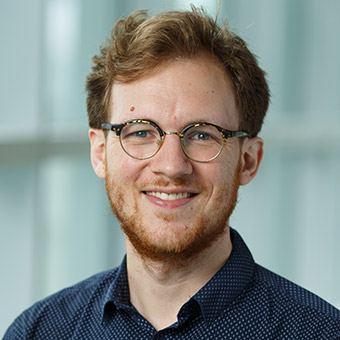
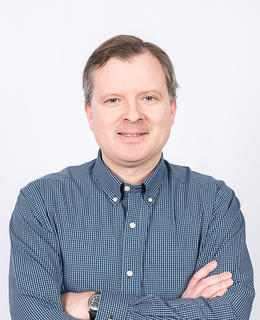
Vinothan N. Manoharan is a Professor in the School of Engineering and Applied Sciences and the Department of Physics at Harvard University. He joined Harvard in 2005 after a postdoctoral fellowship at the University of Pennsylvania and a PhD in Chemical Engineering at the University of California, Santa Barbara. His research bridges colloidal science, biophysics, and materials engineering, focusing on self-assembly processes and advanced imaging techniques.
Andrew Godwin is a Professor at the University of Kansas Medical Center , where he serves as the Chancellor’s Distinguished Chair in Biomedical Sciences and Director of Molecular Oncology in the Department of Pathology and Laboratory Medicine. He is also the Deputy Director of the NCI-designated University of Kansas Cancer Center and the Founding Director of the Kansas Institute for Precision Medicine and Biospecimen Shared Resource . Dr. Godwin is a leader in translational research and precision medicine , with a focus on molecular oncology , biomarker discovery , and genomic diagnostics . His work bridges basic and clinical science to improve cancer patient care, particularly in ovarian cancer , Ewing sarcoma , and breast cancer . He has contributed over 230 ovarian cancer-related publications and pioneered studies linking the PI3K/AKT pathway to cancer treatment targets. His research program encompasses liquid biopsies using extracellular vesicles , molecular therapeutics , companion diagnostics , and clinical trial validation . He leads the Biomarker Discovery Laboratory and has secured over $250M in extramural funding , including a $11.4M NIH grant for precision medicine initiatives. His team has developed CELLSEARCH® , the first FDA-cleared test for circulating tumor cells. Notable awards include the Dolph C. Simons, Sr. Higuchi Award (2020), Outstanding Mentorship in Pathology Award (2024), and multiple mentoring accolades from KU. He has mentored over 150 trainees across career stages and leads a multidisciplinary lab with expertise in genomics , proteomics , and bioengineering . Academic Roles: Chancellor’s Distinguished Chair in Biomedical Sciences Director, Molecular Oncology, Pathology and Laboratory Medicine Deputy Director, KU Cancer Center Founding Director, Kansas Institute for Precision Medicine Adjunct Professor, Bioengineering Program, University of Kansas Scientific Awards: KUMC Achievement Award for mentoring postdocs (2014) Chancellor’s Club Award for Research (2018) Dolph C. Simons, Sr. Higuchi Award (2020) KU Excellence in Mentoring Award (2021) Outstanding Mentorship in Pathology (2024) Key Research Themes: Extracellular vesicles as liquid biopsy tools Molecular mechanisms of sarcoma and breast cancer Genomic diagnostics and precision oncology Clinical trial biomarker validation Biospecimen repository leadership
Sean B. Andersson is a Professor in the Department of Mechanical Engineering at Boston University's College of Engineering. His research focuses on optimal estimation, system identification, single particle tracking, robotics, and control theory. He earned his Ph.D. from the University of Maryland, College Park. Education : Ph.D. in Mechanical Engineering (University of Maryland, College Park) His work integrates control algorithms with applications in microscopy, nanofabrication, and multi-agent systems. Recent research trends highlight persistent monitoring, trajectory optimization, MRI reconstruction, and dip-pen nanolithography. He has mentored numerous graduate and undergraduate students, many of whom now hold positions at institutions like MIT Lincoln Labs, University of Pennsylvania, and Juniper Networks. Scientific Contributions : Developed robust multi-agent control policies for data harvesting Advanced single particle tracking with real-time feedback Innovated in non-raster scanning probe microscopy Optimized sensor scheduling via minimax and semidefinite programming His lab team combines theoretical and applied research in robotics and control systems, with alumni contributing to academia, industry, and research labs globally.
Patrick M. Tarwater is a Professor in the Department of Epidemiology & Biostatistics at Texas A&M University, with research spanning infectious disease epidemiology, traumatic brain injury rehabilitation, sleep science, biostatistical methods, and environmental health impacts on child development. His work integrates clinical, laboratory, and computational approaches to address complex public health challenges. His educational foundation includes: PhD in Biometry from University of Texas Health Science Center at Houston (1999) MS in Mathematics from Texas Tech University (1992) BA in Mathematics from Texas Tech University (1990) Tarwater's research in Infectious Disease Epidemiology features extensive work on HIV/SIV pathogenesis using non-human primate models, SARS-CoV-2 variant dynamics, and microbial risk assessment in environmental settings. His Traumatic Brain Injury and Sleep research includes innovative interventions like the OSABI sleep hygiene protocol and objective sleep monitoring methodologies for rehabilitation patients. The Environmental Health focus centers on the ECHO program's investigation of maternal nutrition and child health outcomes, alongside risk assessments for oil spill contaminants and recreational water safety. Analysis of his 2018-2024 publications reveals three dominant trajectories: (1) viral pathogenesis mechanisms using advanced animal models, (2) neuroimmunological consequences of infections and injuries, and (3) environmental exposure risk modeling. His work consistently employs sophisticated biostatistical techniques and translational approaches bridging laboratory findings to clinical applications. While no specific awards are documented in the source material, Tarwater's prolific publication record in high-impact journals demonstrates significant scholarly contributions. His teaching portfolio includes foundational courses in epidemiology and biostatistics, plus advanced instruction in cohort analysis and epidemiologic inference.
Peter Zijlstra is a Full Professor in the Department of Applied Physics at Eindhoven University of Technology (TU/e), leading the Molecular Plasmonics group. His research focuses on single-molecule sensing using plasmonic and nanophotonic approaches to study biomolecular interactions in complex environments. He is a core member of the Institute for Complex Molecular Systems at TU/e, collaborating across disciplines like chemistry, biomedical engineering, and mathematics. Education: MSc in Applied Physics, University of Twente (2005) PhD from Swinburne University of Technology (2009), studying plasmonic nanoparticles in optical data storage Postdoctoral fellowship at Leiden University under Prof. Michel Orrit Research Interests: Developing novel sensing concepts via nanophotonics and super-resolution microscopy. Key areas include plasmon-enhanced fluorescence, real-time biomolecular dynamics, and applications in cancer management. His work contributes to UN Sustainable Development Goals through advancements in biosensing technologies. Awards: 2013 NWO Vidi Award for research on plasmonic imaging of enzymes in living cells Teaching & Activities: Teaches courses like Advanced Optical Microscopy and Electromagnetism Supervised 32 academic works Contributed to conferences and editorial roles for journals like npj Biosensing Labs & Collaborations: Molecular Plasmonics group website: www.molecular-plasmonics.nl Marie Curie ITN SuperCol project: www.supercol.eu
Nikita Kavokine serves as Tenure Track Assistant Professor at École Polytechnique Fédérale de Lausanne (EPFL) within the School of Basic Sciences . His dual appointments span the Institute of Chemical Sciences and Engineering (ISIC) and the School of Chemical Sciences and Engineering (SCGC) , where he leads the Quantum Plumbing Lab (LNQ) and contributes to graduate teaching. Based at Building CH A2 398 in Lausanne, he maintains active research and instructional roles across EPFL's chemistry and chemical engineering programs. His research pioneers quantum nanofluidics and nanoscale transport phenomena , focusing on electron-ion coupling mechanisms in confined geometries. Key investigations include quantum friction in water-carbon interfaces, hydroelectric energy conversion through nanochannels, and plasmon-hydron resonances in two-dimensional materials. His work bridges condensed matter physics, electrochemistry, and fluid dynamics to develop fundamental principles for next-generation nanofluidic devices and quantum sensors. Analysis of his 15 most recent publications (2023-2025) reveals three dominant research thrusts: quantum-enhanced energy conversion (evident in hydroelectric drag and electron cooling studies), non-classical ion transport (including ionic Coulomb blockade and interaction confinement), and emergent quantum hydrodynamics (momentum tunneling, collective modes). These publications consistently integrate advanced numerical methods with nanoscale experimental systems, establishing new paradigms for solid-liquid quantum interactions. Kavokine currently supervises three PhD students: Gispert Peter , Lu Hao , and Rigaux Killian David . His teaching portfolio includes graduate courses in Statistical Mechanics for Chemistry and Nanofluidics , emphasizing theoretical frameworks for many-particle systems and nanoscale fluid dynamics. Research funding supports his laboratory's exploration of quantum effects in nanofluidic channels, though specific grant details are not provided in source materials. The Quantum Plumbing Lab (LNQ) operates at the forefront of nanoscale quantum transport research, utilizing advanced nanofabrication and characterization techniques to probe electron-ion coupling phenomena. The lab's interdisciplinary team combines expertise in quantum physics, electrochemistry, and fluid dynamics to investigate fundamental limits of energy conversion and transport at atomic scales, with particular focus on graphene-based systems and angstrom-scale confinement.
Sheng Sang is an Assistant Professor in the Department of Engineering Sciences at Bethany Lutheran College. His research lies at the intersection of Mechanical Engineering and Biomedical Engineering, with a strong emphasis on machine learning applications in composite materials and elastic metamaterials. His research interests include: Mechanical & Biomedical Engineering Machine Learning on Composites Elastic Metamaterials and Composites Optimization of Medical Devices Finite Element Modeling and Simulation Dr. Sang's recent publications demonstrate a consistent focus on integrating deep learning techniques with mechanical systems, particularly in predicting composite microstructures, tracking particles in complex systems, and optimizing wave propagation in metamaterials. His work frequently employs 3D CNNs and other neural architectures to solve inverse problems in material science. Scientific awards and recognition include: Dr. Lehtola Fellowship Research Grant ($9,000, PI), 2021–2023 Graco Engineering Lab Development Grant ($60,000), 2020–2022 He has been actively involved in teaching a wide range of engineering courses such as Fluid Mechanics, Solid Mechanics, Thermodynamics, and Computer-Aided Design. His research is supported by external grants, indicating active supervision and project leadership. Dr. Sang has collaborated with researchers across disciplines, including neuroscience and medical imaging, particularly in studies involving deep brain stimulation and fMRI. He is affiliated with research teams working on: Active elastic metamaterials design Machine learning for material characterization Optimization of biomedical devices using swarm intelligence Development of advanced simulation tools for composite systems
Prof. Dr.-Ing. David E. Rival is a full Professor at the Institute of Fluid Mechanics within the Faculty of Mechanical Engineering at Technische Universität Braunschweig. His research spans interdisciplinary domains at the intersection of experimental fluid dynamics, data assimilation, network science, and bio-inspiration, with applications in renewable energy systems and bio-mimetic engineering. Former Associate Professor at Queen’s University, Canada Doctoral work on dragonfly flight aerodynamics at TU Darmstadt Alexander von Humboldt research fellowship recipient (2020) Postdoctoral associate at MIT studying shape morphing in nature Research chair at University of Calgary on atmospheric sensing His work focuses on unsteady flow phenomena, bio-inspired design, and advanced measurement techniques. Key projects include: Co-chairing NATO AVT task group on flow separation International collaborations with AFOSR, NATO, and ONR Development of cost-effective flow-tracking sensors for natural environments Investigations into shear-thinning suspension dynamics and vortex ring behavior Recent publications demonstrate a strong emphasis on: Large-scale particle tracking with natural light and UAVs Machine learning for sparse data reconstruction in fluid flows Soft coastal protection methods and ecohydraulics Advanced sensing techniques for atmospheric and industrial applications Scientific Awards: 2020: Alexander von Humboldt Research Fellowship Notable research achievements include textbook authorship on Biological and Bio-Inspired Fluid Dynamics (Springer) and media features in The Nature of Things (David Suzuki) and Discovery Channel’s Daily Planet .
Xavier Darzacq is a Professor of Molecular Therapeutics at the University of California, Berkeley, holding the Edward E. Penhoet Distinguished Endowed Chair in Global Health and Infectious Disease. His research at the intersection of molecular biology and biophysics focuses on understanding how nuclear organization governs transcription regulation during cellular differentiation. Research Highlights: Investigates transcriptional control via non-canonical mediator complexes in fibroblast-to-myofibroblast differentiation. Develops advanced imaging techniques (single-molecule tracking, 3D FISH) to study transcription factor mobility and chromatin interactions. Proposes biophysical models where protein diffusion in the nucleus is guided by DNA/chromatin networks. Technological Innovations: Pioneered methods for single-molecule tracking and super-resolution imaging, enabling nanoscale and millisecond-resolution analysis of nuclear processes. Collaborates with experts in biophysics, chemistry, and imaging to integrate multidisciplinary approaches. Scientific Awards: Edward E. Penhoet Distinguished Endowed Chair (Global Health and Infectious Disease) Nature Structural & Molecular Biology – Selected Article of the Month (2007) His lab (http://tjian-darzacq.mcb.berkeley.edu/) explores how nuclear architecture influences gene expression, particularly in wound healing contexts. Future work aims to leverage advancements in microscopy and genome editing to unravel transcriptional rules in living organisms.
Igor Jankovic is an Associate Professor in the Department of Civil, Structural and Environmental Engineering at the University at Buffalo's School of Engineering and Applied Sciences. His research focuses on groundwater flow and contaminant transport in heterogeneous aquifers, with particular emphasis on the impact of aquifer heterogeneity on solute movement and transport modeling. Education: PhD in Civil Engineering, University of Minnesota (1997) MS in Civil Engineering, University of Minnesota (1993) BS in Civil Engineering, University of Split, Croatia (1990) His work addresses critical issues in groundwater hydrology including: Advective transport mechanisms in heterogeneous media Breakthrough curve prediction and analysis Effective hydraulic conductivity modeling Upscaling of flow and transport parameters Application of the Analytic Element Method (AEM) for complex aquifer simulations Comparison of transport models (CTRW, MRMT) in heterogeneous environments Research trends in his publications reveal a focus on: Three-dimensional heterogeneous aquifer modeling Non-Fickian and anomalous transport behavior Impact of spatial variability on contaminant migration Development of numerical algorithms for large-scale groundwater simulations Validation of stochastic transport theories against field experiments (e.g., MADE and Borden aquifers) Interaction between physical and chemical heterogeneity in reactive transport
Matthias Weiss is a Professor of Experimental Physics at the University of Bayreuth since 2010. Previously, he held roles including BIOMS Junior Group Leader at the German Cancer Research Center (2004–2010) and postdoc positions at EMBL Heidelberg and the MEMPHYS-Center in Denmark. He studied physics at Frankfurt and Heidelberg, earning a Diploma (1997) and PhD in quantum chaos (2000). His research bridges physics and biology, focusing on dynamic self-organization in living systems. Key areas include transport processes, organelle formation, embryogenesis, and parasite-host interactions. Techniques include advanced light microscopy and computational modeling. His work spans projects like the physics of Giardia adhesion and Trypanosoma motility, funded under SPP 2332 PoP. Notable publications explore anomalous diffusion in nuclei, ER network dynamics, and microtubule roles in Trypanosoma. Collaborations involve institutions like DKFZ, EMBL, and the University of Würzburg. He leads the Experimental Physics I department at Bayreuth and advises on biophysical methodologies.
Professor Hongbin Li is a Professor and Canada Research Chair in the Department of Chemistry at the University of British Columbia. His research program focuses on single molecule biophysical chemistry, biomaterials, and protein engineering. He leads an active research group investigating the mechanical properties and conformational dynamics of elastic proteins using advanced single molecule techniques. Professor Li received his B.Sc in Polymer Engineering from Tianjin University, China in 1993. He earned his Ph.D. in Polymer Chemistry and Physics from Jilin University, China in 1998 under the supervision of Profs. Jiacong Shen, Xi Zhang and Hermann E. Gaub. During his doctoral studies, he was a visiting PhD student at Ludwig-Maximilians-Universität München, Germany (1996-1997) working with Prof. Hermann E. Gaub. Following his Ph.D., he completed a Research Fellowship at Mayo Medical Center, USA (1999-2002) with Prof. Julio M. Fernandez. Professor Li's research program centers on understanding the mechanical properties and conformational dynamics of elastic proteins at the single molecule level. His laboratory combines protein engineering with single molecule atomic force microscopy (AFM) and computational approaches to rationally design and engineer proteins with tailored mechanical properties. Using AFM as their primary tool, his team directly manipulates proteins one molecule at a time to measure mechanical properties and monitor folding/unfolding trajectories in real time. His research spans four main directions: (1) Protein Mechanics and Engineering, where they design proteins with specific mechanical properties; (2) Single Protein Folding/Unfolding Dynamics, investigating folding mechanisms at the single molecule level; (3) Protein-based Biomaterials, designing biomaterials with tailored mechanical properties for biomedical applications; and (4) Polymer physical chemistry using single molecule AFM. His work bridges fundamental protein mechanics with practical applications in biomaterials design. Professor Li has received numerous prestigious awards recognizing his contributions to biophysical chemistry and protein engineering: 2020: AAAS Fellow (the American Association for the Advancement of Science) 2012: Changjiang Guest Chair Professorship (Jilin University, China) 2011: JILA Visiting Fellowship (JILA and University of Colorado, Boulder) 2011: Alexander von Humboldt Fellowship (Technical University of Munich, Germany) 2010: JILA Distinguished Short-term Visiting Fellow 2010: Charles McDowell Award for Research (UBC) 2006: Michael Smith Foundation for Health Research Career Investigator Award 2005: Peter Wall Institute for Advanced Studies Early Career Award (UBC) Professor Li has mentored numerous graduate students and postdoctoral fellows throughout his career at UBC. His research has been supported by multiple grants, including his Canada Research Chair position which he has held continuously since 2004. His work bridges chemistry, physics, and biology, attracting funding from diverse sources including the Natural Sciences and Engineering Research Council of Canada (NSERC), the Michael Smith Foundation for Health Research, and international collaborations. His laboratory maintains strong connections with research groups worldwide, particularly in China and Germany, reflecting his international research profile. Professor Li leads an active research group within the Department of Chemistry at UBC that combines expertise in protein engineering, single molecule biophysics, and biomaterials science. His laboratory is equipped with state-of-the-art atomic force microscopes and optical trapping systems, enabling cutting-edge single molecule studies. The group maintains close collaborations with researchers in the Michael Smith Laboratories and other interdisciplinary centers at UBC, fostering a highly collaborative research environment focused on understanding protein mechanics and developing novel protein-based materials.
Dr. Guillaume Duclos is an Assistant Professor in the Martin A. Fisher School of Physics at Brandeis University, where he leads the Duclos Lab. His research focuses on the physics of active matter, biomimetic systems, and the interplay between molecular motors and soft materials. He holds a PhD from Institut Curie and Pierre et Marie Curie University (Paris, France). His lab investigates pattern formation in active materials, topological defects in nematics, and collective cell migration. Key funding includes NSF CAREER (2021–2026) and DOE Early Career (2023–2028) awards. Current students include Annemarie Winters (co-advised with Hannah Yevick), Benjamin Strain, Bennett Sessa, and Adrielle Cusi. Alumni include Dr. Bibi Najma (now at Caltech) and Dr. Salman Alam (at Lam Research). The lab emphasizes interdisciplinary training in biophysics, soft matter, and quantitative biology. Recent work includes studies on 3D pattern formation in protein-membrane systems, microtubule-motor interactions, and active nematic droplets. Research facilities support cutting-edge microscopy and computational modeling.
Kyle O'Keefe is a Professor in the Department of Geomatics Engineering at the University of Calgary's Schulich School of Engineering. He holds dual B.Sc. degrees in Geomatics Engineering (University of Calgary, 2000) and Honours Physics (University of British Columbia, 1997), and a Ph.D. in Geomatics Engineering (University of Calgary, 2004). He is a Professional Engineer (P.Eng.) registered with the Association of Professional Engineers and Geoscientists of Alberta since 2005. His research focuses on positioning and navigation technologies, including Global Navigation Satellite Systems (GNSS) advancements Ultra-wideband (UWB) ranging for vehicle/pedestrian navigation Indoor positioning using wireless signals Wearable sensor integration for biomechanics and navigation GNSS spoofing detection and cybersecurity Notable projects include: Development of UWB-augmented GNSS for RTK surveying (2007–present) Wearable sensor systems for rowing/kayaking motion analysis (2017–present) CanX-2 nanosatellite GPS receiver operations (2008) Igliniit project with Inuit hunters for Arctic environmental monitoring (2006–2009) Multi-constellation GNSS evaluation across 20+ years He has received prestigious awards including the Michael Richey Medal (2011) and multiple Best Paper Awards at IPIN and ION conferences. His teaching includes courses like Advanced GNSS Theory and Wireless Location. Active in professional organizations, he co-edits special journal issues and advises industry on emerging navigation technologies.
Dr. Alan M. Allgeier is a Professor in the Chemical and Petroleum Engineering Department at the University of Kansas School of Engineering, where he also serves as Associate Director of the Center for Environmentally Beneficial Catalysis (CEBC). He joined KU in Fall 2017 after 20 years of industry experience at DuPont and Amgen. Dr. Allgeier holds a B.S. in Chemistry from Case Western Reserve University (1992) and M.S./Ph.D. degrees in Inorganic Chemistry from Northwestern University (1997). His research focuses on sustainable catalysis and manufacturing with four primary themes: characterization of porous materials using multi-technique approaches including NMR relaxometry; continuous flow processing for pharmaceuticals; synthesis of heterogeneous catalysts; and design of redox enzyme catalytic processes. His work bridges fundamental understanding of catalytic species with practical applications in renewable resource utilization and pharmaceutical manufacturing. Analysis of Dr. Allgeier's recent publications reveals a strong trend toward sustainable chemical processes, particularly in biomass conversion to valuable chemicals and materials. His work integrates advanced characterization techniques (especially NMR-based methods) with catalytic process development, focusing on hydrodeoxygenation reactions, biocatalysis using ethanol as a terminal reductant, and novel reactor design for pharmaceutical manufacturing. The research demonstrates a consistent commitment to Green Chemistry principles across multiple application areas. Bellows Faculty Scholar, University of Kansas School of Engineering (2021) Catalysis Club of Philadelphia Award (2021) Russell Malz Award for Service to Catalysis, Organic Reactions Catalysis Society (2014) Amgen Green Chemistry Award for "A Novel, Green Process for AMG 423" (2011) Sigma Xi Award for excellence in graduate research, Northwestern University (1994) Dr. Allgeier has successfully mentored numerous graduate and undergraduate students, with several completing Ph.D. dissertations under his supervision. His research is supported by significant funding including an NSF RII Track-2 FEC grant ($4 million), multiple Kansas Corn Commission awards, and industry partnerships with Honeywell, IFF Inc., and DuPont. His current projects focus on renewable polymers, ethanol derivatives, and advanced characterization of porous materials. The Allgeier Research Group maintains active collaborations with industry partners and national laboratories, operating specialized facilities for catalysis research, NMR characterization, and continuous flow pharmaceutical manufacturing. The group's work on sustainable catalysis directly supports the UN definition of sustainable development by developing processes that meet present needs without compromising future generations' ability to meet theirs.