Luis Merino Cabañas is a Professor at the Universidad Pablo de Olavide , affiliated with the Deporte e Informática department and leading the SRL Service Robotics Laboratory . His research focuses on robotics, systems engineering, and automation, with a specialization in human-robot interaction and path planning. Education : PhD in Systems Engineering from the Universidad de Sevilla (2007), where his thesis explored cooperative perception techniques for multiple unmanned aerial vehicles in forest fire detection. Research Trends : Recent work (2023–2025) emphasizes 3D path planning, sensor fusion (LiDAR, radar, inertial systems), neural distance fields for safe navigation, and socially aware robotics. His studies integrate AI, genetic programming, and multi-modal perception for applications in construction, healthcare, and GNSS-denied environments. Labs & Teams : He leads the SRL Service Robotics Laboratory , contributing to projects like the Skyeye team and BIM2ROS integration for construction robotics.
Bo Miquel Nordfeldt Fiol is a Doctoral Researcher in Information and Communication Technologies at the University of the Balearic Islands (UIB). He holds a Bachelor’s degree in Industrial Electronic and Automation Engineering (2020) and a Master’s degree in Intelligent Systems with specializations in artificial intelligence and mobile robotics (2022), both from UIB. His research focuses on underwater robotics and computer vision, particularly the localization of autonomous underwater vehicles (AUVs) and swarms using Visual Simultaneous Localization and Mapping (V-SLAM) techniques. Since 2020, he has been an active member of the Systems, Robotics and Vision (SRV) research group and the consolidated R&D&I structure SRV-MARIS (Marine Robotics and Intelligent Systems) at UIB. As a teaching assistant, he instructs courses in Industrial Automation and Industrial Vision, primarily at the undergraduate and master’s levels. His work bridges robotics, computer vision, and intelligent systems, with a strong emphasis on marine applications. He is affiliated with the SRV research group (srv.uib.es), contributing to marine robotics and intelligent systems. While no scientific awards are explicitly mentioned, his involvement in advanced robotics research underscores his commitment to innovation in these fields.
Dr. Juan Manuel Sáez Martínez is a full professor in the Department of Computer Science and Artificial Intelligence at the University of Alicante's Higher Polytechnic School II. With a PhD in Computer Engineering and over two decades of academic experience since 2000, he specializes in Computer Vision and Mobile Device Applications for accessibility, particularly for the blind and visually impaired. His groundbreaking NaviLens project—a digital signage system patented internationally by the University of Alicante and licensed to Neosistec SL—represents a significant contribution to assistive technology. Teaching experience across 15+ years in programming fundamentals, computer systems, and internships for telecommunications and multimedia engineering Supervised one PhD thesis on structural similarity in object recognition Active in public research projects including airport navigation systems and airborne obstacle detection for the visually impaired His research interests focus on computer vision algorithms , stereo-based wearable devices , and ultra-efficient artificial vision systems for mobile platforms . Recent work includes biomedical informatics applications like 3D obstacle detection and accessibility-oriented UI design. He has participated in 10+ competitive public research projects (2016-2021) while contributing to technology transfer initiatives. Teaching contributions include 4 quinquennials (five-year terms) and 14+ years of instruction in Programming Fundamentals I for Telecommunication Sound and Image Engineering. Notable collaborations include co-authorship with Dr. F. Escolano on entropy-based SLAM algorithms and Gaussian mixture models for image processing. Current research emphasizes practical applications through the Mobile Vision Research Laboratory (MVRLab) .
Juan Andrade Cetto is a Researcher at the Institute of Robotics and Industrial Informatics (IRI), part of the Spanish National Research Council (CSIC). He previously served as Director of IRI from 2014 to 2020. His expertise spans mobile robotics, computer vision, and neuromorphic systems. He holds a BSEE from CETYS University (1993), an MSEE from Purdue University (1995), and a PhD in Robotics from the Universitat Politècnica de Catalunya (UPC, 2003), recognized with the EURON Georges Giralt Best PhD Award in 2005. Research Interests: - Mobile Robotics and Autonomous Systems - Event-based Vision and Neuromorphic Sensors - Real-time Sensor Fusion and SLAM - Control Systems for Energy Conversion (e.g., PEM Fuel Cells) - Probabilistic Methods for Robotics and Computer Vision Recent Research Trends: His work emphasizes neuromorphic computing and event-based systems for robotics applications, including optical flow estimation, ego-motion tracking, and real-time SLAM. Collaborations include EU projects like ALLIES (AI for Sustainable Development Goals) and RAMON LLULL (AIRA Postdoctoral Programme). He leads the BOMBUS project (Perception and Navigation for Agile Robotics, 2024–present). Scientific Awards: EURON Georges Giralt Best PhD Award 2005 Grants & Leadership: Principal Investigator in multiple national/EU projects including BOMBUS (CSIC) and ALLIES (European). Advising: - Current Students: José Agustín Aguilar Plazaola (Fuel Cell Control), Raquel De Frutos Arranz (Event Camera-based Collision Avoidance) - Past Students: Not explicitly listed in provided text. Labs & Teams: Active in IRI’s Robotics and Industrial Informatics research groups, focusing on applied robotics and sensor systems.
Antonio de la Oliva is a Professor at the University Carlos III de Madrid, affiliated with the School of Engineering. His primary research focuses on advanced networking technologies, including 5G/6G, Software-Defined Networking (SDN), Network Functions Virtualization (NFV), and mobile edge computing. He leads and contributes to major EU-funded projects such as 5G-CORAL, 5G-Transformer, and 5G-Crosshaul, which aim to integrate and optimize transport networks for industry verticals. He has supervised PhD students like Maria Isabel Sanchez Bueno (awarded UC3M's Special PhD Award) and Sergio Gonzalez Diaz. His work spans experimental evaluations of SDN-based service provisioning, network slicing, and deterministic communications for Industry 4.0. He actively engages in standardization efforts (e.g., IEEE 802.21, IETF) and collaborates with industry partners like Ericsson, Nokia, and Telecom Italia. His research also explores edge robotics, digital twins, and AI integration in networked systems. Key projects include developing the 5G-Crosshaul architecture for integrated fronthaul/backhaul networks and the SLICES-Madrid multi-domain TSN framework. He emphasizes practical applications in healthcare, emergency response, and industrial automation, leveraging edge-fog-cloud architectures.
Marc Carreras Perez is a Professor in the Department of Computer Architecture and Technology at the University of Girona, where he is also affiliated with the Institute for Research in Computer Vision and Robotics (VICOROB) and the Computer Vision and Robotics Research Group (VICOROB). His work spans computer vision, robotics, and autonomous systems, contributing to both academic research and practical applications in intelligent systems. His research interests focus on computer vision , robotics , and autonomous navigation , with applications in real-world environments. These areas are central to modern AI-driven systems, particularly in mobile robotics and perception. His affiliation with VICOROB underscores his engagement in cutting-edge research involving visual perception, sensor fusion, and robotic autonomy. Though specific publications are not listed in the provided text, his participation in research projects, conferences, and book chapters suggests a strong publication record in the domains of robotics and computer vision. The thematic trends likely include SLAM (Simultaneous Localization and Mapping), deep learning for visual recognition, and field robotics. No scientific awards were mentioned in the provided text. Marc Carreras Perez is actively involved in teaching and research supervision, though specific names of students or grant details are not provided. His role includes participation in research projects and academic conferences, indicating ongoing contributions to the scientific community through collaborative work and knowledge dissemination. He is a key member of the Computer Vision and Robotics Research Group (VICOROB) at the University of Girona, a leading research group in computer vision and robotics, particularly known for its work in underwater robotics, agricultural robotics, and 3D reconstruction.
Dr. Antoni Burguera serves as an Associate Professor in the Department of Mathematics and Computer Science at the University of the Balearic Islands, teaching across multiple engineering disciplines including Computer Engineering, Industrial Electronics and Automation Engineering, and the Master's program in Information Technologies. His research expertise encompasses: Mobile Robotics systems Underwater robotics applications Precision robot localization techniques SLAM (Simultaneous Localization and Mapping) algorithms Computer vision for navigation Acoustic sensor integration As an active member of the Systems, Robotics and Vision group (SRV) and the Marine Robotics and Intelligent Systems (SRV-MARIS) research consortium, Dr. Burguera specializes in developing underwater navigation systems using multimodal sensor fusion. His work addresses the unique challenges of underwater environments where traditional GPS systems are ineffective. His comprehensive teaching portfolio includes: Computer Structure II across multiple Informatics Engineering programs Industrial Automation for diverse engineering disciplines Automation and Control systems Integrated Manufacturing Systems Final Degree Projects supervision Master's Thesis guidance in Industrial Engineering Dr. Burguera also contributes to the Topological Models for Fuzzy Information Processing (MOTIBO) research group, demonstrating his interdisciplinary approach that bridges robotics with theoretical computer science.
Francisco Javier Meca Meca is an Associate Professor in the Department of Electronics at the Universidad de Alcalá. He holds a Ph.D. from the same institution (2001), with a thesis titled Medida de temperatura sin contacto con alta velocidad de respuesta supervised by Dr. Manuel Ramón Mazo Quintas and Dr. Francisco Javier Rodríguez Sánchez. His research focuses on electronics engineering applied to renewable energy systems, sensor technology, and control systems, particularly in thermal measurement, infrared systems, and robotics localization. He is a member of the GEISER research group, dedicated to electronic engineering for renewable energy applications. Key research interests include developing sensor systems for industrial monitoring, thermal infrared sensing for aerospace applications (e.g., Mars 2020 mission), and FPGA-based control systems for power electronics. His work integrates signal processing techniques with hardware implementation, emphasizing real-time systems and embedded electronics. Notable contributions span thermal drift compensation in transimpedance amplifiers, phase-based positioning for mobile robots, and optimal anchor placement algorithms for wireless networks. Publications highlight advancements in infrared positioning systems, predictive current control for power converters, and stability analysis of active power filters. His research bridges theoretical modeling with practical applications in renewable energy, industrial automation, and space technology. Ongoing work likely explores sensor fusion, energy-efficient control systems, and smart environmental monitoring.
Dr. Antonio Burguera Burguera is a full professor at the Department of Mathematics and Computer Science, University of the Balearic Islands. He teaches undergraduate and graduate programs including Computer Science, Industrial Electronics and Automation Engineering, and Industrial Engineering. Research focus: Mobile robotics, especially underwater robotics Key technical areas: Localization, SLAM (Simultaneous Localization and Mapping), visual and acoustic sensor integration Research groups: Member of SRV (Systems, Robotics and Vision), MOTIBO (Topological Models for Fuzzy Information Processing), and SRV-MARIS (Marine Robotics and Intelligent Systems) His current teaching includes Industrial Automation and Computer Architecture II courses across multiple degree programs. Scientific contributions are documented at srv.uib.es/member/7 .
José Alberto Benítez Andrades is an Associate Professor at the University of León's School of Industrial, Computer and Aerospace Engineering, affiliated with the Department of Electrical, Systems and Automation Engineering. He holds leadership roles as Deputy Director of the School and coordinates multiple academic programs including the 3rd year of Computer Engineering and Erasmus mobility initiatives. His research focuses on: Biomedical analytics using semantic technologies and machine learning Social network analysis in health contexts AI applications for clinical diagnostics and predictive modeling Robotics and sensor data processing Recent publications demonstrate strong interdisciplinary work combining computer science with healthcare, particularly in: Medical NLP for psychiatric and neurological disorders Robust machine learning models for surgical outcome prediction Multi-sensor fusion for autonomous systems Public health informatics through systematic reviews Awards include Outstanding Cum Laude for his 2017 doctoral thesis on semantic technologies in health-focused social network analysis. He leads the ALBA research group and previously contributed to SALBIS.
Joan Vallvé Navarro is a post-doctoral researcher at the Institut de Robòtica i Informàtica Industrial (IRI), a joint center of CSIC and Universitat Politècnica de Catalunya (UPC). He is part of the Mobile Robotics group, where his work focuses on state estimation, Simultaneous Localization and Mapping (SLAM), and autonomous navigation systems. His research is deeply technical, centered on algorithm development for mobile robots, particularly using factor graph optimization frameworks. His research interests lie at the intersection of robotics, computer vision, and mathematical optimization. Key areas include SLAM, visual and inertial odometry, sensor fusion, and efficient graph-based estimation. He is particularly known for his contributions to sparsification techniques in pose-graph SLAM, enabling faster and more scalable robotic mapping. His work often appears in top robotics conferences such as IEEE/RSJ IROS and journals like IEEE Robotics and Automation Letters. The trend in his recent publications shows a strong focus on improving computational efficiency in SLAM systems through factor graph sparsification, preintegration of IMU data, and modular software design. He also contributes to autonomous delivery robots and intelligent vehicle systems, indicating applied research directions with real-world deployment goals. Scientific Awards: No scientific awards or honors were mentioned in the provided text. Advising and Grants: While no formal students or advisees are listed, Vallvé has co-authored multiple publications with researchers and students at IRI, suggesting active collaboration and mentorship. He has contributed to major research projects in mobile robotics, likely supported by institutional or national grants, though specific funding sources are not detailed in the text. Labs and Teams: He is a core developer of the WOLF (modular estimation framework) and the yaml-schema-cpp library, both developed at IRI. These tools support robust, maintainable software in robotics research, particularly in configuration validation and state estimation. His work is embedded within a collaborative robotics research environment focused on autonomy and intelligent systems.
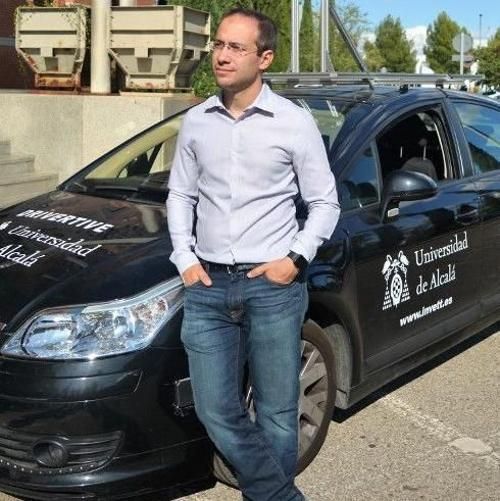
Augusto Luis Ballardini is a Researcher at the Department of Automatic Control, Universidad de Alcalá (UAlcalá), Spain, within the INVETT Research Group focusing on Intelligent Vehicles and Traffic Technologies. He holds a PhD in Computer Science from the University of Milano-Bicocca (2017) and an MSc from the same institution (2012). His work integrates machine learning, computer vision, and sensor fusion for autonomous vehicle localization and decision-making systems. Key awards include a Marie Skłodowska-Curie Actions grant (GET-COFUND fellowship) and a Spanish Ministry grant under Maria Zambrano/NextGenerationEU. His research spans LiDAR-based localization, intersection classification, and uncertainty-aware neural networks. Education: PhD in Computer Science, University of Milano-Bicocca, 2017 MSc in Computer Science, University of Milano-Bicocca, 2012 Research Interests: Autonomous vehicles, sensor fusion, LiDAR and vision-based systems, machine learning for localization, traffic modeling, and safety-critical decision-making. His work emphasizes practical applications such as fail-aware odometry, knowledge graph-driven prediction, and urban scene understanding. Awards & Grants: Marie Skłodowska-Curie Actions research grant (2019) Maria Zambrano/NextGenerationEU project grant (2022) Lab & Collaborations: His research is conducted within the INVETT group at UAlcalá, focusing on interdisciplinary projects that bridge robotics, computer vision, and transportation engineering. Recent work includes benchmarking point cloud registration algorithms and developing explainable AI for autonomous driving.
Iván García Daza is a Professor at the Department of Automática, University of Alcalá, Spain. He leads research in Intelligent Vehicles and Traffic Technologies (INVETT group), focusing on autonomous systems, digital twins, and ADAS technologies. His work integrates computer vision, deep learning, and human-vehicle interaction analysis. Education: PhD in Systems Engineering from University of Alcalá (2011), with a thesis on "Driver Fatigue Detection via ADAS Fusion" supervised by Rafael Barea Navarro and Luis Miguel Bergasa Pascual. Research interests include autonomous vehicle algorithms, real-time sensor fusion, virtual reality simulations for human-factor testing, and ecological conservation projects. His recent work emphasizes digital twin technology to bridge simulation-to-reality gaps in autonomous systems. Publications span autonomous driving validation frameworks, LiDAR-based navigation, and ecological studies. Notable contributions include VR-based human-vehicle interaction testing and synthetic data generation for ADAS systems. Labs/Teams: Director of the INVETT lab at the University of Alcalá, collaborating on EU-funded projects involving automotive industries and environmental agencies.
Javier Civera Sancho is an Associate Professor at the University of Zaragoza, where he serves as Deputy Director of the Institute of Research in Engineering of Aragon (I3A). He is affiliated with the School of Engineering and Architecture in the Department of Computer Science and Systems Engineering, where he leads research in the RoPeRT group (Robotics, Computer Vision and Artificial Intelligence). With a background in Industrial Engineering and a PhD in Systems and Computer Engineering, both from the University of Zaragoza, Civera has established himself as a prominent researcher in computer vision and robotics. Industrial Engineering degree (2004, University of Zaragoza) PhD in Systems and Computer Engineering (2009, University of Zaragoza) Civera's research primarily focuses on computer vision, with special emphasis on SLAM (Simultaneous Localization and Mapping), 3D reconstruction, and spatial artificial intelligence. His work aims to provide computers with human-like visual capabilities, including object recognition, 3D structure estimation, spatial context understanding, and tracking of moving objects. He has maintained a long-standing research line in scene localization and mapping, making significant contributions to visual SLAM methodologies and applications. His publication trends reveal a strong focus on advancing visual SLAM techniques, with recent work exploring neural rendering integration, semantic mapping, robust camera calibration, and applications in challenging environments like agriculture. His research bridges theoretical computer vision with practical robotics applications, showing increasing integration with deep learning approaches while maintaining strong geometric foundations. 2 research sexenios (with last granted for 2012-2017) 2 teaching quinquenios h-index: 21 (Google Scholar) 397 citations in last 5 years (Google Scholar) Civera has directed 2 doctoral theses and is currently supervising 4 PhD students. His research has been supported through various institutional frameworks at the University of Zaragoza, including his role in the I3A which provides critical research infrastructure. He is actively involved in guiding the next generation of researchers in computer vision and robotics, emphasizing both theoretical understanding and practical implementation. As a member of the RoPeRT research group, Civera collaborates with a multidisciplinary team working at the intersection of robotics, computer vision, and artificial intelligence. His work often involves developing systems that integrate multiple sensor modalities and create robust spatial understanding for autonomous agents.
Josep Maria Porta Pleite is an Associate Researcher at the Institut de Robòtica i Informàtica Industrial (IRI), a joint center of the Spanish National Research Council (CSIC) and Universitat Politècnica de Catalunya (UPC). He leads the Kinematics and Robot Design (KRD) research group and has been actively contributing to robotics and computational kinematics since 2007. His work bridges theoretical algorithm development and practical applications in robotics, molecular biology, and environmental toxicology. Porta’s research spans motion planning , robot kinematics , SLAM , and planning under uncertainty . He has made significant contributions to solving complex kinematic problems in closed-chain systems and molecular conformational spaces. His work often involves developing efficient algorithms and open-source software tools such as the CuikSuite , Cuik-KDtree , and Pose SLAM , which are widely used in robotics research. His recent publications (2019–2025) reveal a strong trend toward interdisciplinary applications, particularly in zebrafish behavioral analysis and neurotoxicology , where computational methods are applied to assess environmental contaminants. He also continues to advance core robotics problems, including trajectory optimization, hand-eye calibration, and closed-form solutions in rotation geometry. His work appears in top-tier journals such as IEEE Transactions on Robotics , Mechanism and Machine Theory , and Science of the Total Environment . Porta has served as an associate editor for IEEE Transactions on Robotics (2015–2018) and has supervised numerous students and collaborators. He has led long-term software development efforts and secured research funding through national and European projects. Scientific Contributions: Lead developer of the CuikSuite for motion analysis of closed-chain systems. Coordinator of the KRD research group since 2011. Contributor to ambient intelligence and robot localization during his postdoc at the University of Amsterdam. He advises multiple students in robotics, computer vision, and biomedical applications, and his team develops tools for path planning, singularity analysis, grasp optimization, and molecular modeling. There is no indication of part-time status, retirement, or former affiliation.