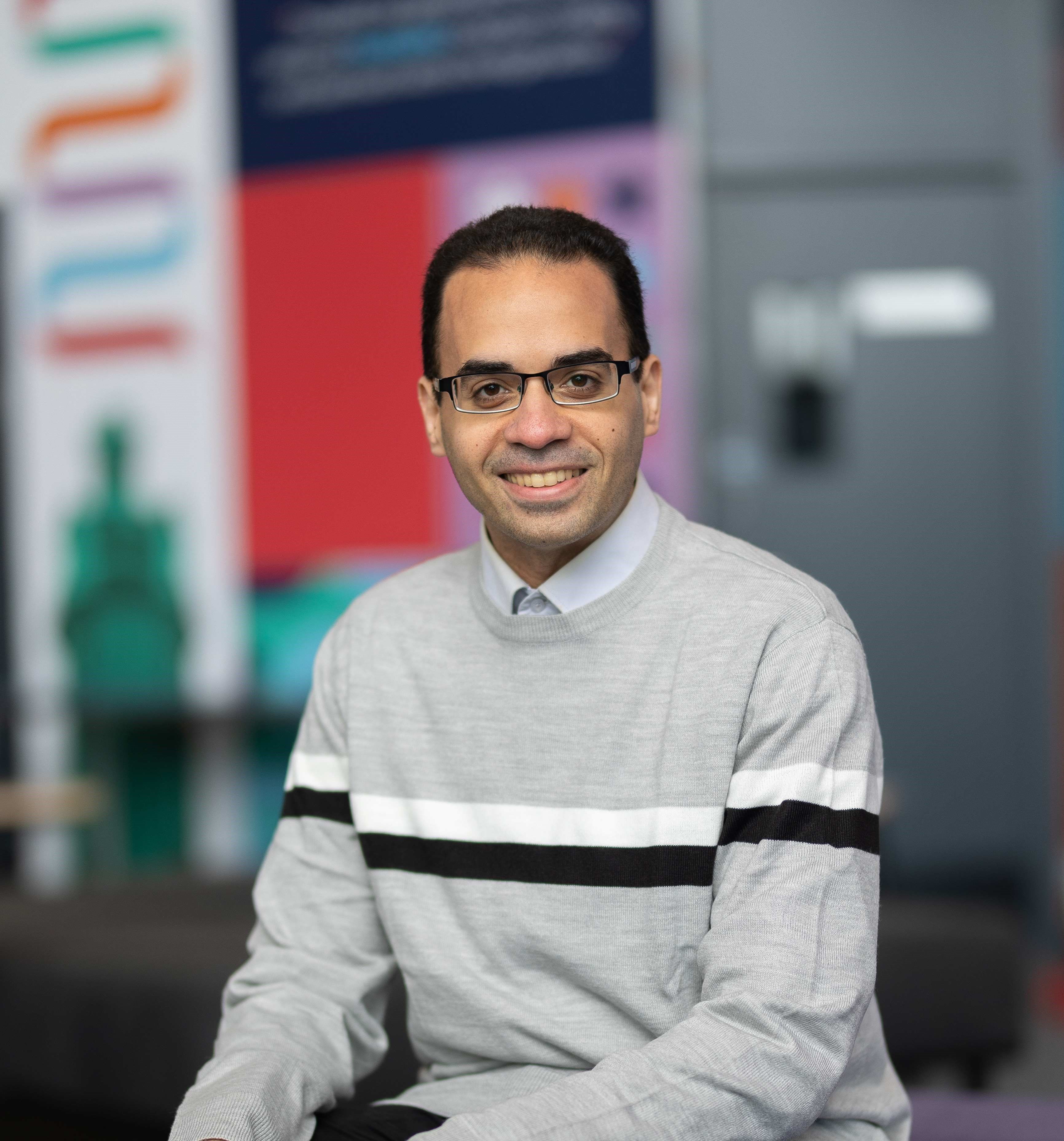
Hazem Eissa is a Lecturer and Researcher in Robotics at the University of Sunderland, affiliated with the School of Computing, Engineering and Digital Technologies. He holds an MSc in Electrical and Electronics Engineering (2016) and a PhD in Distributed Systems for Robotic Swarms (2022), both from the University of Greenwich. His expertise spans robotics, embedded systems, and swarm intelligence. Teaching Modules: Engineering Mathematics, IoT and Robotics, Telecommunications, Advanced Programming Research Focus: Robotic swarm formations, SLAM, swarm optimization, and navigation algorithms Collaborations: Member of IEEE; peer reviewer for IEEE Sensors and IEEE Access Professional Experience: Higher education roles in Egypt, Germany, and the UK His research emphasizes applying robotic swarm formations to mapping and localization challenges. Key themes include multi-agent systems, particle swarm optimization, and biologically-inspired behaviors. He also works on IoT integration and embedded systems applications in biomedical engineering.
Luis Puig is an academic researcher specializing in computer vision and robotics, focusing on omnidirectional imaging systems, 3D reconstruction, and sensor calibration. His work bridges theoretical advancements with practical applications in navigation assistance for visually impaired individuals, intelligent tutoring systems, and multi-camera system integration. Key contributions include: Pioneering research in omnidirectional vision systems, including calibration techniques and feature extraction. Development of algorithms for 3D tracking, deformable surface modeling, and RGB-D sensor fusion. Advances in visual SLAM (Simultaneous Localization and Mapping) and stereo visual odometry. His interdisciplinary approach also extends to educational technology, designing adaptive learning systems for mathematical problem-solving. Over 23 publications in top venues like IEEE Trans. PAMI, CVIU, and ICRA reflect his expertise in both technical and applied domains.
John Arvanitakis is an Assistant Lecturer in the Department of Electronic and Electrical Engineering at Coventry University's School of Engineering. He holds a PhD from the University of Patras (2017) and an MEng in Electrical and Computer Engineering (2009), both from the same institution. His research focuses on navigation systems, robotics control, unmanned vehicles, and fault diagnostics in electrical systems, particularly induction motors. He has been recognized with the 'Best Presentation in session' award (2013) at the Annual Conference. His work spans harmonic isolation methods, rotor fault detection, and nonlinear modeling. He is actively supervising PhD candidates and has contributed to over 25 peer-reviewed publications. Education: PhD (2017), MEng (2009), University of Patras Previous Roles: Researcher at University of Patras (2013–2017) Research interests include SLAM algorithms, optimization theory, and motor diagnostics. His publications emphasize practical solutions for electrical fault detection and control system improvements. Collaborations include international conferences like SDEMPED and ICEM. Current projects involve advancing torque-based diagnostics and harmonic analysis for motor reliability.
Matthew Spenko is a Professor of Mechanical and Aerospace Engineering and Interim Department Chair at Illinois Institute of Technology's Armour College of Engineering . He co-leads the CARNATIONS UTC and leads the Welcome to the Jungle team in the XPRIZE Rainforest competition. Ph.D. in Mechanical Engineering from MIT, 2005 M.S. in Mechanical Engineering from MIT, 2001 B.S. in Mechanical Engineering from Northwestern University, 1999 His research focuses on robotics and soft robotics , including gecko-like adhesives for climbing robots, navigation integrity for autonomous vehicles, and granular-based soft robots for ecological applications. He explores robot mobility in challenging environments, transitioning from climbing robots to multimodal systems (flying/terrestrial) for rainforest biodiversity monitoring. Recent publications highlight advancements in navigation safety for autonomous systems, self-assembling robots , and electrostatic adhesives . Key trends include integrating SLAM with integrity monitoring , developing multi-modal transportation robotics , and enhancing safety protocols for urban autonomous vehicles. Dean’s Award for Excellence in Research, Armour College of Engineering, 2022 MMAE Excellence in Research Award, 2018 IIT/Bauer Family Excellence in Undergraduate Teaching Award, 2014 Best Paper, Planetary Rovers Session, Int. Society of Terrain-Vehicle Systems, 2011 Intelligence Community Postdoctoral Fellowship, 2005-2007 Spenko collaborates with institutions like Purdue University on ecological projects and mentors teams in competitions. He integrates educational initiatives through specialized courses on navigation and autonomous systems within CARNATIONS.
Peyman Moghadam is a Principal Research Scientist at CSIRO Data61 and an Adjunct Professor at Queensland University of Technology (QUT). He leads the Embodied AI Research Cluster at CSIRO, focusing on robotics and machine learning intersections. His roles include former Group Leader of Robotic Perception and Acting Leader of the Spatiotemporal AI portfolio within CSIRO's MLAI Future Science Platform. Education: PhD in Robotics from Nanyang Technological University (2012). Professional experiences include Visiting Professorships at ETH Zurich (2022) and University of Bonn (2019), alongside leadership in multidisciplinary projects. Research interests span self-supervised learning, embodied AI, 3D perception, and agricultural robotics. Awards include CSIRO's Julius Career Award, Collaboration Medal, and national/state iAwards for innovation in robotics. He has held adjunct roles at QUT and the University of Queensland. Current roles emphasize AI-driven solutions for scientific challenges, such as Great Barrier Reef conservation and autonomous systems in agriculture. Key projects include the DARPA Subterranean Challenge (2nd place), Hovermap LiDAR technology, and collaborations with industry partners like Emesent and Georgia Tech. His work bridges foundational research with real-world applications in mining, agriculture, and environmental monitoring.
Zhen Tang is an active researcher with a prolific publication record spanning from 2007 to 2025, primarily in computer science and engineering disciplines. Their work appears consistently in high-impact venues including IEEE Access, IEEE Transactions, and major conferences in computer vision and systems engineering. Research interests span computer vision, control theory, biomedical image analysis, machine learning, and multi-agent systems. Tang's work demonstrates a strong interdisciplinary approach, connecting theoretical control systems with practical applications in medical imaging, distributed computing, and emerging technologies like DNA computing. Recent publications show a growing interest in large language models, blockchain applications, and ethical considerations in technology design. The publication trends reveal an evolution from foundational work in image processing and pattern recognition (2010-2015) to more complex systems involving multi-agent control and deep learning (2016-2020), and most recently expanding into large language models, blockchain healthcare applications, and technology ethics. The research shows strong connections between theoretical control systems and practical applications across multiple domains. Zhen Tang has established long-term collaborations with researchers including Yanli Wan, Zhenjiang Miao, Wei Wang, and others, suggesting stable research group affiliations. The consistent publication output across 18 years indicates an established academic career with significant contributions to multiple subfields within computer science and engineering.
Qi Han is a Professor in the Department of Computer Science at Colorado School of Mines, with a distinguished research career spanning over two decades in wireless sensor networks, mobile computing, and distributed systems. Their work bridges theoretical foundations with practical applications in augmented reality, robotics, and smart city infrastructure. Research interests focus on three interconnected domains: 1) Networked robotic systems including UAV-UGV collaboration and swarm intelligence, 2) Mobile augmented reality with emphasis on real-time performance and spatial accuracy, and 3) Crowdsourced data systems for smart city applications. Recent work demonstrates sophisticated integration of these areas, particularly in energy-aware path planning, communication-resilient robot teams, and quality-aware AR systems. Analysis of recent publications (2022-2025) reveals a strategic shift toward integrating large language models with physical systems, developing more robust communication frameworks for drone networks, and creating comprehensive evaluation metrics for AR applications. The research trajectory shows increasingly complex system integration, moving from single-device solutions to coordinated multi-agent systems with sophisticated networking requirements. Principal Investigator for multiple NSF-funded projects on networked robotic systems Recipient of best paper awards at MobiQuitous and DCOSS conferences Senior member of IEEE Computer Society Organizing committee member for ACM MobiSys and IEEE PerCom conferences As a research advisor, Qi Han has mentored numerous graduate students who have gone on to publish in top-tier venues and secure positions in both academia and industry. Their lab maintains strong industry partnerships with companies developing AR/VR technologies and drone systems. Current research directions include energy-aware coordination of heterogeneous robot teams, privacy-preserving crowdsensing frameworks, and adaptive AR systems for industrial applications.
Ramviyas Nattanmai Parasuraman is an Associate Professor in the Department of Computer Science at the University of Georgia's School of Computing. His research focuses on heterogeneous multi-robot systems, wireless ad hoc networks, and applications in search and rescue robotics, precision agriculture, and human-robot interfaces. He leads the HeRoLab (Heterogeneous Robotics Research Lab) and holds affiliations with the Institute for Artificial Intelligence, Center for Cyber Physical Systems, and Phenomics and Plant Robotics Center. Education: Ph.D. (Robotics and Automation) from Universidad Politécnica de Madrid (2014), M.Tech. from IIT Delhi (2010), and B.Engg. from Anna University (2008). Prior to UGA, he worked as a postdoctoral researcher at Purdue University and KTH Royal Institute of Technology, Sweden. His doctoral work involved optimizing wireless communication for teleoperated robots at CERN. Research Highlights : Developed frameworks for knowledge transfer in multi-robot systems (KT-BT and IKT-BT). Pioneered the Analog Twin Framework for human-AI teleoperation. Advanced localization and trust assessment models for autonomous systems. Designed cybersecurity solutions for cyber-physical systems. Grants include a $1M NIFA grant for AI-driven precision poultry farming (2024) and a $1.68M Army grant for cooperative multi-agent systems (2023). He has been recognized with the CURO Faculty Mentoring Award and multiple Student Career Success awards. Labs & Teams : Director of HeRoLab, focusing on heterogeneous robotics and swarm systems. Faculty Investigator at the Small Satellite Research Lab.
Kris Hauser is a Professor in the Department of Computer Science at the University of Illinois at Urbana-Champaign (UIUC), with affiliate appointments in the Departments of Electrical and Computer Engineering and Mechanical Science and Engineering. He holds a PhD in Computer Science from Stanford University and B.A. degrees in Computer Science and Mathematics from UC Berkeley. Prior to UIUC, he served as faculty at Indiana University (2009–2014) and Duke University (2014–2019), where he founded the Intelligent Motion Lab. He has also consulted for Waymo since 2019 and is the Director of the Coordinated Sciences Lab Robotics Group at UIUC. His research focuses on robot planning and control, semi-autonomous systems, and applications in intelligent vehicles, medical robotics, and legged locomotion. Key methodologies include optimization, probabilistic methods, AI, and physics simulation. His work bridges theory with real-world applications, such as robotic surgery, warehouse automation, and autonomous driving. Prof. Hauser has received notable awards including the NSF CAREER Award, Siebel Scholar Fellowship, and multiple Amazon Research Awards. He actively engages in teaching advanced robotics courses at UIUC and has contributed to open-source robotics frameworks like the Klamp't package. His lab emphasizes interdisciplinary collaboration, with projects ranging from UV disinfection robots to telepresence avatars.
Georg von Wichert is a Rudolf Diesel Industry Fellow at the Technical University of Munich (TUM) since 2009, affiliated with Siemens Corporate Technology. He holds a Diploma (M.Sc.) in electrical and control engineering from Darmstadt University of Technology (1992) and a Ph.D. in electrical engineering (1998). His research focuses on cognitive systems, including computer vision, robotics, and sensor fusion, with applications in autonomous systems and human-robot interaction. Affiliations: Siemens AG (Corporate Technology) & TUM Institute for Advanced Study (Focus Group: Cognitive Technology) Education: Darmstadt University of Technology (Diploma 1992, Ph.D. 1998) His work spans probabilistic modeling for multi-agent systems, semantic scene understanding, and robotic navigation. Notable contributions include table-top scene analysis, semantic indoor mapping, and robotic systems for everyday environments. He has led national and European research projects and contributed to initiatives like the Robotic Bar demonstration of human-robot collaboration. Scientific Awards: Rudolf Diesel Industry Fellowship (2009). Research Highlights: Developed algorithms for 6-DOF pose estimation, robotic exploration in dynamic environments, and context-aware robotic assistants. His publications address challenges in simultaneous segmentation, object recognition, and 3D localization using stereo vision.
Michele Magno is a Senior Lecturer and Privatdozent at ETH Zürich's Department of Information Technology and Electrical Engineering (D-ITET), leading the D-ITET Center for Project-based Learning (pbl.ee.ethz.ch). He holds a PhD in Electronic Engineering from the University of Bologna (2010) and has held visiting roles at institutions like the University of Nice and Mid Sweden University. His research focuses on low-power systems, wearable devices, energy harvesting, and IoT applications. Magno has authored over 350 peer-reviewed papers, with a Google H-index of 49. Notable awards include the 2024 Best Paper Award at ECCV and multiple best poster/demo recognitions at IEEE conferences. His industrial collaborations include projects with STMicroelectronics, Texas Instruments, and Logitech. Teaching contributions include courses on embedded systems, FPGA programming, and machine learning on microcontrollers. Magno's innovations span smart sensors for wind turbines, bio-medical monitoring, and autonomous racing systems, with patents in touch communication and energy-neutral devices. Recent work emphasizes ultra-low-power solutions for AI-integrated wearables, energy-efficient IoT nodes, and real-time embedded vision systems. His labs and teams pioneer technologies like TinyssimoRadar for in-ear gesture recognition and WakeMod for ultra-low-power IoT connectivity.
Patricia A. Vargas is an Associate Professor/Reader in Computer Science and Robotics at the School of Mathematical & Computer Sciences, Heriot-Watt University, UK. She is the Founder Director of the Robotics Laboratory and Director of Ethics. Her research focuses on interdisciplinary robotics, including Evolutionary Robotics, Swarm Robotics, Biologically-Inspired Algorithms, Computational Neuroscience, and Neurorobotics. She holds IEEE Senior Member and Fellow of the Higher Education Academy titles. Education: PhD in Robotics, postdoc at the Centre for Computational Neuroscience and Robotics (University of Sussex, UK). She has contributed to over 66 research outputs since 2009, with recent work emphasizing neurorobotics, SLAM systems, and precision robotics. Her research aligns with UN Sustainable Development Goals, particularly in healthcare and industrial innovation. Research interests span from bio-inspired algorithms to human-robot interaction, with notable contributions in Parkinson’s disease modeling and swarm robotics. She co-founded the Edinburgh Centre for Robotics and is an executive member of the IEEE Ro-Man Standing Steering Committee. Awards include the 2017 Spirit of Heriot-Watt Award (Outward Looking). Her work bridges robotics with neuroscience, aiming to advance assistive technologies and ethical robotic systems.
Yvan Petillot is a Professor of Robotics and Autonomous Systems at Heriot-Watt University, co-academic lead of the National Robotarium, and chair of Robotics at the Scottish Research Partnership in Engineering. His expertise spans marine robotics, autonomous systems, sensor fusion, and subsea domain control. He leads a £3M grant portfolio focused on marine robotics innovations, emphasizing multi-vehicle collaboration and AI-driven autonomy. Petillot co-founded SeeByte Ltd to translate academic research into commercial solutions and pioneered EU robotics competitions fostering talent. His research emphasizes underwater robotics, including navigation, perception, and intervention in hazardous environments. Notable achievements include developing advanced underwater imaging techniques, reinforcement learning platforms (e.g., MarineGym), and frameworks for digital twins in teleoperation. He has received the Royal Society Industry Fellowship (2013) and was part of the 2022 Research Team of the Year award. Key technical contributions include synthetic aperture sonar systems, underwater SLAM (Simultaneous Localization and Mapping), and control strategies for vehicle-manipulator systems. His work addresses challenges in autonomous exploration, environmental monitoring, and safe human-robot collaboration in marine and industrial settings.
Dr. Tobias Fischer is a Senior Lecturer at Queensland University of Technology (QUT) in the School of Electrical Engineering & Robotics, Faculty of Engineering. He is an ARC DECRA Fellow and leads research in robotics, computer vision, and computational cognition. His work focuses on enabling robots to interact with humans through perception systems inspired by animal visual systems. He holds a PhD from Imperial College London and has held postdoctoral roles at Imperial College's Personal Robotics Lab. Education: PhD (Imperial College London, 2019), MSc (University of Edinburgh, 2014), BSc (Ilmenau University of Technology, Germany, 2013). Scholarships include the German National Academic Foundation and DECRA Fellowship. Research interests span bio-inspired neural networks, event-based vision, spiking neural networks, and neuromorphic computing. He has led projects funded by Intel, Amazon, Samsung, EU, and Australian Research Council, including $462,000 DECRA grant for adaptive robot positioning. Key awards include the 2023 IEEE Outstanding Paper Award and Queen Mary UK Best PhD in Robotics. Teaching includes units like EGB339 Introduction to Robotics and EGB439 Advanced Robotics. Supervision involves PhD students in place recognition and underwater imagery. His lab, QUT Centre for Robotics, focuses on long-term localization and bio-inspired autonomy.
Francesco De Pace is a PostDoc Researcher at the Institute of Visual Computing and Human-Centered Technology within the Faculty of Informatics at Vienna University of Technology (TU Wien). His research focuses on the intersection of augmented reality, virtual reality, and human-robot interaction, with particular emphasis on developing innovative interfaces for industrial applications. Dr. De Pace's research spans several key areas in immersive technologies and human-computer interaction. His primary interests include Augmented Reality (AR) and Virtual Reality (VR) systems, Human-Robot Interaction (HRI), Brain-Computer Interfaces (BCIs), and advanced tracking and localization techniques. He has made significant contributions to the development of AR/VR interfaces for industrial robots, outdoor tracking with Real-Time Kinematic GPS, and SLAM (Simultaneous Localization and Mapping) systems. His work bridges theoretical research with practical industrial applications, focusing on creating more intuitive and effective human-machine interfaces. Dr. De Pace's recent publications demonstrate a clear trajectory toward enhancing human-robot collaboration through immersive technologies. His research shows increasing sophistication in integrating multiple modalities (visual, spatial, and neural) to create more natural interaction paradigms. A notable trend is the application of AR/VR to industrial settings, particularly for assembly tasks, path planning, and training scenarios. His systematic evaluation of RTK-GPS for wearable AR represents important foundational work for outdoor AR applications, addressing critical challenges in positional accuracy across different environmental conditions. While specific awards are not prominently documented in the available information, Dr. De Pace's research has been supported by significant funding mechanisms, including grants from the Austrian Research Promotion Agency (FFG) under Grant Agreement No FO999886342 KIRAS MRespond, indicating recognition of the importance and potential impact of his work. Dr. De Pace appears to be actively involved in multiple research projects, including PostDisaster and MRespond as indicated in his profile. His collaborative approach is evident through his extensive co-authorship with researchers across institutions. While specific student advising information isn't detailed in the available materials, his role as a PostDoc Researcher likely involves mentoring junior researchers and contributing to the academic development of students working on related projects. Dr. De Pace is associated with the Mixed Reality Lab at TU Wien, as indicated in the website navigation. His research appears to be conducted within collaborative frameworks that include both academic and industry partners. His work on the MRespond project suggests engagement with emergency response applications of mixed reality technologies, indicating interdisciplinary team involvement spanning computer science, engineering, and potentially public safety domains.