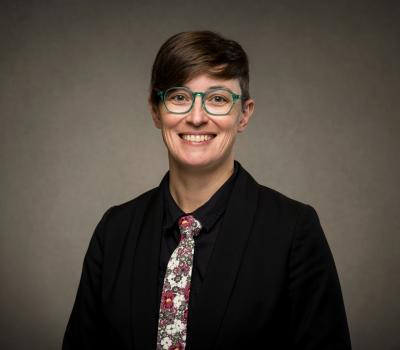
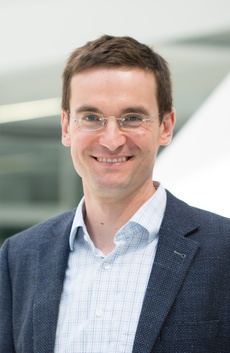
Glencora Borradaile is a Professor and Associate Dean for Graduate, Faculty, and Staff Affairs in the School of Electrical Engineering and Computer Science at Oregon State University. With a PhD in Computer Science from Brown University, their research focuses on the intersection of digital security and social justice, particularly how social movement activists can operate free from surveillance. Borradaile's work bridges theoretical computer science and practical applications, with expertise in cryptography, algorithms, and cybersecurity. Their current projects examine surveillance of activists and develop security tools for vulnerable communities. They've developed a course on communication security and social movements and authored the textbook 'Defend Dissent'. As an administrator, Borradaile focuses on equity and removing structural barriers in academia. They pioneered the Graduate Engineering Research Showcase to amplify student work and enhance science communication skills. Their leadership philosophy emphasizes data-driven decision making to improve institutional policies for faculty, staff, and students. Awards: NSF CAREER Award (2013)
Alessandro Crimi is a Visiting Lecturer at the African Institute for Mathematical Sciences (Ghana & South Africa) and founder of Yawlab (Zurich). He holds a Ph.D. in Medical Imaging from the University of Copenhagen and an MBA in International Health Management from the Swiss Tropical and Public Health Institute (University of Basel). His research focuses on neuroimaging, machine learning applications in healthcare, and global health initiatives. Crimi has extensive experience in postdoctoral research across Italy, France, and Switzerland, specializing in clinical neuroimaging for multiple sclerosis, Alzheimer’s, Parkinson’s, and glioma. He is editor of the MICCAI BrainLesion Workshop and has led healthcare projects in low-resource settings in Africa, including diabetes screening and prenatal care initiatives. Research interests include diffusion MRI, functional MRI, EEG/fNIRS connectivity analysis, quantum computing for brain network analysis, and neurotech device development. Crimi’s work emphasizes translating research into clinical solutions and addressing global health challenges through education and technology. Notable contributions include biomarker discovery for neurodegenerative diseases, green AI for fetal brain segmentation, and explainable AI for epilepsy diagnosis. He has organized workshops on brain lesion analysis and authored over 50 peer-reviewed publications.
Dr. Damiano Rossi is affiliated with the Department of Algebra, Geometry and Computer Algebra at Rheinland-Pfalz Technische Universität Kaiserslautern. His research focuses on advanced topics in algebra and representation theory, including character triples, finite group structures, and conjectures such as Alperin’s, McKay’s, and Webb’s. His work bridges local-global principles in group theory and computational algebra. Recent articles (2022–2025) explore conjectures in finite reductive groups, Brauer pairs, and Sylow subgroup properties. His research often involves cohomological methods and topological tools like simplicial complexes. Notable themes include the interplay between local structures and global group properties, as well as applications of character theory to solving longstanding conjectures. No scientific awards are explicitly listed in the provided materials. His current position involves teaching responsibilities in algebra and geometry, reflecting his academic role in the university’s mathematics department.
Erik P. de Vink is an Associate Professor at Eindhoven University of Technology (TU/e), Department of Mathematics and Computer Science. He also serves as an Associated Research Fellow at CWI, the Dutch National Research Institute for Mathematics and Computer Science. His research focuses on formal methods, software product lines, dynamic system adaptation, and probabilistic process algebra. He has held roles such as Treasurer of Formal Methods Europe and organized symposia like the International Symposium on Formal Methods (2018). His academic background includes a PhD from VU Amsterdam, a Senior Researcher position at KPN, and prior teaching at Leiden University. Key research interests include formal modeling of software systems using tools like mCRL2 and Prism, analysis of feature-behavior interactions in software product lines, and validation techniques for dynamic system adaptation. He has co-promoted 9 PhD students in areas like denotational semantics, security, and probabilistic process algebra. His work integrates theoretical computer science with practical applications in distributed systems and concurrency. Recent articles explore topics such as formal methods education, bisimulation in polyhedral models, and probabilistic process analysis. He contributes to open-source tool development (e.g., mCRL2) and has published extensively in journals like Formal Aspects of Computing and Journal of Logical and Algebraic Methods in Programming .
Overview Jean-François de Kemmeter is an academic researcher at the University of Namur, where he leads research projects focusing on reaction-diffusion processes, network science, and complex systems. He has been Principal Investigator on projects like Reaction-diffusion processes on temporal and non-normal networks (2020–2024), exploring dynamics in evolving networks and segregation phenomena. Research Interests His work spans Mathematical Physics (e.g., 6V model, tiling problems), Network Science (nonlinear random walks, multigraph reconstruction), and Complex Systems (contagion dynamics, criticality in interacting systems). He combines numerical simulations with analytical methods to study self-organization, power-law distributions, and phase transitions in both theoretical and applied contexts. Key Contributions Recent articles highlight his focus on boundary conditions in tiling models, distrust-driven social contagion on simplicial complexes, and segregation in reaction-diffusion systems. His 2024 thesis Emergence of criticality... integrates random walker dynamics and arctic curve phenomena. Awards Best presentation at the Annual Meeting of the COMPLEX Doctoral School (2022) Winner of the PhD Presentations contest (2022) Career Highlights Active in international conferences (SIAM Dynamical Systems, NERCCS) and workshops. Collaborations span topics like nonlinear problems and diffusion on temporal networks.
Félix Loubaton is a Researcher and Postdoc at the Max Planck Institute for Mathematics (MPIM) in Bonn, Germany, under the supervision of Viktoriya Ozornova. His research focuses on higher category theory, including strict and homotopic ω-categories, and their applications in algebraic topology and homotopy theory. He completed his PhD in 2023 at the Université de Nice Côte d'Azur, supervised by Carlos Simpson and Denis-Charles Cisinski, with a thesis titled "Theory and models of (∞,ω)-categories" . His work explores foundational aspects of higher-dimensional category structures and their model-theoretic properties. Recent research trends include inductive model structures for ∞-categories, Kan conditions in ω-categories, and categorical frameworks for (∞,ω)-categories. Collaborations include projects with Amar Hadzihasanovic, Simon Henry, and Martina Rovelli. He co-organized a student seminar on Goodwillie calculus and higher topos theory during the 2024-2025 winter semester with Paula Verdugo.
Professor Elaine Chew is a Professor of Engineering with a joint appointment between the Department of Engineering in the Faculty of Natural, Mathematical & Engineering Sciences and the Department of Cardiovascular Imaging in the School of Biomedical Engineering & Imaging Sciences at King's College London. An operations researcher and pianist by training, she is a pioneering researcher in music information retrieval (MIR) and computational music structure analysis, forging innovative paths at the intersection of music and cardiovascular science. Her work focuses on mathematical and computational modeling of musical structures in both music and electrocardiographic traces, with applications to music-heart-brain interaction and computational arrhythmia research. Professor Chew's educational background includes: PhD and SM in Operations Research from MIT BAS in Mathematical & Computational Sciences (honors) and Music (distinction) from Stanford University FTCL and LTCL diplomas in Piano Performance from Trinity College, London Her research spans multiple disciplines, with a primary focus on the mathematical and computational modeling of musical structures and their physiological effects. She investigates how musical expressivity affects cardiovascular function, developing novel frameworks for understanding music perception and cognition through computational approaches. Her work integrates operations research, computational mathematics, and human-computer interaction to advance music information retrieval and create innovative applications at the intersection of music science and cardiovascular medicine. Professor Chew's research has evolved from theoretical music structure analysis to applied clinical research with direct medical implications, particularly in music-based therapeutics for cardiovascular conditions. Analysis of Professor Chew's recent publications reveals a strong focus on the intersection of music and cardiovascular science, with increasing application of advanced computational methods including graph neural networks, Bayesian inference, and nonlinear dynamics. Her work demonstrates a progression from pure music analysis to clinical applications, with significant contributions to understanding how musical structures affect physiological responses, particularly in hypertension and cardiovascular disease contexts. She has developed innovative approaches to using music as a therapeutic tool for autonomic modulation and cardiovascular health. Professor Chew's groundbreaking contributions have been recognized with numerous prestigious awards: Falling Walls Art & Science Breakthrough of the Year (2023) European Research Council Advanced Grant (2019) Harvard Radcliffe Institute for Advanced Study Fellowship (2007) US Presidential Early Career Award in Science & Engineering (PECASE, 2005) US National Science Foundation Faculty Early Career Development (CAREER) Award (2004) As Principal Investigator of the European Research Council Advanced Grant COSMOS (Computational Shaping and Modeling of Musical Structures) and Proof of Concept HEART.FM (Maximizing the Therapeutic Potential of Music through Tailored Therapy with Physiological Feedback in Cardiovascular Disease), Professor Chew leads significant interdisciplinary research initiatives that bridge music science and cardiovascular medicine. Her work has secured substantial funding from the European Commission, supporting innovative research that combines data analytics, citizen science, and physiological monitoring to advance understanding of music's effects on the human body. She has mentored numerous researchers through her various positions and projects, fostering interdisciplinary collaboration across music, engineering, and medical domains. Professor Chew founded and directs the Music Theranostics Laboratory, which focuses on developing music-based diagnostic and therapeutic approaches for cardiovascular conditions. She leads the COSMOS and HEART.FM projects, which involve collaborations with researchers across multiple disciplines including cardiology, musicology, computer science, and engineering. Her work often integrates interactive scientific visualizations and lab-grown compositions in live demonstrations, creating unique concert-conversations that bridge artistic performance with scientific discovery. She is a frequent invited keynote speaker who effectively communicates complex interdisciplinary research to diverse audiences.
Eric Goubault is a Professor of Computer Science at École Polytechnique, France, where he leads the Department of Computer Science. He holds a position at the Laboratoire d'informatique (LIX), part of the UMR 7161 research unit. His research focuses on formal verification of numerical programs, concurrency theory, directed algebraic topology, and hybrid systems. Currently, he directs the 'Engineering of Complex Systems' academic and research chair alongside colleagues from ENSTA ParisTech and Télécom ParisTech, supported by industry partners like Thales and Dassault Aviation. Key roles include heading the master's program COMASIC (Conception, Modélisation et Architecture des Systèmes Industriels Complexes) and overseeing ongoing projects such as the ANR-funded Coverif, Malthy, and CAFEIN initiatives. His work bridges theoretical computer science with practical applications in embedded systems and safety-critical software validation. Research interests span geometric methods for concurrency, topological approaches to verification, and robustness analysis of numerical computations. Notable contributions include developing abstract interpretation techniques for static analysis and co-authoring the book *Directed Algebraic Topology and Concurrency* (2016). He advises multiple PhD students and collaborates on projects involving distributed computing and fault-tolerant protocols. Recent activities include organizing academic positions openings at LIX and contributing to conferences like CAV, EMSOFT, and FLOC. His publications emphasize formal methods, hybrid systems analysis, and geometric models for distributed systems.
Paul L Bendich is an Adjunct Professor of Mathematics at Duke University's Trinity College of Arts & Sciences. He holds a Ph.D. from Duke University (2008). His research focuses on adapting topological and geometric methods for data analysis, particularly in topological data analysis (TDA). He has pioneered TDA methodologies for applications in machine learning, sensor fusion, and environmental modeling. Current appointments include leading research initiatives in multi-modal data analysis and reinforcement learning optimization. Key areas of expertise include computational topology, persistent homology, and topological signal processing. He teaches courses on topological data analysis (COMPSCI 434, MATH 412) and has developed educational programs like Data+ at Duke. Grants include NSF-funded projects (BIGDATA: F: DKA: CSD) and Air Force Office of Scientific Research initiatives. Recent work emphasizes topological methods in AI safety (topological parallax), reinforcement learning efficiency, and geophysical feature tracking. Professional activities include conference presentations on TDA applications and editorial work for journals. His research bridges theoretical mathematics with practical data-driven challenges in science and engineering.
Georg Loho is a Visiting Professor at Freie Universität Berlin (FU Berlin), currently acting as head of the Discrete Geometry and Topological Combinatorics group, substituting for Günter Ziegler. He is on leave from his position as an Assistant Professor at the University of Twente in the Discrete Mathematics & Mathematical Programming group. His academic journey includes postdoctoral roles at the London School of Economics (LSE) and EPFL, supported by an ERC Starting Grant, and a PhD from TU Berlin under Michael Joswig. Research Interests: Loho focuses on the interplay between discrete geometry, combinatorics, and optimization, with applications in machine learning, data science, and sustainability. His work bridges theoretical foundations and practical applications, including tropical geometry, algorithm design, and mathematical programming. Articles Trends: Recent publications explore stochastic games, tropical geometry in neural networks, oriented matroids, and optimization algorithms. His work often intersects algebraic geometry, combinatorial optimization, and computational complexity. Grants and Awards: He secured an ERC Starting Grant (2019–2020) and has been involved in projects like the HIM Trimester Program in Bonn. No explicit awards are listed, but his research contributions are widely recognized in discrete mathematics and optimization. Teaching: Loho has taught courses on discrete geometry, sustainability in mathematics, and AI applications. He emphasizes innovative pedagogy, including free open-source course materials and sustainability-focused curricula. Labs/Teams: He leads the Discrete Geometry and Topological Combinatorics group at FU Berlin and collaborates on projects like the MatchTheNet educational game, promoting interactive learning in geometry.
Peter Stiller is a Professor in the Department of Mathematics and Computer Science at Texas A&M University, where he also serves as Assistant Director of the Institute for Scientific Computation. He holds dual S.B. degrees in Mathematics and Economics from MIT (1973), an M.A. (1974) and Ph.D. (1977) in Mathematics from Princeton University. Stiller's research spans algebraic geometry, applied computational geometry, robotics, and computer vision. His current projects investigate geometric methods for automated manufacturing, printed electronics fabrication, and hybrid systems control. Recent publications focus on optimizing inkjet-printed sensors, distributed navigation algorithms, and formal composition of control systems. Stiller maintains interdisciplinary collaborations bridging mathematics with engineering applications. He teaches courses in algebraic geometry and computational methods, advising graduate students in mathematical applications. Stiller holds joint appointments in Mathematics (Blocker 623D), Computer Science (HRB), and ISC (Blocker), with multiple contact points for collaboration.
Christopher Eur is an Assistant Professor in the Department of Mathematical Sciences at Carnegie Mellon University's Mellon College of Science. His research explores advanced topics in combinatorial algebraic geometry with particular focus on matroid theory. He received: Ph.D. from University of California Berkeley Postdoctoral appointments at Harvard University and Stanford University Dr. Eur's research integrates combinatorial structures with geometric frameworks, specializing in matroid theory, tropical geometry, and Hodge-theoretic approaches to combinatorial objects. His work frequently examines cohomological properties, polyhedral structures, and combinatorial invariants across diverse mathematical contexts. His recent publications demonstrate consistent focus on combinatorial algebraic geometry, with recurring examination of matroid cohomologies, polyhedral structures like permutohedra and stellahedra, and tropical geometric approaches. The work incorporates techniques from algebraic topology, representation theory, and statistical geometry to solve fundamental problems in discrete mathematics.
James Chapman is an Assistant Professor at Boston University, with a dual affiliation in the Departments of Mechanical Engineering and Materials Science & Engineering. His primary appointment is in Mechanical Engineering. He holds a PhD in Materials Science and Engineering from the Georgia Institute of Technology (2020). His research focuses on computational materials informatics, integrating machine learning with atomistic simulations to design novel catalysts and corrosion-resistant materials. Current work emphasizes high-entropy alloys for hydrogen production and pollution mitigation. Key honors include the Junior Faculty Fellow from the Hariri Institute for Computing (2024), the Trusted Reviewer Award from the Institute of Physics (2023), and the Lamar H. Franklin Fellowship (2020). His research lab, the Materials Informatics Lab, explores interdisciplinary approaches at the intersection of machine learning and materials science. Notable contributions include advancements in graph neural networks for material characterization and predictive modeling of atomic structures using diffusion models. Publications highlight themes such as topological message-passing algorithms, stratified data analysis, and multiscale modeling of defects in materials. His work bridges fundamental computational methods with practical applications in energy storage and environmental sustainability.
Prof. Dr. Roman Sauer is a Professor of Mathematics at Karlsruhe Institute of Technology (KIT), leading the Topology and Geometric Group Theory Group within the Institute of Algebra and Geometry. His research focuses on geometric topology, geometric group theory, and L²-invariants, with particular emphasis on manifolds, cohomology, and group actions. He has held roles such as Head of the Topology Group and contributed to foundational work on simplicial volume, bounded cohomology, and Kazhdan properties. Key research areas include the interplay between geometry and topology in manifolds, the study of arithmetic groups through profinite invariants, and applications of measure-theoretic methods to group theory. His work often bridges algebraic topology with geometric analysis, addressing questions about rigidity, stability, and quantitative invariants. Publications highlight contributions to L²-Betti numbers, geometric group actions, and the interplay between group properties and topological structures. Notable collaborations involve Uri Bader, Clara Löh, and others in advancing the field of geometric topology and related cohomological theories.
Bei Wang is an instructor in the Department of Computer Science at the University of Utah, School of Computing. She teaches CS 6210: Advanced Scientific Computing I, focusing on numerical methods and algorithms for scientific computing. Her research interests span topological data analysis, scientific visualization, and algorithm design for data compression and analysis. She contributes to the Computational Engineering and Science (CES) program, supporting interdisciplinary scientific computing education. Her work emphasizes integrating topology into computational frameworks and advancing visualization techniques for complex scientific data. Education: Not explicitly stated in the provided materials. Research Focus: Numerical algorithms, topological methods, and visualization tools for scientific computing. Her recent articles explore topics such as lossy compression with topological guarantees, harmonic chain analysis, and uncertainty-driven visualization. These contributions highlight her expertise in merging computational efficiency with topological rigor. She actively participates in academic initiatives like the CES program, fostering collaboration in scientific computing education and research. Bei Wang’s academic contributions include developing algorithms for topological data structures and enhancing visualization techniques for fluid dynamics and astronomical data. Her work bridges theoretical foundations and practical applications, advancing the analysis of complex datasets in multiple domains.