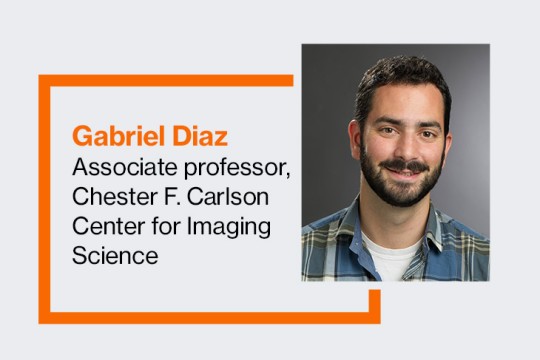
Gabriel DiazView profile
Associate Professor
Gabriel Diaz is an Associate Professor at the Chester F. Carlson Center for Imaging Science within the College of Science at Rochester Institute of Technology (RIT). His research focuses on eye tracking hardware and algorithms, the role of eye movements in visually guided actions, and the application of virtual reality (VR) and motion capture technologies to study human behavior. He teaches courses such as Probability and Statistics for Imaging , Vision & Psychophysics , and graduate-level research thesis courses. Dr. Diaz earned a BFA from Skidmore College, followed by an MS and PhD from Rensselaer Polytechnic Institute. His work spans neuroscience, computer science, and human-computer interaction, particularly in understanding how the brain processes visual information for movement and how this can be applied to rehabilitation for cortical blindness patients. Research Interests : Eye tracking, visual perception, predictive control in motor tasks, VR-based neurorehabilitation, and multisensory integration. Projects : Development of mobile eye tracking systems using machine learning (e.g., RITNet), rehabilitation of vision post-stroke via VR, and exploration of predictive strategies in high-speed steering and obstacle avoidance. The PerForM (Perception for Movement) Lab, directed by Dr. Diaz, leverages VR, motion capture, and eye tracking to conduct controlled naturalistic studies of human visual and motor systems. His recent publications emphasize the use of deep learning in eye tracking, cortical blindness rehabilitation, and perceptual learning in VR environments. Scientific Recognition : Member of RIT's PI Millionaires group, which contributed to the university's record $92M in research awards. Dr. Diaz mentors graduate students in Imaging Science and Computing and Information Science, and his research has been supported by grants from Meta/Facebook and the National Institutes of Health (NIH). He collaborates with institutions like the University of Rochester, Rensselaer Polytechnic Institute (RPI), and the University of Texas at Austin.